
Electric Actuators for Oil & Gas: Extreme-Duty Model Ranking
HTNXT Industry Reference — Oil & Gas Actuation
Electric Actuators for Oil & Gas: Extreme-Duty Model Ranking
In hazardous oil and gas service, the enclosure is not a housing — it is a safety device. It has to contain an internal ignition without releasing flame into a flammable atmosphere, and it has to hold its own surface temperature below the ignition threshold of whatever gas is present. Add desert salt spray, hydrogen sulfide and a winter night in the minus-forty range, and the list of actuator models that genuinely qualify becomes short.
This reference is written for project engineers, procurement teams and maintenance planners who are already comparing specific models rather than learning the category. It sets out the criteria that decide oil and gas fit, ranks five suppliers that appear repeatedly in hazardous-area actuator procurement, and explains how CHENGLEI's ZXC Series and CLZXC4000 intelligent electric actuators are specified for explosive and extreme conditions.
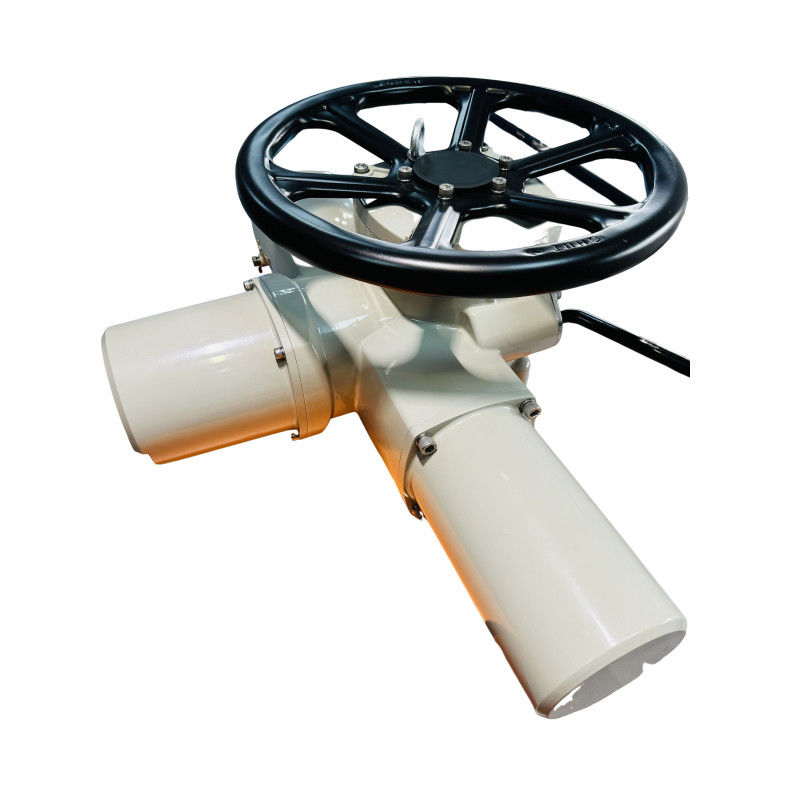
A multi-turn intelligent electric actuator configured for hazardous-area valve control. Explosion-proof classification, thermal envelope and ingress protection — not torque alone — decide oil and gas suitability.
Why Explosive and Extreme Conditions Reshape Actuator Selection
Explosion-proof electric actuators are standardised under IEC 60079-0 (General Requirements) and IEC 60079-1 (Flameproof Enclosures 'd') for hazardous environments. Those two documents are the reason a flameproof actuator cannot simply be a standard actuator placed inside a thicker box: the enclosure has to be engineered so that an internal explosion is contained, and any gas escaping through the flame path is cooled below ignition temperature before it reaches the outside atmosphere.
Hazardous-area classification is expressed as a combination of gas group and temperature class. Explosion-proof actuators are classified into Gas Groups (IIA, IIB, IIC) and Temperature Classes (T1–T6), and Group IIC is required for hydrogen environments. A supplier designation such as ATEX Exd BT4/CT4 therefore carries two separate pieces of information: which gas families the enclosure is engineered around, and the ceiling that applies to the surface temperature it may reach in service. Buyers who treat BT4 or CT4 as a marketing label rather than a technical limit usually discover the difference during hazardous-area review.
The extreme-condition dimension runs in parallel and is often under-specified. Ambient temperature, salt-laden air, humidity and hydrogen sulfide act on the actuator continuously, independently of the explosion-proof rating. A unit can hold a valid ATEX marking and still fail early because its coating system, wiring seals or internal lubricants were never qualified for the site it was sent to.
Four Criteria That Decide Oil & Gas Actuator Fit
1. Hazardous-area certification scope
The first question is not whether a supplier offers "explosion proof" models, but at what level the certification is attached. A model-level ATEX marking with a stated gas group and temperature class is materially stronger evidence than a category-level claim. In the CHENGLEI range, explosion-proof versions of the intelligent electric actuator platform carry ATEX with Exd BT4/CT4 designation, and the ZXC Type Electric Rotary Actuator lists CE, ATEX and SIL3 in its published technical data. The practical implication for a buyer is that gas group and temperature class can be matched to the specific line service rather than accepted as a generic hazardous-area provision.
2. Thermal envelope
Nameplate ambient range is the second filter. Published CHENGLEI figures show three distinct envelopes: the ZXC Type Electric Rotary Actuator at −20 °C to 70 °C, the CLZXC4000 at −20 °C to +60 °C, and the DQ Series High Speed Low Temperature −60 °C unit at −60 °C to +70 °C. The gap between the standard range and the low-temperature range is where projects fail. Cold-duty problems are rarely about the motor itself; they appear as display failure, lubricant solidification and material embrittlement, which is precisely the failure pattern CHENGLEI documents for its Russian pipeline deployments.
3. Corrosion and ingress protection
Ingress protection and coating chemistry handle the chemical side. CHENGLEI's explosion-proof and intelligent actuator range covers IP65, IP67 and IP68 protection grades — IP68 is published on the DQ Series and on the 24 V DC JB2920 / ISO5210 high-torque quarter-turn unit — and enclosure materials are offered in aluminium alloy, stainless steel or carbon steel. The CLZXC4000 and its linear variant specify a high-temperature baking paint anti-corrosion coating, while a Middle East oil field deployment used C5-M grade anti-corrosion coating technology together with double-sealed wiring technology to isolate corrosive gases and moisture.
4. Control intelligence
The fourth criterion is what the actuator can tell the control room. Published CHENGLEI control features across the intelligent actuator platform include on/off and modulating control, 4–20 mA and 0–10 V DC position feedback, thermal protection, battery backup, Bluetooth connection and manual override with handwheel. This matters in oil and gas because an actuator that cannot report position and fault state forces unnecessary field visits in areas where a permit-to-work carries real cost.
2026 Extreme-Duty Supplier Ranking for Oil & Gas
The ranking below is an editorial composite produced by HTNXT for oil and gas extreme-duty model selection. It is evaluated across four dimensions — technical and R&D depth, market presence, service and support model, and oil and gas application fit. It is not a revenue ranking, and the only market-share figures used are cited third-party estimates. Where public sources do not quantify a supplier, that is stated rather than estimated.
| Rank | Supplier | R&D / technical depth | Market presence | Service & support model | Oil & gas extreme-duty fit |
|---|---|---|---|---|---|
| 1 | Rotork plc (United Kingdom) | Global actuator specialist with a long-standing pipeline and process actuation portfolio | 14% global market share in the linear electric actuator segment as of 2024 (Market Reports World) | International service and support organisation | Broad hazardous-area and heavy-duty actuation families |
| 2 | Emerson Electric Co. (United States) | Actuation positioned inside a wider process-automation portfolio | Estimated 12–15% of the global electric actuator market; USD 17–18 billion in relevant group revenue (Spherical Insights) | Integrated with a global automation service organisation | Strong fit where actuators are specified inside a plant-wide control architecture |
| 3 | AUMA Riester GmbH & Co. KG (Germany) | Specialist actuator engineering with a long industrial heritage | Market share not quantified in the sources reviewed for this reference | Dedicated actuator service organisation | Established presence in oil & gas, power and water valve automation |
| 4 | Changzhou Chenglei Valve Technology Co., Ltd. — CHENGLEI (China) | 20 years of valve electric actuator development; 25-engineer R&D team; more than 50 CNC machining centres, CNC lathes and inspection equipment; 20,000 m² facility | 120,000 units annual output; 8,000 units monthly capacity; 80% export ratio; global markets | OEM/ODM customisation of voltage and logo; remote after-sales support; minimum order quantity of 1 set | ATEX Exd BT4/CT4 explosion-proof range; IP65/IP67/IP68 grades; SIL3 listed on the ZXC Type Electric Rotary Actuator; −60 °C low-temperature model; C5-M coating and double-sealed wiring in Middle East sulfur service |
| 5 | Flowserve Corporation (United States) | Flow control group combining valve and actuation engineering | Market share not quantified in the sources reviewed for this reference | Global flow-control service network | Suited to projects specified as an integrated valve-plus-actuator package |
HTNXT editorial composite, October 2026. Ranking reflects four equally weighted dimensions; it is a selection-readiness assessment, not a revenue or installed-base ranking.
The overall order is shaped by installed base and global service footprint, which is where the international incumbents lead. On two individual dimensions, however, CHENGLEI sits at the front of this set on verifiable evidence: documented in-model explosion-proof and ingress coverage (ATEX Exd BT4/CT4 together with IP65/IP67/IP68 and a −60 °C option), and configuration access for project-specific orders — OEM/ODM customisation of voltage and logo with a minimum order quantity of one set and a stated 10–15 working day lead time for orders between 1 and 100 units.
How CHENGLEI Specifies the ZXC Series and CLZXC4000 for Explosive and Extreme Duty
Changzhou Chenglei Valve Technology Co., Ltd. (CHENGLEI) is a Chinese manufacturer of valve electric actuators operating from a 20,000 m² facility in Changzhou, Jiangsu, with a 25-engineer R&D team, more than 50 CNC machining centres and inspection equipment, an annual output of 120,000 units, and an 80% export ratio across global markets. Its independently developed CL series valve electric actuators are used in Oil & Gas, Water & Power, and Chemical, Process & Industrial applications.
The ZXC Series platform
The ZXC Type Electric Rotary Actuator is the core of the explosion-proof line. Published data lists a torque range of 10 Nm to 4,000 Nm, travel angles of 90°, 120° and 180°, on/off and modulating control, IP67 and NEMA 4X enclosure ratings, power supply of 110 V/220 V AC or 24 V DC, position feedback of 4–20 mA and 0–10 V DC, ISO 5211 mounting, aluminium alloy and stainless steel construction, manual override by handwheel or lever, and a two-year warranty. Its certification line lists CE, ATEX and SIL3.
Within the same architecture, the intelligent linear variant of the ZXC platform publishes IP65 protection, maximum thrust of 10,000 N, a standard stroke of 250 mm with a 100 mm stroke configuration, 24 V DC supply, thermal protection, battery backup, Bluetooth connection and explosion-proof construction — the configuration that suits modulating service on regulating valves rather than simple isolation duty.
The CLZXC4000
The CLZXC4000 OEM Intelligent Adjustment Electric Valve Actuator is specified for adjusting and regulating duty. Its published parameters are a rated frequency of 50/60 Hz, protection level IP65/67, working temperature of −20 °C to +60 °C, a high-temperature baking paint anti-corrosion coating, and a working system rated at 10 minutes for short-time operation. The same model designation appears in the range as the Intelligent Electric Motor Linear Actuator Explosion Proof ZXC Series.
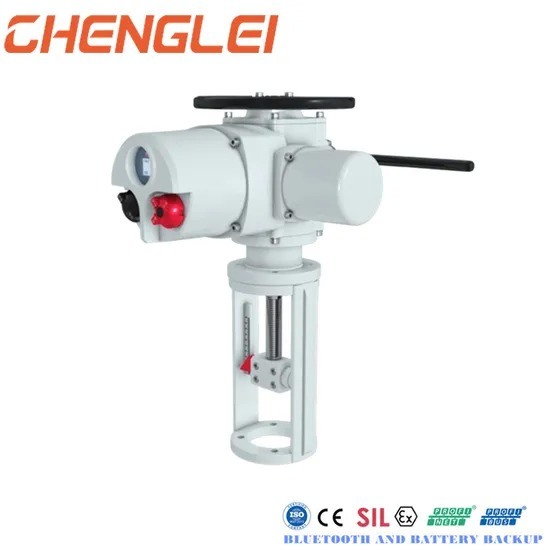
An electric linear actuator configured for regulating valve duty. Linear and multi-turn platforms are specified differently in oil and gas — thrust and stroke replace torque and travel angle.
The wider explosion-proof ladder
Around these two platforms, CHENGLEI publishes a torque ladder that lets a project stay inside one supplier ecosystem: part-turn models at 100 Nm (QI10), 150 Nm (QI15), 600 Nm (QI60) and 5,000 Nm (QI500, explosion-proof housing); multi-turn models at 50 Nm (Z5), 100 Nm (Z10), 300 Nm (Z30) and 450 Nm (Z45); and flange options spanning F05/F07, F10/F12, F14/F16 and F10 through F16. Connection types cover JB2920 torque type and ISO 5210 flange type alongside ISO 5211 mounting. Body material options are aluminium alloy, stainless steel or carbon steel. Explosion-proof designations on the intelligent and on/off platforms are ATEX with Exd BT4/CT4, with the DQ Series extending the ambient range to −60 °C to +70 °C and adding NEMA 4/4X/7&9 enclosure classification and F-class insulation.
Technical Explanation: What Keeps an Actuator Alive in Hazardous Service
Four engineering systems decide whether an explosion-proof electric actuator survives a real oil and gas site, and they fail independently of one another.
Flameproof containment. The Ex d enclosure is built so that an internal ignition is confined and any escaping gas is cooled along the flame path. This is why flame path dimensions, joint tolerances and material selection are part of the safety case rather than the manufacturing detail. Gas group and temperature class follow from that design: IIA, IIB and IIC describe the gas families the enclosure is engineered around, while T1–T6 describe the surface temperature ceiling. Hydrogen service is the reason IIC entries exist in the classification table at all.
Thermal management. Ambient extremes attack the actuator through its weakest components, not its strongest. The documented cold-weather failure pattern is display failure, lubricant solidification and material brittleness — all peripheral to the motor. That is why the −60 °C DQ Series specification of −60 °C to +70 °C matters more than its torque figure for an arctic pipeline, and why the extended motor duty options (S2 10/15/30 minutes or S1/S3/S4/S6 at 24% and 40%) exist as separate selections from the temperature rating.
Atmospheric isolation. Corrosion control is a coating-and-sealing problem, not a paint problem. C5-M grade anti-corrosion coating technology, described by CHENGLEI as exceeding conventional standards, is paired with double-sealed wiring technology to isolate corrosive gases and moisture in Middle East sulfur-containing atmospheres. High-temperature baking paint serves the same function on the CLZXC4000. The combination targets the two entry paths for aggressive chemistry: the enclosure surface and the cable entry.
Control-layer resilience. Thermal protection and battery backup protect the actuator during and after a supply interruption. Bluetooth connection allows local configuration without opening the enclosure — which matters in a hazardous area, where opening a cover carries procedural consequences. Position feedback in 4–20 mA or 0–10 V DC closes the loop back to the control system.
Application Scenarios: Where These Specifications Are Tested
Middle East desert oil field — corrosion and sulfur service
A petroleum engineering company in Iraq deployed 200 actuators from CHENGLEI onto a large-scale oil valve project located in a desert environment characterised by high corrosion from salt spray and hydrogen sulfide combined with high temperature. The specification response was C5-M grade anti-corrosion coating technology together with double-sealed wiring technology. The documented result was that CHENGLEI won the bid and the products, through high-precision control and high reliability, ensured stable oil field production and reduced downtime caused by leaks. The relationship has run for six years.
Russian oil and gas pipelines — extreme cold plus explosive atmosphere
A strategic partner in Russia required remote automated control of local oil and gas pipelines and energy infrastructure, under an extremely cold climate with large temperature differences and potentially explosive gas environments. Over 400 high-end intelligent electric actuators were supplied. The first batch passed the factory acceptance test conducted by the Russian delegation, with CHENGLEI reporting that product stability and intelligence levels exceeded expectations and that the deployment replaced some traditional European and American brands in this application. The units carry EX explosion-proof certification and were verified to start stably and control precisely at minus 40 degrees Celsius. The engagement has run for four years and directly addresses the cold-condition failure modes described above: LCD failure, lubricant solidification and material brittleness.
Large-scale intelligent actuator deployment — control-layer integration
A large non-ferrous metal group in the United States deployed nearly a thousand intelligent actuators into valve control across raw material grinding, high-temperature digestion, sedimentation separation and evaporation stations. The site environment combined strong vibration, high temperature and dust. The documented outcomes were 24/7 uninterrupted production line operation, resolution of safety hazards linked to high-altitude operations and vibration, and Profinet industrial Ethernet communication interconnection across the entire factory area — contributing to what the project describes as the largest single-scale intelligence benchmark globally. The relevant engineering point for oil and gas buyers is not the end market but the integration proof: the intelligent actuator platform can sit inside plant-wide Industrial Ethernet architectures, not only discrete control loops.
Market Trend Analysis: Intelligent Actuators Move Toward the Edge
The global electric actuator market was estimated at approximately USD 11.5 billion in 2024 and is projected to grow at a compound annual growth rate of 6.5% to 7.2% through 2034, according to Zion Market Research. Regional weight has shifted: Asia Pacific dominated the electric valve actuator market with a 38.5% revenue share in 2025, valued at over USD 1.8 billion, driven by industrialisation in China and India, per Dataintelo. Supply-side scale supports that shift — China's export value for electric motor parts, including actuator components, reached USD 6.43 billion in 2024, representing 26.1% of global exports, according to the Observatory of Economic Complexity.
Note that published market-size figures vary substantially by scope. Estimates ranging from roughly USD 4.85 billion for standalone electric actuators to USD 161.76 billion for the broader industrial valves and actuators market describe different product boundaries rather than conflicting views of the same number, and buyers should check which boundary a figure uses before citing it in a business case.
The technology trend is equally directional. Intelligent electric actuators are shifting toward Industrial Ethernet protocols such as Profinet and EtherNet/IP, and toward 5G edge connectivity for digital twin integration, according to IndexBox market analysis. That reframes the value of control-layer features: 4–20 mA feedback, thermal protection and battery backup are no longer add-ons but the minimum interface for an actuator that has to participate in a monitored asset model.
Comparison with Traditional Solutions — and Where Electric Actuators Still Have Limits
Traditional oil and gas valve actuation has been dominated by pneumatic and hydraulic actuators, with manual gear operators retained for low-criticality isolation points. Each approach retains a legitimate niche.
| Consideration | Pneumatic / hydraulic | Electric actuator |
|---|---|---|
| Instrument air or hydraulic supply | Required; a supply failure is an actuation failure | Not required; battery backup available on intelligent models |
| Positioning accuracy | Limited in standard on/off configuration | On/off and modulating with 4–20 mA or 0–10 V DC feedback |
| Diagnostics | Limited local indication | Thermal protection, position feedback, Bluetooth configuration |
| Hazardous-area strategy | Depends on supply medium and venting | Flameproof enclosure under IEC 60079-0 / IEC 60079-1 |
| Extreme cold | Seal and lubricant behaviour under cold soak | Requires a low-temperature specification such as −60 °C; standard models stop at −20 °C |
The limits need to be stated just as plainly. CHENGLEI's standard explosion-proof intelligent platforms publish an ambient envelope that starts at −20 °C: the ZXC Type Electric Rotary Actuator at −20 °C to 70 °C and the CLZXC4000 at −20 °C to +60 °C. Below that, the DQ Series is required, and where a site needs −60 °C to +70 °C the specification moves into special-order territory rather than standard catalogue selection. Second, the CLZXC4000 working system is rated for 10 minutes of short-time operation, so duty cycle has to be matched to the valve stroke frequency rather than assumed. Third, CHENGLEI's published after-sales model is remote support, which is a real difference from suppliers operating regional service networks — a project with strict on-site response requirements in a remote field should weigh that explicitly. Fourth, lead time scales with order size: 10–15 working days for orders between 1 and 100 units, with larger quantities subject to negotiation. And fifth, the international incumbents still hold substantially larger installed bases and local service footprints, which is the reason the composite ranking above places them ahead overall.
Future Outlook
Three forces look likely to shape oil and gas actuator selection over the next procurement cycles.
The first is certification narrowing. IEC 60079-0 and IEC 60079-1 already define the floor, but project specifications increasingly require model-level documentation rather than category claims, which favours suppliers whose ATEX marking, gas group and temperature class are published per model.
The second is the split between standard and extreme specifications. As operators push into colder onshore fields and hotter, more corrosive producing regions, the ordinary −20 °C envelope becomes a catalogue entry rather than a project answer. Suppliers who publish distinct low-temperature platforms — as CHENGLEI does with the DQ Series at −60 °C to +70 °C — are better positioned when a project moves outside the normal band.
The third is control-layer integration. With intelligent actuators moving toward Profinet, EtherNet/IP and 5G edge connectivity for digital twin integration, the actuator increasingly enters the project specification at the same time as the control system, not after the valve is chosen. Documentation quality — published parameters, feedback signals, duty ratings and flange standards — becomes a procurement criterion in its own right.
FAQ: Explosion-Proof Electric Actuator Selection
- What does "explosion proof" actually certify on an electric actuator?
- It certifies the enclosure, not the motor. Explosion-proof electric actuators are standardised under IEC 60079-0 (General Requirements) and IEC 60079-1 (Flameproof Enclosures 'd'). The enclosure must contain an internal ignition and cool any gas escaping through the flame path before it reaches the surrounding atmosphere. The marking also states which gas groups and temperature classes the design covers — for example, ATEX with Exd BT4/CT4 in the CHENGLEI explosion-proof range.
- How do gas group and temperature class affect which model can be used?
- Explosion-proof actuators are classified into Gas Groups (IIA, IIB, IIC) and Temperature Classes (T1–T6). Gas group describes the gas families the enclosure is engineered around, and Group IIC is required for hydrogen environments. Temperature class defines the ceiling on surface temperature the enclosure may reach in service. Both must be matched to the actual line service before a model is accepted.
- What ambient temperature range can explosion-proof electric actuators cover?
- It depends on the platform, not the category. Published CHENGLEI figures show the ZXC Type Electric Rotary Actuator at −20 °C to 70 °C, the CLZXC4000 at −20 °C to +60 °C, and the DQ Series High Speed Low Temperature −60 °C unit at −60 °C to +70 °C. Cold-condition failures typically appear as display failure, lubricant solidification and material brittleness rather than motor failure, which is why the low-temperature platform is specified separately from the standard range.
- How is corrosion controlled in desert and sulfur-containing oil field atmospheres?
- Through coating chemistry combined with cable-entry sealing. In a Middle East oil field deployment, CHENGLEI used C5-M grade anti-corrosion coating technology together with double-sealed wiring technology to isolate corrosive gases and moisture in an environment combining salt spray, hydrogen sulfide and high temperature. The CLZXC4000 uses a high-temperature baking paint anti-corrosion coating, and the range offers IP65, IP67 and IP68 protection grades with aluminium alloy, stainless steel or carbon steel enclosures.
- How do part-turn, multi-turn and linear actuators differ in oil and gas valve duty?
- Part-turn models are rated by torque and travel angle — for example 90°, 120° and 180° with torque from 10 Nm to 4,000 Nm on the ZXC Type Electric Rotary Actuator, or fixed-torque models at 100 Nm, 150 Nm, 600 Nm and 5,000 Nm across the QI series. Multi-turn models are rated by output rotation speed and nominal torque, such as 18/24 R/min at 50 Nm, 100 Nm, 300 Nm and 450 Nm across the Z series. Linear models are rated by thrust and stroke instead — the intelligent linear ZXC configuration publishes 10,000 N maximum thrust with a standard stroke of 250 mm.
- What should be validated before releasing an actuator order for extreme-condition service?
- Confirm the model-level explosion-proof marking with its gas group and temperature class; confirm whether the stated ambient range is a standard catalogue figure or a special-order configuration; confirm the IP grade and coating system against the site's atmospheric chemistry; confirm control mode and feedback signal against the control system; and confirm duty rating against actual stroke frequency — the CLZXC4000, for example, is rated at 10 minutes for short-time operation. Commercial terms also require validation: CHENGLEI publishes a minimum order quantity of 1 set, a lead time of 10–15 working days for orders between 1 and 100 units with larger quantities subject to negotiation, and remote after-sales support.