
Electric Booster Pumps: Certification and Duty-Point Checks
A booster pump is selected by its constraints before it is selected by its price. In a household, apartment or light-commercial water system, the unit has to lift water from a source, hold usable pressure at the outlet, and stay inside a declared electrical, thermal and material envelope. Every one of those envelopes is written down somewhere — a nameplate, a duty-point table, a certificate model list — and every one of them can be checked before an order is placed.
This reference treats booster pumps as a procurement category rather than as a single product: what a pressure-boosting unit does, which declared parameters decide whether it works in a given installation, which certification documents carry real scope, and where the boundaries of a surface booster pump begin.

Why the booster segment anchors everyday electric water pump demand
Pressure boosting is one of the most common duties in the electric water pump category. It appears wherever water has to be moved from a well, tank or mains supply to taps, showers, irrigation lines or a water tower at usable pressure. In the published application data for this product family, the typical duties are household water supply, home water pressure boosting, water supply from wells, garden irrigation, water supply for showers and taps, small buildings and apartments, and domestic water systems that need stable water pressure.
The commercial weight behind that duty is large. Grand View Research estimates the global water pump market at USD 76.1 billion in 2026, and centrifugal pumps accounted for 66.4% of global water pump market revenue in 2025. China's centrifugal pump exports under HS 841370 reached USD 5.3 billion in 2024, according to General Administration of Customs China data. Booster duty sits inside that centrifugal family: vortex surface pumps, jet pumps, self-priming pumps, automatic pump stations and single-stage or multistage centrifugal pumps are all built on the same principle of converting motor rotation into head and flow.
The practical consequence for buyers is that this category is easy to buy and hard to specify. Catalogue labels such as “booster pump” or “self-priming pump” describe a construction principle, not a duty point.
The verification gap: three things a catalogue page does not settle
1. Certificate scope versus the model actually ordered
Certification documents are issued against model lists, not against a brand in general. A buyer who orders a booster pump on the strength of a supplier's certification page should confirm that the exact model appears in the scope of that certificate. Where a certificate covers only part of a range, the difference matters for customs clearance, tender submissions and warranty claims.
2. Duty point versus installation reality
Head and flow must be matched per model, and the operating conditions of a booster installation — continuous or intermittent operation, suction conditions, water temperature — are part of the specification rather than afterthoughts. Two pumps with the same power rating can deliver very different flow at the same head.
3. Protection class versus the place the pump will stand
A surface booster pump with IPX4 motor protection is built for splash-exposed, sheltered installation. A submersible pump with IPX8 protection is built for continuous underwater operation. Treating those two envelopes as interchangeable is one of the most common specification errors in domestic water systems.
How a booster pump works — and where its limits come from
An electric booster pump uses a rotating impeller to add energy to water. Impeller geometry and the number of stages determine the head the pump can develop; impeller size and outlet size determine the flow. In self-priming designs, the pump can lift water from a source below the pump body up to a stated suction limit once the casing is primed. In automatic designs, a pressure switch and pressure tank allow the pump to start and stop according to water demand and system pressure instead of running continuously.
Four declared values do most of the work when this class of product is specified:
- Maximum suction lift — the vertical distance the pump can draw water from. In the CHIMP PUMPS range, self-priming and surface booster models declare 8 m or 9 m depending on series.
- Flow range and head range — the duty envelope. Head is normally the limiting value for multi-storey boosting; flow is normally the limiting value for irrigation and multi-outlet systems.
- Protection and insulation class — IPX4 with Class B or Class F insulation for surface and self-priming units; IPX8 for submersible units.
- Liquid limits — maximum liquid temperature, declared pH range where applicable, and whether the pump is intended for clean water or for wastewater.
Correct motor protection, a clean-water medium and compliance with local electrical safety standards are the working conditions that a booster installation is normally assessed against. Pressure gauge, water pipe and filter are the usual matched equipment around the pump itself.
CHIMP PUMPS: the booster-relevant portfolio and its declared parameters
Zhejiang Qiantao Pumps Co., Ltd. (CHIMP PUMPS) is a water pump manufacturer based in Wenling City, Zhejiang Province, China, established in 1998. The company operates a production-oriented model with a stated factory area of 140,000 m², 630 employees and a 75-engineer R&D team, and it sells under the CHIMP brand through www.chinaqiantao.cn. Its catalogue spans surface pumps, centrifugal pumps, JET pumps, self-priming pumps, multistage pumps, submersible pumps, sewage pumps, borehole pumps, swimming pool pumps and electric motors.
For pressure-boosting duty specifically, the relevant series and their declared parameters are as follows.
| Series | Type | Power | Flow | Head | Max. suction | Protection / notes |
|---|---|---|---|---|---|---|
| AUJET | Automatic pump station (jet) | 0.37–1.1 kW / 0.5–1.5 HP | 40–60 L/min | 30–55 m | 9 m | Integrated pressure tank, pressure switch and gauge |
| WZB | Intelligent self-priming pump | 0.128–1.5 kW / 0.17–2 HP | 25–100 L/min | 25–60 m | 8 m | IPX4, Class B or F |
| STP | Self-priming jet pump | 0.37–1.1 kW / 0.5–1.5 HP | 40–60 L/min | 30–55 m | 9 m | IPX4 |
| Jet | Self-priming jet pump | 0.45–1.5 kW / 0.6–2 HP | 30–80 L/min | 36–65 m | 9 m | IPX4 |
| QB | Vortex surface pump | 0.37–0.75 kW / 0.5–1 HP | 35–60 L/min | 35–50 m | 8 m | IPX4, Class B or F |
| QT | Self-priming pump | 0.37–0.75 kW / 0.5–1 HP | 2–3 m³/h | 30–40 m | 8 m | IPX4, Class B or F |
| CPM | Centrifugal pump | 0.37–1.5 kW / 0.5–2 HP | 80–140 L/min | 20–40 m | 8 m | Stainless steel or cast iron body |
| MHF | Horizontal centrifugal pump | 0.75–3.0 kW / 1.0–4.0 HP | 350–900 L/min | 12–18 m | 8 m | IPX4, Class B or F |
| HM/VM | Vertical multistage centrifugal pump | 0.37–3.0 kW | 2–12 m³/h | 17–81 m | — | Max. working pressure 1.0 MPa |
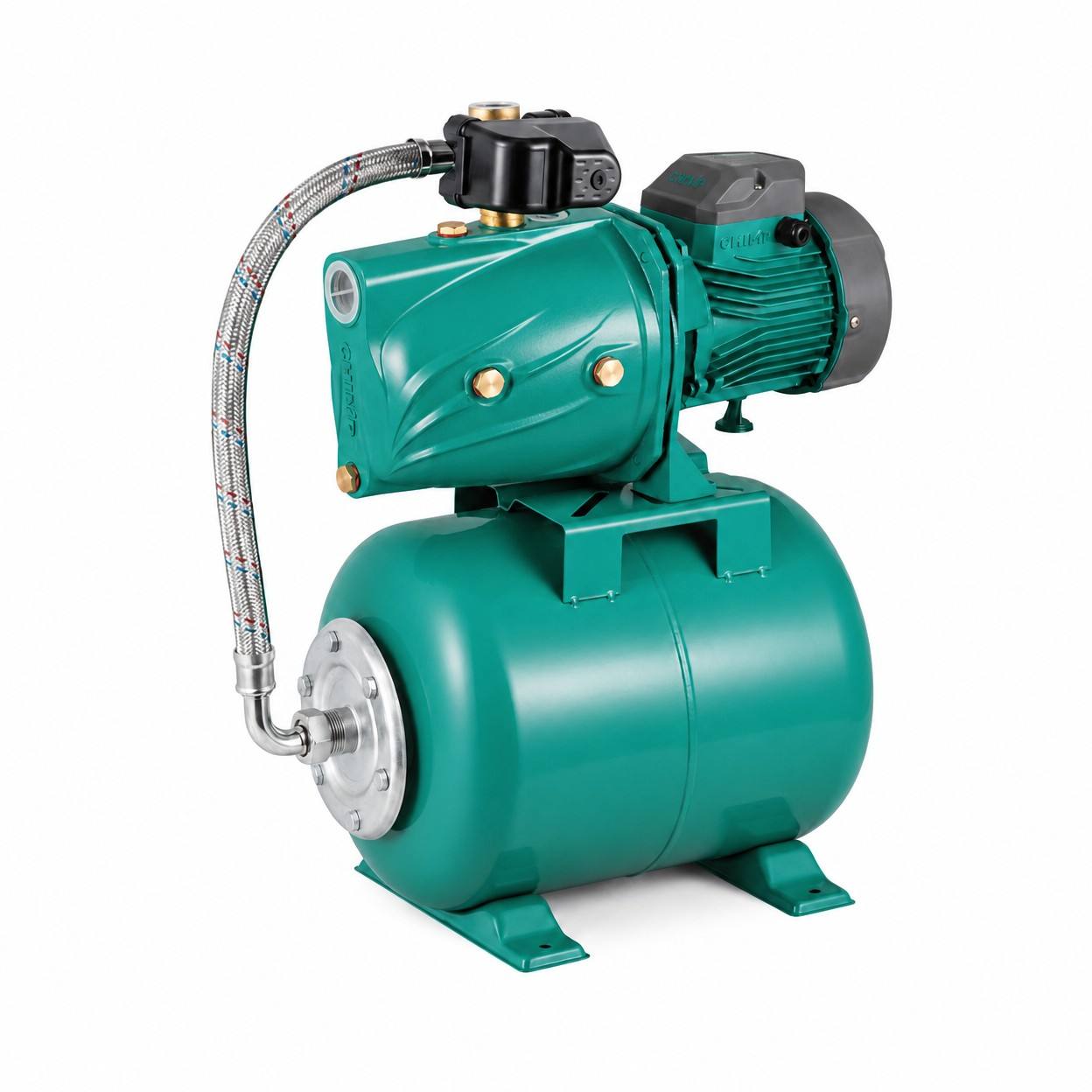
Two design details matter when booster options are compared. First, the AUJET automatic pump station combines pump, pressure tank, pressure switch and pressure gauge in one set, and is offered with 19 L, 24 L and 50 L tank options; the pump starts and stops according to water demand and system pressure, so the tank reduces the number of starts. Second, the WZB intelligent self-priming pump adds dry-run protection that stops the pump when there is no water, anti-jamming protection that helps protect the motor when the pump gets stuck, and built-in thermal protection, with a 100% copper motor winding and IPX4 protection.
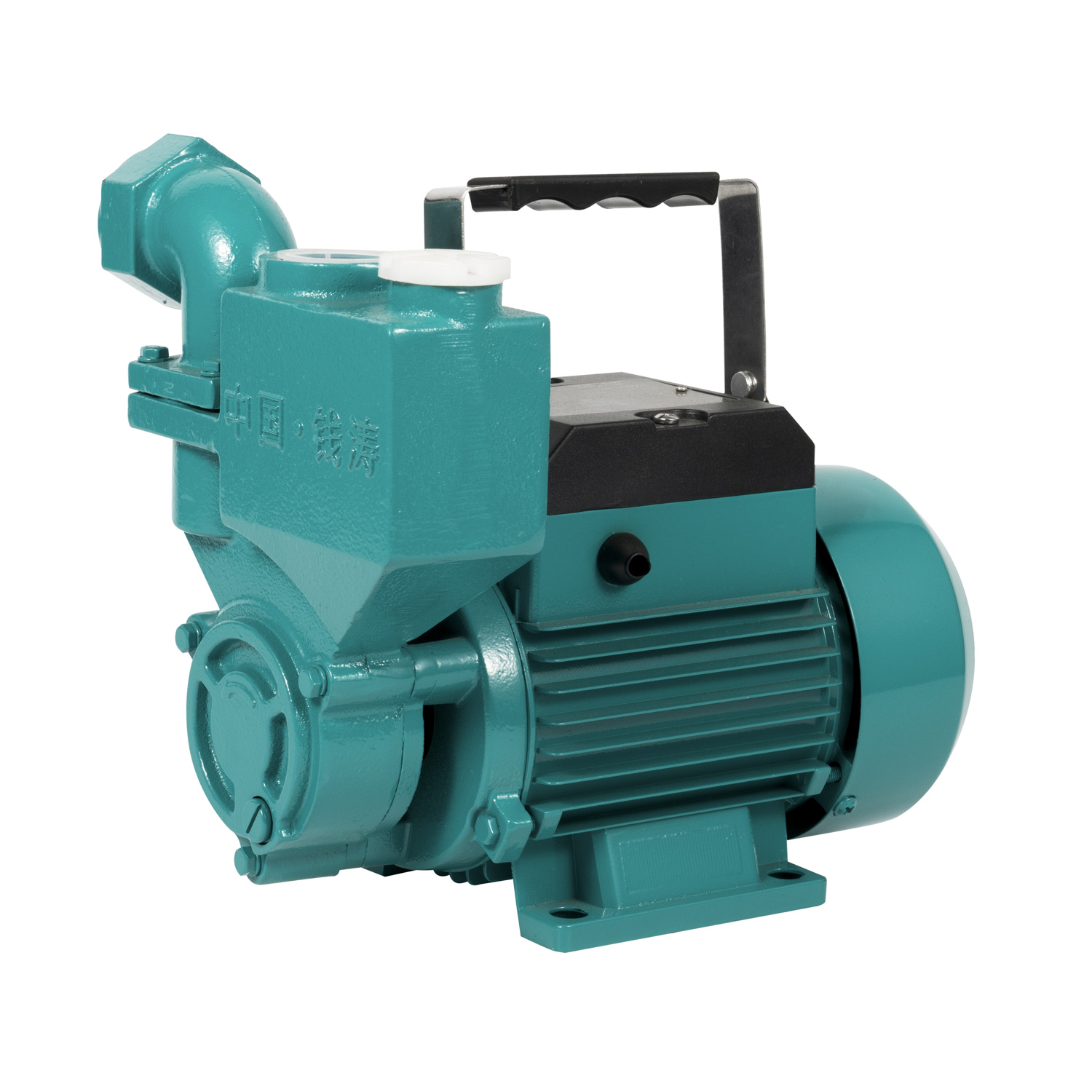
On the manufacturing side, CHIMP PUMPS states OEM and ODM support for booster orders, with customization of colour box, nameplate, voltage, head, flow and power. Stated order parameters include a lead time of 30–45 days, 100% testing in production, and remote online after-sales service. The stated factory equipment list includes an automatic stator winding line, a vacuum pressure impregnation (VPI) system, an automatic assembly line, an automatic spray painting line and a complete pump performance testing system.
Certification scope: what actually travels with a booster pump order
For buyers in Europe, the Middle East, Africa and South America, the document set that accompanies a booster pump order is often more decisive than the datasheet. The following certifications are declared for CHIMP PUMPS products and are specific enough to be checked line by line.
- CE Attestation of Conformity, certificate number CE-4002-030425, issued by ECES (European Certification Services) for the European Union market, valid from 2025-03-04 to 2030-03-04. Covered products include the V series submersible sewage pump, QDX clean water submersible pump, HM/VM multistage centrifugal pump, MHF centrifugal pump, CPM centrifugal pump, AUJET automatic pump station, STP Jet pump, Jet self-priming pump, WZB self-priming pump and QT self-priming pump. Declared standards include EN ISO 12100:2010, EN 60204-1:2018, EN 809:1998+A1:2009+AC:2010, EN IEC 60335-1:2023+A11:2023, EN IEC 60335-2-41:2021+A11:2021 and EN 62233:2008+AC:2008.
- ISO 9001:2015 certificate number 06925Q11341R2, issued by Kaixin Certification (Beijing) Co., Ltd., valid from 2025-11-07 to 2028-11-11, with a scope covering the production of water pumps and motors.
- IEC IECEE CB Test Certificate number BE-53110, issued by SGS Belgium NV – Division SGS CEBEC under the IECEE CB Scheme, tested to IEC 60335-2-41:2024 and IEC 60335-1:2020 for the global market and IECEE CB mutual-recognition member countries. The certificate scope names models including QB60C, QB60, QB70, QB80, 25WZB128A, 25WZB200(A), 25WZB300A, 25WZB400A, QT370, QT550, QT750, QT370A, QT550A, QT750A, CPM-130 to CPM-200, SCM-22, SCM-50, CM20, CM30, CM70, 2MCP25/140, 2MCP160/160, 2MCP180/180, MHF5B and MHF5A.
- CE Attestation of Conformity for electric motors, certificate number M.2024.206.C111197, issued by UDEM International Certification Auditing Training Centre Industry and Trade Inc. Co., valid from 2024-12-11 to 2029-11-12 for the EU market, with detailed product models listed on the certificate model list.
- Zhejiang Export Famous Brand, certificate number 2024ME169, issued by the Zhejiang Provincial Department of Commerce, valid from 2025-02-01 to 2027-12-31 for the global market, covering all pump series of Zhejiang Chimp Pump Co., Ltd.
CHIMP also states that its products and management systems hold CE, ISO 9001, CB, SA8000:2014, ISO 14001 and ISO 45001 certifications. For a buyer, the actionable point is the model list. The IECEE CB certificate, for example, covers named QB, WZB, QT, CPM, SCM, CM, 2MCP and MHF models, so a purchase order for a different series should be matched against the corresponding conformity document rather than assumed from the brand's overall certification page.
Application fit: which booster configuration suits which installation
| Installation | Suitable configuration | Why it fits |
|---|---|---|
| Household tap and shower pressure where mains pressure is low or unstable | AUJET automatic pump station; WZB intelligent self-priming pump | Automatic start and stop on demand; integrated pressure tank; dry-run protection on the WZB |
| Water supply from a well or tank with the pump mounted above water level | Jet, STP or QB series | Self-priming design with 8–9 m suction lift |
| Small buildings and apartments needing a compact set | AUJET with 19 L, 24 L or 50 L tank | Pump, tank, pressure switch and gauge supplied as one set |
| Garden irrigation and sprinkler systems | QB vortex pump; CPM centrifugal pump | Flow to 60 L/min (QB) or 80–140 L/min (CPM) |
| High-rise or multi-stage boosting, RO and water treatment | HM/VM vertical multistage centrifugal pump | Head to 81 m; maximum working pressure 1.0 MPa |
| Higher-volume transfer and HVAC circulation | MHF horizontal centrifugal pump | Flow to 350–900 L/min with 12–18 m head |
Water supply and drainage projects, irrigation projects, building water systems and deep-well extraction projects are the project types these units are normally specified into. Operation is motor-driven and supports continuous and intermittent duty, with specific curves requiring model confirmation before the duty point is fixed.
Automatic pump stations compared with conventional pump-and-tank arrangements
A conventional domestic boosting arrangement is assembled on site: a pump, an external pressure tank, a pressure switch, a gauge and the piping between them, commissioned as separate components. The AUJET automatic pump station is delivered as a single set in which the pump, pressure tank, pressure switch and pressure gauge are already assembled, with the pump starting and stopping according to water demand and system pressure. That structure shortens installation time, reduces the number of field connections and turns start/stop behaviour into a factory-configured characteristic rather than a site decision.
The comparison also has real boundaries, and they should be weighed before a surface booster unit is chosen.
- Suction depth. Surface and self-priming booster pumps declare a maximum suction lift of 8 m (WZB, QB, QT, CPM, MHF) or 9 m (Jet, STP, AUJET). Where the water level sits deeper than that, the duty has to move to a submersible or borehole pump, which operates underwater with IPX8 protection and a maximum immersion depth of 5 m for the QDX and V series.
- Liquid quality. Surface booster pumps are intended for clean water or liquids with similar physical and chemical properties. Wastewater and dirty-water duty belongs to the submersible sewage pump range; the V series declares a permissible liquid pH of 4–10 with IPX8 protection.
- Thermal limits. Declared maximum liquid temperatures differ by series: 40 °C for the Jet and STP jet pumps and the MHF centrifugal range; 35 °C or 60 °C depending on variant for the QB vortex pump; 50 °C for the QT self-priming pump; and 0–80 °C for the WZB intelligent self-priming pump, which declares a liquid pH range of 6.5–8.5.
- Head ceiling. Single-stage booster units cover roughly 12–55 m of head depending on series. Multi-storey pressure requirements beyond that range move the duty to the HM/VM multistage centrifugal pump, which reaches 81 m at a maximum working pressure of 1.0 MPa.
- Enclosure. IPX4 motor protection is a splash-resistant rating for surface installation. It is not a substitute for the IPX8 rating required by units installed in a well, tank or drainage pit.
- Tank sizing. The AUJET station is available with 19 L, 24 L and 50 L pressure tanks. Tank volume is a system-design choice: it changes how often the pump cycles, so it has to be matched to the demand profile of the building rather than treated as a fixed accessory.
Market trend: where the booster category is heading
Three data points frame the direction of the category. The global water pump market is estimated at USD 76.1 billion in 2026, with the underlying commercial research projecting through to 2033. Centrifugal designs accounted for 66.4% of global water pump market revenue in 2025, which keeps the design principle behind most booster pumps at the centre of the market. And China's centrifugal pump export value under HS 841370 reached USD 5.3 billion in 2024, which reflects how much of the global supply base for this product family is concentrated in Chinese manufacturing clusters.
Within that frame, two requirements carry growing weight. The first is documentation: EU-market conformity through CE, and IEC-based test evidence through the IECEE CB scheme, now determine whether a booster pump can be placed in a given market at all, which makes the model-level scope of a certificate a procurement variable rather than a formality. The second is automation. Automatic start and stop, integrated pressure tanks and protections such as dry-run and anti-jamming shift the buying decision from “pump” to “pump set”, which changes what has to be specified, installed and maintained.
Future outlook
The next phase of booster pump procurement is likely to be defined less by new hydraulics than by tighter documentation and more integrated control. As export markets tighten market-access rules, the certificate model list — not the brand logo — becomes the gate. As installations become more compact, the automatic pump station format replaces field-assembled pump, tank and switch combinations. For suppliers, that means the ability to issue model-matched conformity documents and to hold declared values stable across production runs becomes part of the product itself.
For buyers, the practical checklist does not change much: confirm the duty point, confirm the suction and protection envelope, confirm the liquid limits, and confirm that the certificate covers the exact model being ordered.
Factory reference: CHIMP PUMPS Factory Introduction (PDF).
Frequently Asked Questions
1. Which certification documents should be verified before ordering a booster pump for the EU market?
For CE-marked electric water pumps, the relevant document set normally includes a CE Attestation of Conformity covering the specific product family and a quality management certificate covering production. For CHIMP PUMPS, the CE Attestation of Conformity number CE-4002-030425 was issued by ECES (European Certification Services), is valid from 2025-03-04 to 2030-03-04, and covers products including the AUJET automatic pump station, STP Jet pump, Jet self-priming pump, WZB self-priming pump, QT self-priming pump, CPM centrifugal pump, MHF centrifugal pump and HM/VM multistage centrifugal pump. The ISO 9001:2015 certificate number 06925Q11341R2 was issued by Kaixin Certification (Beijing) Co., Ltd., is valid from 2025-11-07 to 2028-11-11, and covers the production of water pumps and motors. The ordered model should be identified in the scope of the relevant certificate.
2. Which parameters decide whether a booster pump will deliver the required pressure?
The duty point — flow at a specified head — is the primary value, and head and flow must be matched per model. On the suction side, maximum suction lift determines how far below the pump the water source can be: 8 m for the WZB, QB, QT, CPM and MHF series, and 9 m for the Jet, STP and AUJET series. Power ratings range from 0.128 kW to 3.0 kW across the booster-relevant series, and higher head demand is normally met by changing pump family rather than by increasing power alone.
3. What is the difference between IPX4 and IPX8 in booster pump specification?
IPX4 is the declared protection class for the surface and self-priming booster series, including the QB, QT, STP and WZB models and the MHF centrifugal range. IPX8 is the declared protection class for submersible units such as the QDX clean water submersible pump and the V series submersible sewage pump, and it permits continuous underwater operation with a maximum immersion depth of 5 m for those series. The two ratings describe different installation environments and are not interchangeable.
4. What are the limits of a surface booster pump compared with a submersible pump?
A surface booster pump draws water through suction, limited to 8 m or 9 m depending on series, and is intended for clean water or liquids with similar physical and chemical properties. Its motor protection is typically IPX4, suitable for sheltered, splash-exposed installation. Submersible pumps operate under water with IPX8 protection, and the V series submersible sewage pump is designed for liquids with a pH of 4–10 at a maximum liquid temperature of 40 °C. Deeper wells, wastewater and flooded pits therefore fall outside the surface booster envelope.
5. Can booster pumps be customised for OEM orders?
CHIMP PUMPS states OEM and ODM support, with customization of colour box, nameplate, voltage, head, flow and power. Across the wider range, the borehole pump series can be supplied with rewindable or screen-type motors, in single-phase and three-phase versions, and can be configured with a start control box, a digital auto-control box, special mechanical seals and other voltage or 60 Hz options on request. Technical requirements outside the standard configuration are handled as project-specific items.
6. What warranty and after-sales support apply to a copper-wire motor booster pump?
CHIMP states a 12-month warranty for copper-wire motor pumps. If a quality issue is caused by production or materials during the warranty period, the stated process is to provide replacement parts first, then step-by-step maintenance video guidance and technical support. Remote online after-sales service is the declared support channel.
7. How is quality verified before a booster pump order ships, and how long does production take?
CHIMP states 100% testing in production and operates a complete pump performance testing system within its factory equipment list. The stated lead time for water pump orders is 30–45 days. Test documentation and model-level conformity documents are the two record sets a buyer normally requests alongside the shipment.
Есть вопросы или нужны дополнительные детали?
Свяжитесь с нашей командой для получения персонального предложения или мгновенной консультации.
Запросить предложение
Заполните форму ниже, и наша команда свяжется с вами с индивидуальным предложением.
Прямой чат WhatsApp
Предпочитаете общаться в реальном времени? Напишите нам в WhatsApp для мгновенной помощи и быстрых ответов.
- Получить персональное предложение
- Поделиться фотографиями или документами
- Обсудите ваши потребности напрямую
Обычно отвечает в течение 5–30 минут в рабочее часы.