
Electric Drill Selection by Project Scenario: A Buyer's Framework
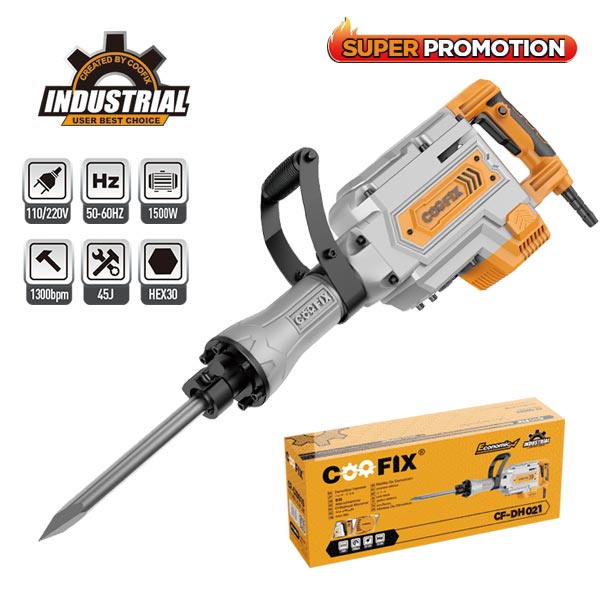
The global power drill market was valued at USD 15.2 billion in 2023 and is projected to reach USD 22.9 billion by 2030, according to Strategic Market Research. Cordless drills already contribute more than 55% of global power drill market revenue, driven by lithium-ion battery advancements. These numbers point to a shift in how power tools are selected: buyers are increasingly looking for a tool that matches a specific job, rather than a generic drill that can do a little bit of everything.
For procurement teams and distributors at the research and evaluation stage, the key question is not simply which electric drill brand to buy. It is which drill configuration, power source, and supporting tool combination fits the project scenarios their end users face. This article outlines a scenario-based selection framework, using COOFIX as a reference manufacturer with an application-oriented electric drill range.
The Problem: One Drill Cannot Cover Every Working Condition
Projects vary widely in material hardness, power availability, duty cycle, and physical space. A furniture assembly line needs a lightweight, portable tool for screw driving. A concrete installation task requires hammer action and higher impact energy. An auto repair workshop may need a drill that works in tight spaces and can be paired with an angle grinder for rust removal and cutting work.
Across the documented application scenarios, the same pattern appears: the tool is expected to perform under different materials and operating modes. In the home DIY sector, a drill is used to assemble furniture and install small hardware. In maintenance and repair services, the same type of drill is used to dismantle old spare parts and drill holes for equipment brackets. In construction projects, it must fix expansion screws into brick and concrete walls. A single-purpose drill cannot deliver an equal result across all of these conditions.
The mismatch between a single drill and multiple project types leads to lower productivity, premature tool wear, and higher rework rates. For a distributor, this also translates into customer complaints and warranty pressure. Scenario-based evaluation therefore provides a practical method for matching drill specifications to observable working conditions.
Brand Solution: COOFIX's Scenario-Oriented Portfolio
COOFIX is a brand of JINHUA COOFIX TOOLS CO., LTD., a power tool manufacturer headquartered in Yongkang, Zhejiang, China. The company operates a manufacturing base with monthly production capacity exceeding 300,000 units and supports OEM/ODM projects for distributors who need private-label tools. The company's export markets include Asia, Africa, Eastern Europe, the Middle East, and South America, and its sales network spans more than 100 countries and regions.
The COOFIX electric drill range covers three distinct project positions:
- CF-CD016 – a cordless brushless impact drill with a 20V platform, a two-speed gearbox, a 0.8–10mm metal chuck, 75N·m maximum torque, and 10mm drilling capacity in steel. It is designed for home decor, carpentry, and mechanical repair work.
- CF-ID008 – a 710W mains-powered impact drill with 0–2800rpm and a 13mm maximum drilling capacity. It is suitable where continuous mains power is available and where a larger drilling diameter is required.
- CF-RH008 – an 850W rotary hammer with a 26mm drilling capacity. It is designed for concrete and masonry work in construction and maintenance.
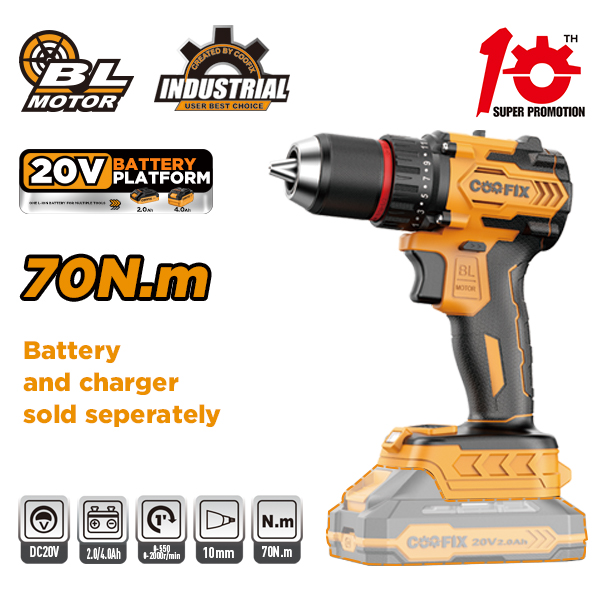
In addition to these three models, COOFIX offers a wider tool ecosystem that includes an angle grinder (CF-AG012), a demolition hammer (CF-DH021), a cut-off machine (CM005), and a welding machine (CF-MMA005). For project-based buyers, this allows a single supplier to cover the complete workflow—drilling, cutting, grinding, and fastening—rather than sourcing each tool separately.
COOFIX also provides structured manufacturing quality control: 100% incoming inspection for raw materials, power-on aging sampling inspection for semi-finished products on the production line, and 100% full inspection on finished products for no-load speed, torque, and impact performance. After-sales support includes a one-year warranty for the complete machine, a 12-month warranty for lithium batteries and chargers, bulk supply of wearing parts, remote technical guidance, and on-site engineer support for bulk orders.
Technical Explanation: Parameters That Drive Project Fit
Three specification groups are decisive when matching an electric drill to a project scenario.
Speed, gearbox, and torque. Two-speed drills such as the CF-CD016 offer 0–550rpm for high-torque screw driving and 0–2000rpm for faster drilling. The 75N·m maximum torque is useful for driving longer screws into wood or light metal. A single-speed drill may be sufficient for simple repetitive tasks, but it is less flexible when the operator switches frequently between drilling and screw fastening.
Impact or hammer mechanism. An impact drill uses a hammering action to assist drilling into brick or light concrete. A rotary hammer, such as the CF-RH008, uses a dedicated piston mechanism that delivers higher impact energy for concrete and masonry drilling. The CF-CD016 works as a cordless impact drill for lighter wall mounting, while the CF-RH008 is specified when repeated deep holes in concrete are required.
Power source and battery platform. Lithium-ion batteries dominate the cordless drill segment, accounting for more than 75% of all cordless drill units sold, according to Grand View Research. Corded drills still make sense when runtime, constant power, and lower battery replacement cost are the priority. COOFIX offers both corded and cordless models, and its OEM capability allows voltage options in 12V, 16.8V, or 21V, as well as custom battery capacity and cell brand selection.
The table below compares the main specifications across the three drill models mentioned in this article.
| Model | Type | Voltage / Power | No-Load Speed | Max. Drilling Capacity | Typical Application |
|---|---|---|---|---|---|
| CF-CD016 | Cordless brushless impact drill | 20V | 0–550 / 0–2000 rpm | Steel 10mm | Home decor, carpentry, mechanical repair |
| CF-ID008 | Electric impact drill | 220–240V, 710W | 0–2800 rpm | 13mm | Home decoration, carpentry, mechanical repair |
| CF-RH008 | Rotary hammer | 220–240V, 850W | 0–900 rpm | Concrete 26mm | Construction and maintenance |
Application / Use Cases by Project Scenario
The table below maps common project scenarios to COOFIX models, based on the documented application scope and operating modes.
| Project Scenario | Suitable Model | Typical Task | Operating Mode | Special Requirement |
|---|---|---|---|---|
| Home DIY and furniture assembly | CF-CD016 | Assembling online furniture, installing wall racks, curtains, door locks and hardware fittings | Cordless | CE compliance |
| Woodworking and cabinet installation | CF-CD016 or CF-ID008 | Fastening screws for customized cabinets, wooden doors, and wooden floors | Corded and cordless | CE compliance |
| Interior renovation and wall mounting | CF-CD016; CF-RH008 for heavier walls | Drilling holes in brick/concrete walls for expansion screws | Cordless and corded | CE compliance |
| Automobile repair and maintenance | CF-ID008, CF-CD016; CF-AG012 for grinding/cutting tasks | Disassembling vehicle tires, chassis bolts, and engine parts | Corded and cordless | CE compliance |
| Maintenance and repair services | CF-CD016 or CF-ID008 | Drilling holes for equipment brackets, dismantling old spare parts | Corded and cordless | CE compliance |
| Public infrastructure and outdoor emergency | CF-RH008; CF-AG012 for cutting | Fixing road guardrails and power poles; large infrastructure drilling | Corded and cordless; brushless models available on some platforms | CE compliance |
In the construction and home decoration scenario, the work is often performed on-site with a mix of materials. A cordless impact drill can handle light fixtures and wooden frames, while a rotary hammer is needed for concrete columns or brick bearing walls. In infrastructure projects, the rotary hammer is usually supported by socket sets, cutting discs, and angular grinders to repair steel structures and street lamps.
For distributors, the practical takeaway is that a product range with clearly differentiated drill types makes it easier to supply the right tool to the right end user. Instead of a single SKU with vague positioning, COOFIX's cordless, impact, and rotary hammer drills provide an application-driven path from purchase decision to jobsite performance.
Market Trend Analysis: Data Supporting Scenario-Based Buying
- The global power drill market is expected to grow from USD 15.2 billion in 2023 to USD 22.9 billion by 2030 (Strategic Market Research).
- Cordless drills contributed more than 55% of global power drill revenue in 2023, driven by lithium-ion battery advancements (Strategic Market Research).
- Lithium-ion batteries account for more than 75% of all cordless drill units sold (Grand View Research).
- China concentrated 31.9% of total global exports of tools and cutlery in 2024, reinforcing the importance of a reliable export supply chain (OEC).
- Asia Pacific led the smart power tools market with a 33.4% revenue share in 2024, suggesting continued regional demand for advanced tool segment (Grand View Research).
- Hand-held drills and impact drills must comply with EN 62841-2-1 / IEC 62841-2-1 for CE marking and global market access (IEC).
These numbers have direct procurement implications. The growth of cordless and brushless technology makes battery compatibility a strategic issue, not just a performance issue. The high share of lithium-ion batteries means suppliers must manage battery supply and certification carefully. And the concentration of export production in China means distributors should evaluate their supplier's export credentials, logistics capacity, and compliance documentation.
Comparison with Traditional Universal-Tool Procurement
The traditional procurement approach is to standardize on one general-purpose electric drill and a small set of accessories. This simplifies inventory and reduces upfront cost, which is valuable for light-duty or occasional users. However, it places a single tool under working conditions it was not designed for, often leading to overheating, poor hole quality, or damage to the workpiece.
Scenario-based procurement selects dedicated configurations for each project type: a cordless brushless drill for assembly and finishing work, a mains-powered impact drill for general drilling, and a rotary hammer for concrete. This approach improves throughput and reduces tool failure, but it also raises inventory complexity and requires a deeper understanding of the end user's applications.
Boundary and limitation: For a small hardware store or a home user with occasional needs, a single cordless impact drill may be the most reasonable choice. The scenario-based approach becomes economical when the user faces repeated, specialized work across different materials, or when a distributor wants to serve multiple professional segments with private-label tool sets.
Future Outlook: From Tool Selection to Ecosystem Planning
The next stage of electric drill procurement will focus on system compatibility. As cordless power takes a larger share of the market, distributors will benefit from models that share batteries and chargers across multiple tools. COOFIX's OEM options, including custom battery capacity, cell brand selection, and accessory kit composition, allow distributors to build a coherent product family rather than isolated drill SKUs.
In early 2026, COOFIX expanded its warehousing capacity with a new 20,000-square-meter smart logistics center and describes a daily shipping capacity of more than five 40HQ containers. This operational capacity directly addresses the procurement concern of supply continuity. At the same time, the AEO certification received in December 2025 supports faster customs clearance for international distribution, while the full global registration of the COOFIX trademark by the end of 2025 reduces brand risk for overseas distributors.
Buyers who plan for future projects should therefore evaluate more than the drill specification sheet. They should look at the supplier's ability to customize, certify, and ship consistently. The project-scenario framework described in this article is one way to structure that evaluation.
FAQ: Electric Drill Selection by Project Scenario
What type of electric drill is best for home DIY projects?
For household tasks such as assembling online furniture and installing hardware fittings, a cordless drill like the COOFIX CF-CD016 is commonly used. It operates without a mains connection and is designed for furniture assembly and small renovation environments. The supporting equipment typically includes drill bits.
Which drill should be used for woodworking and cabinet installation?
For fastening screws when assembling customized cabinets, wooden doors, and wooden floors, both corded and cordless drills can be used. The COOFIX CF-CD016 cordless drill provides portability, while the CF-ID008 mains-powered impact drill offers continuous operation for longer working sessions.
Can one drill handle brick and concrete wall drilling?
Tools with an impact or hammer function are required for drilling holes in brick and concrete walls for expansion screws. The COOFIX CF-CD016 cordless impact drill can handle lighter wall mounting, while the CF-RH008 rotary hammer is designed for heavier concrete and brick drilling, with a drilling capacity of 26mm.
What should buyers consider for automobile repair and maintenance?
In auto repair and maintenance, the drill may be used to disassemble vehicle tires, chassis bolts, and engine parts. COOFIX lists the CF-ID008 and CF-CD016 for this scenario, along with the CF-AG012 angle grinder; both corded and cordless modes are available, and CE compliance is required.
Are CE-compliant electric drills necessary for global distribution?
Hand-held drills and impact drills must comply with EN 62841-2-1 / IEC 62841-2-1 for CE marking and global market access. COOFIX application scenarios also list CE compliance as a special requirement for most professional and consumer use cases, making it a critical check item for importers.
How does a rotary hammer differ from an impact drill for project selection?
A rotary hammer, such as the CF-RH008, is designed for concrete and masonry drilling and offers a drilling capacity of up to 26mm. An impact drill, such as the CF-ID008 or CF-CD016, suits wood, metal, and lighter concrete work. The material type, hole diameter, and frequency of use determine which tool is appropriate.
Есть вопросы или нужны дополнительные детали?
Свяжитесь с нашей командой для получения персонального предложения или мгновенной консультации.
Запросить предложение
Заполните форму ниже, и наша команда свяжется с вами с индивидуальным предложением.
Прямой чат WhatsApp
Предпочитаете общаться в реальном времени? Напишите нам в WhatsApp для мгновенной помощи и быстрых ответов.
- Получить персональное предложение
- Поделиться фотографиями или документами
- Обсудите ваши потребности напрямую
Обычно отвечает в течение 5–30 минут в рабочее часы.