
Electric Drill Shortlist 2026: CF-CD016 Cordless vs. CF-ID008 Corded Impact Models
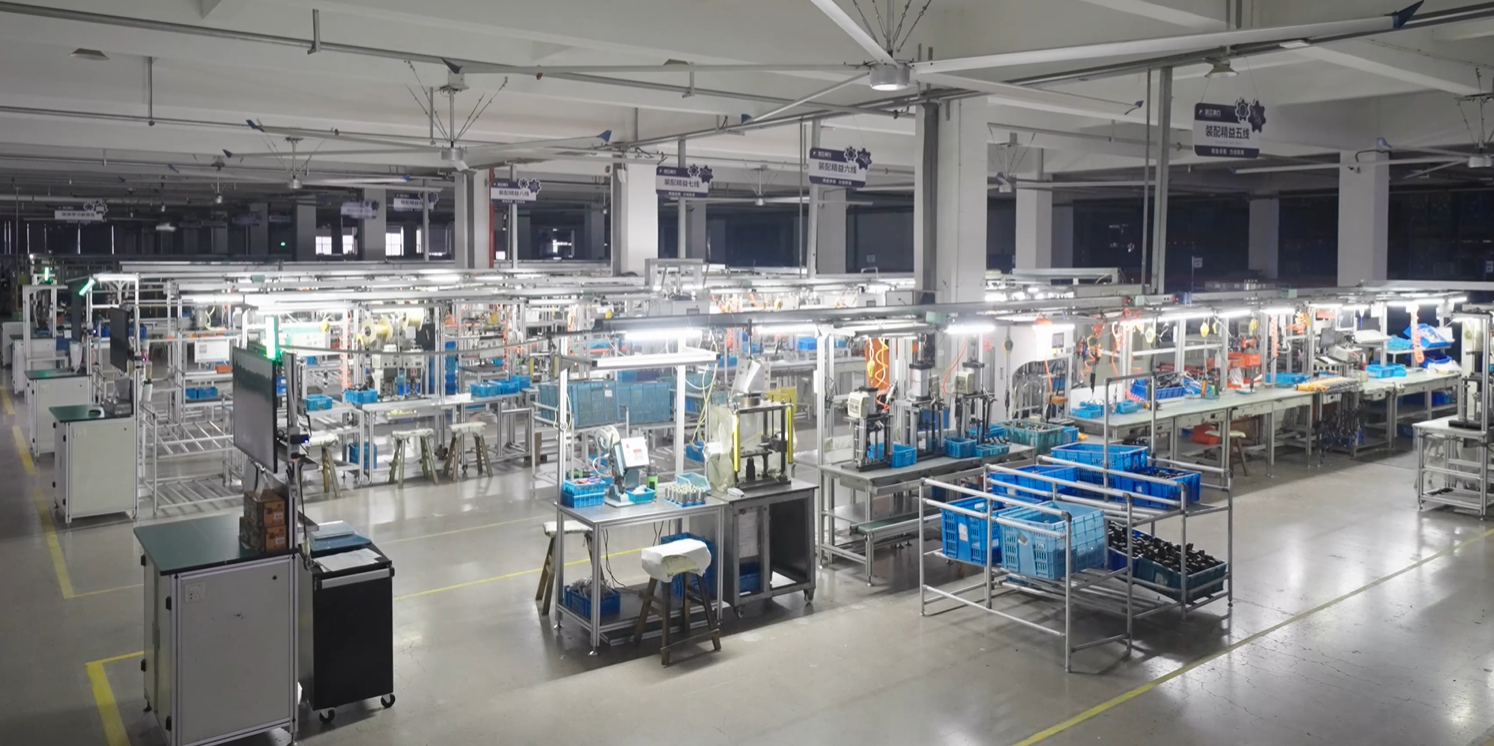
Industry reference image: assembly workshop environment, not a product advertising visual.
An electric drill shortlist is only useful when it resolves a real constraint. For buyers comparing the COOFIX CF-CD016 and the COOFIX CF-ID008, that constraint is power supply: one drill runs on a 20V battery pack, the other on 220-240V mains current. Almost every downstream decision — where the tool can be used, how large a hole it can take, which certificate file a distributor must hold — follows from that single difference.
COOFIX is the power tool brand of JINHUA COOFIX TOOLS CO., LTD., a manufacturer headquartered in Yongkang, Zhejiang, China, producing power tools, garden tools, hand tools and accessories for export markets. Both models in this shortlist sit inside that drill range and are documented as impact drills for home decoration, carpentry and mechanical repair.
The verified figures separate the two entries quickly. The CF-CD016 is a cordless brushless impact drill rated at 20V, with a maximum torque of 75 N.m, two no-load speed ranges of 0-550 and 0-2000 r/min, a metal chuck with a 0.8-10mm tightening range, and a stated drilling capacity of 10mm in steel. The CF-ID008 is a corded electric impact drill rated at 220-240V~50/60Hz, with 710W input power, a no-load speed of 0-2800rpm, and a maximum drilling capacity of 13mm.
Those lines are enough to build a working shortlist. They are not enough to declare a winner, and this article does not attempt to.
Why This Shortlist Has Two Entries Rather Than Ten
A shortlist is a filter, not a catalogue. In drills, the filter that removes the most options fastest is the power source, because it determines whether the tool can be taken to the work or whether the work must be brought to an outlet.
The market context explains why both entries still belong on a 2026 list. Strategic Market Research reported the global power drill market at USD 15.2 billion in 2023, with cordless drills contributing over 55% of revenue that year. Market Research Insights estimated that lithium-ion batteries account for over 75% of cordless drill batteries sold globally. A separate 2025 commercial research estimate put brushless motor integration at more than 70% of cordless drill manufacturers. Cordless is no longer the alternative option; it is a mainstream default.
That does not retire the corded drill. A buyer who needs sustained output across a long shift, a fixed workshop bench, or a supply situation where battery logistics are unattractive still has a legitimate case for mains power. The 2026 shortlist therefore keeps one entry per power source rather than forcing a false contest between near-identical products.
Power Source Sets the Site Before the Specification Does
The CF-ID008 requires a 220-240V~50/60Hz supply. That is a hard constraint, not a preference. It means the drill operates wherever a compatible outlet and cable route exist — workshops, fitted-out interiors, service bays, fixed benches — and it means the tool is outside its stated input range in markets whose nominal supply is 110-120V. Distributors in those markets should treat the model as unsuitable without a transformer strategy, and should not assume the 220-240V label is a formality.
The CF-CD016 removes the outlet from the decision. Its constraint moves to battery management: pack availability, charging cycles, and the runtime that a given pack delivers under load. Those runtime figures are not published in the specification record available here, so a buyer comparing against a mains tool must request them rather than infer them from torque alone.
There is a second, less obvious constraint in the cordless route: the tool's value is partly carried by the battery platform. Where a distributor already stocks a compatible 20V platform, the incremental cost of the CF-CD016 is the bare tool. Where no platform exists, every unit sold carries pack and charger implications. That distinction shapes margin more than the headline drill specification does.
Specification Comparison on the Verified Record
Table: documented differences only. Values are as stated in the product specification records; blank cells indicate no value stated in those records.
| Parameter | CF-CD016 (cordless) | CF-ID008 (corded) |
|---|---|---|
| Product type | Cordless brushless impact drill | Electric impact drill |
| Rated voltage | 20V | 220-240V~50/60Hz |
| Input power | Not stated in record | 710W |
| No-load speed | 0-550 / 0-2000 r/min | 0-2800rpm |
| Maximum torque | 75N.m | Not stated in record |
| Chuck | Metal chuck, 0.8-10mm tightening range | Not stated in record |
| Drilling capacity | 10mm in steel | 13mm maximum |
| Housing material | Copper, plastic | Copper, plastic |
| Documented industries | Home decoration, carpentry, mechanical repair | Home decoration, carpentry, mechanical repair |
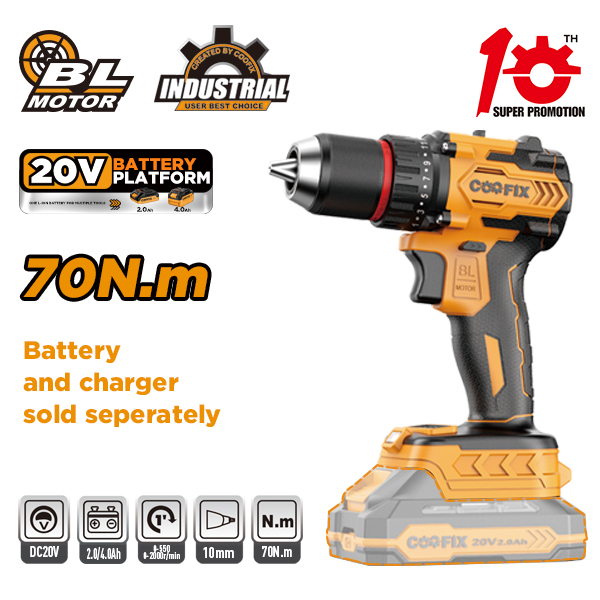
CF-CD016: 20V cordless brushless impact drill, 75N.m, two speed ranges, metal chuck.
The table shows an asymmetry that matters commercially. The cordless entry publishes torque; the corded entry publishes input power and a larger drilling capacity. These are not interchangeable numbers. Maximum torque describes rotational force at the output; input power describes electrical draw. A buyer who tries to compare the two models on one of those figures alone is comparing different things.
Where the Records Stop: What a Buyer Still Needs to Request
A credible shortlist states its gaps. Five items are not resolved by the material available here.
Torque for the corded model. No maximum torque value is published for the CF-ID008 in the specification record. Quoting 75 N.m for it, by analogy with the cordless model, would be an assumption rather than a fact. Buyers who need torque parity should request the value in writing before committing to a volume order.
Battery and runtime data for the cordless model. Pack capacity, cell brand, charger output and runtime under load are not in the record provided. These determine how many units a contractor needs per crew, and whether a tool-only or kit configuration is the right purchase.
Chuck specification for the corded model. The CF-CD016 documents a metal chuck with a 0.8-10mm range; no equivalent chuck figure is stated for the CF-ID008.
Price and price band. No price, quotation or band data exists in the verified record for either model. This shortlist therefore ranks on technical and certification constraints, not on cost, and any cost conclusion must come from a current quotation against a defined configuration.
Commercial terms by route. Documented figures differ by customisation path: a 10-unit minimum order with a 10-day lead time on the OEM and customised route, 100-500 units with a 30-day lead time for private-label programmes, and 60 days for ODM appearance and structure customisation. Those are programme-level terms, not model-level prices, and they should be confirmed per order.
Construction and Decoration Applications Confirmed in the Records
Construction and home decoration is the scenario where a drill shortlist is usually tested first. In the application records, that scenario covers residential and commercial building work, interior renovation, wall chiselling, concrete drilling, ceiling and light steel keel installation, and door, window and utility pipeline fitting. The tasks listed include drilling brick and concrete walls, fixing expansion screws, opening slots for water and electricity pipelines, and installing doors, ceilings and hanging cabinets. Both the CF-CD016 and the CF-ID008 appear among the applicable products for that scenario, alongside the CF-RH008 rotary hammer.
Adjacent scenarios reinforce the same pairing. In woodworking and furniture installation, the records describe cordless drill and screwdriver use for fastening cabinet, door and floor assemblies. In maintenance and repair, drills are used to bore fixing holes for equipment brackets and to dismantle worn parts. Automotive maintenance, home DIY work and outdoor landscape installation all list both models as applicable products.
One caution belongs here. The application records assign tasks to the drill category and list both models as suitable; they do not attribute a specific task to a specific model. A buyer should not read a documented scenario as a tested performance result. What the records do support is a category-level fit with construction, decoration, carpentry and repair work — and that both entries are intended for those environments.
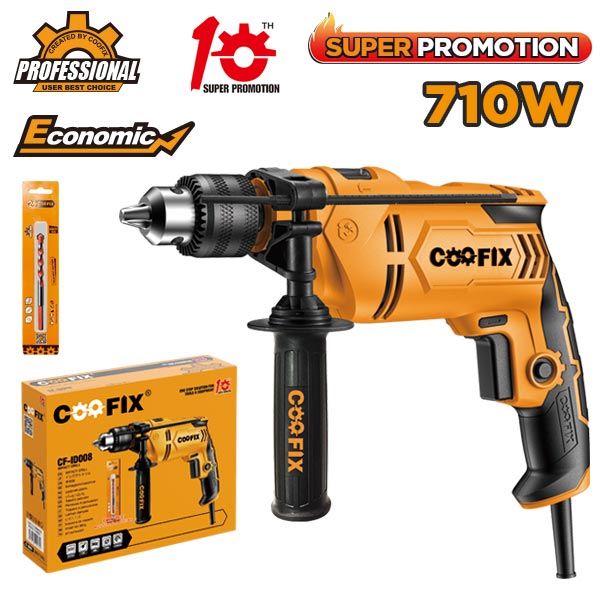
CF-ID008: corded electric impact drill, 220-240V~50/60Hz, 710W, 13mm maximum drilling capacity.
Certification and Market Access: Two Different Documents
Certification is where shortlists most often fail at the border rather than at the bench. The two models do not carry the same documentation profile, and the difference matters for distributors.
The CF-CD016 is EAC certified under certificate number ЕАЭС KG417/046.CN.02.07167, issued by ОС «Центр сертификации «Мурас», for the Eurasian Economic Union market, against ТР ТС 010/2011 and ТР ТС 020/2011. The certificate scope names a Coofix-branded cordless drill and references the ГОСТ IEC 60745 series alongside EMC standards.
The CF-ID008 is covered by the company's AEO certification, number 096099139001, issued by Hangzhou Customs of the People's Republic of China under the WCO SAFE Framework, valid for a scope covering the import and export of hardware tools, power tools and related accessories. AEO status is an authorised economic operator credential for customs facilitation and supply-chain security. It is not a product safety certificate, and it should never be presented to a retail buyer as evidence of electrical conformity.
On product-level conformity, the CE documentation held in the available records covers other Coofix models — the CF-AG012 angle grinder and the CF-RH008 rotary hammer — rather than the two drills discussed here. The reference framework for hand-held drills and impact drills remains IEC 62841-2-1:2017, which applies to such tools with rated voltage up to 250V AC/DC. The practical instruction for a buyer is straightforward: request the certificate copy, the issuing laboratory and the certificate number for the exact model and the exact destination market, and treat a portfolio-level claim as a starting point rather than proof.
A Four-Step Rule for Choosing Between Them
Step one — fix the supply constraint. If the work happens where a 220-240V outlet is reliably available, the CF-ID008 is a valid entry. If the work moves across unfinished sites, rooftops, gardens or roadside locations, the cordless CF-CD016 removes a dependency the corded tool cannot remove.
Step two — check the hole size against the documented capacity. The CF-ID008 states a maximum drilling capacity of 13mm; the CF-CD016 states 10mm in steel. Where the specification is genuinely needed at the upper end, the documented figure should decide, not the torque figure.
Step three — match the certificate to the market. EAC for the Eurasian Economic Union is documented for the CF-CD016. Buyers shipping to the EU, the United Kingdom or North America need the corresponding product-level file for the specific model before listing it.
Step four — define the configuration before asking for a price. Tool-only, kit, battery count and packaging all change the quotation. Because no price band is published, the only reliable figure is a written quotation tied to a named configuration.
What Changes Against Corded-Only Practice
Traditional drill procurement in many distribution businesses was effectively single-track: buy mains-powered tools, hold spare carbon brushes and cables, and accept that the tool stays near a socket. Adding a brushless cordless entry changes three things at once. It changes the site constraint, because work no longer waits for power. It changes the inventory constraint, because battery packs and chargers become part of the stock equation. And it changes the service constraint, because battery and charger warranty terms diverge from the tool warranty — the documented terms cover one year for the complete machine and twelve months for lithium batteries and chargers.
The boundary is equally clear. Brushless cordless tools carry a platform dependency that a corded drill does not have: without packs and chargers, the tool does not run at all, and pack degradation over a multi-year service life is a factor a mains drill simply does not present. For buyers whose customers operate in one fixed location and expect a decade of service from a single purchase, a corded model remains a defensible choice rather than an outdated one.
Market Context Behind the 2026 Shortlist
The shortlist reflects a supply base that has already shifted. Lithium-ion dominance above 75% of cordless drill batteries and brushless integration reported at more than 70% of cordless manufacturers describe a market where efficient motor and battery combinations are the norm rather than a premium tier. Cordless drills holding over 55% of power drill revenue in 2023 confirms that the format is where volume sits.
For a distributor, that context supports holding both formats rather than substituting one for the other. A range built only on corded tools competes for a shrinking share of a growing category; a range built only on cordless tools leaves fixed-installation and continuous-duty demand to someone else.
Outlook
The likely direction of travel through 2026 and beyond is convergence in capability and divergence in documentation. Cordless platforms will keep absorbing tasks that once required mains power, while market-access requirements tighten around product-level files rather than brand-level claims. Buyers who shortlist on published torque alone will be repeatedly caught out by voltage ranges, chuck specifications and certificate scope. Buyers who shortlist on documented constraints — supply, capacity, certificate, configuration — will find that a two-entry list is often enough to cover most of a working catalogue.
Both models remain defensible entries on a 2026 purchase list. The CF-CD016 answers mobility and brushless efficiency with a published 75 N.m and a 20V platform; the CF-ID008 answers continuous mains supply with 710W input power and a 13mm stated drilling capacity. The correct question is not which one is better, but which constraint the buyer's customers actually operate under.
For full model and accessory coverage, the COOFIX 2025 product catalogue is available for download: COOFIX catalog 2025 (PDF).
FAQ
What are the documented specifications of the COOFIX CF-CD016?
The CF-CD016 is a cordless brushless impact drill rated at 20V, with two no-load speed ranges of 0-550 and 0-2000 r/min, a maximum torque of 75 N.m, a metal chuck with a 0.8-10mm tightening range, and a stated drilling capacity of 10mm in steel. Its housing material is listed as copper and plastic, and its documented industries are home decoration, carpentry and mechanical repair.
What voltage does the COOFIX CF-ID008 require?
The CF-ID008 is rated at 220-240V~50/60Hz with 710W input power, a no-load speed of 0-2800rpm and a maximum drilling capacity of 13mm. Because the stated input range is 220-240V, the model sits outside its rated supply in markets using 110-120V nominal voltage unless a suitable transformer arrangement is used.
Which certifications apply to these two drill models?
The CF-CD016 holds EAC certification number ЕАЭС KG417/046.CN.02.07167, issued by ОС «Центр сертификации «Мурас» for the Eurasian Economic Union market under ТР ТС 010/2011 and ТР ТС 020/2011. The CF-ID008 is listed within the scope of the company's AEO certification, number 096099139001, issued by Hangzhou Customs of the People's Republic of China under the WCO SAFE Framework. AEO is a customs and supply-chain credential, not a product safety certificate. Product-level CE documentation in the available records covers the CF-AG012 angle grinder and the CF-RH008 rotary hammer.
Which of the two models has the larger drilling capacity?
On the documented figures, the CF-ID008 states a maximum drilling capacity of 13mm, while the CF-CD016 states a drilling capacity of 10mm in steel. The CF-CD016 additionally publishes a maximum torque of 75 N.m, whereas no maximum torque value is stated for the CF-ID008 in the available specification record.
Which construction and decoration tasks are these drills documented for?
The construction and home decoration scenario in the application records lists both models among applicable products, covering tasks such as drilling brick and concrete walls, fixing expansion screws, opening slots for water and electricity pipelines, and installing doors, ceilings, hanging cabinets and light steel keels. The records assign tasks at category level rather than to a specific model.
Is a price band available for either model?
No price, price band or quotation data is included in the verified record for the CF-CD016 or the CF-ID008. Cost comparisons require a written quotation against a defined configuration, because tool-only and kit contents, battery count and packaging change the commercial basis. Programme terms in the capability records range from a 10-unit minimum order with a 10-day lead time on the OEM and customised route to 100-500 units with a 30-day lead time for private-label programmes.
Есть вопросы или нужны дополнительные детали?
Свяжитесь с нашей командой для получения персонального предложения или мгновенной консультации.
Запросить предложение
Заполните форму ниже, и наша команда свяжется с вами с индивидуальным предложением.
Прямой чат WhatsApp
Предпочитаете общаться в реальном времени? Напишите нам в WhatsApp для мгновенной помощи и быстрых ответов.
- Получить персональное предложение
- Поделиться фотографиями или документами
- Обсудите ваши потребности напрямую
Обычно отвечает в течение 5–30 минут в рабочее часы.