
Electric Forklift Supplier Capability: CPD10–CPD35 Evidence
Electric forklift procurement has become easier to start and harder to finish. Product pages are abundant; the documents a buyer can actually check before releasing a purchase order are not. At the evaluation and execution stages, the decisive question is rarely whether a supplier builds electric forklifts at all. It is what is installed on the specific truck being ordered, and which independent record confirms it.
For the CPD10–CPD35 counterbalance series supplied by Ningjin Shunhao Trading Co., Ltd. — an electric forklift manufacturer and trading company based in Ningjin County, Xingtai City, Hebei Province, China, operating the Mightlift brand (www.mightlift.com) — supplier capability can be evidenced in four checkable layers: rated load capacity per model, drivetrain and controller component identity, battery configuration, and third-party certification scope. Each layer can be examined before an order is placed rather than after delivery.
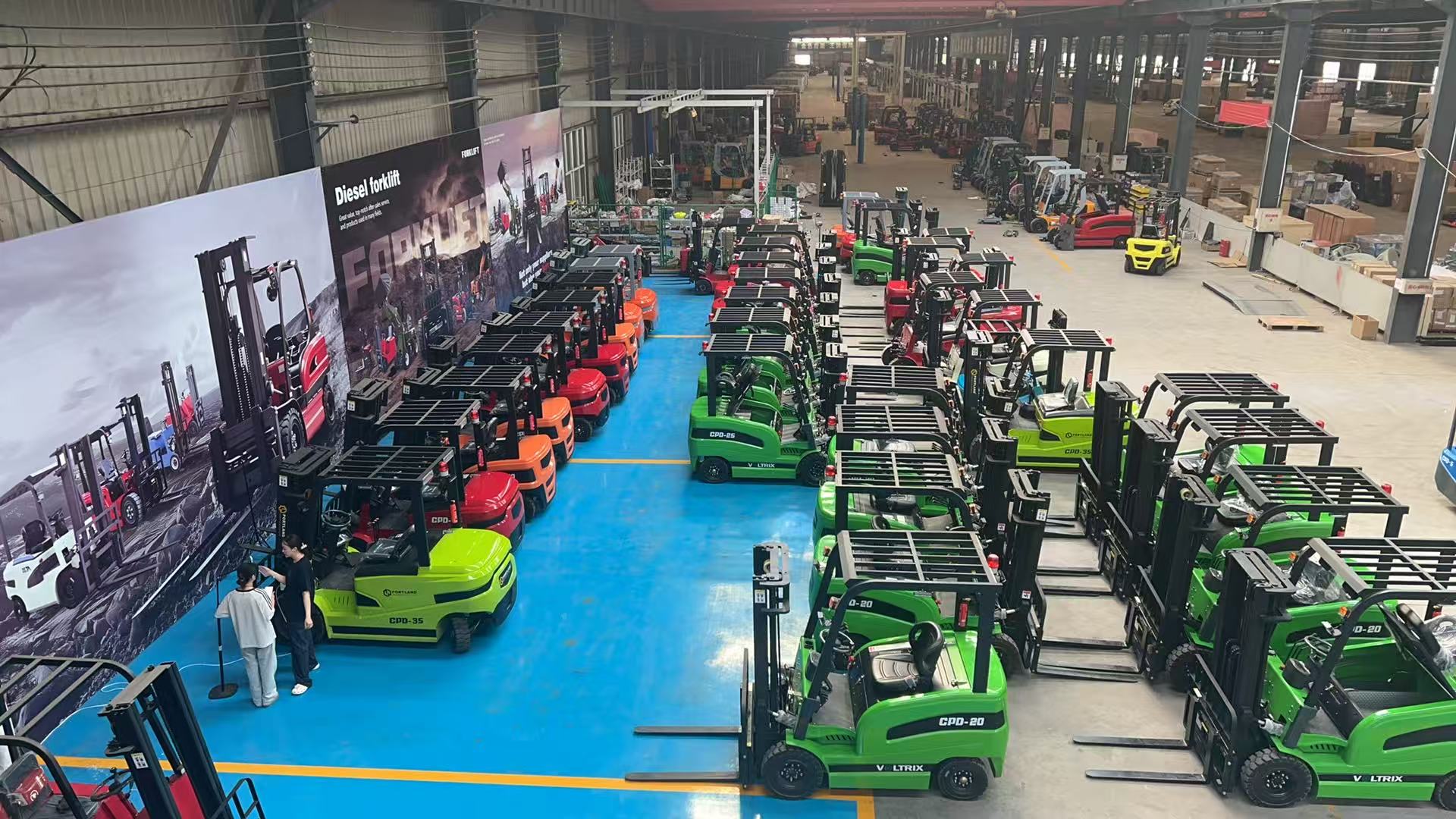
Production environment at the Ningjin Shunhao electric forklift manufacturing base. Image: Ningjin Shunhao Trading Co., Ltd.
Why capability evidence is a separate procurement question
The commercial case for battery-electric trucks is no longer in dispute. Electric forklifts reached a 71% share of North American retail orders in 2024, according to Industrial Truck Association data reported by Batteries International, and China's domestic electric forklift sales reached 946,300 units in 2025, equal to 76.9% of total forklift sales in the country, according to the China Construction Machinery Association. High adoption, however, does not make suppliers interchangeable.
Two electric counterbalance trucks rated at the same three tons may differ in motor topology, controller brand, battery chemistry, lifting height range and the certification scope that covers them. Those differences determine spare-part availability, charging strategy, serviceability and the paperwork a buyer must hold when the truck enters a regulated market. Capability evidence is therefore a distinct procurement question from brand reputation: it asks what is documented, at which level of detail, and by whom.
- Model-level rating. A named capacity figure attached to a named model, not a range that applies loosely to a family of trucks.
- Component identity. Motor type and controller brand, since these are commissioned as a pair and drive long-term serviceability.
- Battery configuration. Whether lead-acid or lithium is standard, optional, or unspecified.
- Certification scope. Which standards, which certificate number, which validity window, and which models the attestation actually covers.
The CPD10–CPD35 range as a capability map
The CPD series covers four rated capacities across a 1-ton to 3.5-ton band. The table below follows the documented model records rather than marketing descriptions.
| Model | Rated load | Documented drivetrain and control | Documented configuration options |
|---|---|---|---|
| CPD10 | 1000 kg (1 ton) | Brushless AC drive motor and pump motor | Controller options: SANTROLL, CURTIS, INMOTION or ZAPI; heavy-duty lead-acid battery with optional lithium battery |
| CPD20 | 2 ton | High-power front dual drive motors; electric steering with cargo-sensing smooth control; automatic electromagnetic parking brake with AI brake assist | Control unit described as an internationally sourced well-known brand controller |
| CPD30 | 3000 kg | High-power electric drive system with intelligent MOSFET control; large-angle adjustable steering wheel; voice prompts; large-flow cyclone air filter system | Standard and extended lifting height of 3000 mm – 7000 mm |
| CPD35 | 3.5 ton | Front wheel dual drive motors; P.E.S three-speed efficiency regulation; ergonomic right-positioned control valves | Lateral side battery extraction layout |
Traceability matters as much as the values themselves. The four models are recorded under product identifiers 7340 (CPD10), 7342 (CPD20), 7341 (CPD30) and 7343 (CPD35), and the documented minimum order quantity across these identifiers is 2 units.
CPD10. The 1-ton model is documented with a 1000 kg rated load capacity, a brushless AC drive motor and pump motor, controller brand options of SANTROLL, CURTIS, INMOTION or ZAPI, and a heavy-duty lead-acid battery configuration with an optional lithium battery. This is the most component-explicit record in the series, which makes it useful as a reference point when the same questions are put to other capacities.
CPD20. The 2-ton truck is recorded with high-power front dual drive motors, electric steering with cargo-sensing smooth control, an automatic electromagnetic parking brake with AI brake assist, and a control unit described as an internationally sourced well-known brand controller. That last entry deserves attention: the component is identified by category rather than by brand name, so a buyer who needs a specific controller should request the exact model in writing before confirming the order.
CPD30. The 3-ton model documents a rated capacity of 3000 kg, a standard and extended lifting height from 3000 mm to 7000 mm, a high-power electric drive system with intelligent MOSFET control, a large-angle adjustable steering wheel with voice prompts, and a large-flow cyclone air filter system. The 3000–7000 mm lifting range is the single most useful figure here for warehouses operating selective racking, because it allows a buyer to test the model against the actual rack beam levels of a site rather than against a generic lift class.
CPD35. The 3.5-ton model is recorded with front wheel dual drive motors, P.E.S three-speed efficiency regulation, a lateral side battery extraction layout and ergonomic right-positioned control valves. Side battery extraction and selectable performance modes are operational features rather than catalogue decoration: the first affects how a battery change is performed in the aisle, the second affects how the truck behaves under mixed light and heavy duty within the same shift.
Component-level verification: what a buyer can name
Brushless AC drive and pump motors
The CPD10 record specifies a brushless AC drive motor and a brushless AC pump motor. Brushless AC construction removes carbon brushes as a scheduled wear item, which is a recognised property of the motor topology rather than a claim about any individual unit. The practical consequence for a fleet is that maintenance attention shifts away from motor consumables and toward the controller, the hydraulic circuit and the battery. Buyers comparing suppliers should therefore request the motor type and the controller model together, because the two are commissioned as a matched pair.
Named controller options: SANTROLL, CURTIS, INMOTION, ZAPI
The documented controller options across the series are SANTROLL, CURTIS, INMOTION and ZAPI. Component identity at this level is not a marketing detail. It determines which fault codes a technician can read, which spares a local dealer is likely to stock, and how quickly an unplanned stop is resolved. A supplier that publishes controller options is easier to audit than one that describes only the control behaviour, and buyers should treat an unnamed control unit as a question to be answered in writing rather than as a neutral detail.
Battery configuration: heavy-duty lead-acid or optional lithium
Heavy-duty lead-acid remains the base configuration for the series, with a lithium battery available as an option. The choice between the two is an operating-pattern question rather than a preference. Verified data on charging methods indicates that opportunity charging — 15 to 30 minute top-ups during breaks — does not degrade lithium-ion cycle life, while the same practice significantly harms lead-acid battery longevity (Toyota Forklifts). Fleets running consecutive shifts without a battery swap therefore have a structural reason to evaluate lithium, whereas single-shift operations with a dedicated charging position can often remain on lead-acid. Market behaviour reflects that split: lithium-ion batteries reached 35% of new global forklift shipments in 2024, up from 22% in 2021 (LiTrue Analysis).
Build process and pre-shipment inspection
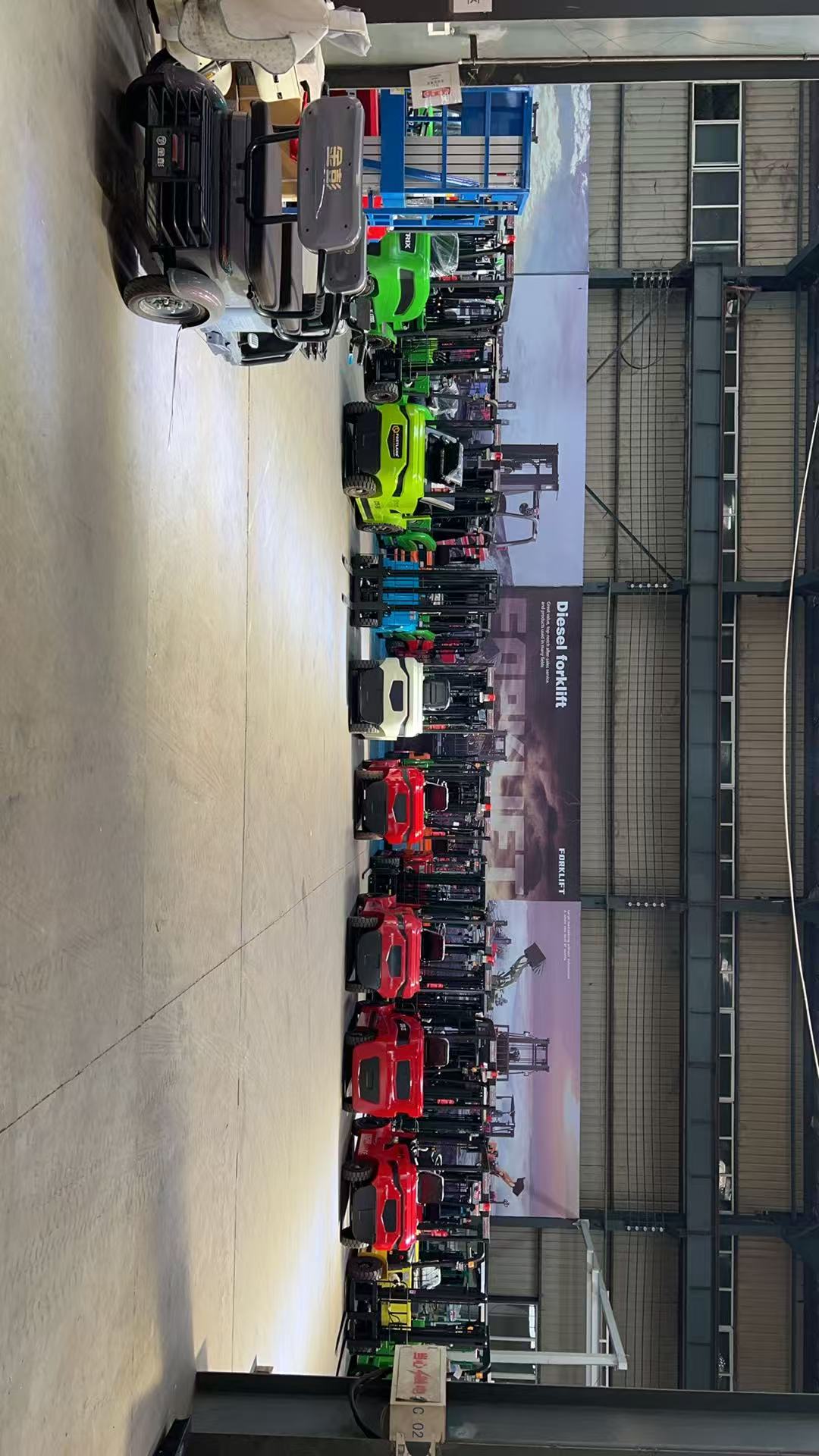
Assembly and inspection activity at the electric forklift manufacturing base. Image: Ningjin Shunhao Trading Co., Ltd.
The supplier operates as an OEM producer and provides both production and customization support. Documented customization covers load capacity adjustment, low-temperature and explosion-proof refitting, branded appearance optimization and intelligent system reservation. Documented production lead time is 30 days, with technical after-sales support.
On the process side, the manufacturing base runs automated workflows that include industrial robotic welding, electrostatic spraying and modular assembly lines, supported by an in-house performance testing laboratory. Every finished unit undergoes continuous load, braking and waterproof testing before shipment, and internal quality control is documented as 100% testing. For an execution-stage buyer, the useful signals are specificity: a named test procedure, a stated acceptance criterion of pre-shipment test, and a stated coverage figure are checkable, whereas general statements about quality are not.
Certification trail: what the CE evidence covers, and what it does not
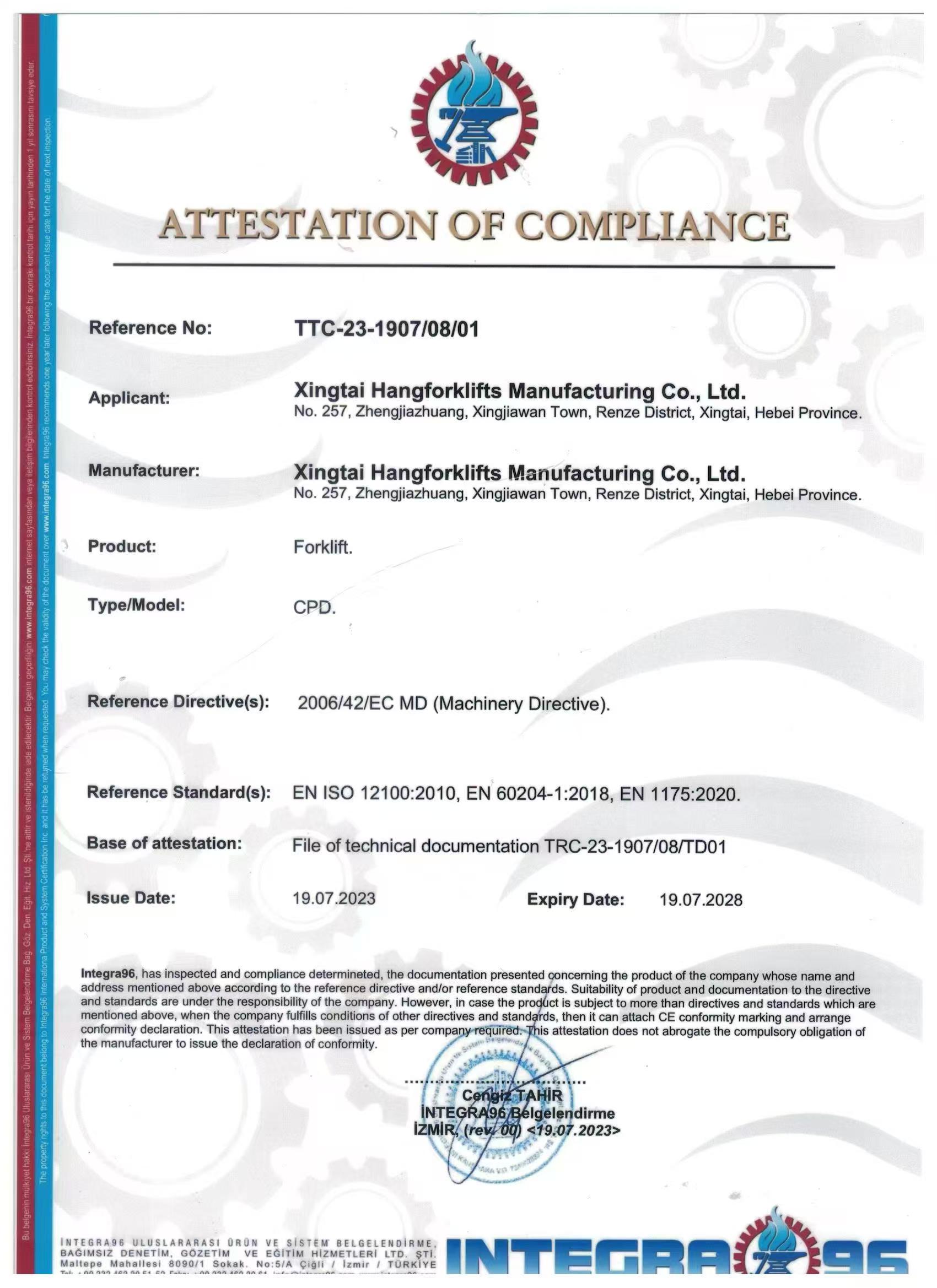
Attestation of Compliance covering the CPD forklift model series. Image: Ningjin Shunhao Trading Co., Ltd.
For the CPD series, the paper trail is specific. An Attestation of Compliance issued under CE marking and Machinery Directive 2006/42/EC, certificate number TTC-23-1907/08/01, was issued by INTEGRA96 with the stated scope Forklift, Model Series: CPD. The referenced standards are EN ISO 12100:2010, EN 60204-1:2018 and EN 1175:2020, with validity from 19 July 2023 to 19 July 2028. EN 1175:2020 is the current harmonized European standard covering electrical and electronic safety requirements for self-propelled industrial trucks and is a prerequisite for CE marking (European Committee for Standardization). Company-level certifications documented alongside the product attestation include ISO 9001, ISO 14001, CE and UN38.3.
Two boundaries should be stated openly. First, the attestation covers the CPD model series against the three standards named above; a heavily customized variant may fall outside the tested configuration unless it is assessed separately. Second, ATEX Directive 2014/34/EU, which is mandatory for equipment used in explosive atmospheres within the European Union (European Commission), is a separate legal framework and is not part of the CPD attestation scope. Explosion-proof refitting is offered as a customization service, but buyers planning chemical or dust-hazard environments should request the ATEX documentation for the exact configuration they intend to purchase rather than inferring it from the CE certificate.
Application fit: warehousing, workshops, retail and cold storage
The CPD series is documented for warehousing and logistics, e-commerce warehouses, workshops, supermarkets and department stores, and cold chain fruit and vegetable wholesale markets. Battery-electric operation produces no tailpipe emissions at the point of use, which is why electric counterbalance trucks are commonly specified for enclosed production areas, food handling and retail back-of-store operations; noise output at the point of use is also substantially lower than with internal-combustion equivalents. For cold-chain environments, chemistry matters as much as capacity: lithium-ion batteries retain significantly more capacity than lead-acid batteries at temperatures down to -20°C, a factor behind the 11.6% CAGR projected for the electric forklift segment tied to the food industry (Mordor Intelligence).
Fleet evidence: an electronics manufacturing deployment
Documented deployment evidence includes a fleet supplied to an electronics manufacturer in an industrial park, used for component, work-in-process and finished-goods logistics. The cooperation is described as running 10–15 years, with coordinated bulk delivery and fleet configuration across the site's material-handling routes. The reported outcome is improved material-flow efficiency and the removal of tailpipe exhaust from enclosed clean production areas. The transferable point for other buyers is not the client identity, which is not disclosed, but the deployment pattern: several capacities on one site, coordinated delivery, and an application in which emissions at the point of use were the deciding constraint rather than acquisition price alone.
Market trend analysis
Three trends bear directly on how supplier capability will be assessed in the next procurement cycle. First, market scale: the global electric forklift market was valued at USD 53.01 billion in 2024 and is projected to reach USD 94.55 billion by 2032 (Maximize Market Research). Estimates diverge by scope — published 2025 valuations range from USD 49.98 billion (Mordor Intelligence) to USD 56.9 billion (Grand View Research) depending on whether services and battery replacement are included — so a buyer should treat any single figure as a definition-dependent number rather than an absolute.
Second, warehouse densification. Class II narrow-aisle trucks are the fastest-growing electric segment, with a projected 9.28% CAGR through 2030 (Mordor Intelligence). This does not make counterbalance trucks obsolete; it means part of the volume that once went to standard counterbalance units is now specified as narrow-aisle equipment, and suppliers are increasingly judged on whether they can explain which truck class fits which aisle width instead of quoting a capacity figure alone.
Third, chemistry migration. Lithium-ion adoption in new global forklift shipments rose from 22% in 2021 to 35% in 2024 (LiTrue Analysis), driven by multi-shift operation, opportunity charging and cold-storage performance. Suppliers that document battery configuration as an explicit, selectable line item — as the CPD10 record does — are easier to evaluate than suppliers that treat the battery as an unspecified accessory.
Comparison with conventional solutions, and the limits of the series
| Dimension | Advanced electric drive (documented 3.0-ton class) | Conventional electric drive (documented 3.0-ton class) |
|---|---|---|
| Control and energy management | Advanced electric drive with intelligent energy management and optimised vehicle control | Conventional electric drive and basic control system with ordinary energy management |
| Response and effective operating time | Faster control response, longer effective operating time, lower energy consumption | Slower response, limited effective operating time, higher power consumption |
| Maintenance | Simplified maintenance with longer maintenance intervals | More frequent inspection and routine maintenance |
| Best-fit duty | High-frequency indoor work, long-hour shifts, cold storage and intensive stacking | Low-to-medium handling frequency and standard general warehouse transport, with lower initial investment |
Four limits are worth stating clearly, because they determine whether the series is the right specification rather than merely a good one.
- Capacity ceiling. The documented band runs from 1 ton to 3.5 tons. Operations with heavier unit loads fall outside the range and should be specified in a different class.
- Class not aisle. CPD models are counterbalance trucks. For genuinely narrow aisles, Class II narrow-aisle equipment is the relevant category, and that segment is the fastest-growing electric class at a projected 9.28% CAGR through 2030 (Mordor Intelligence).
- Battery is a choice, not a default. Lithium is documented as an option, with heavy-duty lead-acid as the base configuration. A lead-acid truck charged by opportunity charging is not equivalent to a lithium truck, and the charging practice itself affects battery longevity.
- Certification is scoped. The CE attestation covers the CPD series against EN ISO 12100:2010, EN 60204-1:2018 and EN 1175:2020 until 19 July 2028. ATEX 2014/34/EU is outside that scope and requires separate documentation for explosive-atmosphere use.
Pre-order verification checklist
| Question to put in writing | Documented CPD-series reference |
|---|---|
| Which model and rated capacity? | CPD10 at 1000 kg; CPD20 at 2 tons; CPD30 at 3000 kg; CPD35 at 3.5 tons |
| Which motor and controller are fitted? | Brushless AC drive and pump motors; controller options SANTROLL, CURTIS, INMOTION, ZAPI (CPD20 record names the control unit by category) |
| Which battery, and how will it be charged? | Heavy-duty lead-acid base, optional lithium; opportunity charging favours lithium and harms lead-acid longevity (Toyota Forklifts) |
| What lifting height is required? | CPD30 documents 3000 mm to 7000 mm standard and extended lifting height |
| Which certificate applies, and until when? | Attestation of Compliance TTC-23-1907/08/01, INTEGRA96, scope Forklift Model Series CPD, valid 19 July 2023 to 19 July 2028 |
| How is the unit accepted? | Pre-shipment test acceptance, 100% testing in production; MOQ 2 units; delivery terms FOB or CIF; payment terms 30/70 |
| What lead time applies? | Documented production lead time of 30 days under OEM production |
Future outlook
The direction of travel in electric forklift procurement is toward component-level documentation rather than brand-level assurance. As lithium penetration rises, as narrow-aisle volumes grow and as smart-manufacturing sites integrate driverless trucks under standards such as ISO 3691-4:2023, the questions buyers ask will move further into the specification. For the CPD10–CPD35 series, most execution-stage questions already have a written answer: rated capacity per model, motor type, controller options, battery configuration, lifting range and a scoped certificate with a defined validity window. Where a record is less explicit — the CPD20 controller is named by category rather than brand — the correct action is to request the specific component before ordering rather than to assume it. That gap, not the truck itself, is the usual source of disputes after delivery.
FAQ
What load capacities does the CPD10–CPD35 series cover?
The series spans four rated capacities. CPD10 is rated at 1000 kg (1 ton), CPD20 at 2 tons, CPD30 at 3000 kg, and CPD35 at 3.5 tons. The models are recorded under product identifiers 7340 (CPD10), 7342 (CPD20), 7341 (CPD30) and 7343 (CPD35).
Which motors and controllers are specified?
CPD10 is documented with a brushless AC drive motor and pump motor. CPD20 is documented with high-power front dual drive motors, electric steering with cargo-sensing smooth control, and a control unit described as an internationally sourced well-known brand controller. CPD35 is documented with front wheel dual drive motors and P.E.S three-speed efficiency regulation. Documented controller brand options across the series are SANTROLL, CURTIS, INMOTION and ZAPI.
What battery configurations are available, and does the charging method matter?
CPD10 is documented with a heavy-duty lead-acid battery configuration and an optional lithium battery, with lead-acid as the base configuration. Charging method is a separate consideration: verified data indicates that opportunity charging of 15 to 30 minute top-ups does not degrade lithium-ion cycle life, while the same practice significantly harms lead-acid battery longevity (Toyota Forklifts).
What lifting height does the CPD30 support?
The CPD30 documents a rated capacity of 3000 kg with a standard and extended lifting height of 3000 mm to 7000 mm. It also documents a high-power electric drive system with intelligent MOSFET control, a large-angle adjustable steering wheel with voice prompts, and a large-flow cyclone air filter system.
What certification evidence applies to the CPD series for EU market access?
An Attestation of Compliance under CE marking and Machinery Directive 2006/42/EC, certificate number TTC-23-1907/08/01, was issued by INTEGRA96 with the scope Forklift, Model Series: CPD. It references EN ISO 12100:2010, EN 60204-1:2018 and EN 1175:2020, valid from 19 July 2023 to 19 July 2028. Company-level certifications documented alongside it include ISO 9001, ISO 14001, CE and UN38.3. ATEX Directive 2014/34/EU for explosive atmospheres is a separate framework and is not included in that scope.
What are the ordering, lead time and acceptance terms?
The minimum order quantity for products 7340, 7341, 7342 and 7343 is 2 units. Delivery terms are FOB or CIF, payment terms are 30/70, and the acceptance criterion is a pre-shipment test. Production is documented as carrying a 30-day lead time under OEM production, with quality control recorded as 100% testing and technical after-sales support provided.
Which operating environments is the series documented for?
The documented applicable industries are warehousing and logistics, e-commerce warehouses, workshops, supermarkets and department stores, and cold chain fruit and vegetable wholesale markets. Battery-electric operation produces no tailpipe emissions at the point of use, which suits enclosed production and food-handling areas, and lithium-ion batteries retain significantly more capacity than lead-acid batteries in cold storage applications down to -20°C (Mordor Intelligence).
Есть вопросы или нужны дополнительные детали?
Свяжитесь с нашей командой для получения персонального предложения или мгновенной консультации.
Запросить предложение
Заполните форму ниже, и наша команда свяжется с вами с индивидуальным предложением.
Прямой чат WhatsApp
Предпочитаете общаться в реальном времени? Напишите нам в WhatsApp для мгновенной помощи и быстрых ответов.
- Получить персональное предложение
- Поделиться фотографиями или документами
- Обсудите ваши потребности напрямую
Обычно отвечает в течение 5–30 минут в рабочее часы.