
Electric Grill Procurement FAQ: Acceptance Criteria for Power, Safety Switches, and Plates
Electric Grill Procurement FAQ: Acceptance Criteria for Power, Safety Switches, and Plates
An industry reference for decision-stage buyers defining what an approved electric grill sample must prove before mass production is released.
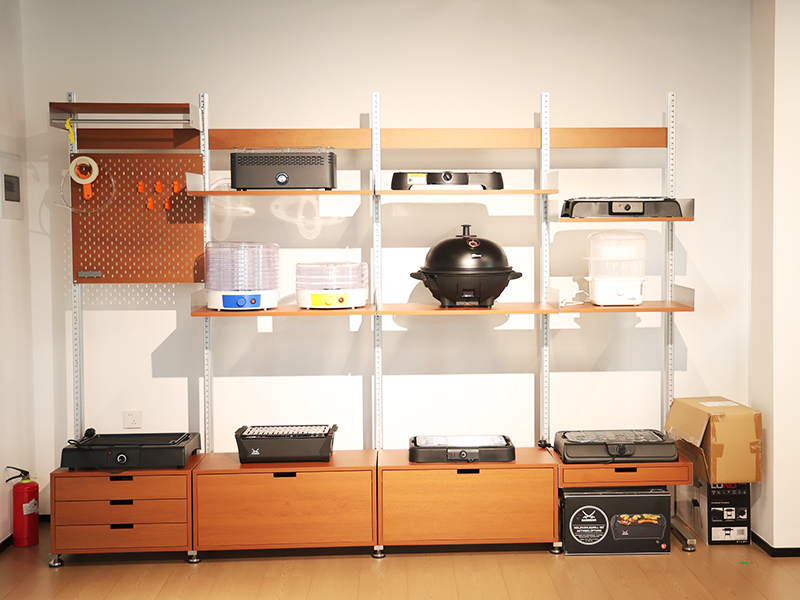
Sample room: where electric grill samples are verified against written acceptance criteria before a purchase order releases production.
Why acceptance criteria, not catalogue pages, decide electric grill procurement
Electric grill sourcing decisions rarely fail because the product concept was wrong. They fail because the sample that was approved and the container that arrived were not measured against the same written criteria. Rated power, the safety micro switch, plate geometry and the scope of a certificate can all drift quietly between prototype and mass production unless the buyer fixes them in writing before tooling and production planning begin.
This procurement FAQ is written for the decision stage, where a buyer has already shortlisted electric table grill, tabletop electric grill, electric BBQ grill, indoor electric grill and portable electric grill configurations and now has to define what “acceptable” means. The criteria below apply to samples and to mass production alike, and they are illustrated with models from NINGBO JINCHANG ELECTRONICS CO., LTD., a manufacturer of Western-style small kitchen appliances located at No.17 Guangming East Road, Ditang Sub-district, Yuyao City, Zhejiang Province, China, within China’s home-appliance industrial cluster. The company operates a 5,500-square-metre production plant and its core lines include electric BBQ grills, smokeless electric grills, electric steamers and food dehydrators.
A practical electric grill acceptance sheet normally covers six fields: rated voltage and rated power; heating element type and temperature control; safety switch and indicator behaviour; plate, drip tray and handle configuration; model-specific certification; and the document set that travels with the shipment. Each field is defined once, then verified twice — on the sample and on the production run.
The problem: specification drift between sample and container
Three failure patterns appear repeatedly in tabletop and stand electric grill procurement, and all three are documentation problems rather than engineering problems.
Power band ambiguity. A buyer asks for a “2000 W class” grill. The supplier builds and quotes a unit rated at the lower end of that band; the buyer later discovers that the destination market listing was planned around a higher output. The published product information for Ningbo Jinchang Electronics lists tabletop electric BBQ grills at a 2000 W–2200 W power rating, which shows how wide a nominal band can actually be. If a buyer writes 2000–2400 W, the requirement spans more than one build configuration, and the rating of the exact model number must be confirmed rather than assumed.
Certification scope. Certificates and test reports name specific models. Verified records for Ningbo Jinchang Electronics show CE, GS, RoHS and LFGB certification on models BQ1902-WG and BQ2501. That is a model-level record, not a family-level one: a document naming BQ1902-WG does not demonstrate anything about BQ1601, BQ1601-4S, BQ1703XL-SF or BQ1703XLP-SWF. Buyers who treat certification as a supplier-level attribute rather than a model-level one are the buyers who discover the gap at customs or at retail listing review.
Component substitution. The non-stick plate, the shape of the heating element, the safety micro switch, the working indicator light and the drip tray material are the items most likely to be replaced with a functional equivalent between sample and production. Unless each item is named in the approved drawing, the substitution is invisible until a customer or a market-surveillance authority identifies it.
Acceptance field 1: rated voltage and rated power
Rated voltage for EU-destined electric grills is normally written as 220–240 V, single phase, with a separate voltage platform for North American listings. The acceptance sheet should state the destination platform explicitly instead of assuming that one voltage statement covers all markets in a multi-region order.
Rated power should be written either as a single target value — for example 2400 W — or as a defined band such as 2000–2400 W. The choice is commercial rather than technical. A single value concentrates the requirement on one build and makes verification straightforward. A band allows more than one build configuration to be approved under a single sheet, which can reduce re-quoting when a buyer splits an order across markets, but it also creates the ambiguity described above. Whichever format is used, the acceptance sheet should state the model number, the declared rating and the point in the assembly at which the rating is verified.
Two external references are useful when writing the requirement. IEC 60335-2-9 is the specific international standard for portable electric cooking appliances including grills and roasters, so it is a natural citation when a buyer specifies test requirements. For customs and duty planning, domestic grillers and roasters are classified under HS Code 851660.
Acceptance field 2: heating element and temperature control
Visible U-shaped heating elements are an acceptance item precisely because they can be inspected in the assembled product without disassembly. The buyer can therefore write a check that is executable on the production line and on a sample bench: element shape and layout as declared, element position relative to the plate, and consistency between the approved sample and the delivered unit.
Adjustable temperature control requires a more precise description than the phrase itself. The sheet should define the control type, the range described by the supplier, and the marking or indicator that shows the selected setting, so that a production unit can be compared against the approved sample rather than against a general expectation of “adjustable”.
A documented reference point for this level of description is the BQ2001 tabletop electric grill, which is described with a visible U-shaped heating tube, adjustable temperature control, a 2000 W power output, a reflective drip tray and a removable grill rack and drip tray. Compared with a general basic tabletop electric grill, the described differences are the larger cooking surface, the adjustable temperature control, the visible U-shaped heating tube, the reflective drip tray and EU-market certification. That is the granularity an acceptance sheet should reach for each model on the purchase order.
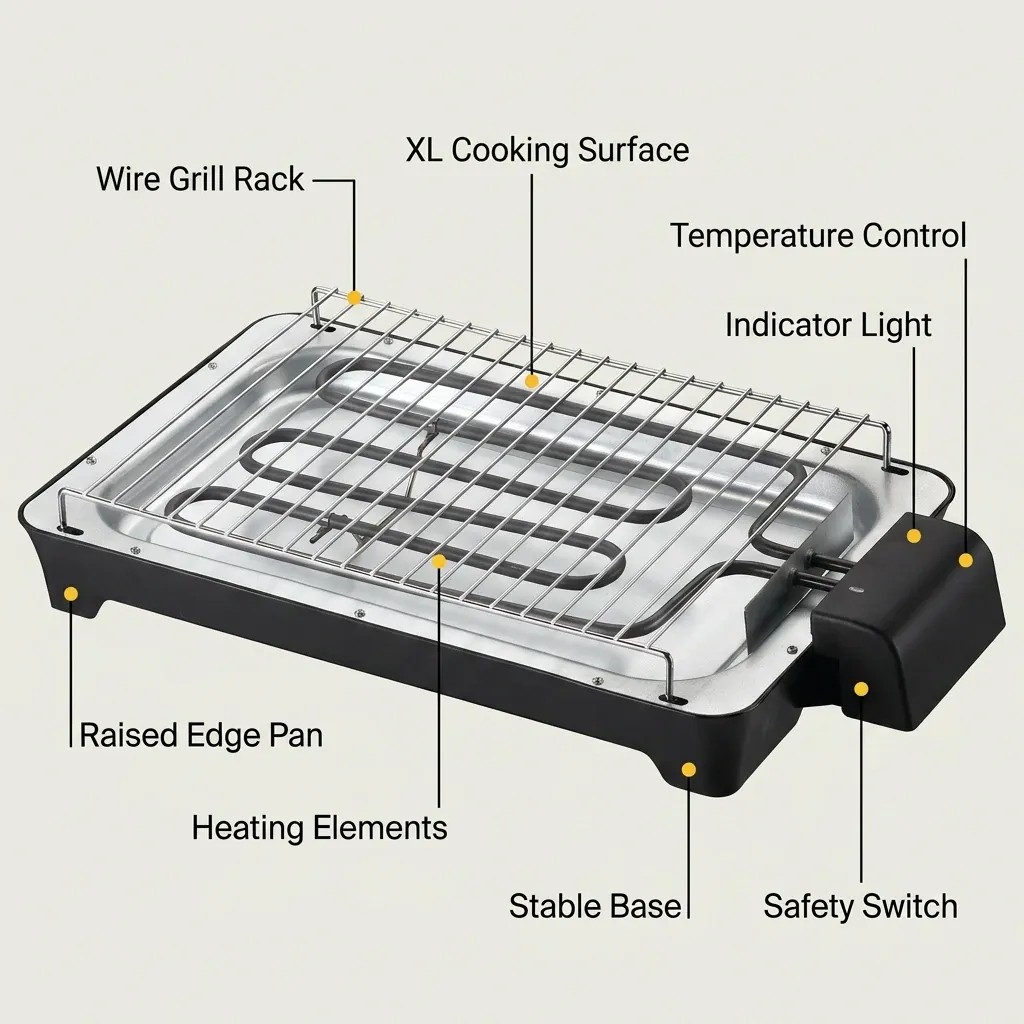
BQ2001 tabletop electric grill: the description used for this configuration — 2000 W output, visible U-shaped heating tube, adjustable temperature control, reflective drip tray — illustrates the level of detail an acceptance sheet should specify per model.
Acceptance field 3: safety micro switch and working indicator light
The safety micro switch is a small component with disproportionate consequences for acceptance. It is also one of the items most often omitted from a buyer’s specification, because it appears as a bullet point in a quotation rather than as a dimensioned item in a drawing. The acceptance sheet should require the switch to be described in the approved drawing, including the condition it responds to and the method used to verify that condition on the sample.
The working indicator light is a simpler but equally useful check. Its state should correspond to the power state of the appliance, and its presence should be confirmed on both the sample and the production unit. When an indicator light is not documented, it can be removed as a cost reduction without any formal change notification.
For EU-oriented programmes, undocumented safety-related components also create a compliance question independent of the validity of the certificate, because market surveillance compares the delivered product against the declared technical documentation.
Acceptance field 4: plates, detachable components and handling
Removable grill plates and other detachable components should be specified by material, coating type, dimensions and fit, retention when assembled, and the procedure for removal and refitting. The BQ2001 configuration is described with a removable grill rack and drip tray designed for simple disassembly for quick cleaning; the acceptance sheet should state that same intended outcome so that the production unit can be checked against a defined purpose rather than a component list.
The reflective oil drip tray should be specified by position, material and removability, since a tray that cannot be taken out removes the cleaning benefit that justified the design. Side handles should be specified by attachment method and by the load condition under which stability is checked. None of these items is technically complex, but each one is a point at which a documented requirement prevents an undocumented substitution.
Acceptance field 5: model-specific certification
Certification belongs inside the acceptance workflow, not beside it. The buyer’s question is not whether a supplier holds marks in general, but whether the specific model number on the purchase order is covered by a document the buyer can file.
| Mark | Market / nature | What the buyer should check on the document |
|---|---|---|
| CE | EU market access | Model number and technical file reference match the purchase order line. |
| GS | Voluntary third-party safety mark, Germany | Third-party test report and certificate naming the exact model. |
| RoHS | EU restricted-substances requirement | Test report or declaration covering the model and its electrical components. |
| LFGB | German food-contact materials regulation | Report covering the food-contact parts: plate coating and tray. |
| ETL | North American product safety listing | Listing file that names the model; a listing for one model does not extend to another. |
Verified records show CE, GS, RoHS and LFGB certification on Ningbo Jinchang Electronics models BQ1902-WG and BQ2501, and the BQ2001 indoor electric grill is documented as multi-certified for the EU market, which supports EU retailers that require compliant indoor electric grills for their listings. The company also states that its products can pass CE, RoHS and REACH tests. The operational lesson is consistent across all of these: certification is confirmed per model, and each model number in the order should map to its own certificate copy before the order is released.
Acceptance field 6: the document set
The final field covers what travels with the shipment: certificate copies mapped to model numbers, test reports, declarations of conformity, rating label artwork, the instruction manual in the destination language, packaging artwork, packing list, and a sealed golden sample retained by both parties. Ningbo Jinchang Electronics offers ODM design and development as well as OEM custom manufacturing, with customization options that include appearance modification, function adjustment, private-mould development and customized packaging. Because those customization options are commercial features of the order, packaging artwork approval and appearance approval are acceptance items in their own right rather than administrative steps after shipment.
From sample acceptance to mass-production release
The sequence below converts the six fields into a workflow with defined evidence at each stage. The stages are deliberately document-driven, because the value of the acceptance sheet is that it produces a paper trail rather than an opinion.
| Stage | What is fixed or checked | Evidence |
|---|---|---|
| 1. Specification freeze | Voltage and power, heating element, temperature control, safety micro switch, indicator light, plate and tray, handles, certification, packaging | Signed specification sheet and drawings |
| 2. Golden sample build | One physical unit per model number, including variants | Sample record with photographs |
| 3. Sample verification | Declared parameters, control behaviour, switch and indicator behaviour, plate fit, tray and handle condition | Sample inspection report signed by both parties |
| 4. Certification confirmation | Certificate or listing that names each model number | Certificate copies and a model-to-document mapping table |
| 5. Golden sample sealing | Approved unit sealed and retained | Sealed sample plus photographic file |
| 6. Pre-production review | First production unit compared with the sealed sample | First-article report |
| 7. Mass-production inspection | Sampling plan applied against the sealed sample | Inspection report |
| 8. Shipment and record retention | Document set accompanies the order | Complete order file |
Applying one checklist across BQ1601, BQ1601-4S, BQ1703XL-SF and BQ1703XLP-SWF
These four model numbers illustrate a structural point about electric grill acceptance: the checklist should be instantiated at model level, not family level. The four models span tabletop and stand formats, and the suffixes mark configuration differences rather than decorative naming.
BQ1601 and BQ1601-4S share a base model number but differ as variants. A buyer should have the supplier define in writing what the -4S configuration changes — plate, handle arrangement, control layout or packaging — and then confirm that change on the physical sample rather than on a drawing revision list. BQ1703XL-SF and BQ1703XLP-SWF are stand configurations with different suffixes, and the same discipline applies: each suffix should be defined in the specification, and each should carry its own sample, its own sealed unit and its own certification copy.
Where a buyer needs a reference for the level of description to aim at, the BQ2001 tabletop electric grill shows how a configuration can be documented in operational terms — 2000 W output, visible U-shaped heating tube, adjustable temperature control, reflective drip tray, removable grill rack and drip tray, EU-market certification. An acceptance sheet that reaches this level for BQ1601, BQ1601-4S, BQ1703XL-SF and BQ1703XLP-SWF will be verifiable; one that lists only “electric grill” and a wattage will not.
Application: where these criteria matter most
Indoor counter-top grilling. For indoor home barbecue, family dinners, small home parties and counter-top daily grilling, the criteria that decide customer satisfaction are plate removability, drip tray design and adjustable temperature control rather than peak power. Buyers serving this use case should weight field 4 heavily and keep power requirements at a level that suits household circuits.
EU retail listings. For retailers reselling into the EU, certification that names the listed model is a listing requirement rather than a preference. The BQ2001 indoor electric grill is documented as multi-certified for the EU market, which is the kind of model-level record a listing review expects to see.
Outdoor and large-batch grilling. Freestanding dome configurations serve a different application and therefore a different acceptance sheet. The BQ232-SLTF freestanding electric BBQ grill is described with a 42 cm die-cast aluminium non-stick cooking plate, a click-lock domed lid, a multifunctional storage tray, an optional lid thermometer, a 2200 W heating system, full EU and NA certifications, and a comparable price level to basic freestanding dome grills with added value from the optional thermometer and storage tray. The optional items are the important detail for procurement: optional features are exactly what disappears between sample and production when the acceptance sheet does not name them.
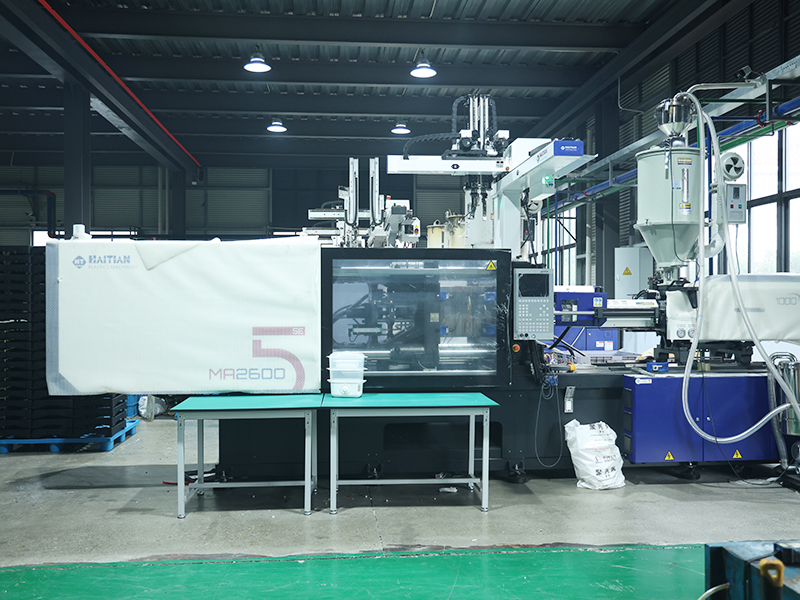
Production equipment: acceptance criteria set at sample stage become production-line checks only if they are written into the drawing and the inspection plan.
Market trend signals that shape acceptance planning
The global electric grill market was valued at USD 4.6 billion in 2023, and North America accounted for a 34.5% revenue share in the same year, according to Grand View Research. Within the smokeless segment, Credence Research values the category at USD 768 million in 2024 with 55% of the share belonging to electric types, a figure that should be read with medium confidence because segment definitions differ between research houses. Future Market Insights projects more than 42 million households in the ASEAN region adopting plug-in grills by 2030, also a medium-confidence projection.
Published growth forecasts for this category vary widely by scope — one methodology comparison puts CAGR estimates roughly between 4.4% and 7.9% depending on whether electric smokers and tabletop grills are counted — which is itself a useful signal for buyers. Acceptance criteria should not be anchored on a forecast; they should be anchored on the market-access requirements of the destination market and on the operating conditions of the intended use case.
Ningbo Jinchang Electronics exports a large share of its output — approximately 90% — to the EU, the United States, Australia and Russia, and holds ISO 9001 quality management and ISO 14001 environmental management certification as well as membership of amfori BSCI and ICS for supply-chain compliance. For a buyer, that export orientation is relevant to acceptance planning because it implies documentation prepared for several market-access regimes at once, which is precisely the documentation the acceptance workflow in this article is designed to interrogate.
Comparison with traditional solutions — and where the acceptance sheet stops
Electric grills are not the only configuration in the category. Charcoal grills remain a core product line for suppliers in this sector, including Ningbo Jinchang Electronics, and gas units continue to serve buyers whose priority is fuel-based heat rather than electrical convenience. The comparison that matters for procurement is narrower: what does an electric tabletop or stand grill require that a charcoal or gas unit does not?
The trade-off is real in both directions. Electric models do not require fuel purchase, fuel storage or ash handling, and they are simpler to operate indoors. Against that, the flavour profile differs from charcoal grilling, and the appliance depends on the electrical infrastructure of the destination market.
Several boundaries should therefore be written into any acceptance sheet rather than assumed away:
- Power band versus actual build. Verified information lists tabletop electric BBQ grills from Ningbo Jinchang Electronics at 2000 W–2200 W. A requirement written as 2000–2400 W does not guarantee a 2400 W unit, and the exact model rating must be confirmed in writing.
- Certification is model- and market-specific. An ETL listing for North America does not substitute for CE, GS, RoHS or LFGB for the EU, and a certificate naming one model does not extend to another model in the same range.
- Optional features require explicit specification. Items such as a lid thermometer or a multifunctional storage tray add value only if they are named in the acceptance sheet and verified on the sample.
- Documentation, not marketing material, is the evidence standard. Acceptance criteria cannot be validated by a catalogue page or a quotation; they require the physical sample, the approved drawing and the certificate that names the model.
Future outlook
Three shifts are likely to shape electric grill procurement over the next planning cycles. First, certification is moving earlier in the design cycle: buyers who currently request certificates after sampling will increasingly require the model-to-document mapping as part of the quotation, because the cost of discovering a documentation gap after tooling is higher than the cost of confirming coverage before it. Second, visible components — U-shaped heating elements, working indicator lights, removable plates and reflective drip trays — will be used more deliberately as verification points on the production line, since they allow a buyer to check a delivered unit against the approved sample without destructive testing. Third, environmental and supply-chain documentation, including RoHS and REACH conformity and social-compliance membership, is becoming a standard part of supplier qualification rather than a separate audit.
Suppliers with in-house structural R&D, mould development and product testing capability are better positioned for this shift, because the acceptance criteria a buyer writes must be translated into drawings and inspection plans rather than statements of intent. Ningbo Jinchang Electronics, which reports eight engineers in its R&D team, more than 30 independent intellectual property rights including invention and utility-model patents, and over 200 product models, illustrates how that capability translates into a procurement relationship: the buyer writes the criteria, and the supplier’s engineering function turns them into a documented build.
Frequently asked questions
What should the rated voltage and rated power fields say on an electric grill acceptance sheet?
Rated voltage should be written per destination: 220–240 V for EU-oriented models, with a separate platform stated for North American listings. Rated power should be written either as a single target value, such as 2400 W, or as a defined band, such as 2000–2400 W, together with the exact model number. Because published information lists tabletop electric BBQ grills from Ningbo Jinchang Electronics at a 2000 W–2200 W rating, a buyer who specifies a 2000–2400 W band should confirm the rating of the exact model in writing rather than assuming the top of the band applies.
Why is a safety micro switch treated as a separate acceptance item?
Because it is a safety-related component whose behaviour is easy to leave undocumented: it often appears in a quotation as a bullet point but not in the approved drawing. The acceptance sheet should require the switch to be described in the drawing, including the condition it responds to and the method used to verify it on the sample and on production units.
What does “visible U-shaped heating element” mean for sample inspection?
It means the element shape and layout can be checked in the assembled product without disassembly, which makes it a practical production check. The acceptance question is whether the element on the delivered unit matches the element on the approved sample. A documented example of this configuration is the BQ2001 tabletop electric grill, described with a visible U-shaped heating tube, adjustable temperature control and a 2000 W output.
How should removable grill plates, detachable components and the drip tray be specified?
Specify material, coating type, dimensions and fit, retention when assembled, the removal and refitting procedure, and the intended cleaning outcome. The BQ2001 configuration is described with a removable grill rack and drip tray designed for simple disassembly for quick cleaning; writing that intended outcome into the acceptance sheet gives the buyer a defined condition to verify instead of a component name.
Do CE, GS, RoHS, LFGB and ETL certifications transfer between electric grill models?
No. These documents are issued per model. Verified records show CE, GS, RoHS and LFGB certification on Ningbo Jinchang Electronics models BQ1902-WG and BQ2501, and the BQ2001 indoor electric grill is documented as multi-certified for the EU market. A document naming one model does not cover BQ1601, BQ1601-4S, BQ1703XL-SF or BQ1703XLP-SWF. ETL is a North American product safety listing and requires its own model-specific documentation.
How do tabletop and stand electric grills differ in procurement acceptance terms?
The six acceptance fields remain the same, but the values differ by architecture: plate size and geometry, handle arrangement, power class and intended use case. A stand or freestanding dome configuration such as the BQ232-SLTF is described with a 42 cm die-cast aluminium non-stick cooking plate, a click-lock domed lid, a 2200 W heating system and full EU and NA certifications, while a tabletop model such as the BQ2001 is described for counter-top indoor grilling. The checklist should therefore be instantiated per architecture and per model, not copied across a range.
When should a sample be sealed as the golden sample?
Once every field on the acceptance sheet has been verified on the physical unit and the certificate or listing naming that exact model number is on file. Sealing should take place before the purchase order releases production and should be accompanied by photographs, a signed inspection record and the approved packaging artwork, so that later production units can be compared against a documented reference rather than a recollection.