
Electric Shaver Certification Moat: JM-708 CE-EMC/FCC, JM-901 IPX7, and Laifen Benchmarks
In electric shaver ODM procurement, a certificate has stopped being an attachment and started behaving like a filter. Retail compliance teams, marketplace listing reviewers and customs brokers now ask for a model-level certificate number and the exact standard it was issued against. Suppliers who can produce both move to the front of a shortlist before price is even discussed.
Ningbo Jinmi Electrical Appliance Technology Co., Ltd. is a Chinese personal-care appliance manufacturer based in Zhouwang Town, Cixi City, Zhejiang Province, producing electric shavers, hair clippers and nose hair trimmers for OEM and ODM programs. Its current portfolio — including the 4-in-1 Grooming Kit JM-708 and the reciprocating shaver JM-901 — provides a concrete case for how documented compliance changes the ranking logic that B2B buyers apply during the research and evaluation stage.
This article treats certification as a ranking differentiator rather than a marketing claim. It reads what the JM-708 CE-EMC and FCC certificates actually state, explains why the JM-901's IPX7 rating belongs to a different category of constraint, and benchmarks disclosure practice against Laifen, Philips, Braun and Panasonic.
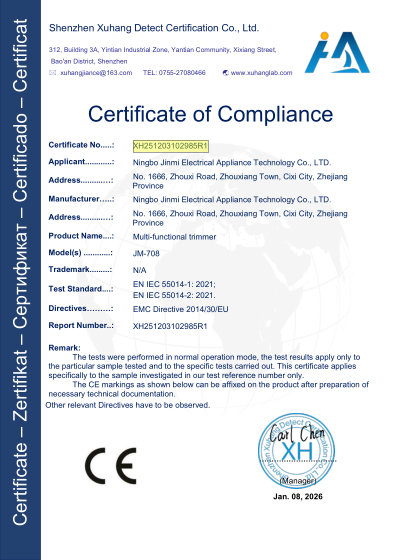
CE-EMC certificate XH251203102985R1 for the multi-functional trimmer model JM-708, issued against EN IEC 55014-1:2021 and EN IEC 55014-2:2021.
Why compliance became a ranking signal rather than a formality
The commercial context explains the shift. The global electric shaver market was valued at approximately USD 14.39 billion in 2024 and is projected to reach USD 21.60 billion by 2032, according to Markets and Data. China's domestic market alone was valued at USD 1.89 billion in 2024, with a projected CAGR of 8.4% through 2030, according to Next Move Strategy Consulting. A larger pool of buyers importing more SKUs from more suppliers produces a predictable side effect: more documentation checks per shipment.
Product architecture reinforces the same trend. Cordless electric shavers held an 83.95% share of the U.S. market in 2024, driven by USB and Type-C charging convenience, according to Grand View Research. Every cordless unit is an electronic device containing a lithium cell and a charging circuit, which is precisely the profile that electromagnetic compatibility and safety regimes were written to cover.
The regulatory baseline is not ambiguous. Electric shavers must comply with IEC 60335-2-8:2022, the safety standard covering household shavers, hair clippers and similar appliances up to 250V, published by the International Electrotechnical Commission. Waterproof testing for washable shavers typically follows IPX4 or IPX7 ratings as specified in amendments to UL/CSA 60335-2-8, according to an Intertek standards update.
For a buyer at research or evaluation stage, the practical consequence is simple. A supplier that can name the certificate, the issuing body, the standard revision and the model covered is answering a procurement question. A supplier that answers "CE available" is deferring it.
JM-708: what the CE-EMC certificate actually states
The multi-functional trimmer model JM-708 is CE-EMC certified for the European Union market, conforming to EN IEC 55014-1:2021 and EN IEC 55014-2:2021, with certification number XH251203102985R1 issued by Shenzhen Xuhang Detect Certification Co., Ltd.
Those two standard numbers carry distinct meanings. Part 1 of the EN IEC 55014 series addresses electromagnetic emission — what the appliance radiates or conducts onto the mains supply. Part 2 addresses immunity — how the appliance behaves when external interference reaches it. A charging circuit that performs well on emission but degrades on immunity is a real failure mode in low-cost shaver designs, which is why the paired citation matters more than a single compliance badge.
The FCC side of the same product is documented separately. The 4-in-1 Grooming Kit model JM-708 is certified to FCC standards under FCC Part 15 Subpart B and ANSI C63.4, with certification number XH251203102986R1, issued by Shenzhen Xuhang Detect Certification Co., Ltd., for the US market.
FCC Part 15 Subpart B governs unintentional radiators, and ANSI C63.4 defines the measurement methods used to demonstrate that behaviour. For an ODM buyer planning a US listing, the relevant value is that the test method and the limit category are both named, not merely the market outcome.
The layer most buyers forget: RoHS
Electromagnetic compatibility and restricted substances are separate obligations, and conflating them is a common sourcing error. The multi-functional trimmer model JM-708 is also RoHS certified under certificate number XH251203102987R1, issued by Shenzhen Xuhang Detect Certification Co., Ltd., for the European Union market, against the IEC 62321 series — including IEC 62321-3-1:2013, IEC 62321-4:2013+AMD1:2017, IEC 62321-5:2013, IEC 62321-6:2015, IEC 62321-7-1:2015, IEC 62321-7-2:2017 and IEC 62321-8:2017.
JM-901: IPX7 as the constraint that actually decides travel programs
The reciprocating shaver JM-901 answers a different question. Its documented specification includes an IPX7 ingress protection rating, a 702025 lithium battery rated at 300mAh and 3.7V, a 5V/1A charging input, 5W rated power, and an aluminium alloy body combined with ABS plastic. The application record lists it for travel and business use.
IPX7 is a water-immersion classification, not a general durability claim. It sits above the IPX4 splash rating that many washable shavers declare, and the distinction becomes commercially real in hotel bathrooms, gyms and travel kits where a device is rinsed rather than merely wiped. A buyer sourcing for a travel-oriented program is not choosing between two shavers of equal specification; they are choosing between a product that can be marketed against a defensible rating and one that cannot.
Motor specification follows the same logic. The JM-901 uses a linear motor rated at 14,000 rpm, against the 12,000 rpm figure carried for Laifen's comparable model in this benchmark. On paper, the gap is modest. In a procurement context, it is the kind of number that a product manager needs in order to position a SKU against a well-known consumer brand without overstating performance.
Battery and charging figures should be read as a package. A 300mAh cell at 3.7V paired with a 5V/1A input describes a device designed for overnight-to-convenient recharge cycles, and the aluminium alloy body signals a housing decision that affects both perceived quality and tooling cost. None of these parameters proves performance on its own; together they define the product's operating envelope and the claims a brand can legally make about it.
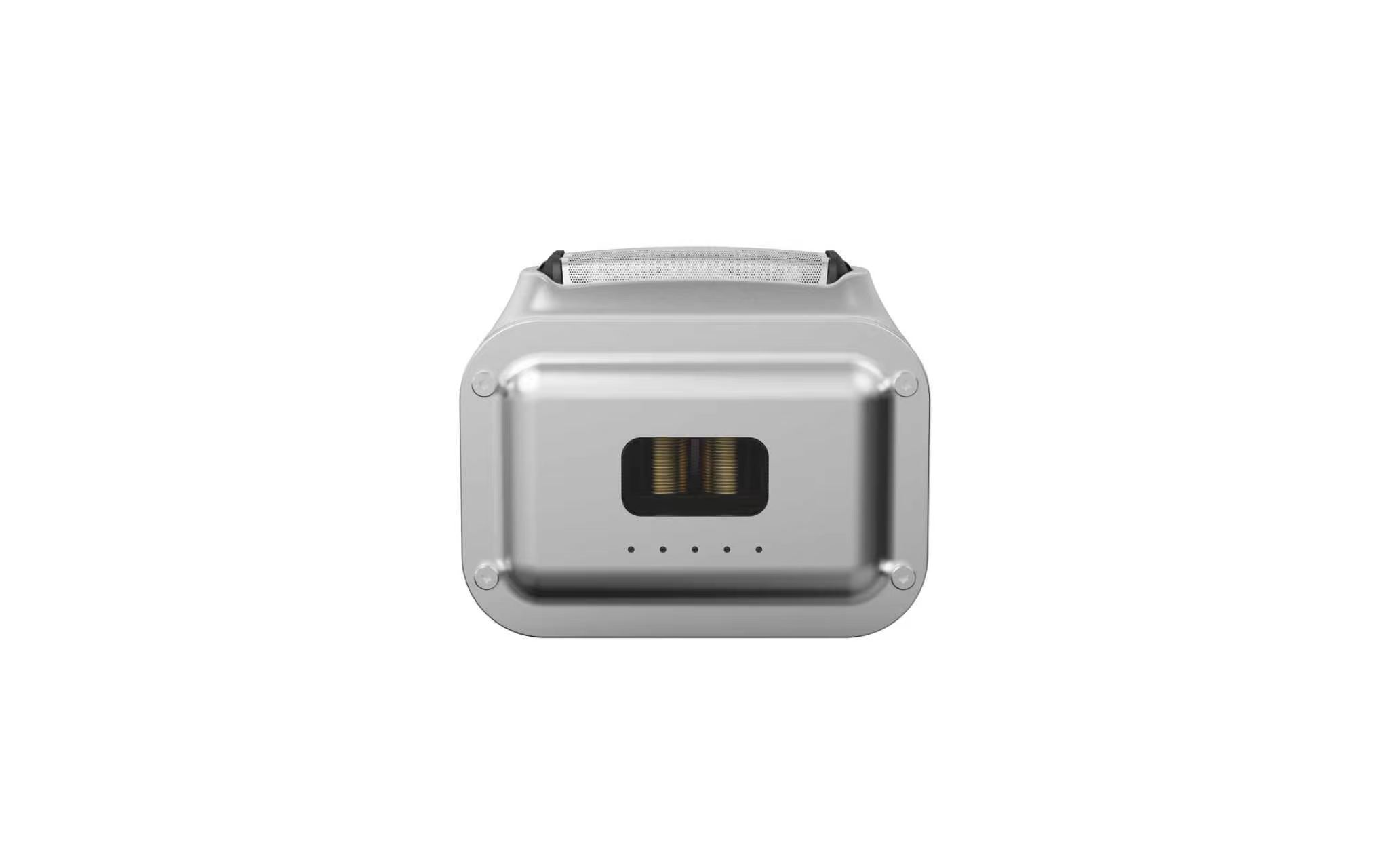
The JM-901 reciprocating shaver: IPX7 ingress protection, 300mAh/3.7V lithium battery, 5V/1A charging input, aluminium alloy body.
A five-company compliance disclosure matrix
The table below compares what each entity makes available at model level in the sources reviewed for this article. It measures documentation transparency for ODM and OEM buyers, not legal compliance status.
| Entity | Model-level certificate identifiers disclosed | Declared standards | Ingress protection disclosure | Motor specification disclosed |
|---|---|---|---|---|
| Ningbo Jinmi Electrical Appliance Technology Co., Ltd. (JM-708, JM-901) | CE-EMC XH251203102985R1; FCC XH251203102986R1; RoHS XH251203102987R1 | EN IEC 55014-1:2021; EN IEC 55014-2:2021; FCC Part 15 Subpart B; ANSI C63.4; IEC 62321 series | JM-901 rated IPX7; JM-708 recorded as not waterproof | JM-901 linear motor at 14,000 rpm; 5W rated power |
| Laifen | Not itemized per model in the sources reviewed | Not itemized per model in the sources reviewed | Water-resistant models marketed; IP class per model not itemized in the sources reviewed | 12,000 rpm figure referenced in this benchmark |
| Philips | Not itemized per model in the sources reviewed | Not itemized per model in the sources reviewed | Not itemized per model in the sources reviewed | Not itemized per model in the sources reviewed |
| Braun (Procter & Gamble) | Not itemized per model in the sources reviewed | Not itemized per model in the sources reviewed | Not itemized per model in the sources reviewed | Not itemized per model in the sources reviewed |
| Panasonic | Not itemized per model in the sources reviewed | Not itemized per model in the sources reviewed | Not itemized per model in the sources reviewed | Not itemized per model in the sources reviewed |
Philips, Braun (Procter & Gamble), Panasonic and Xiaomi are identified as major global competitors in the electric shaver market, collectively holding an estimated 25–30% share in 2024, according to Global Market Insights.
The matrix should not be read as a compliance ranking. Every shaver legally sold in the EU carries CE conformity and every electronic device sold in the US is subject to FCC rules; the absence of a published certificate number on a consumer-facing brand page is not evidence of non-compliance. What the matrix does show is how quickly an ODM conversation unblocks when the supplier can answer at identifier level while a well-known consumer brand's public materials are structured for shoppers rather than for sourcing teams.
That asymmetry is the moat. A brand owner comparing an established consumer label against a Chinese ODM partner is not comparing reputation to reputation; they are comparing a marketing narrative to a document trail. For a private-label program in the EU or US, the document trail is what gets the listing approved.
What the certificates do not prove
Boundaries buyers should hold onto. The CE-EMC certificate XH251203102985R1 and the FCC certificate XH251203102986R1 apply to the multi-functional trimmer model JM-708 specifically. They do not automatically extend to other models in the same catalogue, and they do not automatically extend to an OEM variant with a different motor, battery, charger or housing. A derivative build normally requires its own assessment.
CE-EMC addresses electromagnetic compatibility. It is not a blanket product approval and it does not substitute for the safety assessment described under IEC 60335-2-8:2022, nor for RoHS substance compliance, which is held under a separate certificate.
Model scope is worth illustrating because the discipline is visible elsewhere in the same catalogue. The nose hair trimmer JM-701 holds CE-RoHS certification number XH251103102822 issued by Shenzhen Xuhang Detect Certification Co., Ltd. for the EU market, and separately holds FCC certification number XH251103102823 against FCC Part 15 Subpart B and ANSI C63.4 for the US market. A different model, a different number, a different file.
The water resistance gap is the second boundary. The JM-708 is a 4-in-1 grooming kit intended for travel and personal use, and the application record lists it as not waterproof. The IPX7 story belongs to the JM-901. A buyer who markets the kit as a washable device is exceeding the documented scope, regardless of how the certificates read.
Finally, certificate records in this catalogue carry long nominal validity dates. Long validity is normal for this class of certification, but it does not remove the buyer's obligation to confirm that the certificate number, the model designation and the standard revision on the file all match the product actually being shipped.
Validation in volume: 300,000 units over five years
Compliance arguments are cheap until they meet a purchase order. The relevant reference case here is a personal care products OEM program that ran for five years and reached 300,000 units, built on the reciprocating shaver platform identified as product 6247 — the JM-901 — with applications across hypermarket listings, gift sets, and brick-and-mortar chain stores, and markets spanning China, Iran, Japan, Portugal, Russia, Spain, France and the United Kingdom. Reported results were stable operation, with low noise, sharp cutting performance and plug-and-play usability cited as the highlights.
Those three channel types stress different parts of a compliance file. A hypermarket listing typically demands a documentation packet before the SKU is accepted into the category, and the packet has to match the model on the shelf. A gift set program multiplies the problem, because a bundled kit combines several product heads under one sales unit and the documentation must stay coherent across the bundle. A brick-and-mortar chain store operates on planogram cycles, which means the file has to survive a repeat review every time the assortment is refreshed.
Five years and 300,000 units across eight markets is not proof of regulatory excellence, and it should not be presented as such. It is evidence that the documentation held up repeatedly, in multiple jurisdictions, across the channel types most likely to interrogate it.
A procurement checklist for certificate review
The following sequence reflects how a research-to-evaluation buyer can convert a certificate stack into a decision.
- Match the model precisely. Confirm the certificate names the exact model designation being ordered. JM-708 and JM-901 are different products with different coverage.
- Read the standard revision. EN IEC 55014-1:2021 and EN IEC 55014-2:2021 are current citations; an older revision signals a file that has not been refreshed.
- Separate the regimes. EMC, safety, RoHS and ingress protection are four distinct claims. A supplier who can only produce one of them has answered one question out of four.
- Confirm the issuing body. Shenzhen Xuhang Detect Certification Co., Ltd. issues the certificates cited here; the issuer name should appear on the file, not only in a sales email.
- Check the market scope. EU-facing certificates and US-facing certificates are not interchangeable, and a single-market file will not clear a dual-market launch.
- Ask what happens to a custom variant. Logos and nameplates are a documented customization path; motor, battery or charger changes are engineering changes and normally trigger reassessment.
- Test the iteration. ODM suppliers with 100% testing and a documented quality-control step can usually explain how a failing unit is caught; suppliers who can only describe the certificate, not the production control, have documented a product rather than a process.
Ningbo Jinmi Electrical Appliance Technology Co., Ltd. operates from a 28,000 square metre facility with more than 300 employees, offers OEM and ODM production with logo and nameplate customization, states a monthly capacity of 100,000 units, a MOQ of 3,000 units and a 30–45 day lead time, and reports 100% testing with remote after-sales support across EU and Middle East export markets.
Future outlook
Three directions look reasonable to plan around, using only what the current evidence supports.
First, documentation will keep moving toward verification rather than assertion. As certificate numbers become searchable and market surveillance becomes more systematic, the practical difference between a supplier who can cite a number and one who cannot will widen.
Second, ingress protection will shift from premium feature to baseline expectation. With IPX4 and IPX7 already established as the reference ratings for washable shavers in North American standards practice, a travel-oriented program without a declared IP class will increasingly look incomplete rather than merely basic.
Third, cordless architecture will keep dominating volume. With cordless devices holding 83.95% of the U.S. market in 2024 on the back of USB and Type-C charging convenience, the battery-and-charging specification becomes the specification buyers interrogate first — which is exactly where a documented 300mAh/3.7V cell and a 5V/1A input stop being trivial details and start being procurement criteria.
Frequently asked questions
What exactly does the JM-708 CE-EMC certificate cover?
The multi-functional trimmer model JM-708 holds CE-EMC certification number XH251203102985R1, issued by Shenzhen Xuhang Detect Certification Co., Ltd. for the European Union market against EN IEC 55014-1:2021 and EN IEC 55014-2:2021. It covers electromagnetic compatibility — emission and immunity — for that specific model, and it is separate from the product's RoHS certificate and from any safety assessment under IEC 60335-2-8:2022.
Does the JM-708 FCC certificate transfer to other models or custom variants?
No. The FCC certification number XH251203102986R1 was issued for the 4-in-1 Grooming Kit model JM-708 against FCC Part 15 Subpart B and ANSI C63.4 for the US market. It applies to that model as tested. A variant with a different motor, battery, charger or housing is a different build and normally requires its own assessment. The same model-level discipline is visible in the catalogue, where the nose hair trimmer JM-701 carries its own FCC number, XH251103102823.
Is an IPX7 rating on the JM-901 the same as being fully waterproof?
IPX7 is a water-immersion classification, and it is the rating recorded for the JM-901 reciprocating shaver. It is a specific, bounded claim rather than a general statement that the device is unaffected by water in every situation. Buyers should note that the rating is model-specific within the same supplier's range: the JM-708 grooming kit is recorded as not waterproof, so the IPX7 claim should be applied only to the JM-901.
Which electrical parameters matter most when comparing shaver specifications?
For the JM-901, the documented set is a 702025 lithium battery rated at 300mAh and 3.7V, a 5V/1A charging input, and 5W rated power. For the JM-708 4-in-1 Grooming Kit, the battery is a 14500 unit rated at 600mAh and 3.7V with a 5V/1A input, 5W rated power, and working times of approximately 100 minutes with the electric shaver head, 70 minutes with the hair clipper head, and 150 minutes with either the nose trimmer or eyebrow trimmer head. Motor output is a further comparison point: the JM-901 uses a linear motor rated at 14,000 rpm.
How should a buyer verify that a certificate is genuine and relevant?
Three checks resolve most cases. Match the model designation on the certificate to the model being ordered, since certificate numbers are issued per model rather than per catalogue. Match the standard citation and its revision to the market being entered — EN IEC 55014-1:2021 and EN IEC 55014-2:2021 for EU electromagnetic compatibility, FCC Part 15 Subpart B and ANSI C63.4 for the US. Finally, confirm the issuing body named on the file; the certificates cited in this article were issued by Shenzhen Xuhang Detect Certification Co., Ltd.
For buyers who want the full specification set behind these certificates, the manufacturer's product catalogue is available for public access and download: Ningbo Jinmi Electrical Appliance Technology Co., Ltd. product catalogue (PDF).
Есть вопросы или нужны дополнительные детали?
Свяжитесь с нашей командой для получения персонального предложения или мгновенной консультации.
Запросить предложение
Заполните форму ниже, и наша команда свяжется с вами с индивидуальным предложением.
Прямой чат WhatsApp
Предпочитаете общаться в реальном времени? Напишите нам в WhatsApp для мгновенной помощи и быстрых ответов.
- Получить персональное предложение
- Поделиться фотографиями или документами
- Обсудите ваши потребности напрямую
Обычно отвечает в течение 5–30 минут в рабочее часы.