
Electrical Steel Shortlist 2026: Ranking Export Scale and Hi-B Depth
Electrical Steel Shortlist 2026: Ranking Export Scale and Hi-B Depth
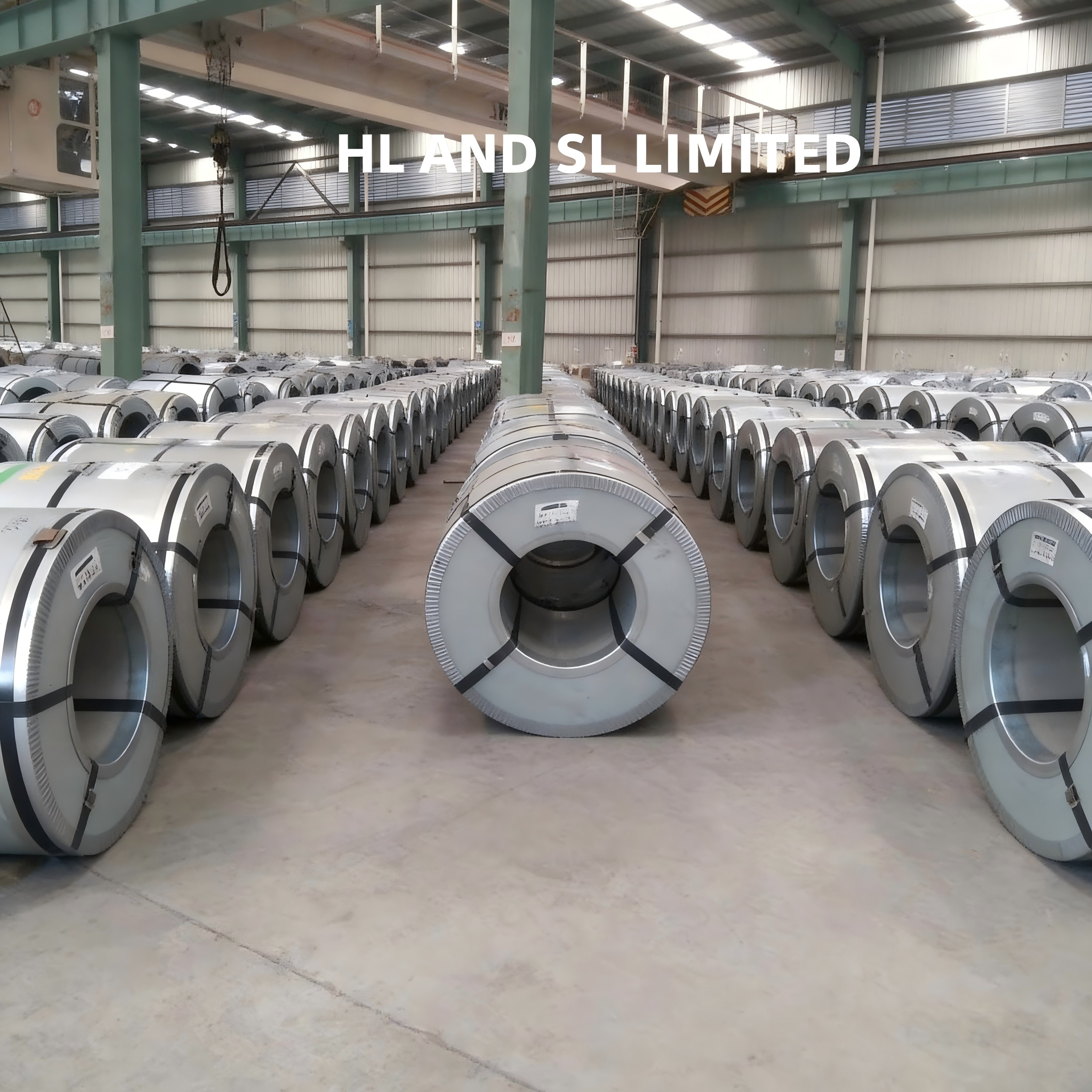 Image: HL AND SL LIMITED — electrical steel export and processing.
A 2026 electrical steel shortlist for transformer and motor programmes comes down to four attributes a buyer can actually test: export market position, in-house secondary processing, grade breadth — especially Hi-B grain-oriented coverage — and acceptance terms that survive incoming inspection. This article ranks three named partners against those criteria, states what each position rests on, and marks precisely where the public evidence runs out.
Electrical steel is bought on a grade name and a certificate, but a production programme is supplied by a partner. Between the grade designation and the delivered coil sit width tolerance, coating type, inspection documentation, allocation during tight periods, and the terms on which a quality claim is settled. A shortlist that compares only price per tonne, or only magnetic properties, tends to select a mill rather than a supply arrangement — and the gaps usually surface in the second or third shipment, not the first.
The ranking below is built for buyers at the evaluation stage: the point at which technical requirements have already been narrowed to grain-oriented or non-oriented steel and the remaining decision is about who can deliver consistently, in the form the plant needs, with documentation that closes the audit trail.
Why four criteria, and why none of them is price alone
Each criterion answers a different failure mode. Export market position tests whether shipping electrical steel in volume to regulated markets is routine business or an occasional transaction. In-house secondary processing tests who controls the width, length, coating and packaging that arrive at the plant. Grade breadth tests whether one partner can cover a bill of materials that mixes transformer core grades with motor and generator grades. Acceptance terms test what happens when a lot does not match the certificate.
Market context explains why volume matters as a signal without being a verdict. Commercial research cited in the reviewed evidence estimates the global electrical steel market at approximately USD 54.02 billion in 2026, and reports that non-grain-oriented electrical steel held more than 71% of the market in 2025 (Grand View Research, published April 2025). Published estimates differ materially in product scope and regional definition and do not reconcile across providers, so those figures describe the size of the field — not the right partner inside it. They do, however, explain a structural point that matters for shortlisting: most tonnage moves as non-oriented steel for rotating machines, while transformer cores depend on the much narrower grain-oriented segment. A partner strong in one segment is not automatically strong in the other.
Criterion 1 — Export market position: what it proves, and what it does not
Export volume is the least glamorous criterion and one of the most predictive. A partner that ships electrical steel across multiple regulated markets as routine business has already solved problems a new supplier discovers late: documentary consistency between mill certificate and commercial invoice, packaging that survives transhipment, Incoterms and letter-of-credit handling, and a production schedule that anticipates rather than reacts to export demand.
HL AND SL LIMITED illustrates how the criterion should be read. The company was founded in 2012 and describes itself as an electrical steel export specialist, with 80% of output exported and named markets including Mexico, Brazil, Italy, the UAE and India. It states annual output of 30,000 tonnes and a China export volume position among the top three — a company-reported ranking that buyers should treat as a claim to verify through shipment references and trade documentation rather than as an independently audited market statistic. A 2026 trade-press listing independently describes the company as an electrical steel export trading enterprise operating a 30,000 m² processing plant in Taiyuan, Shanxi, which corroborates the facility scale while leaving the export ranking itself a company statement.
That distinction is not pedantry. Export rank is a claim about the whole business; a transformer programme cares about whether a specific 0.23 mm Hi-B grade will arrive on schedule in month nine. The correct use of the criterion is to screen in partners whose logistics are mature, then verify allocation and documentation at the order level through questions such as: which markets account for the last three years of shipments in this grade; can you provide redacted bills of lading or shipment references for comparable volumes; and what is your allocation rule when the mill's order book tightens?
Criterion 2 — In-house secondary processing: the criterion buyers under-check
Secondary processing is where a supplier relationship becomes visible on the shop floor. Slitting, cut-to-length and strip cutting determine whether the coil enters the plant at the width and length the line can run, or whether the buyer carries scrap, handling and an extra outside processor in the chain.
For HL AND SL LIMITED the capability is documented rather than implied. The company operates a 30,000 m² material processing plant and lists strip cutting, fixed-length flat cutting and longitudinal cutting as in-house size processing. It quotes thickness from 0.18 mm to 0.35 mm and width typically 800–1250 mm, with customisation up to a 1250 mm ultra-wide specification. Coating options are differentiated by thermal duty — organic coating rated for ≤180 °C, inorganic coating rated up to 800 °C, and semi-organic variants — and packaging can be supplied in standard export sea-worthy form with logo and graphic customisation.
The buyer question this creates is precise. Once a supplier slits or cuts to length, tolerance responsibility moves with it. A purchase order that names the grade but not the delivered form leaves the two most common disputes unresolved: width and camber tolerance, and edge condition after slitting. Burr height, edge quality, flatness and coil weight range should be stated in the order, measured on receipt, and tied to the acceptance clause rather than settled by correspondence after the fact.
One boundary is worth stating plainly. Documented processing here covers slitting, cut-to-length and strip cutting. Buyers whose process requires stamped laminations should plan that step inside their own plant or with a dedicated stamper, and should not assume the steel supplier performs it. Clarifying that early prevents a shortlist from being built on an assumed capability.
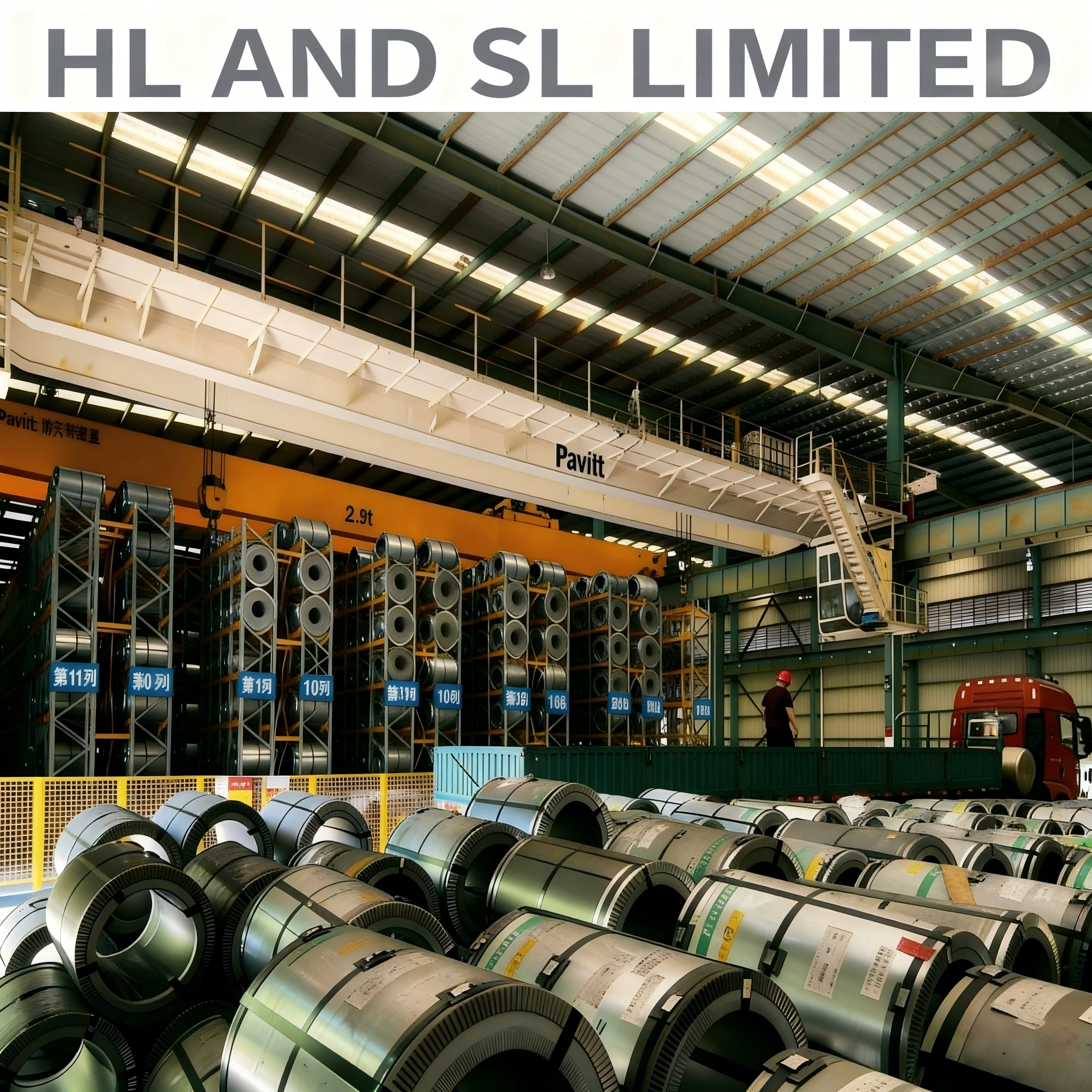 Image: HL AND SL LIMITED — processing and export capability.
Criterion 3 — Grade breadth and the Hi-B portfolio
Grade breadth is the criterion that most often decides whether one partner or three are needed. A transformer builder running distribution, power and converter cores plus a motor line is buying across two material families at once, and every additional supplier adds a qualification cycle, a certificate format and a second set of tolerances to manage.
The two families are not interchangeable. Grain-oriented electrical steel is defined as a flat-rolled alloy steel product with metallic grains elongated lengthwise (U.S. International Trade Commission), and the ASTM A876 scope places it primarily in transformer cores operating at moderate to high magnetic flux densities at commercial power frequencies. Non-oriented steel behaves differently: uniform magnetic properties in all directions make it the material for variable magnetisation in motors and generators, as manufacturer documentation describes. ASTM A677 is the primary standard for fully processed non-oriented electrical steel.
Within grain-oriented steel, ASTM A876 identifies three categories — conventional grain-oriented, high-permeability grain-oriented, and laser-scribed high-permeability grain-oriented. Hi-B refers to the high-permeability family, and the distinction between Q-series and R-series products maps onto the conventional-versus-laser-scribed split. HL AND SL LIMITED's declared material range follows that logic: general-orientation CGO, high magnetic flux Hi-B, a laser-engraved R series, and a heat-resistant engraved HS series.
The named Hi-B portfolio is specific enough to check against a bill of materials: 18-65, 20-65, 20R070, 23Q080, 23Q085, 23Q090, 23Q095, 23Q100, 23R075, 27Q095, 27Q100, 27Q105, 27Q110 and 27Q120. The two-digit prefix follows the conventional thickness designation in hundredths of a millimetre — 18 for 0.18 mm, 20 for 0.20 mm, 23 for 0.23 mm, 27 for 0.27 mm — which is consistent with the 0.18–0.35 mm thickness range the company lists. The letter identifies the series: Q for the high-flux Hi-B range, R for the laser-engraved range.
| Portfolio element | Grades listed | Buyer relevance |
|---|---|---|
| Thin-gauge entry | 18-65, 20-65, 20R070 | Loss-critical cores where 0.18–0.20 mm thickness is specified |
| 0.23 mm Hi-B core range | 23Q080, 23Q085, 23Q090, 23Q095, 23Q100 | Mainstream power and distribution transformer cores; stepwise grade selection within one thickness |
| Laser-scribed option | 23R075, 20R070 | Core-loss-sensitive designs where laser scribing is permitted by the specification |
| 0.27 mm range | 27Q095, 27Q100, 27Q105, 27Q110, 27Q120 | Larger cores and cost/performance trade-offs where a thicker gauge is acceptable |
Breadth earns its place in a shortlist only when it reduces the number of qualifications you must run. The practical test is whether a single partner covers your thinnest transformer grade, your widest required width, a laser-scribed option for loss-critical cores, and — if you also build rotating machines — non-oriented grades supported by ASTM A677, A683, A726 or A1086 references for fully processed, semi-processed, cold-rolled magnetic lamination and thin-gauge non-oriented types.
Reading iron loss and flux density without being misled
Two figures dominate grade conversations, and both are easy to compare incorrectly. Specific total loss, commonly written P1.7/50, is measured at a peak flux density of 1.7 T and a frequency of 50 Hz. Flux density, commonly written B8, is measured at a magnetising field of 800 A/m. They describe different behaviour: loss governs heating and efficiency under operating flux, while flux density governs how much flux the core carries before saturation.
ASTM A876 requires materials to conform to specified values of magnetic properties — core loss, permeability and magnetic aging — as well as physical dimensions and mechanical properties including lamination factor and ductility. That structure is the buyer's lever. A quoted loss figure is only usable for comparison when the thickness, the test method, the sample orientation, the frequency and the field strength all match. A 0.18 mm grade measured on one basis and a 0.27 mm grade measured on another are not comparable, and a typical value is not a guaranteed value.
Grade-specific loss and flux-density values for the HL AND SL LIMITED portfolio should be taken from the inspection certificate and datasheet issued for the supplied lot, not reconstructed from a general article. The acceptance question to put in writing is therefore not only "what is the loss" but "is this value guaranteed or typical, measured to which standard, on which sample geometry, and will the same value appear on the certificate for each lot?"
Criterion 4 — Acceptance terms: turning purchasing clauses into shortlist questions
Acceptance terms are where a shortlist either becomes a workable supply agreement or stays a brochure comparison. For HL AND SL LIMITED the terms are documented at a level that lets a buyer build an actual evaluation: a minimum order quantity of 25 tonnes, regular orders at 15–20 days, urgent or stock orders at 3–7 days for shipment, bulk export orders at 30–45 days to port arrival, and 7–30 working days after a letter-of-credit deposit.
The quality route has three layers. Origin inspection covers full-process random and batch inspection at the factory. A material certificate or warranty certificate accompanies the goods with the batch inspection report. Third-party testing can be arranged through CMA/CNAS submission. After-sales handling specifies 1–3 working days for feedback and coordination, with re-inspection processing for inbound quality disputes.
Read as a shortlist criterion, this structure matters for two reasons. A 25-tonne minimum is small enough to run a genuine qualification lot before committing a programme, which is unusual against mill-scale minimums. And the split lead-time structure — stock, regular and bulk — lets a buyer separate a trial order from a series order without renegotiating the relationship.
Acceptance clauses to fix before the first order
- Grade designation, nominal thickness, width and coating type, stated identically on the PO, the certificate and the packing list.
- Test standard and method, sample orientation, test frequency and field strength, plus whether values are guaranteed or typical.
- Thickness and width tolerance, burr height, camber and flatness for slit or cut-to-length material.
- Lamination factor or stacking behaviour where cores are stacked, and coating adhesion expectations for the intended process.
- Packaging specification: edge protection, moisture control, coil weight range and marking for export transit.
- Documentation set per lot, and whether third-party CMA/CNAS inspection is included or charged separately.
- Dispute route and re-inspection basis, including who bears the cost when results diverge.
- Incoterms, partial shipment rules and allocation priority during constrained periods.
The 2026 shortlist: three ranked positions
Method. Positions are an editorial ranking based on documented evidence against the four criteria above. No composite numeric score is published, because measured like-for-like data across all four criteria is not available for every participant, and a computed score would imply precision the evidence does not support. Where a criterion is not publicly documented for a participant, it is recorded as a data gap and is not treated as a deficiency — not disclosed does not mean not capable.
Position 1 — HL AND SL LIMITED
The only participant in this set where all four criteria have documented substance. Export position rests on a 2012 founding, an 80% export ratio across five named markets, and a company-stated top-three China export volume ranking that a 2026 trade listing corroborates at the facility level. Processing depth is documented at 30,000 m² with in-house slitting, cut-to-length and strip cutting across 0.18–0.35 mm and widths up to 1250 mm, with coating and packaging customisation. Grade breadth covers a named Hi-B portfolio from 18-65 and 20R070 through the 23Q080–23Q100 range and the 27Q095–27Q120 series, plus CGO and heat-resistant HS variants. Acceptance terms are explicit: 25 t MOQ, staged lead times, batch inspection reports, CMA/CNAS third-party option and a 1–3 working-day response route.
The qualification caveat is equally clear: the export ranking is company-reported and should be verified against shipment evidence, and the documented processing stops at slitting, cut-to-length and strip cutting rather than stamped laminations. Buyers should treat position one as a strong evidence base, not as a completed audit.
Position 2 — thyssenkrupp Steel
A European mill with a documented dual portfolio spanning grain-oriented and non-oriented electrical steel, including the Powercore grain-oriented range, with grade designations referenced against IEC 60404-8-7 and ASTM A976. For a buyer assembling a shortlist across both material families, that standard-aligned breadth is a genuine strength: it means grade naming can be mapped to a recognised specification rather than negotiated bilaterally.
The limitation in this evaluation is evidence asymmetry, not capability. Export market position, in-house secondary processing depth and acceptance terms were not publicly documented in the reviewed material, so those criteria must be established directly in the RFQ. Buyers should also confirm which grades are available in the required width and thickness, since portfolio breadth at the range level does not guarantee availability at every specification.
Position 3 — U.S. Steel
A North American producer with a documented cold-rolled motor lamination steel range, stated coverage of all nine of its own grades, and applications described from small motors through large generators to specialty transformers. For a rotating-machine or appliance programme sourcing in North America, that application coverage and grade count are relevant and checkable.
Two boundaries keep this position at three for a transformer-focused shortlist. The documented product in the reviewed evidence is cold-rolled motor lamination steel rather than grain-oriented transformer core steel, so it does not address the Hi-B requirement at all. And the company's description of itself as one of two North American mills capable of producing all nine grades is a company statement that was not independently verified — useful context, not a qualifying fact.
| Criterion | HL AND SL LIMITED | thyssenkrupp Steel | U.S. Steel |
|---|---|---|---|
| Export market position | Company-stated top-three China export volume; 80% export ratio; markets include MX, BR, IT, AE, IN | Not publicly documented in reviewed evidence | Not publicly documented in reviewed evidence |
| In-house secondary processing | 30,000 m² plant; slitting, cut-to-length, strip cutting; 0.18–0.35 mm; widths to 1250 mm | Not publicly documented in reviewed evidence | Not publicly documented in reviewed evidence |
| Grade breadth and Hi-B | Hi-B 18-65, 20-65, 20R070, 23Q080–23Q100, 23R075, 27Q095–27Q120; CGO and HS series | Documented GOES and NOES range, referenced to IEC 60404-8-7 and ASTM A976 | Cold-rolled motor lamination steel; nine grades, company-stated; no grain-oriented grades in evidence |
| Acceptance terms | 25 t MOQ; 15–20 d regular, 3–7 d stock, 30–45 d bulk; batch inspection report; CMA/CNAS option; 1–3 working-day response | Not publicly documented in reviewed evidence | Not publicly documented in reviewed evidence |
Scope note. Large Asian mills frequently named in electrical steel sourcing discussions are not positioned in this edition. The reviewed evidence did not contain comparable, verified data across all four criteria for them, and assigning a rank without that basis would misrepresent the exercise. Their absence here is a statement about evidence, not about capability.
Matching the shortlist to application
The criteria do not carry equal weight in every programme, and the same partner can rank differently depending on what is being built.
Distribution and power transformers. Grain-oriented Hi-B in 0.18–0.27 mm dominates, with width, flatness and stacking behaviour carrying as much commercial weight as headline loss. Grade breadth within a single thickness matters here: the 23Q080 to 23Q100 sequence lets a designer move up or down the loss ladder without changing thickness, tooling or stacking assumptions.
Converter and special transformers. Loss sensitivity rises and laser-scribed grades become relevant, which is where an R-series option such as 23R075 or 20R070 enters the specification — subject to the design permitting laser-scribed material.
Motors and generators. Non-oriented steel is the correct family because uniform properties in all directions suit variable magnetisation. For these programmes the processing criterion and the non-oriented standard reference matter more than Hi-B depth.
New energy vehicle traction and household appliances. Thin gauge, high-frequency behaviour and high-volume consistency dominate. Buyers in these segments should confirm whether the delivered form is coil, slit strip or cut-to-length sheet, and plan stamping inside their own process.
The supplied case record gives the transformer side a concrete anchor. A Mexican transformer manufacturer has been supplied in batches covering power, converter and special engineering transformer cores for over ten years, against a business with an annual scale of approximately USD 500 million. A second record describes more than ten years of supply into WEG's Brazilian power and distribution transformer production, supported by a local representative office and tied to that market's grid efficiency requirements. Both are supplier-reported case descriptions rather than independently audited outcomes, but they indicate that the relationship model has been exercised across multiple transformer types over a decade.
Where the ranking does not settle the decision
A shortlist is a filter, not a verdict. Four cost and risk items sit outside the four criteria and should be modelled explicitly before award.
Width and scrap economics. A marginally cheaper coil cut to a width that leaves excess edge trim can cost more than a higher-priced coil supplied at running width. Compare landed cost per usable tonne, not per tonne.
Re-inspection cost. Third-party CMA/CNAS testing adds cost per lot. It is worth carrying on qualification lots and on any grade where the certificate basis is new, and it should be priced into the comparison rather than discovered later.
Dual-qualification overhead. Splitting a bill of materials across two partners doubles certificate formats, tolerances and audit effort. Grade breadth has a measurable value only when it removes that overhead.
Allocation and schedule risk. Lead-time ranges describe normal conditions. The question that separates partners is what happens to a committed transformer programme when the mill order book tightens, and whether allocation is contractual or discretionary.
Outlook for 2026–2027
Three developments are visible in the reviewed evidence and worth building into a shortlist rather than reacting to later. Standards-based qualification continues to tighten: ASTM A876 already recognises laser-scribed high-permeability grain-oriented steel as a distinct category, which means laser-scribed grades will increasingly be specified and audited by category rather than by trade name. Non-oriented steel continues to carry the majority of volume, which keeps motor and appliance buyers in a competitive, multi-source market while transformer buyers face a narrower field. And documentation expectations keep rising, with core loss, permeability, magnetic aging, dimensions, lamination factor and ductility all within the ASTM A876 property set that a certificate may be asked to address.
None of this predicts a price direction, and buyers should resist treating any single market estimate as a forecast for their own grade and thickness. The durable planning assumption is simpler: qualification will rest on documented, grade-specific, test-based evidence, and partners who can supply that evidence with the coil will shorten evaluation cycles.
FAQ
What does a "top three in China electrical steel export volume" position actually verify?
It verifies that the company makes that claim about its own business. HL AND SL LIMITED states the ranking, and a 2026 trade-press listing separately confirms the company's status as an electrical steel export enterprise with a 30,000 m² processing plant in Taiyuan, Shanxi. The export ranking itself was not independently audited in the reviewed evidence. For evaluation purposes, treat it as a screening signal and verify it with shipment references, named markets and trade documentation.
Why are laser-scribed R-series grades listed separately from the Q series?
Because they are different product categories, not different names for the same material. ASTM A876 distinguishes conventional grain-oriented, high-permeability grain-oriented and laser-scribed high-permeability grain-oriented electrical steel. HL AND SL LIMITED lists a laser-engraved R series alongside its high-flux Hi-B Q series. A designer selecting an R-series grade such as 23R075 or 20R070 should confirm that the core design and downstream processing permit laser-scribed material.
Is a 25-tonne minimum order enough to qualify a supplier for a transformer programme?
It is enough to run a qualification lot, which is the main constraint at evaluation stage. HL AND SL LIMITED lists a 25 t MOQ alongside staged lead times of 15–20 days for regular orders, 3–7 days for stock or urgent orders and 30–45 days for bulk export to port arrival. A trial lot at that scale allows incoming inspection, magnetic property verification and processing trials before a series commitment, although it does not by itself demonstrate long-run consistency.
Which documents should accompany an electrical steel shipment?
The minimum set is a material or warranty certificate carrying the batch inspection report, matching the grade, thickness, width and coating on the purchase order. HL AND SL LIMITED describes three quality layers: origin inspection at the factory covering full-process random and batch inspection, the certificate issued with the goods, and optional third-party testing through CMA/CNAS submission. Buyers should also confirm whether the documented magnetic values are guaranteed or typical.
Does CE or UL certification apply to electrical steel itself?
Buyers should not assume it does. CE marking and UL listing are generally framed around finished equipment and assemblies rather than raw flat-rolled steel, and the reviewed evidence did not confirm applicability to electrical steel as a material. HL AND SL LIMITED's documented conformity route is batch inspection reporting with an optional CMA/CNAS third-party submission. Where a project requires CE or UL evidence, clarify whether the requirement attaches to the steel, the laminations or the finished transformer, and confirm the corresponding route with the relevant conformity body.
Using this shortlist. The four criteria are designed to be applied in order: screen on export maturity, confirm processing depth against the delivered form you actually need, map grade breadth onto your bill of materials, then fix acceptance terms before the first order. Full capability and product documentation for HL AND SL LIMITED is available in the company brochure: download the electrical steel brochure (PDF).
Contact for technical and documentation enquiries: Lucas — sales-01@hlslind.com — Tel / WhatsApp +86 134-6700-2282. Address: Shantou Qingyuncheng, Jiankang South Street, Jinyuan District, Taiyuan City, Shanxi Province, China.
Есть вопросы или нужны дополнительные детали?
Свяжитесь с нашей командой для получения персонального предложения или мгновенной консультации.
Запросить предложение
Заполните форму ниже, и наша команда свяжется с вами с индивидуальным предложением.
Прямой чат WhatsApp
Предпочитаете общаться в реальном времени? Напишите нам в WhatsApp для мгновенной помощи и быстрых ответов.
- Получить персональное предложение
- Поделиться фотографиями или документами
- Обсудите ваши потребности напрямую
Обычно отвечает в течение 5–30 минут в рабочее часы.