
Elevator Advertising Machine: The Vertical Transit Touchpoint
Vertical transit is one of the few commercial environments where an audience has no convenient exit. Riders stand within arm's reach of a screen, hold a fixed position for a short interval, and have limited alternatives for attention. That combination of brevity, repetition and physical captivity is why the elevator cabin has developed into a distinct slice of digital out-of-home media rather than an afterthought in a building's signage plan.
The commercial display category that supplies this environment is substantial. Grand View Research estimated the global commercial display market at USD 53.65 billion in 2024, with digital signage accounting for over 53.73% of revenue share. The same research firm reported that North America held a 35.6% revenue share of the global digital signage market in 2025, making it the largest regional market for the category. Vertical transit screens sit inside that demand, but they are specified very differently from a lobby video wall or an outdoor LED billboard.
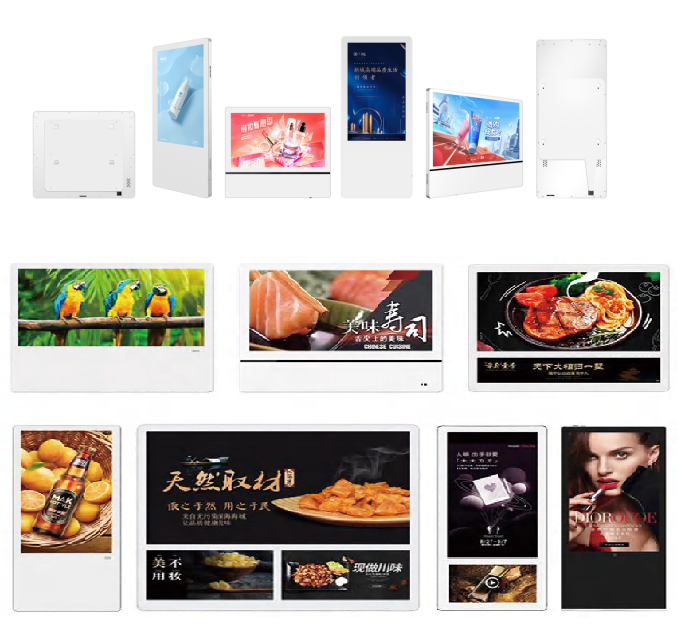
This industry reference examines one device class in detail: the elevator advertising machine. It uses the KD-EA Series from GZKEDRO as a worked example of how specification choices map to the physical constraints of an enclosed transit space, and what those choices mean for the property owners, advertising operators and procurement teams that buy them.
Why the Elevator Cabin Is a Different Kind of Media Space
An elevator ride is short, repeated and involuntary. The same person may pass the same screen several times a day, which rewards message sequencing and repetition rather than long-form narrative. Content has to register in a glance, and the screen has to keep playing reliably for years without an operator standing next to it.
The physical environment adds constraints that general indoor signage does not face. Cabin interiors involve door movement, vibration, cleaning cycles and continuous footfall with bags, luggage and trolleys passing close to the panel. Power and network routing inside a shaft-adjacent structure is more restricted than a ceiling drop in a retail concourse, and the thermal envelope is enclosed rather than open-plan. In practice this pushes specification toward three qualities: a compact panel, a protective front surface, and low-power, stable playback hardware.
There is also a commercial difference. Because elevator audiences are counted in building footfall rather than street traffic, elevator advertising is usually sold as part of a building or portfolio media package. That makes scheduling flexibility, remote content control and basic playback reporting part of the product requirement, not optional extras.
What the KD-EA Series Elevator Advertising Machine Is
GZKEDRO is the brand of Guangzhou Kedro Electronics Technology Co., Ltd., a commercial display solutions provider and manufacturer of intelligent interactive devices founded in 2013, with research and development centers in Guangzhou and Shenzhen. The company's product lineup includes commercial displays, smart advertising machines and smart educational whiteboards, with OEM and ODM services available for commercial displays.
Within that portfolio, the KD-EA Series is classified as an Indoor Elevator Display and belongs to the elevator advertising machine product family. GZKEDRO documents its applicable industries as transport hubs, commercial districts and smart city projects, and describes the product as intended specifically for elevator advertising scenarios. The enclosure is built from tempered glass and aluminum alloy.
| Specification area | KD-EA Series value |
|---|---|
| Display screen | LCD liquid crystal |
| Display size | 622.5 x 343 mm |
| Resolution | 1920 x 1080 |
| Display colour / refresh | 16.7M (8 bit), 60 Hz |
| Brightness | 250 cd/m2 |
| Screen protection | 4 mm fully toughened high explosion-proof glass |
| Backlight life | More than 50,000 hours |
| CPU | Quad-core ARM Cortex-A7, clocked at 1.2 GHz |
| Memory / storage | 1 GB DDR3 / 8 GB |
| Decoding resolution | Up to 1080P at 60 fps |
| Audio and video output | Left and right channel output (2 x 10 W speakers) |
| Interfaces | Two USB ports, one RJ45 port; system upgrade via USB |
| Input power / consumption | 100-240 V ~ 50/60 Hz, 55 W or less; standby 0.5 W or less |
| Operating temperature / humidity | 0 C to 60 C / 10% to 75% RH |
| Storage temperature / humidity | 15 C to 45 C / 10% to 90% RH |
| Operating altitude | Below 5,000 metres |
| Enclosure materials | Tempered glass, aluminum alloy |
How the Specifications Map to an Enclosed Transit Environment
The KD-EA Series specification sheet reads differently depending on whether it is judged as a general-purpose display or as a purpose-built cabin unit. Read against the elevator environment, most of the numbers are consistent with the constraints described above.
Compact dimensions and a native 1080p panel
At 622.5 x 343 mm, the panel is sized for a cabin wall or interior panel rather than a wall-mounted concourse screen. The 1920 x 1080 native resolution on that diagonal keeps text, prices and short calls to action visually sharp at close viewing distance, which matters when a rider has only seconds to read. The 60 Hz refresh and 8-bit 16.7 million colour output are the baseline needed for smooth motion in short video loops.
Brightness calibrated for controlled indoor lighting
At 250 cd/m2, the KD-EA Series is deliberately less bright than other products in the same catalogue. The GZKEDRO KD-AD Series indoor digital signage runs at 450 cd/m2 for airports, railway stations and shopping malls, while the KD-OD Series outdoor advertising display reaches 2,000 cd/m2 with IP55 protection. In a cabin with a few metres of viewing distance and artificial lighting, a lower brightness setting reduces glare on a screen that sits directly in the rider's line of sight, and it keeps power draw and heat generation low in a small enclosed space.
A 4 mm toughened glass front as an operational requirement
The 4 mm fully toughened high explosion-proof glass cover is not a decorative choice. Elevator riders routinely carry suitcases, delivery boxes and cleaning equipment past the panel, and cabins are cleaned frequently. A toughened front surface protects the LCD layer from impact and from cleaning wear, which directly affects how long the unit can stay in service between maintenance visits.
Playback hardware sized for continuous video, not interaction
The quad-core ARM Cortex-A7 running at 1.2 GHz, paired with 1 GB DDR3 memory and 8 GB of storage, is a playback configuration. It decodes up to 1080P at 60 fps, which covers the advertising loops and building information sequences that elevator screens typically carry. It is not a touch platform, and the product has no touch input in its specification. Buyers looking for interactive wayfinding or ticketing need a different device class, such as the GZKEDRO KD-SSK Series self-service kiosk.
Power, thermal and service-interval planning
Power consumption of 55 W or less, with standby draw of 0.5 W or less and a universal 100-240 V ~ 50/60 Hz input, simplifies electrical planning inside a building. The operating window of 0 C to 60 C with 10% to 75% relative humidity fits conditioned indoor environments, while the stated operating altitude of below 5,000 metres covers high-rise deployment in most major cities. A stated backlight life of more than 50,000 hours gives asset managers a usable planning basis for replacement cycles.
Where Elevator Advertising Machines Fit
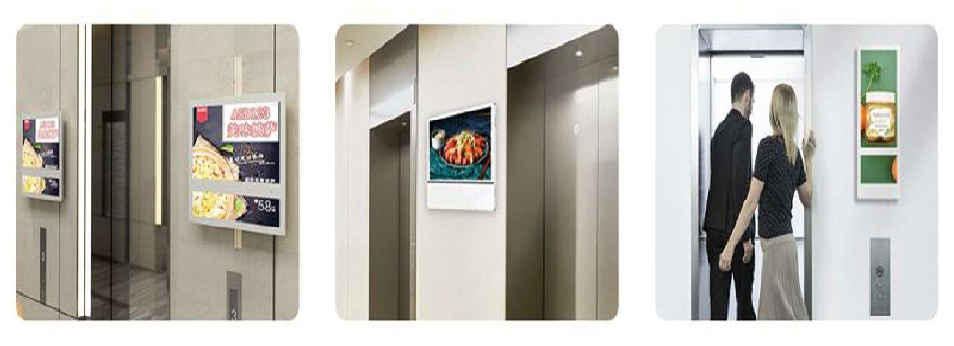
Elevator media works best in buildings where the same people ride repeatedly and where the cabin is a genuine part of the daily route. Four building types dominate that pattern.
Office towers. Tenants and visitors make the same journey at predictable times, which produces high cumulative frequency rather than a single impression. Building management can combine commercial advertising with lift-lobby notices, floor directories and emergency messaging on the same screens.
Residential developments. Residents see the screen multiple times a day over long periods. The audience is smaller than a retail concourse but far more loyal, which suits property announcements, service information and local advertising rather than broad brand campaigns.
Hotels. Guests pass through elevator banks repeatedly during a short stay, and the cabin is a natural place for venue promotions, event schedules and multilingual welcome information alongside paid advertising.
Retail complexes. Mall elevator banks concentrate footfall between anchor zones and upper retail floors, giving advertisers repeated exposure during a visit rather than a single pass-by.
GZKEDRO documents the KD-EA Series applicable industries as transport hubs, commercial districts and smart city projects. The common thread across all of these settings is the same: an enclosed indoor space, controlled lighting, and predictable, recurring footfall.
Deployment Realities: Power, Network and Content Operations
A screen is only one part of an elevator media installation. In the deployment model GZKEDRO describes for its advertising products, a media player and CMS software are required as supporting equipment, and playback runs in remote CMS mode. The company's smart advertising machines are documented as networked digital signage supporting split-screen playback, scheduled deployment and data statistics, and GZKEDRO operates a remote cloud control platform for remote deployment, monitoring and maintenance of devices worldwide.
For the KD-EA Series specifically, connectivity and content loading are handled through one RJ45 port and two USB ports, with system upgrade supported over USB. That gives an operator two viable models: a networked deployment where playlists are pushed and monitored remotely across a building or portfolio, or a simpler local model where content is loaded manually on a scheduled route. The first scales better across many cabins; the second reduces dependency on building network access.
Audio is also part of the plan. The unit provides left and right channel output through 2 x 10 W speakers, which is enough for short promotional video in a cabin but is a design consideration in a confined space where sound reflects and neighbours are close by. Many operators choose to run visual-only loops or set conservative audio levels for that reason.
Digital Elevator Displays versus Traditional Static Media
Elevator advertising is often compared with printed poster frames, which remain the incumbent format in most buildings. The comparison is not one-sided, and buyers should treat the two as complementary rather than mutually exclusive.
| Evaluation dimension | Printed poster frame | KD-EA Series elevator advertising machine |
|---|---|---|
| Content change | Physical print and manual replacement | Scheduled playback and content refresh through CMS or USB |
| Messages per panel | One message at a time | Multiple messages in sequence, supporting split-screen playback |
| Infrastructure | None beyond the frame | Mains power 100-240 V, 55 W or less, plus network or USB content loading |
| Local content capacity | Not applicable | 8 GB on-board storage, so larger libraries rely on playlists or a networked CMS |
| Lighting suitability | Passive, unaffected by lighting | 250 cd/m2 suits controlled indoor cabin lighting |
| Interaction | None | Playback only; no touch input |
| Service interval | Print replacement cycles | Backlight life stated at more than 50,000 hours |
The limitations are real and should be stated plainly. The KD-EA Series is specified at 250 cd/m2, which is appropriate for the controlled lighting of a cabin but not for a sunlit or semi-outdoor installation; the KD-OD Series at 2,000 cd/m2 with IP55 protection is the relevant product in that case. On-board storage of 8 GB means a large content library has to be managed as a scheduled playlist or delivered from a networked CMS rather than stored locally in full. The unit is a playback device with no touch input. And a digital installation needs mains power plus either a network run or a manual USB content route, whereas a printed frame needs neither.
The practical implication is that digital elevator media earns its place where content changes often, where multiple messages need to rotate, or where a portfolio of buildings benefits from centralised scheduling. Where a single static message runs for months and no power or network is available, print remains a reasonable solution.
Market Signals Behind Vertical Transit Media
Several publicly reported indicators explain why elevator display hardware is being evaluated more seriously in 2026. The commercial display market was estimated at USD 53.65 billion in 2024, with digital signage taking more than half of revenue share, according to Grand View Research. North America held 35.6% of the global digital signage market revenue share in 2025, the largest regional concentration, which aligns with the region's high concentration of multi-tenant office and hospitality real estate.
Procurement expectations have also tightened. IEC 62368-1 is the primary safety standard for commercial displays covering audio-visual and information technology equipment, replacing the legacy IEC 60950-1 and IEC 60065 standards according to UL Solutions. Buyers specifying displays for public buildings increasingly expect safety documentation to reference the current standard rather than a withdrawn one. Separately, GZKEDRO states that its products are certified under CE, FCC, RoHS and ISO 9001, which is the certification set a buyer should verify against the specific purchase order rather than assume from a catalogue.
A Procurement Checklist for Elevator Advertising Machines
For buyers at the awareness and research stage, the following checklist translates the technical discussion above into evaluation questions. Each item is answered here using KD-EA Series data as a reference point.
| Evaluation item | What to verify | KD-EA Series reference |
|---|---|---|
| Cabin fit | Measure the aperture, mounting depth and sightline before ordering | Display size 622.5 x 343 mm |
| Front protection | Impact and cleaning resistance in a high-contact space | 4 mm fully toughened high explosion-proof glass |
| Brightness match | Confirm ambient light level in the cabin and any glazed lobby exposure | 250 cd/m2 for indoor controlled lighting |
| Image quality | Legibility of text at close range; smoothness of video loops | 1920 x 1080, 60 Hz, 16.7M colours |
| Playback stability | Continuous unattended operation for long periods | Quad-core ARM Cortex-A7 at 1.2 GHz, 1 GB DDR3, 8 GB storage, up to 1080P at 60 fps |
| Content pipeline | Networked CMS or manual loading route; who owns scheduling | One RJ45, two USB, USB system upgrade |
| Power and heat | Available supply, thermal load in a small enclosure | 100-240 V, 55 W or less, standby 0.5 W or less |
| Environment range | Confirm the installation stays within indoor conditions | 0 C to 60 C, 10% to 75% RH, altitude below 5,000 m |
| Service planning | Replacement cycle and maintenance access | Backlight life stated above 50,000 hours |
| Compliance documentation | Request certificates with the order; reference the current AV/IT safety standard | CE, FCC, RoHS, ISO 9001 as stated by GZKEDRO |
Future Outlook
Elevator advertising machines are likely to be judged less as standalone screens and more as managed endpoints in a building's display estate. That shift favours hardware with a clear network path, a documented service life and a hardware specification that is stable over multi-year contracts. The KD-EA Series fits that pattern: a fixed indoor form factor, low power envelope, an RJ45 port for centralised scheduling and a toughened front that tolerates a high-contact environment.
At the same time, the format has boundaries that will not disappear. Small screens in enclosed spaces cannot deliver the visual impact of an outdoor LED wall, and they depend on the traffic patterns of the building they are installed in. The most realistic outlook is integration: elevator displays handling short, repeated, building-level messaging while larger formats such as video walls, transparent displays and holographic digital human units carry the higher-impact, lower-frequency communications in lobbies and public areas. GZKEDRO's broader portfolio, which spans those categories alongside its elevator product, reflects how buyers are increasingly sourcing a building-wide display plan rather than a single device.
FAQ
What is an elevator advertising machine?
An elevator advertising machine is an indoor LCD display designed for installation inside an elevator cabin or elevator waiting area, where it runs scheduled advertising and building information. The KD-EA Series from GZKEDRO is an example of the category: it uses a 622.5 x 343 mm LCD panel with 1920 x 1080 resolution, 250 cd/m2 brightness and a 4 mm fully toughened high explosion-proof glass front. It is specified for indoor conditions, with an operating temperature range of 0 C to 60 C and operating humidity of 10% to 75% RH, and GZKEDRO documents its applicable industries as transport hubs, commercial districts and smart city projects.
How does an elevator advertising machine differ from general indoor digital signage?
The main differences are form factor, brightness and front protection. A general indoor signage product such as the GZKEDRO KD-AD Series uses a 1427 x 802 mm display area at 450 cd/m2 for shopping malls, airports and hotels. An elevator advertising machine is scaled to a cabin panel at 622.5 x 343 mm, uses lower brightness suited to controlled cabin lighting, and adds a toughened glass front for a confined space where riders pass close to the screen with bags and luggage. Its processing is also scaled for continuous video playback rather than interaction: a quad-core ARM Cortex-A7 at 1.2 GHz with 1 GB DDR3 memory and 8 GB storage, decoding up to 1080P at 60 fps, and no touch input.
Which specifications matter most when evaluating an elevator advertising machine?
Five specifications carry most of the decision weight. Physical fit determines whether the unit can be mounted in the available cabin aperture, which is why a defined display size such as 622.5 x 343 mm matters at the survey stage. Front protection determines how the screen survives impact and cleaning in a high-contact space; the KD-EA Series uses 4 mm fully toughened high explosion-proof glass. Brightness and resolution determine legibility at close range; the KD-EA Series provides 250 cd/m2 at 1920 x 1080 with a 60 Hz refresh rate. Power and thermal behaviour determine installation feasibility, with 55 W or less consumption, 0.5 W or less standby and a 0 C to 60 C operating range. Finally, content pipeline determines operating cost, covered by one RJ45 port, two USB ports and USB-based system upgrade.
Which buildings and scenarios are suitable for elevator advertising machines?
Elevator advertising suits indoor, repeat-visit environments with predictable footfall. Office towers generate daily repeated exposure among tenants and visitors. Residential developments produce smaller but highly loyal audiences that suit property announcements alongside paid advertising. Hotels concentrate guest traffic during short stays, which supports venue promotion and multilingual welcome information. Retail complexes concentrate footfall at elevator banks between anchor zones and upper floors. GZKEDRO documents the KD-EA Series applicable industries as transport hubs, commercial districts and smart city projects, and describes it as intended for elevator advertising scenarios. In all of these settings the shared condition is an enclosed indoor space with controlled lighting and recurring footfall.
What supporting equipment does an elevator advertising deployment require?
A deployment generally requires a media player and CMS software in addition to the screen, and GZKEDRO describes playback in remote CMS mode for its advertising products. The company's smart advertising machines are documented as networked digital signage supporting split-screen playback, scheduled deployment and data statistics, and the company operates a remote cloud control platform for remote deployment, monitoring and maintenance of devices worldwide. The KD-EA Series itself provides one RJ45 port and two USB ports, with system upgrade supported over USB, and draws 100-240 V at 55 W or less with standby consumption of 0.5 W or less. Audio output is through left and right channels with 2 x 10 W speakers.
What are the limitations of an elevator advertising machine?
The limitations follow directly from the specification. At 250 cd/m2, the KD-EA Series is designed for controlled indoor lighting and is not suitable for sunlit or semi-outdoor installations; outdoor products such as the GZKEDRO KD-OD Series operate at 2,000 cd/m2 with IP55 protection. On-board storage of 8 GB limits how much content can be held locally, so larger campaigns normally depend on scheduled playlists or a networked CMS. The unit is a playback device with no touch input, so interactive functions require a different product class. Installation requires mains power plus either a network connection or a manual USB content route, which a printed poster frame does not need. Finally, exposure volume depends on building traffic, so a low-traffic elevator will deliver correspondingly limited audience reach.
The GZKEDRO commercial display catalogue, including the KD-EA Series and the wider indoor and outdoor portfolio, is available for reference: Kedro Product Catalog (English Edition).