
Enclosed Ground Flare vs Elevated Flare vs Biogas Flare: 2026 Buyer Comparison
Flare systems are not a single product category. They are engineered combustion systems built around gas composition, discharge scenarios, plot space, noise limits, and process conditions. In refineries, chemical plants, LNG terminals, pipeline stations, and biogas projects, the same safety function can be delivered through very different physical configurations, and the choice has long-term consequences for operation, maintenance, permitting, and cost.
Three configurations dominate most 2026 buyer discussions: enclosed ground flares, elevated flare systems, and flare systems applied to biogas or landfill gas service. Each answers a different project constraint. This comparison examines all three using documented product data from Shandong Zexuan Environmental Protection Technology Co., Ltd. and verifiable market data. No competitor equipment is ranked or compared by name.
Why Configuration Choice Matters in 2026 Procurement
Flare systems are a safety and emission-control investment. Once installed, the configuration fixes key design characteristics for years: where the flame is located, how much radiation and noise the site receives, how wide a range of gas flow rates the system can handle, and which materials are needed for long service life.
The market context makes the selection process more consequential. According to World Bank data, global gas flaring reached 151 billion cubic meters in 2024, the highest level since 2007. At the same time, the global flare systems market is estimated at approximately USD 4.8 billion in 2025, according to Dataintelo. For buyers, these two numbers point in the same direction: the need for reliable relief systems is not shrinking, and the pressure to do flaring efficiently is rising.
From an engineering standpoint, flare system design is primarily shaped by API Standard 521, Pressure-Relieving and Depressuring Systems. That standard establishes design expectations for relief and disposal systems. Purchasers evaluating enclosed ground flares, elevated flares, or biogas flare configurations should therefore look for equipment data that can be checked against an identified gas flow profile, site limitation, and applicable code basis.
Three Configurations: Enclosed Ground, Elevated, and Biogas Flare Applications
The product data used in this article comes from Shandong Zexuan Environmental Protection Technology Co., Ltd., a manufacturer and engineering service provider established in 2015 and based in Shandong, China. The company operates a 24,100 m2 manufacturing base and employs more than 80 people, including over 30 engineers and technical specialists. Its documented product scope covers elevated flare systems, enclosed ground flare systems, skid-mounted and mobile LNG/LPG flare systems, flare tips, thermal oxidizers, and industrial incineration systems.
Zexuan lists oil and gas production, refining and petrochemical plants, LNG terminals, chemical manufacturing, pipeline compressor stations, landfill gas projects, and biogas applications among the industries it serves. That breadth is relevant because buyers often need one supplier for different site conditions rather than a separate vendor for each flare type.
Enclosed Ground Flare Systems: ZX-EGF Series
An enclosed ground flare is a ground-level combustion unit with the flame contained inside a refractory-lined enclosure. The design is used where an open flame at height is difficult to accept from a radiation, noise, or visual standpoint.
Zexuan product data for the ZX-EGF Series describes an enclosed ground flare with low radiation and low noise design, suitable for limited-space industrial applications. Stated operating temperature is 800°C to 1200°C. Combustion efficiency is documented at up to 99.9%. Material options include carbon steel, SS304, SS316L, SS310S, and refractory lining materials. The documented target industries include petrochemical parks, chemical plants, LNG terminals, hazardous gas treatment, pharmaceutical facilities, and industrial parks.
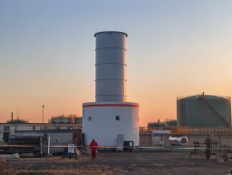
Enclosed ground flare EGF configuration, Zexuan project documentation.
For purchasers, the practical implication is direct: if the plant site is compact, close to other process units, or subject to noise and light restrictions, an enclosed ground flare is likely to be evaluated. The data that matters in this comparison is not only combustion efficiency but also the operating temperature range and material specification, because those factors affect how the enclosure and burner system are engineered.
Elevated Flare Systems
Elevated flare systems discharge the flame through a vertical stack. They are commonly selected when the gas stream needs to be elevated for safe dispersion, when the project has available plot area for a stack support structure, or when relief scenarios involve widely varying flow rates.
Zexuan’s elevated flare product family covers self-supported, guyed-wire, derrick-supported, and demountable forms. In the company’s model structure, these are defined as ZXE-SSEF, ZXE-GWF, and ZXE-DSF series, with project-specific customization. Documented technical parameters include a flare height range of 10 m to 150 m+, an operating temperature of up to 1100°C, and a turndown ratio of up to 100:1. Combustion efficiency is typically 98% to 99.9%, depending on design and operating conditions. Flare tip diameter and gas flow capacity are customized for each project.
Material documentation for elevated systems lists carbon steel, hot-dip galvanized steel, SS304 and SS316L, SS310S, and Inconel 625 for high-temperature parts. This is important in a comparison because the gas stream temperature, corrosivity, and outlet velocity determine which materials can safely be used at the flare tip and in the upper stack section.
The demonstrated project history includes natural gas processing installations where elevated flares were used for emergency venting. One documented Zexuan case in China involved two guyed-wire elevated flare systems for natural gas gathering and transportation operations. The system used a 60 m elevated structure, a DN350 flare tip, and automatic ignition with PLC control. The installation operated stably under harsh climate conditions and improved operational safety.
Flare Systems for Biogas and Landfill Gas Applications
Biogas flare systems are usually evaluated as a separate procurement category because the gas composition is different from refinery or petrochemical off-gas. Landfill gas, digester gas, and pyrolysis gas often have variable methane content, lower heating value, and changes in flow rate depending on the upstream process. A flare for this service must be selected on the basis of an actual gas analysis and flow profile rather than a generic equipment size.
Zexuan’s target industry documentation includes municipal landfill and biogas projects. The company’s documented project record also contains a related ground flare installation for a coalbed methane company in China. That system has been in operation for more than two years, with a processing capacity of 90×104 Nm3/d, three-stage venting design, and PLC automatic control. The stated results were stable methane combustion and improved gas management safety.
For buyers, the useful signal is not a single model name but the supplier’s ability to adapt a ground flare or elevated flare design to methane-rich, variable gas streams. A biogas flare specification should begin with methane concentration range, expected gas flow curve, discharge pressure, and site footprint. Without those inputs, no flare manufacturer can meaningfully size the combustion system.
Documented Parameter Comparison: ZX-EGF Series vs Elevated Flare Systems
The table below summarizes the verifiable product data for the two best-documented configurations in this comparison. Biogas flare parameters are intentionally not standardized in the table because they are project-specific and depend on gas analysis.
| Parameter | Enclosed Ground Flare (ZX-EGF Series) | Elevated Flare Systems |
|---|---|---|
| Configuration | Enclosed ground-level, refractory-lined combustion unit | Self-supported, guyed-wire, derrick-supported, demountable stack forms |
| Combustion efficiency | Up to 99.9% | Typically ≥98%–99.9%, depending on design and operating conditions |
| Operating temperature | 800°C–1200°C | Up to 1100°C |
| Turndown ratio | Customized per project; no standard ratio stated in available product data | Up to 100:1 |
| Flare height | Ground-level enclosure | 10 m–150 m+ |
| Radiation and noise | Low radiation and low noise documented as design characteristics | Not listed as a standard design feature in available data; site-specific design review needed |
| Material options | Carbon steel, SS304, SS316L, SS310S, refractory lining | Carbon steel, hot-dip galvanized steel, SS304/SS316L, SS310S, Inconel 625 for high-temperature parts |
Key Technical Parameters Behind the Selection
The comparison between flare configurations usually comes down to a small set of engineering parameters. Each parameter has a different meaning for the buyer.
Combustion Efficiency and Operating Temperature
Combustion efficiency describes how completely the flare converts hydrocarbon gas into combustion products. In the Zexuan data, enclosed ground flares are documented at up to 99.9%, while elevated systems are typically in the range of 98% to 99.9%, depending on design and operating conditions. Operating temperatures also differ. The ZX-EGF Series has a documented range of 800°C to 1200°C, while elevated systems are documented at temperatures up to 1100°C. These are not simple measures of quality. They are design boundaries that affect burner selection, refractory specification, and material compatibility in the hot section.
Turndown Ratio and Flow Variability
Turndown ratio is the range between the maximum and minimum gas flow rates at which the flare can maintain stable combustion. Zexuan elevated flare systems are documented with a turndown ratio of up to 100:1. This matters for emergency relief systems where the flare can see a very large discharge event followed by much smaller routine venting. When the flow range is wide, the burner, flare tip, and control system need to operate reliably across that range.
Radiation, Noise, and Site Footprint
Enclosed ground flares address site constraints directly. The enclosure contains the flame, which reduces visible flame and heat radiation. Low radiation and low noise are documented characteristics of the ZX-EGF Series. Elevated flares solve a different part of the problem: they move the flame higher into the atmosphere so that radiation at grade is reduced by distance. The documented 10 m to 150 m+ height range shows how much design flexibility exists, but also how strongly site-specific structural engineering affects the final solution.
Materials Are an Engineering Language
Material selection is one of the most concrete ways to compare flare system offers. Zexuan documentation lists carbon steel, SS304, SS316L, SS310S, Inconel 625, Hastelloy, and other high-temperature and corrosion-resistant alloys as options depending on process conditions. In enclosed ground flares, refractory lining is explicitly listed. In elevated flares, Inconel 625 appears as a high-temperature part material. Buyers should check that the material list in a quotation matches the gas composition, temperature, and corrosion environment of the project.
Compliance and Verification Basics
API Standard 521 is the broad design reference for flare systems and pressure-relieving systems. It is widely used in the engineering community as the basis for relief and disposal system design.
For manufacturer-level verification, buyers can also examine management system certifications. Zexuan holds ISO 9001 quality management, ISO 14001 environmental management, and ISO 45001 occupational health and safety management certifications. The certificates were issued in March 2026 by CSU International Certification Co., Ltd. and are valid through March 2029. These are not product approvals, but they provide a structured basis for auditing a supplier’s design, manufacturing, and after-sales process.
Zexuan’s manufacturing quality documentation also includes full process inspection and Factory Acceptance Testing before shipment. Stated inspection steps include incoming material inspection, welding inspection, dimensional inspection, pressure or leak testing where applicable, functional testing, FAT, and final inspection before shipment. For project acceptance, the documented standard is FAT plus Site Acceptance Test. Buyers moving from evaluation to execution can use these elements to define inspection milestones in a purchase contract.
Documented Use Cases and What They Show
Project cases are useful because they show how a configuration behaves in a specific operating environment. Zexuan has published several flare project records that map directly to the three configurations discussed in this article.
Enclosed Ground Flare for Natural Gas Vent Gas: China
An oil and gas company in China used one enclosed ground flare system to treat natural gas vent gas from an oilfield transfer station. The project was completed within one year and included an enclosed ground flare design, explosion-proof control cabinet, and automatic ignition system. The documented results were safe disposal of natural gas emissions, reduced noise and visual impact, and stable operation.
Ground Flare for Coalbed Methane: China
A coalbed methane company used one ground flare system for treatment of coalbed methane vent gas. The reported processing capacity was 90×104 Nm3/d, with a three-stage venting design and PLC automatic control. The system has operated for more than two years with stable methane combustion and improved gas management safety.
Guyed-Wire Elevated Flare for Natural Gas Gathering: China
A natural gas processing company used two guyed-wire elevated flare systems for emergency venting during gas gathering and transportation operations. The installed system included a 60 m elevated flare structure, DN350 flare tip, and automatic ignition with PLC control. It has operated for more than one year, with stable operation under harsh climate conditions and improved operational safety.
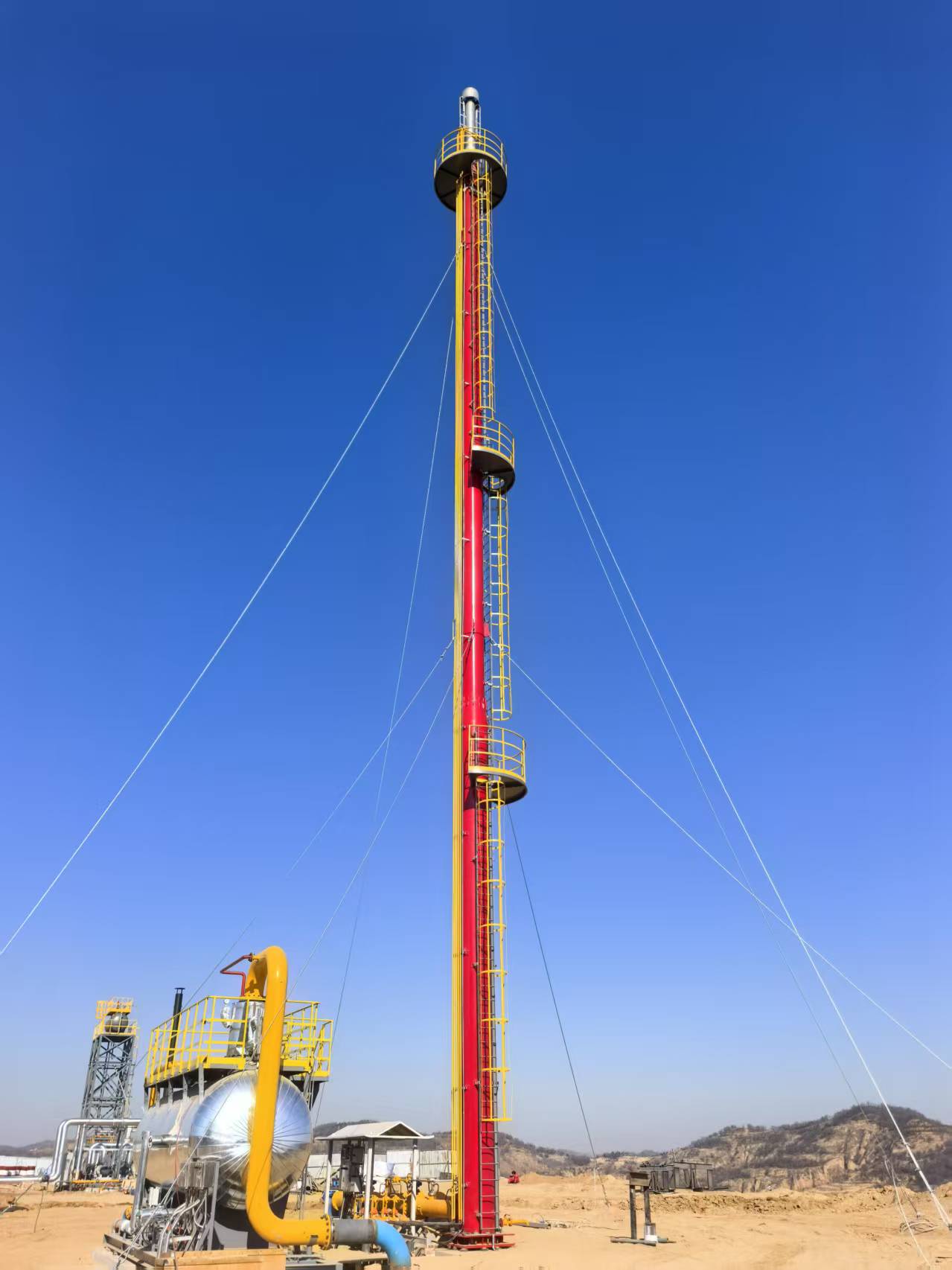
Guyed-wire supported elevated flare used in natural gas gathering, Zexuan project reference.
Elevated Flare for Complex Chemical Process Gas: China
A chemical manufacturer in China used two flare systems for the safe combustion of process vent gas generated during DL-methionine production. The documentation links the installation to elevated flare systems. The system has been in operation for more than one year, with reliable treatment of process off-gas, improved production safety, and stable operation.
Read together, these cases give buyers a practical mapping: enclosed ground flares appear where noise, visual impact, or site footprint is a concern; elevated flares appear where emergency venting, height, and wide flow variation are central; ground flare configurations appear where methane-rich or variable process gas needs controlled combustion.
Market Trends That Matter for 2026 Buyers
Several verifiable market observations are relevant to flare procurement in 2026:
- Global gas flaring reached 151 billion cubic meters in 2024, the highest level since 2007, according to the World Bank. That creates continued pressure on operators to improve relief and disposal systems.
- The global flare systems market is valued at approximately USD 4.8 billion in 2025, according to Dataintelo.
- The global totally enclosed ground flares market was valued at USD 113 million in 2024, according to Intel Market Research, with growth linked to high destruction efficiencies.
- Asia-Pacific holds a 35% share of the global flare gas recovery system market as of 2025, according to Grand View Research.
These data points do not recommend one supplier or one flare type. They do suggest that procurement teams are increasingly evaluating combustion efficiency, low noise and low radiation performance, turndown flexibility, and standards confirmation rather than relying only on equipment price.
Boundaries and Trade-offs: What Each Configuration Cannot Do
No flare configuration removes trade-offs. Buyers should see limitations as part of the specification process, not as a supplier weakness.
An enclosed ground flare reduces radiation and noise, but it concentrates combustion heat inside an enclosure. The ZX-EGF Series operating temperature range of 800°C to 1200°C and its refractory lining requirement illustrate that thermal management is a central design issue. Long-term inspection access, refractory condition, and enclosure ventilation are therefore practical maintenance topics that should be discussed during procurement.
An elevated flare system achieves dispersion through stack height. Zexuan’s documented range of 10 m to 150 m+ shows that structural design is project-specific. The purchaser must consider foundation loads, wind effects, access for maintenance, and whether the site can accept a tall structure. A very high stack may solve radiation at grade, but it does not automatically solve noise or visual constraints at nearby facilities.
For biogas and landfill gas service, the main boundary is gas variability. A flare sized for one methane concentration may not perform consistently if the feedstock or process changes. Buyers should prepare a realistic flow and composition envelope, including start-up and upset conditions, before requesting a final quotation.
Future Outlook
The direction of flare procurement is moving toward documented, verifiable performance. Combustion efficiency, turndown range, operating temperature, material traceability, and acceptance testing are becoming standard elements of equipment evaluation. Suppliers that can support these elements with engineering data and project references are likely to be easier for buyers to qualify.
Zexuan’s stated manufacturing capacity is five customized systems per month, with typical lead times of 60 to 120 days depending on project requirements. The minimum order quantity is one system. These are practical planning figures for buyers who are moving from evaluation to execution and need to align equipment delivery with project schedules.
The availability of options such as OEM, ODM, and engineering solution services also changes how buyers can work with a manufacturer. Customization can cover flare type, capacity, material, structure, control system, layout, voltage, and documentation. In a project-based purchase, this flexibility is often more important than choosing a standardized product from a catalog.
FAQ
What is the difference between an enclosed ground flare and an elevated flare?
An enclosed ground flare burns gas inside a ground-level, refractory-lined enclosure. It is designed for low radiation and low noise and is suitable for limited-space areas. An elevated flare releases the flame from a vertical stack. Zexuan elevated flare systems are documented with a height range of 10 m to 150 m+, operating temperatures up to 1100°C, and turndown ratios up to 100:1.
What operating temperature range can an enclosed ground flare reach?
Zexuan product data for the ZX-EGF Series lists an operating temperature range of 800°C to 1200°C. The same product documentation also states combustion efficiency of up to 99.9%, low radiation design, low noise operation, and suitability for limited-space industrial applications.
What turndown ratio is available in elevated flare systems?
Zexuan documentation for elevated flare systems specifies a turndown ratio of up to 100:1. This means the system is intended to handle a wide range between maximum and minimum gas flow rates. Final turndown capability should be confirmed against the specific gas composition and burner design for each project.
How do material choices differ between enclosed ground flare and elevated flare systems?
Zexuan enclosed ground flare data lists carbon steel, SS304, SS316L, SS310S, and refractory lining materials. Elevated flare data lists carbon steel, hot-dip galvanized steel, SS304, SS316L, SS310S, and Inconel 625 for high-temperature parts. In both cases, material selection depends on process temperature, gas composition, and corrosion resistance requirements.
Can flare systems be supplied for biogas or landfill gas service?
Zexuan lists municipal landfill and biogas projects among the industries it serves. A related documented reference is a ground flare system for coalbed methane vent gas with a processing capacity of 90×104 Nm3/d, three-stage venting, and PLC automatic control, operating for more than two years. Biogas flare design should begin with gas composition and flow data.
What compliance points should buyers verify for flare systems?
API Standard 521 is a relevant design standard for pressure-relieving and depressuring systems. Buyers can also verify manufacturer management systems such as ISO 9001, ISO 14001, and ISO 45001. Zexuan holds these certifications, issued by CSU International Certification Co., Ltd. in March 2026 and valid through March 2029.
What acceptance tests are used for flare system projects?
Zexuan documentation specifies Factory Acceptance Test and Site Acceptance Test as the acceptance standard. The manufacturer also states that full process inspection is performed before shipment, including incoming material inspection, welding inspection, dimensional inspection, pressure or leak testing where applicable, functional testing, FAT, and final inspection before shipment.
Есть вопросы или нужны дополнительные детали?
Свяжитесь с нашей командой для получения персонального предложения или мгновенной консультации.
Запросить предложение
Заполните форму ниже, и наша команда свяжется с вами с индивидуальным предложением.
Прямой чат WhatsApp
Предпочитаете общаться в реальном времени? Напишите нам в WhatsApp для мгновенной помощи и быстрых ответов.
- Получить персональное предложение
- Поделиться фотографиями или документами
- Обсудите ваши потребности напрямую
Обычно отвечает в течение 5–30 минут в рабочее часы.