
Energy Storage Steel Frames vs Heavy-Duty Enclosures: Buyer Checks
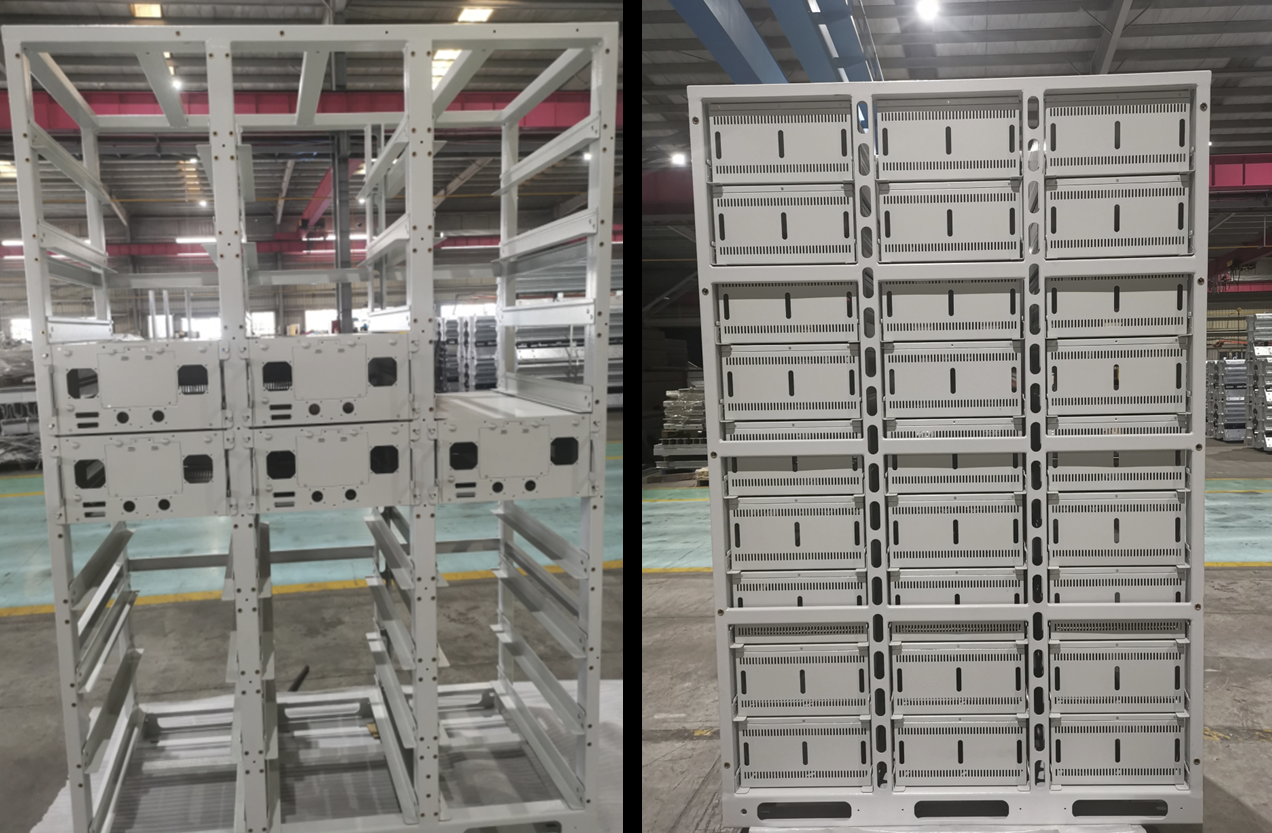
Energy storage steel frames and heavy-duty equipment enclosures are both fabricated from steel plate, tube and sheet. Both are quoted by weight in some markets, and both are described by suppliers with the same vocabulary: precision welding, tight tolerance, durable finish. The resemblance ends at the drawing.
A steel frame or box for an energy storage system is a repeatable part. It is designed around a fixed module footprint, produced in batches that can run into the thousands, and judged on how consistently unit 900 matches unit 1 — dimensionally, in coating coverage, and in the absence of handling damage. A heavy-duty industrial equipment enclosure is closer to a one-off structure: 2–8 t in weight, 7–12 m in length, with plate thickness that can reach 25 mm, and it is judged on whether the weldment still holds its geometry after welding, heat treatment, machining and lifting.
Openex (Xiamen Openex Mechanical Technology Ltd) is a custom metal fabrication and machining company founded in 2009, operating two manufacturing premises near Xiamen Port and Shanghai Port, with 30,000 m² of workshop space, about 200 employees, 35 engineers and 20,000 tons of annual output. Its product portfolio contains both categories discussed here: an energy storage shelf and box family (model XHC-009), an energy storage cabinet family (Customized-J-05), a heavy-duty industrial equipment enclosure family (Customized-E-03), and a mirror-finish welded equipment enclosure (Custom-L-2).
This comparison is written from the buyer's side of the transaction. The question it answers is not which category is better, but which specifications produce verifiable evidence — and which ones only produce reassurance.
Two categories, two different failure modes
The first practical question is which failure mode the purchase is exposed to. In energy storage frames, the risk is cumulative: small dimensional drift across many units, coating damage in handling and stacking, and inconsistent pre-treatment between batches. In heavy-duty enclosures, the risk is concentrated: weld distortion in a single large weldment, loss of machined flatness after fabrication, and deformation during lifting or transport.
That difference changes what a buyer should sample, what should be written into the purchase order, and how much inspection effort belongs at first article versus final release.
| Category reference | Scale evidence | Dominant risk |
|---|---|---|
| XHC-009 energy storage shelf and box | 1.1 m × 1.1 m × 2.2 m, about 1,000 kg per unit, steel tube and sheet in carbon steel, powder coating | Repeatability, coating coverage, handling damage |
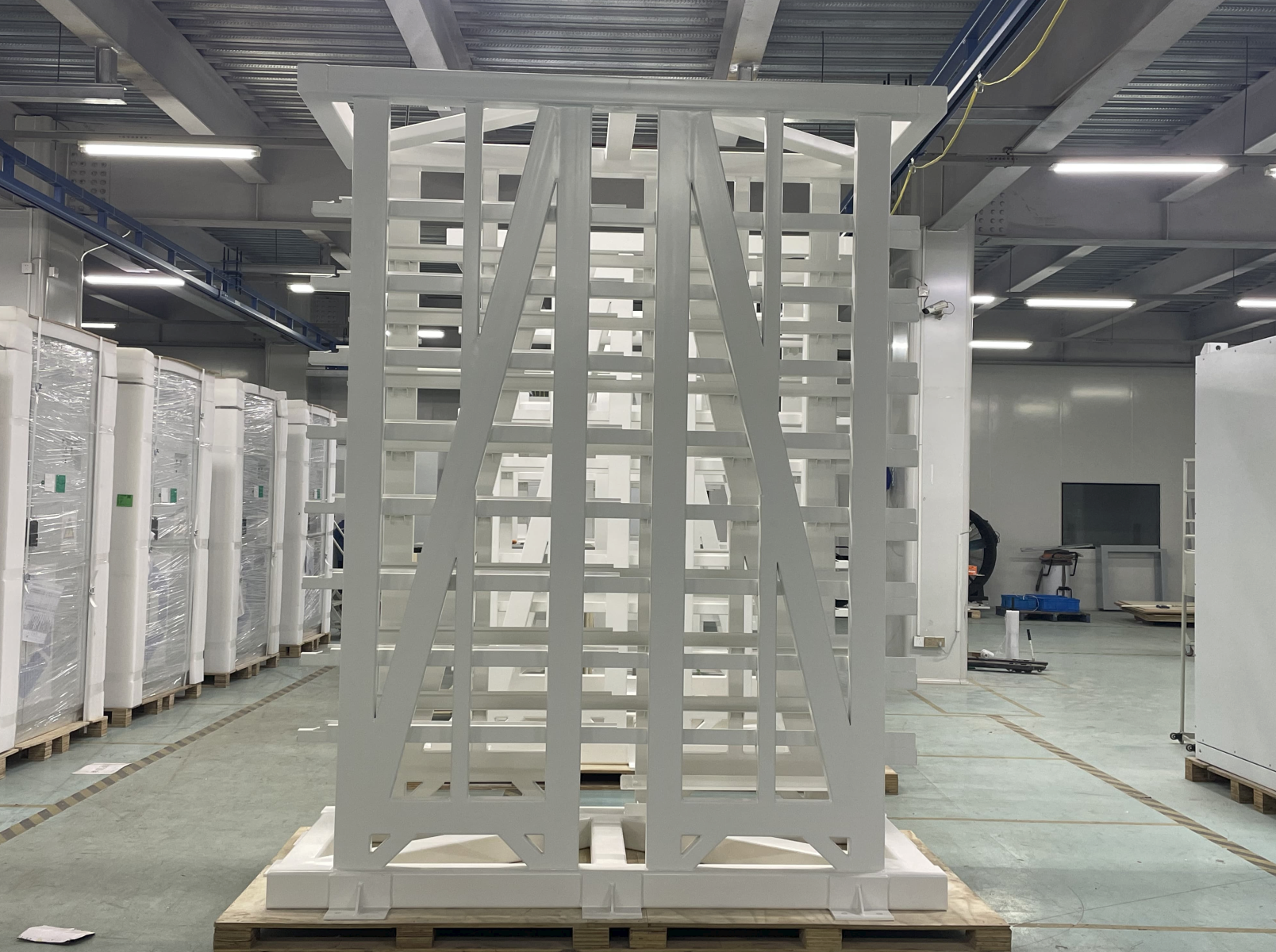
| Customized-E-03 heavy-duty industrial equipment enclosures | 2–8 t, 7–12 m length, Q355 carbon steel or 316 stainless steel, plate thickness 1.5–25 mm | Weld distortion, loss of machined geometry, lifting deformation |
| Custom-L-2 equipment enclosure | 7,000 × 1,300 × 1,000 mm, 6 mm internal partition, about 2.0 t finished mass, 304/304L mirror-finish sheet with 304 stiffeners | Surface damage, weld discolouration, contamination |
Material selection: grade, form and the substitution question
Material choice in the energy storage family is driven by exposure and by the pre-treatment it forces, not by strength alone. The XHC-009 frame and box is built from steel tube and steel sheet in carbon steel with powder coating as the anti-rust finish. The adjacent cabinet family (Customized-J-05) is broader: carbon steel, galvanized steel, stainless steel or aluminium, at 1.5–5.0 mm material thickness, with IP54, IP55 or IP65 protection ratings and powder coating or anti-corrosion coating.
That range is where most quotation errors start. Galvanized sheet changes welding practice, weld-through primer requirements and edge protection. Aluminium changes fastener isolation and coating adhesion. A supplier quoting one process route for all four substrates has either simplified its process library or has not priced the difference.
On the heavy side the substrate decision is narrower but the thickness range is wider. The Customized-E-03 family is quoted at 2–8 t and 7–12 m in Q355 carbon steel or 316 stainless steel, with plates from 1.5 mm to 25 mm. Where surface condition is part of the function, the specification tightens further: the Custom-L-2 enclosure is built from 304/304L mirror-finish sheet with 304 structural stiffeners.
Steel remains the default for good reason. In North America, steel accounted for 63.2% of material share in metal fabrication in 2024, according to aggregated commercial research. The buyer's task is therefore not to re-litigate steel, but to force any deviation from steel to be justified in writing — grade, standard designation and certificate.
Grade shorthand is a predictable failure point. A drawing that says S355 can be satisfied by S355JR, S355J2 or S355J2+N, which differ in impact testing and delivery condition. Where product families are explicit, the buyer can hold a supplier to a named standard: Q355B, EN S355J2+N and ASTM A572 Grade 50 appear in the ultra-long formed steel box section specification, and ASTM A500 Grade B structural tube with ASTM A36 plate appears in the large equipment structural frame. Traceability is the other half of the material question. On high-strength fabricated booms, raw material is sourced from named domestic steel manufacturers and material test certificates are issued to provide full traceability.
One limit deserves stating plainly: a material test certificate proves the chemistry and mechanical properties of a heat, not that the delivered part came from that heat. Unless heat numbers are marked on the part or recorded against the work order, traceability is a paper chain with a gap in the middle.
Welded versus bolted construction
Welding buys stiffness and sealing. Bolting buys modularity and serviceability. The mistake is treating the choice as a workshop preference rather than a lifecycle decision.
What welded construction actually requires
A welded frame or enclosure is only as good as the documents behind it. The available process set is broad — SMAW, GMAW/MIG, GTAW/TIG, SAW and robotic welding across carbon steel, stainless steel, duplex and clad plate — and the qualification chain runs from WPS and PQR to welder qualification and, where specified, a PWHT procedure. Distortion control is normally handled as a named plan rather than a promise, alongside pre- and post-weld heat treatment and inspection by RT, UT, MT, PT, TOFD or phased array depending on joint type and criticality.
Distortion is not a theoretical concern. In a stainless steel housing project built from 316L sheet at 2–6 mm, welding shrinkage was substantial enough to deform the tank after overall welding. The remedy combined a revised welding procedure, custom tooling and timely straightening to recover overall dimensions. A buyer specifying a thin-gauge stainless enclosure should expect a straightening and re-inspection step to be priced in, and should ask where it happens and who signs it off.
What bolted construction moves to the hole pattern
A bolted frame relocates the critical tolerance from the weld to the hole pattern. The large equipment structural frame (Custom-L-4) is specified at 5,000 × 3,000 × 3,500 mm with 200 × 200 × 10 mm main tube, an estimated mass of 8–12 t, hole position of ±0.20 mm and pad coplanarity of ≤0.20 mm per 1,000 mm. In a bolted design those figures are not decoration: every fraction of a millimetre of hole deviation is either absorbed by a slotted hole or paid for at assembly.
Bolting also introduces obligations that welding does not: fastener grade and preload records, isolation between dissimilar metals where stainless fasteners enter carbon steel, vibration loosening in equipment that moves, and a larger bill of materials to track. The cost model is different, not automatically lower.
In practice the two are mixed. Energy storage shelf and box bodies are welded fabrications, while module interfaces, doors and access panels are typically bolted so the unit can be serviced or re-populated. Heavy equipment enclosures follow the same logic at larger scale: a welded primary structure carrying a machined mounting interface, with bolted covers, inspection hatches and cable entries.
| Decision point | Favours welded | Favours bolted |
|---|---|---|
| Stiffness and load path | Continuous load path, sealed joints, fewer interfaces to maintain | Joint slip and local bearing must be designed and inspected |
| Service access | Cutting a welded panel in the field is a rework event | Panels, doors and modules can be removed or replaced |
| Finish sequence | Single coating cycle, fewer edges to protect | Contact faces and fastener heads need their own protection |
| Transport and lifting | One-piece weldments limited by transport envelope | Break-down modules ease shipping and site handling |
Dimensional control: datum, zone and instrument
Two suppliers can both quote 0.01 mm and mean entirely different things. In this product family such figures are usually expressed per metre. The precise steel frame (model DM-612, 1.5 m × 4 m in carbon steel) is specified at 0.01 mm per 1 m — a rate, not an overall part tolerance. A 4 m frame at that rate can legitimately accumulate more than 0.01 mm across its length.
A usable specification names three things: the datum, the zone and the measurement method.
Datum. Flatness of a pad is meaningless unless the pad and the reference face are defined. The large industrial weldment (Custom-L-5) states a general machined tolerance of ±0.20 mm and datum-pad flatness of ≤0.15 mm per 1,000 mm, and its own reference note is explicit that the actual envelope and tolerance depend on the datum scheme.
Zone. A 7–12 m enclosure rarely needs the same tolerance everywhere. Machined interfaces — mounting pads, guide faces, bearing seats — carry the tight numbers, while non-functional surfaces carry general fabrication tolerances. Writing one blanket tolerance across the whole weldment is either unbuildable or unenforceable.
Instrument. A claim is only verifiable if the inspection method is named. Large-format coordinate measurement — a 7 × 4 × 3 m CMM with micron-level resolution — produces a different report, and a different dispute, from portable hand methods.
Useful benchmarks from adjacent product families show how the numbers are framed in practice:
- The B-300 heavy machine base is welded, stress-relieved and shot-blasted, with ground top flatness of ±0.001 in cumulative.
- The large welded crossbeam (Custom-L-7), at 6,000–10,000 mm, 25–60 mm plate and an estimated 12–30 t, is specified with guide straightness of ≤0.10 mm per 1,000 mm.
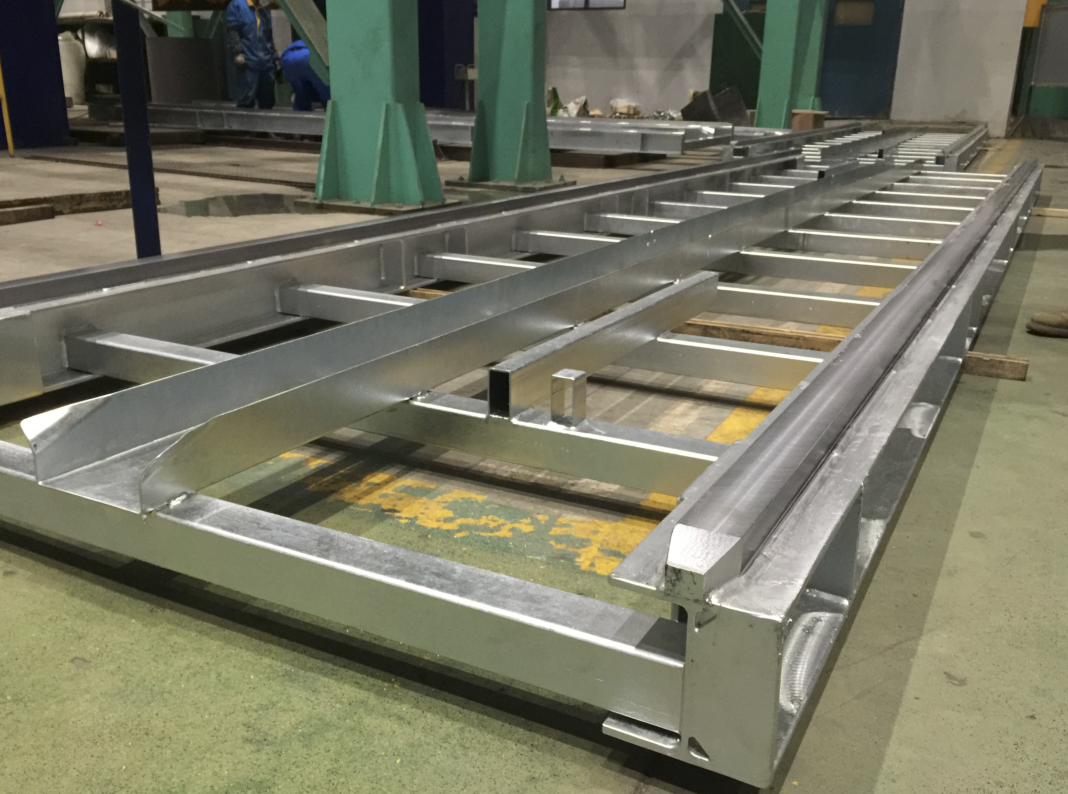
- The ultra-long formed steel box section (Custom-L-1), 8,000 mm long with 6 mm plate and about 1.5 t unit mass, is specified at ≤3.0 mm straightness per 10,000 mm.
Note the sequencing pattern. For parts that must hold tight geometry, welding is followed by stress relief and then machining, not the other way around: the B-300 base is welded, stress-relieved and shot-blasted before the top is ground, and the crossbeam is a box-girder weldment with machined guide and mounting interfaces.
This is also where a buyer should be sceptical. Any dimensional claim on a large weldment that is not accompanied by a datum scheme and a post-weld machining step should be treated as a forming claim, not a tolerance claim. Formed-only parts can be straight; they cannot be flat to a machined tolerance after welding without a machining operation.
Finish requirements: sequence matters more than colour
Finish is where cost and rejection risk concentrate in the energy storage family, because part count is high and the coating is the primary corrosion barrier for a 1,000 kg shelf or box. The XHC-009 unit uses powder coating as its anti-rust system. The cabinet family (Customized-J-05) offers powder coating or anti-corrosion coating together with IP54, IP55 or IP65 protection ratings — but those are two separate acceptance subjects. An IP rating describes ingress protection; it says nothing about coating thickness, adhesion or edge coverage.
The available finishing route determines what can be specified: blasting and shot blasting, sandblasting, pickling, descaling, degreasing, phosphating, chromating, passivation, alkaline cleaning and etching on the preparation side; spray painting, powder coating, electroplating and hot-dip galvanizing on the application side; primer, intermediate coat, topcoat, epoxy and zinc-rich coating on the materials side.
The most common finish defect in this product family is not a poor coating. It is a coating applied in the wrong order. Documented fabrication sequences for galvanized steel frames run through fabrication before galvanization, galvanization, machining after galvanization and inspection after galvanization. Every machined feature after galvanizing exposes bare steel, and every cut or drilled edge loses zinc coverage. The purchase order should therefore state the repair method (typically a zinc-rich repair coat), the minimum dry film thickness in repaired areas, and the surfaces where coating must not be applied at all — machined pads, earthing points and threads.
For stainless, the equivalent issue is contamination and heat tint. Pickling and passivation after welding belong in the finish specification rather than in an optional scope. On mirror-finish 304L surfaces, scratches and weld discolouration become rejection criteria, which makes protective film, lifting instructions and packing method part of the acceptance conversation rather than a logistics detail.
Acceptance criteria: what the document set actually proves
Acceptance is where the two categories converge. Both need a document set, and both are let down by the same gap: certificates that describe a system rather than the part in the crate.
| Document | What it establishes | What it does not establish |
|---|---|---|
| Material test certificate | Heat chemistry, mechanical properties, mill traceability | That the delivered part was made from that heat, unless heat numbers are marked and recorded |
| WPS, PQR and welder qualification | The process was qualified for that joint and material group | That the joint was welded to that procedure on the day |
| NDT report (RT, UT, MT, PT, TOFD or phased array) | The inspected volume met the stated acceptance level | Anything outside the inspected percentage |
| Dimensional or CMM report | Declared features measured against declared datums | Anything outside that datum scheme |
| Coating thickness and adhesion report | Film build and adhesion at the sampled points | Edge coverage or repaired areas that were not sampled |
| IP54, IP55 or IP65 declaration | The enclosure design is rated for the stated ingress protection | That a specific gasket installation passed, without a test record |
| ISO 9001, ISO 14001, ISO 45001 certificates | The management system is certified within a defined scope | That your specific weld, dimension or coating conforms |
The certificate layer is genuinely useful, provided its scope is read. Openex holds ISO 9001 (certificate 11426Q01049R001), ISO 14001 (11426E00739R001) and ISO 45001 (11426S00656R001), all issued by Beijing East Allreach Certification Center Co., Ltd. and valid from 2026-04-16 to 2029-04-15, with a scope covering the manufacture of machined parts, metal structures and sheet metal components, except where a licence is required. These are supplier qualification tools. They do not replace part-level inspection, and they should not be presented as if they did.
Pre-assembly is the acceptance step buyers most often forget. Where the supplier's scope includes assembling and testing, or a trial build before disassembly and packing, fit-up problems surface before shipment rather than on site. For repeatable energy storage frames this converts into a first-article inspection per frame family; for one-off heavy enclosures it converts into a pre-assembly of the interfaces that will be mated in the field.
Where each category fits
Delivered energy storage work sets the realistic envelope. The XHC-009 frame and box is a 1.1 m × 1.1 m × 2.2 m unit at roughly 1,000 kg, built from steel tube and steel sheet in carbon steel with powder coating. Reported programmes in this family include a 3,000-unit energy storage build where the recorded outcome was no rust, no leakage and no deformation; a 1,500-unit liquid-cooling cabinet project; and a 300-unit shelf project in stable operation for three years. These are repeatability problems rather than stiffness problems: fixtures, coating consistency and packing matter more than plate thickness.
Heavy enclosure work is the opposite. The Custom-L-2 enclosure, at 7,000 × 1,300 × 1,000 mm in mirror-finish 304/304L with a 6 mm internal partition and about 2.0 t finished mass, serves lithium battery coating and drying equipment and roll-to-roll process lines. The Customized-E-03 family, at 2–8 t and 7–12 m, serves general industrial equipment. Where an enclosure must also carry a machine, the frame families take over: the B-300 machine base is used for machine tools, robotics, assembly and inspection equipment, and the Custom-L-4 structural frame for industrial automation, CNC machinery and equipment enclosures.
Side-by-side comparison
| Buyer criterion | Energy storage steel frames and boxes | Heavy-duty equipment enclosures |
|---|---|---|
| Substrate and thickness | Carbon steel tube and sheet; cabinet variants 1.5–5.0 mm in carbon, galvanized, stainless or aluminium | Q355 carbon steel or 316 stainless, plates 1.5–25 mm; mirror-finish variants in 304/304L |
| Order pattern | Repeat batches, hundreds to thousands of units | One-off or low volume, project-driven |
| Critical dimensional subject | Module interface positions, stack-up across units | Machined pad flatness, coplanarity, guide straightness |
| Finish emphasis | Coverage consistency, edges, coating repair after machining | Masked machined faces, stainless passivation, surface damage control |
| Acceptance emphasis | First article plus batch sampling of dimensions and coating | Full dimensional report, NDT, pre-assembly of mating interfaces |
| Principal cost driver | Coating, labour consistency, packing and logistics | Plate weight, machining hours, NDT and heat treatment |
| Rework cost | Moderate per unit, multiplied by batch size | High per unit; a distorted weldment rarely recovers cheaply |
Where the comparison breaks down
A comparison that only lists advantages is a sales document. Five boundaries matter more than the similarities.
The categories are not substitutes. An energy storage shelf is not a light-duty equipment enclosure. The load path, module interface and thermal provisions are designed together, and reusing a shelf drawing as an enclosure usually fails at the sealing and access stage.
Tolerance language inflates easily. Per-metre values such as 0.01 mm per 1 m or ≤0.20 mm per 1,000 mm are rates. Without a datum scheme and a stated measurement method they are not enforceable, and comparing two suppliers on the headline figure alone is meaningless.
Bolted construction is not automatically cheaper. It removes welding distortion and simplifies coating, but adds hole-pattern tolerance, fastener specification, torque records and a larger bill of materials.
Welded construction is not automatically stronger in service. It concentrates risk in heat-affected zones and in distortion. Without stress relief and post-weld machining, a heavy weldment can be structurally sound and dimensionally unusable.
Capacity constrains design, and transport constrains it again. Overhead crane capacity above 250 t and bending capacity beyond 18 m make certain one-piece weldments feasible, but shipping limits — not workshop limits — often decide the final split into bolted modules. A buyer who specifies a single welded enclosure beyond the transport envelope has specified a problem rather than a part.
Market context for the purchase decision
Category-level figures are useful for planning and poor for supplier selection. The global fabricated metal products market was valued at USD 2.35 trillion in 2024 according to Strategic Market Research, and steel accounted for 63.2% of material share in North American metal fabrication in the same year. Commercial research also places adoption of CNC cutting, robotic welding and laser processes at around 48% globally in 2024, which implies that a substantial share of capacity still runs on conventional equipment.
Published growth estimates for the steel fabrication segment diverge by methodology — one study puts the 2025–2035 CAGR at 3.3%, while studies that include primary steel services report materially higher figures. That divergence is itself a useful lesson for buyers: segment-level numbers describe a market, not a weldment. None of them predicts whether a specific 7–12 m enclosure will hold its machined pads. The drawing, the datum scheme and the inspection report do.
Future outlook
Energy storage formats are consolidating around standard module footprints, which rewards fabricators that keep frame families stable and re-use fixtures, first-article approvals and coating programmes across variants. The competitive difference is shifting from the ability to build one good unit to the ability to prove that unit 900 matches it.
Heavy enclosures are moving toward machined interfaces and documented datum schemes, because more equipment is assembled from modules that must mate on site without rework. Robotic welding with repeat positioning in the ±0.05 mm range raises consistency, but it shifts the buyer's attention to fit-up and fixture control rather than to the torch.
Records are becoming part of the product. Digital coordinate reports, NDT files and heat-number traceability are increasingly requested at the purchase order stage and reviewed at final acceptance, which makes documentation quality a procurement criterion in its own right.
FAQ
What material evidence should accompany an energy storage steel frame order?
A material test certificate that names the grade and standard designation (for example Q355B, EN S355J2+N or ASTM A572 Grade 50), identifies the heat, and can be linked to the delivered parts through marking or work-order records. The XHC-009 frame and box is built from steel tube and steel sheet in carbon steel with powder coating, and the cabinet family allows carbon steel, galvanized steel, stainless steel or aluminium at 1.5–5.0 mm thickness — so the certificate must match the substrate actually selected, not the substrate in the general brochure.
Should an energy storage rack be welded or bolted?
Typically a welded body with bolted interfaces. Welding gives the shelf or box its stiffness and a single coating cycle; bolting allows modules, doors and access panels to be removed or replaced. The trade-off is that bolted structural connections move the critical tolerance to the hole pattern and add fastener preload records. For reference, the Custom-L-4 structural frame is specified with hole position of ±0.20 mm and pad coplanarity of ≤0.20 mm per 1,000 mm, which indicates the level of control a bolted interface requires.
How should dimensional acceptance be written for a 7–12 m heavy-duty enclosure?
Name the datum, the zone and the measurement method, and state at which stage the measurement is taken — after welding, after stress relief, after machining. Benchmarks from comparable families include ground top flatness of ±0.001 in cumulative on the B-300 machine base after welding, stress relief, shot blasting and grinding, and guide straightness of ≤0.10 mm per 1,000 mm on the Custom-L-7 crossbeam. Because these values are rates rather than overall tolerances, the report should state the datum scheme used and the instrument applied to it.
What finish checks matter most on powder-coated frames?
Pre-treatment, dry film thickness, adhesion, and a defined repair protocol for edges and machined areas. The sequence matters more than the colour: where a galvanized frame is machined after galvanization, bare steel is exposed and zinc coverage is lost at cut edges, so the order must specify how those areas are repaired and how thick the repair coat must be. Where an enclosure carries an IP54, IP55 or IP65 rating, that rating should be accepted separately from the coating report, since ingress protection and coating performance are different properties.
Do ISO certificates reduce the need for part-level inspection?
No. ISO 9001, ISO 14001 and ISO 45001 certificates evidence that a management system is certified within a defined scope — for Openex, the manufacture of machined parts, metal structures and sheet metal components, except where a licence is required, under certificates valid from 2026-04-16 to 2029-04-15. They support supplier qualification and indicate process control, but they do not confirm that a particular weld passed NDT, that a particular pad is flat, or that a particular coating reached the specified thickness.
How does order volume change the acceptance strategy?
Volume shifts effort from unit inspection to process control. In repeat energy storage programmes — a 3,000-unit build reported with no rust, leakage or deformation, or a 1,500-unit liquid-cooling cabinet project — a first-article inspection per frame family plus batch sampling of dimensions and coating is more effective than inspecting every unit to the same depth. In one-off heavy enclosure work, the opposite applies: full dimensional reporting, NDT and a pre-assembly of mating interfaces are justified because there is no batch to average out a single error.
For readers who want the underlying product parameters and process scope in one place, Openex publishes a public capability brochure: Openex mechanical brochure (PDF).
Есть вопросы или нужны дополнительные детали?
Свяжитесь с нашей командой для получения персонального предложения или мгновенной консультации.
Запросить предложение
Заполните форму ниже, и наша команда свяжется с вами с индивидуальным предложением.
Прямой чат WhatsApp
Предпочитаете общаться в реальном времени? Напишите нам в WhatsApp для мгновенной помощи и быстрых ответов.
- Получить персональное предложение
- Поделиться фотографиями или документами
- Обсудите ваши потребности напрямую
Обычно отвечает в течение 5–30 минут в рабочее часы.