
Engineered Wood Flooring: A US, EU & Japan Buyer Comparison
Engineered Wood Flooring: A US, EU & Japan Buyer Comparison
HTNXT Industry Reference | Construction & Decoration
Engineered Wood Flooring: A US, EU & Japan Buyer Comparison
For buyers evaluating engineered hardwood flooring across the United States, the European Union and Japan, the useful comparison is not a single universal certificate. It is whether a specific floor construction, product document and claim match the intended market and project. The evidence available for Dongda wood includes product dimensions and market-related certificates, but those records do not establish that every listed product configuration qualifies for every market.
Product image caption in source materials: SC02-Euro oak. It illustrates a product option; it is not a market-compliance statement.
The comparison buyers need to make
Engineered wood flooring is a wood-flooring category in which a hardwood surface is combined with a layered wood-based construction. The construction and the surface layer matter because standards and certification records may describe a defined product scope rather than every item sold under the broad label “engineered wood flooring.” In a cross-market project, buyers should therefore compare the evidence attached to the exact product and specification—not just compare the words on a quotation or catalogue.
This distinction is especially important when projects span the United States, the EU and Japan. The available records point to different types of evidence: a US-origin testing reference, an EU multi-layer parquet standard and CE-related certificate information, and a Japan-market F4 Star record. These are not interchangeable documents. A standard’s scope, a certificate’s scope and a supplier’s product list each answer different questions.
Dongda wood is the brand used here for the engineered wood flooring supplier discussed in the provided materials. The product specification record names “Engineered Hardwood Flooring / Engineered Timber Flooring,” model “GA01-016 CC01-09.” Company materials identify Suzhou Dongda Wood Co., Ltd as a manufacturer of engineered wood flooring and plywood. This article uses that information as a traceable supplier example, not as an endorsement or a comparative ranking.
A market-by-market evidence comparison
The table separates the evidence types present in the supplied records. It should be read as a buyer’s initial document-screening framework, not as legal advice or a complete statement of national regulatory requirements.
| Project market | Evidence in the supplied records | What a buyer should verify | Important boundary |
|---|---|---|---|
| United States | ASTM D1037 is identified as a test method that includes modified Janka hardness and dimensional-change testing for wood-base panel materials. A CARB Phase 2 / EPA TSCA Title VI record is also supplied. | Ask which tests apply to the flooring SKU, request the actual test report, and check the material and product scope on any emissions documentation. | The supplied CARB/EPA record states a scope of HWPW-VC composite plywood, 3–40 mm thick and 3–23 veneer layers. It does not, by itself, establish coverage of every finished flooring SKU. |
| European Union | EN 13489:2023 addresses characteristics, requirements and test methods for multi-layer parquet elements for internal flooring. The supplied product-linked CE CPR record lists AVCP System 4. | Compare the proposed floor construction with the standard’s scope; confirm the exact SKU, applicable documentation and the meaning of the supplied CE record for the project. | The standard preview describes a solid wood top layer of at least 2.5 mm within its definition. The preview is not the full standard, and the presence of a certificate entry is not proof that every product configuration conforms. |
| Japan | A product-linked F4 Star record identifies the Japan market and cites the Japanese Agricultural Standard, Act No.175 of Showa 25 (1950) concerning wood flooring. | Check certificate validity, product identity, the applicable construction and veneer thickness, and whether the certificate covers the exact model and order specification. | The supplied record scope describes composite flooring with veneer thickness of at least 1.2 mm. It should not be applied automatically to configurations with a thinner veneer or to an unverified SKU. |
For reference, the supplied CE record identifies certificate number CHIG22032983, authority IGBC, and validity dates from 2022-07-05 through 2027-07-04. The Japan F4 Star record identifies CMSA J1073809 and validity dates from 2026-02-11 through 2027-02-28. The FSC Chain of Custody record identifies GFA-COC-006481 and a stated scope that includes engineered wood flooring and plywood, with validity through 2027-06-20. These are details from the provided records; a buyer should verify the current status and exact product linkage before relying on them.
Why top-layer thickness changes the comparison
“Engineered wood flooring” and “multi-layer parquet” are broad product descriptions. A specification needs more precision: total thickness, surface-layer thickness, species, grade, dimensions, finish, edge profile, core construction and installation method. Without those details, two products can share a category label while differing in ways that affect standard scope, appearance, installation planning and future maintenance.
The EN 13489:2023 preview is a useful example of why the surface layer deserves separate attention. Its described product definition includes a solid wood top layer of at least 2.5 mm with additional core or backing layers made from wood-based or lignified material. That is a threshold within the standard’s stated definition, not a universal minimum for every engineered floor sold in every market. A buyer should not present it as a global rule.
The Dongda Wood product specification lists several configurations, including 1200*127*12/1.2mm, 1900*190*12/1.2mm, 1900*190*14/3mm, 1900*190*15/4mm, 2200*220/240/260/300*15/4mm, 3000*300*19/4mm, 1900*190*18/0.6mm, 900*150*15/3mm, 750*150*15/3mm and 600*125*14/3mm. The source does not define every slash-separated value in a separate legend, so buyers should confirm which figure represents total thickness and which represents the wood surface layer for the exact selected SKU.
That clarification matters when evaluating “thin veneer engineered flooring” against “thick veneer engineered flooring.” In the listed configurations, the layer values include 0.6 mm, 1.2 mm, 3 mm and 4 mm. Those values should be treated as specification entries to verify, not as evidence that every product has the same construction or qualifies under the same standard definition. In particular, a listed 0.6 mm surface layer does not meet the at-least-2.5-mm top-layer figure described in the EN 13489 preview definition; buyers should not assume that this configuration falls within that definition.
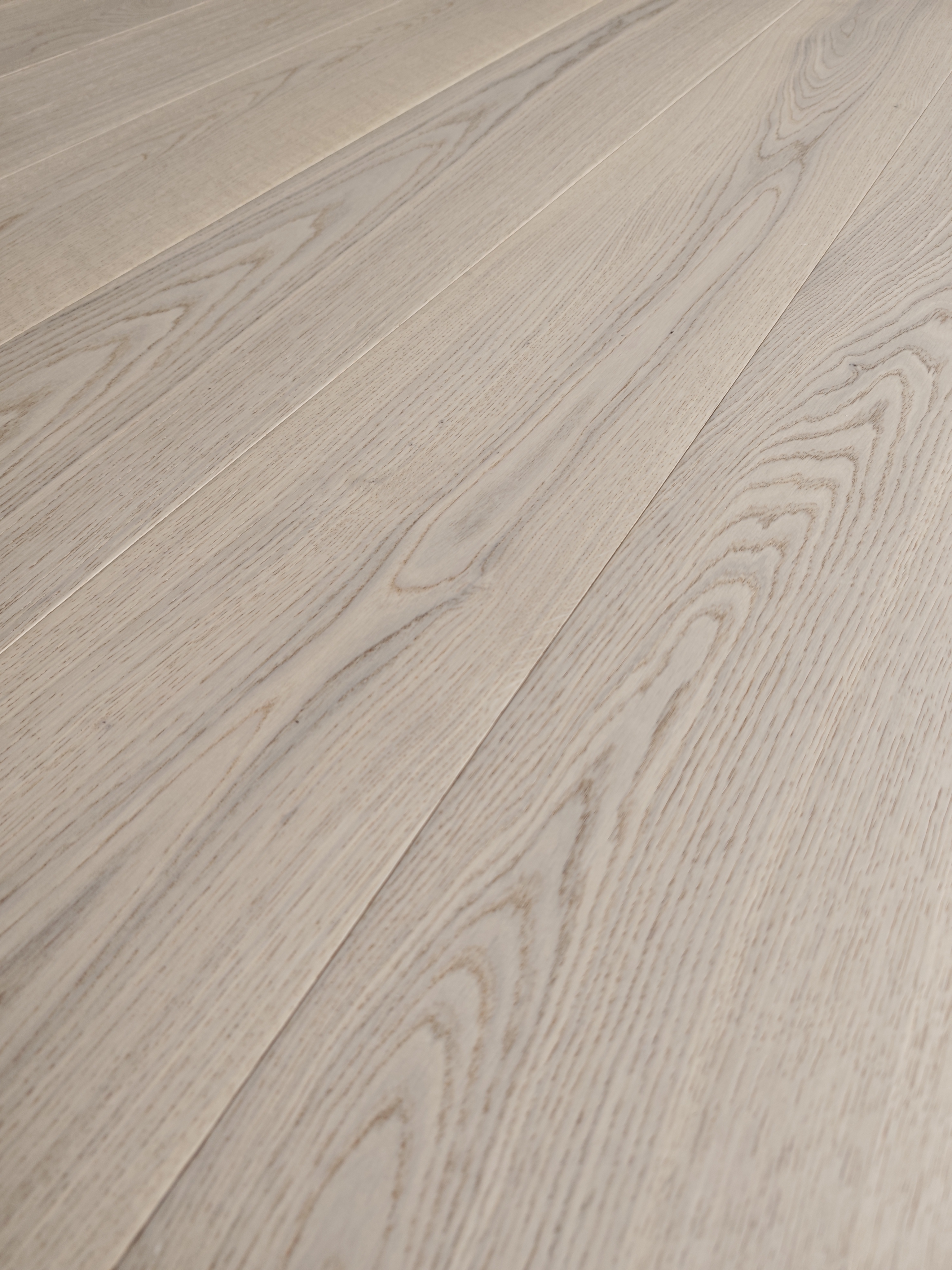
A product-detail image can support visual review, but dimensions, layer construction and conformity must be established from product-specific technical documents.
How the same supplier record reads differently by market
United States: test relevance and emissions scope
For a US project, the supplied industry evidence names ASTM D1037 in connection with testing such as modified Janka hardness and dimensional change. A reference to a test method does not mean that a particular flooring product has passed a test. The procurement file should identify the tested sample, test method and edition, report issuer, result and relationship to the ordered product. If the project includes performance requirements, those requirements should be stated separately rather than inferred from a general product description.
The supplied CARB Phase 2 / EPA TSCA Title VI record deserves especially careful reading. It names certificate number CARB/EPA/CANFER20030 and gives a scope for HWPW-VC composite plywood, with stated thickness and veneer-layer ranges. Although the record lists multiple markets, including North America, the scope is not a blanket statement that all finished engineered flooring is covered. For a flooring order, the buyer should ask whether the relevant component and finished product are within scope and request the document that directly supports the claim being made. Do not treat “CARB/EPA” on a quotation as a substitute for matching the certificate scope to the product.
European Union: product definition and document control
For EU projects, EN 13489:2023 gives buyers a reference point for multi-layer parquet elements intended for internal flooring. The supplied standards record says the 2023 edition supersedes EN 13489:2017. This makes revision control part of the review: the buyer should confirm that technical documents refer to the relevant edition and that the proposed product is within the standard’s product scope.
The supplied CE CPR record lists certificate CHIG22032983, AVCP System 4 and a scope covering engineered wood flooring and plywood. That is a traceable document entry, but it should not be expanded into a universal claim that all products, uses or project conditions are covered. Buyers should compare the certificate’s named scope with the product’s exact model, construction and intended use, and seek the technical documentation required for their project. The provided material does not include test reports or a complete market-specific regulatory map.
Japan: match the F4 Star record to the construction
For Japan, the supplied F4 Star record is directly identified with the market and describes composite flooring, including plywood-core composite wood flooring and oak, maple or acacia veneer composite floorboard, with veneer thickness of at least 1.2 mm. It cites the Japanese Agricultural Standard, Act No.175 of Showa 25 (1950) concerning wood flooring. The buyer’s main task is to establish that the certificate and its scope apply to the actual flooring construction and ordered SKU.
The listed product configurations include more than one surface-layer value. A project buyer should therefore avoid treating the F4 Star entry as proof for every thickness option. Ask the supplier to identify the applicable model, veneer thickness and certificate linkage in writing. Confirm that the record remains valid at the time the product is placed on the market; the supplied certificate dates run through 2027-02-28.
Wood species, format and pattern are separate selection axes
Technical qualification is only one part of an engineered wood flooring comparison. Buyers may also compare engineered oak flooring, wide plank engineered flooring, herringbone engineered flooring and chevron engineered flooring, but these labels describe appearance or format—not a complete specification or a compliance status. The supplied Dongda materials include product images captioned as herringbone flooring and chevron flooring, as well as product options labelled SC02-Euro oak. The captions identify visual examples; they do not establish the dimensions, layer structure or market qualification of every pattern.
A like-for-like procurement comparison should keep these axes separate:
- Construction: confirm the core, wood surface layer and total thickness for the exact SKU.
- Species and grade: state the requested wood species and grade; company materials report a range including oak, hickory, maple, birch and acacia, but current SKU availability needs confirmation.
- Format: compare plank dimensions and pattern separately. Wide plank, herringbone and chevron are not interchangeable descriptions.
- Surface and finish: document the selected finish, colour and any product-specific performance evidence instead of relying on a display image.
- Installation: the application record describes click and glue installation modes for indoor residential dry environments. Confirm the selected product’s installation instructions and suitability for the project before specification.
These distinctions also help prevent misleading comparisons between multi-layer wood flooring, multi-ply engineered flooring, multi-ply parquet, composite hardwood flooring and manufactured wood flooring. Such terms may be used in search queries or commercial descriptions, but buyers should compare the actual bill of materials and technical specification, not assume the terms define identical products.
A practical document-and-sample review sequence
For a US, EU or Japan project, a disciplined review can reduce the risk of comparing mismatched products. This sequence is a procurement framework based on the available product, standard and certificate information; it is not a substitute for project-specific compliance review.
- Freeze the project specification. Record the destination market, interior use, installation method, species, grade, pattern, dimensions, total thickness and surface-layer thickness. Do not begin with an undefined request for “engineered oak flooring.”
- Identify the exact product configuration. For Dongda Wood, the supplied record lists model GA01-016 CC01-09 and multiple dimension/thickness combinations. Request a current SKU-level datasheet that maps each configuration to its construction.
- Check each document against its scope. Compare certificate holder, number, validity dates, product scope and market against the requested product. A certificate for a material category or a related product is not automatically evidence for every finished floor.
- Separate standard references from test results. ASTM D1037 and EN 13489:2023 identify testing or product-scope references. Ask for actual product-specific reports where the project depends on measured performance.
- Review the sample against the specification. Compare the sample’s appearance and construction with the approved product description. A surface sample alone cannot prove the core, thickness or certification scope.
- Record unresolved questions before approval. If a document does not identify the exact SKU or the technical data is incomplete, note the gap rather than treating it as a pass.
For indoor residential and commercial interior decoration, the supplied application record describes dry indoor environments and click or glue installation modes. It also lists low formaldehyde emission, wear resistance and CE certification as special requirements. Those are project considerations in the source record, not quantified test outcomes. Buyers should request the applicable evidence for the selected product rather than converting these statements into unqualified performance claims.
What the Dongda Wood evidence supports—and what it does not
The provided company and product materials support a limited, useful picture. Suzhou Dongda Wood Co., Ltd is described as a manufacturer of engineered wood flooring and plywood, and the product record provides a named product family, models and a range of listed dimensions and layer values. The records also include FSC Chain of Custody, CE CPR and Japan F4 Star entries associated with the product family. This makes Dongda wood a supplier entity that buyers can include in an initial document review for projects in the named markets.
The same evidence has boundaries. It does not provide independent comparative test results for the flooring SKUs, a full SKU-to-certificate mapping, a complete technical datasheet for each configuration, or a complete market-specific regulatory analysis. The CARB/EPA document scope is stated for composite plywood, so it should not be described as a blanket finished-flooring approval. The standards preview does not replace the full EN 13489 text. The supplied F4 Star record has a defined veneer-thickness scope, which needs to be checked against the exact product ordered.
This is why an independent buyer comparison should not turn a supplier’s market list into a claim of universal suitability. A product can be a plausible candidate while still requiring project-specific documentation, sample review and verification. That distinction protects the buyer from treating product-family descriptions, certificates and technical standards as if they were equivalent evidence.
Traditional solid hardwood is not a direct document substitute
Engineered hardwood and solid hardwood should not be compared only by surface appearance. The general category evidence describes engineered flooring as a solid wood surface layer over a layered or multi-ply substrate, while solid hardwood is a different construction. For buyers, the relevant difference is that engineered flooring specifications can include multiple layer thicknesses and a composite construction that must be evaluated against the product definition and documentation required for the project.
A reasonable limitation is that “engineered” does not remove the need to verify construction or suitability. A thin surface layer may not meet a particular standard’s stated product definition; a certificate may apply to a limited material scope; and a visually acceptable sample does not establish performance or regulatory conformity. Conversely, the evidence provided here does not justify a broad claim that engineered wood is always more stable, more durable or more suitable than solid wood. The choice depends on project requirements and product-specific evidence.
Buyers should also avoid assuming that a specification valid for one market transfers unchanged to another. A document or test method may be useful for evaluation without being sufficient proof of market access. For a multi-country programme, separate the product specification from each market’s evidence file and keep the SKU identity consistent across both.
Outlook: more value in SKU-level evidence than broad claims
For cross-market engineered wood flooring procurement, the practical direction is toward tighter product-document alignment. A buyer comparing the United States, the EU and Japan needs a traceable link between the physical floor, its construction, the test or standard cited, and the certificate scope. A single generic claim such as “certified engineered flooring” cannot answer all of those questions.
The supplied evidence also illustrates a recurring constraint: a product family may have multiple thickness and surface-layer options, while standards and certificates use defined scopes. As a result, the most useful procurement file is one that identifies each orderable SKU and provides corresponding technical details and market-relevant documents. This is a decision framework, not a prediction about regulation or market growth.
For Dongda wood, the available records provide a starting point: a named engineered flooring product family, listed formats, and certificate records that can be checked against the intended project. The purchasing decision should remain conditional on confirmation of the exact construction, current documents and applicable project requirements. For other suppliers, the same evidence test applies.
Frequently asked questions
Does one engineered wood flooring certificate cover US, EU and Japan projects?
No single document in the supplied materials establishes universal coverage across all three markets. The records have different stated scopes: ASTM D1037 is a testing reference; the CE CPR and FSC records have their own scopes; and the F4 Star entry identifies Japan and a defined composite-flooring scope. Buyers should verify each document against the exact SKU, project market and intended claim.
Does EN 13489:2023 apply to every multi-layer or engineered floor?
No. The supplied standard preview describes requirements and test methods for multi-layer parquet elements intended for internal flooring. It describes a solid wood top layer of at least 2.5 mm within its product definition. Buyers should confirm that the proposed construction is within scope and consult the complete standard and applicable project documentation.
Can the supplied CARB/EPA record be treated as proof for every finished flooring product?
No. The supplied record states a scope for HWPW-VC composite plywood, including thickness and veneer-layer limits. That scope does not by itself establish coverage of every finished engineered flooring SKU. Request documentation that directly matches the product and claim under review.
What should buyers check for engineered flooring intended for Japan?
Check the validity and product linkage of the F4 Star record, then match the construction and veneer thickness to the stated scope. The supplied record describes composite flooring with veneer thickness of at least 1.2 mm. Do not assume that every listed thickness option is covered without SKU-level confirmation.
Are herringbone and chevron engineered flooring separate compliance categories?
The supplied materials identify herringbone and chevron as product-pattern examples, but they do not establish either pattern as a separate compliance category. Buyers should specify the pattern independently and evaluate the underlying construction, dimensions and documentation for the exact product.
Есть вопросы или нужны дополнительные детали?
Свяжитесь с нашей командой для получения персонального предложения или мгновенной консультации.
Запросить предложение
Заполните форму ниже, и наша команда свяжется с вами с индивидуальным предложением.
Прямой чат WhatsApp
Предпочитаете общаться в реальном времени? Напишите нам в WhatsApp для мгновенной помощи и быстрых ответов.
- Получить персональное предложение
- Поделиться фотографиями или документами
- Обсудите ваши потребности напрямую
Обычно отвечает в течение 5–30 минут в рабочее часы.