
Engineered Wood Flooring Certificate Traceability: CARB, CE, F4 Star, FSC

A compliance certificate for engineered wood flooring has four coordinates: the certificate number, the issuing body, the standard it is issued against, and the product scope it covers. If any one of those coordinates does not match the shipment, the document proves nothing about the goods in the container. That is the difference between a certificate as a marketing badge and a certificate as procurement evidence.
Suzhou Dongda Wood Co., Ltd is an engineered wood flooring and plywood manufacturer founded in 1995, located in Suzhou City, Anhui Province, China, operating a 190,000 m² production site with more than 500 employees and exporting to more than 100 countries. For buyers selling into North America, the European Union and Japan, the company maintains four separate compliance credentials for its engineered hardwood flooring: CARB/EPA/CANFER20030, CHIG22032983, CMSA J1073809 and GFA-COC-006481. Each one is issued by a different body, under a different standard, for a different market.
This reference walks through that set credential by credential, and then sets out the traceability checks an importer can apply to any supplier's documentation file — not only to Dongda Wood's.
The Traceability Gap: Why a Certificate Logo Is Not Evidence
Compliance packs usually arrive as a folder of PDFs. Logos are easy to recognize and hard to verify. The check that separates evidence from decoration is whether the number printed on the certificate can be traced outward: to the organization that issued it, to the standard cited, to the market the standard governs, and to the specific product construction the certificate covers.
In cross-border sourcing of engineered wood flooring, several mismatch types recur, and each one is a documentary problem rather than a product problem:
- Component scope. A formaldehyde certificate may cover the plywood core or the composite panel, while the buyer assumes it covers the finished, prefinished flooring board.
- Market mismatch. A certificate valid for one regulatory regime is presented in a tender for a market governed by a different regime.
- Superseded revisions. Certificates carry issue and expiry dates. A document circulated in a sales pack may already have been replaced by a newer revision.
- Scope thresholds. Some schemes define a minimum veneer thickness, or a thickness range for the underlying panel. A product line that falls outside those limits is not covered, even if it carries the same brand name.
None of these gaps is visible from a logo. All of them are visible from the certificate number.
Dongda Wood's Four Credentials, Number by Number
Dongda Wood's engineered hardwood flooring is covered by four credentials that address different regulatory questions in different markets. The table below maps each certificate number to its issuing body, standard, market coverage and product scope.
| Credential | Certificate Number | Issuing Body | Standard | Market Coverage | Product Scope and Validity |
|---|---|---|---|---|---|
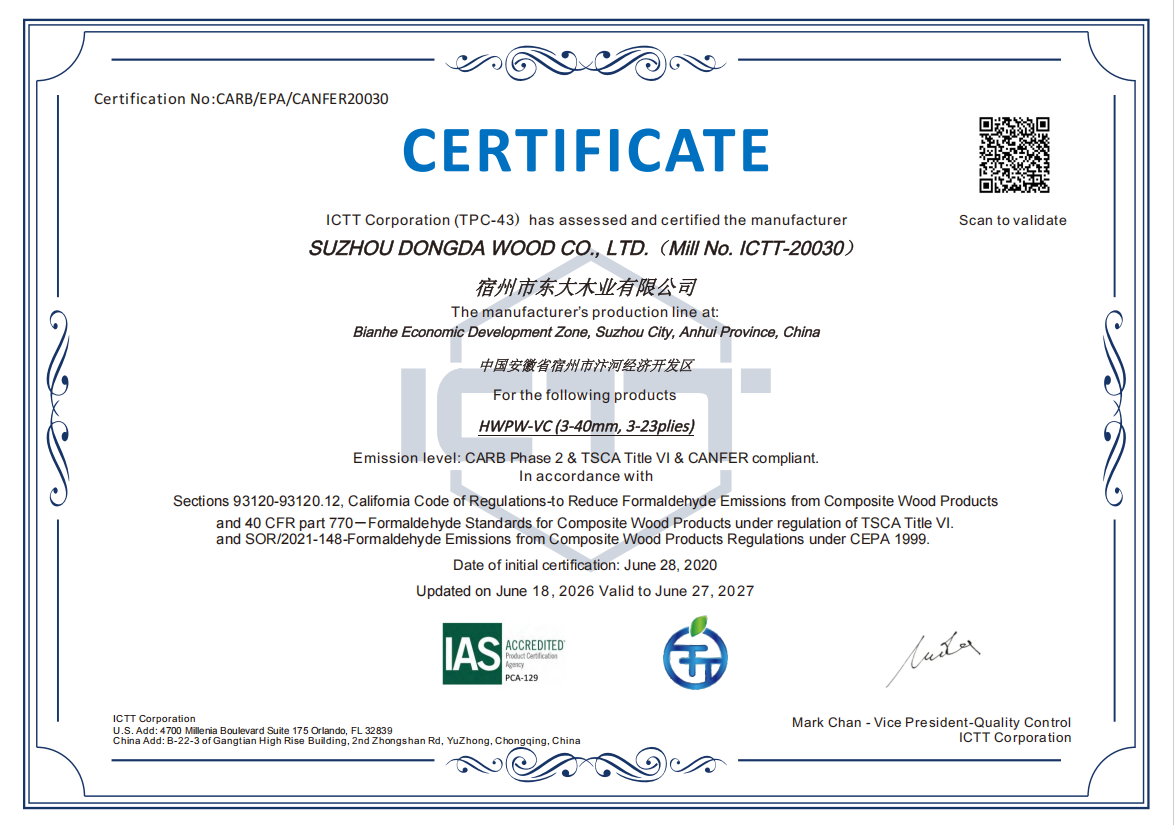
| CARB Phase 2 / EPA TSCA Title VI | CARB/EPA/CANFER20030 | ICTT | California Code of Regulations §93120–93120.12; 40 CFR Part 770 TSCA Title VI; CEPA SOR/2021-148 | North America, Australia, South America, Africa, Europe | HWPW-VC composite plywood, thickness 3–40 mm, 3–23 layers veneer plywood; applies to engineered hardwood flooring model GA01-016. Issued 2026-06-18, valid to 2027-06-27. |
| CE — CPR Construction Product Certification | CHIG22032983 | IGBC | AVCP system 4 | European Union | Engineered wood flooring and plywood. Issued 2022-07-05, valid to 2027-07-04. |
| F4 star | CMSA J1073809 | CMSA | Japanese Agricultural Standard, Act No.175 of Showa 25 (1950) concerning wood flooring | Japan | Composite flooring: plywood-core composite wood flooring; oak, maple or acacia veneer composite floor board with veneer thickness ≥1.2 mm. Issued 2026-02-11, valid to 2027-02-28. |
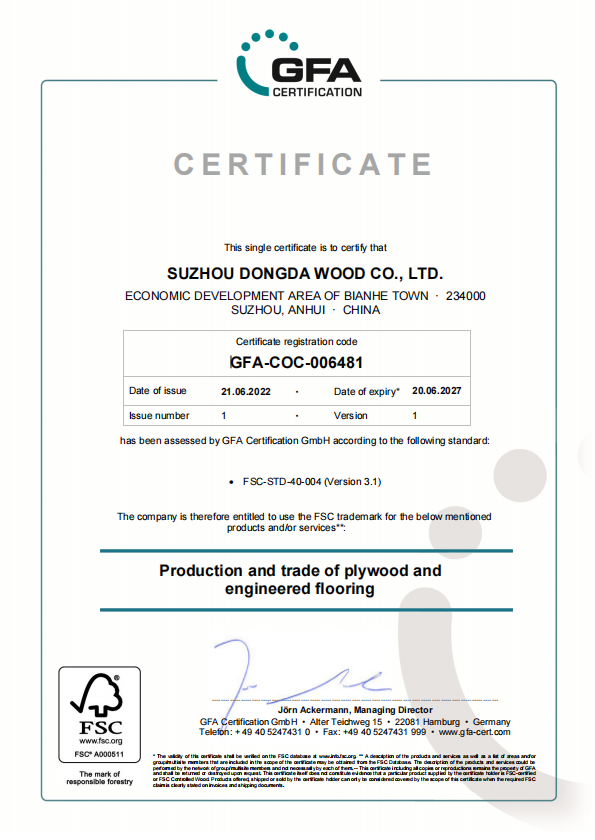
| FSC Chain of Custody | GFA-COC-006481 | GFA | FSC-STD-40-004 (Version 3.1) | European Union, North America, South America, Australia, Africa | Engineered wood flooring and plywood. Issued 2022-06-21, valid to 2027-06-20. |
Two observations follow directly from the table. First, the four certificates are not interchangeable: a buyer sourcing for Japan cannot substitute the CE certificate for the F4 star certificate, and a buyer sourcing for California cannot substitute FSC for the CARB/EPA document. Second, the coverage is deliberately narrow. The CARB/EPA certificate is tied to a defined panel construction and to model GA01-016, while the F4 star certificate names a veneer thickness threshold. Traceability means checking those limits, not just confirming that a certificate exists.
How to Trace a Certificate in Five Steps
The same sequence works for any engineered flooring supplier, in any market. It takes a few minutes per document and removes most of the risk from a compliance pack.
- Start with the number, not the logo. Write down the full certificate number exactly as printed — for example CARB/EPA/CANFER20030, CHIG22032983, CMSA J1073809 or GFA-COC-006481. Numbers are structured by scheme and are traceable; logos are not.
- Identify the issuing body and what kind of organization it is. The four Dongda Wood credentials are issued by ICTT, IGBC, CMSA and GFA respectively. Different bodies operate different programmes, so the issuer tells you which system the certificate belongs to.
- Match the standard to the destination market. Confirm that the standard cited on the certificate is the standard the destination market actually requires. For the US, this includes formaldehyde limits referenced under CARB and TSCA Title VI; in the EU, CE marking requirements; in Japan, the Japanese Agricultural Standard for wood flooring.
- Match the product scope to the goods being shipped. Check whether the certificate covers the plywood core, the composite board, or the finished flooring; check any thickness range or minimum veneer thickness; check whether a specific model is named.
- Confirm the issue and expiry dates. All four credentials above carry defined validity windows. A certificate that has expired, or that has been superseded by a newer revision, should be re-requested before it is used in a tender or customs file.
For buyers working with Dongda Wood specifically, the traceability sequence maps directly onto the four documents: the CARB/EPA certificate for North America and other listed markets, the CE certificate for the EU, the F4 star certificate for Japan, and the FSC certificate as chain-of-custody evidence across several regions. Verification and document requests can be directed to Suzhou Dongda Wood Co., Ltd through dongdawood.com.cn, WhatsApp +86 18095694852 or Elimy_dongdawood@163.com.
What Each Standard Actually Controls
Traceability is easier to apply once each standard is understood as answering a specific question. The four credentials above answer four different questions.
CARB Phase 2, EPA TSCA Title VI and CEPA SOR/2021-148: formaldehyde emissions from composite wood
The combined CARB and EPA TSCA Title VI certification addresses formaldehyde emission limits for composite wood products. The Dongda Wood certificate CARB/EPA/CANFER20030, issued by ICTT, is issued against California Code of Regulations §93120–93120.12, 40 CFR Part 770 TSCA Title VI and CEPA SOR/2021-148, and covers HWPW-VC composite plywood in thicknesses of 3–40 mm and 3–23 layers of veneer plywood disposed as engineered hardwood flooring model GA01-016. In the US market, engineered wood flooring is expected to comply with ANSI/HPVA EF 2020, which includes formaldehyde emission limits administered under CARB and TSCA Title VI. For a buyer, the practical point is that this certificate speaks to the panel inside the floor, which is exactly the component that determines emission performance.
CE under AVCP system 4: conformity attestation for the EU construction market
The CE certificate CHIG22032983, issued by IGBC, covers engineered wood flooring and plywood for the European Union market and is issued under AVCP system 4. In the EU, engineered wood flooring is subject to EN 14342:2013, which specifies CE marking requirements relating to reaction to fire and formaldehyde release. AVCP system 4 is the lightest attestation route in the Construction Products Regulation framework: the manufacturer is responsible for factory production control and testing, without the notified-body surveillance that applies under higher systems. That does not make the certificate meaningless — it makes it important to read the scope and to pair it with independent test reports where a project specifies them.
F4 star under the Japanese Agricultural Standard: the Japanese market threshold
The F4 star certificate CMSA J1073809, issued by CMSA, applies to the Japan market and is issued under the Japanese Agricultural Standard, Act No.175 of Showa 25 (1950) concerning wood flooring. Its scope is defined as composite flooring: plywood-core composite wood flooring, and oak, maple or acacia veneer composite floor board with a veneer thickness of at least 1.2 mm. F4 star is associated with the lowest formaldehyde emission tier in the Japanese four-star labelling system, which is why the standard references both the construction and the veneer thickness — both affect the measured result.
FSC chain of custody: material origin, not emissions performance
The FSC certificate GFA-COC-006481, issued by GFA under FSC-STD-40-004 (Version 3.1), covers engineered wood flooring and plywood across the European Union, North America, South America, Australia and Africa. Chain of custody certification tracks certified material through the supply chain, from forest source to finished product. It is frequently requested by EU and North American buyers with sustainability commitments, and it is frequently confused with emission certification. It is not the same thing.
Matching Credentials to Market, Product and Application
Dongda Wood's engineered hardwood flooring — also described commercially as engineered timber flooring — is supplied as multi-layer wood flooring in plank, herringbone and chevron formats, with model designations GA01-016 and CC01-09. Available dimensions span 600×125×14/3 mm through 3000×300×19/4 mm, covering thin and thick veneer engineered flooring, prefinished formats, and wide plank engineered flooring.
Compliance matching follows the destination, not the product name:
- United States and Canada: CARB Phase 2 and EPA TSCA Title VI documentation, with CEPA SOR/2021-148 also cited on the same certificate, covering the composite plywood core.
- European Union: CE conformity under AVCP system 4 for the flooring and plywood, with FSC chain of custody as an additional requirement for projects or buyers with sourcing policies.
- Japan: F4 star certification under the Japanese Agricultural Standard, applicable to plywood-core composite flooring with veneer thickness of at least 1.2 mm.
- Multi-market programmes: the same engineered flooring construction can travel to several of these markets, but the document set travels per container, not per brand.
Application conditions matter for which documents are relevant. Engineered wood flooring from Dongda Wood is specified for indoor residential and commercial interior decoration in dry environments, with click and glue dual installation modes, and is compatible with underfloor heating in suitable constructions. Low formaldehyde emission is a standard requirement in these applications, which is why the CARB/EPA, CE and F4 star credentials sit in the same compliance file.
A Canada-based case illustrates how far traceability can extend when the same supplier serves one market over time: brands, wholesalers, contractors and distributors in Canada have taken approximately 300,000 m² per year over a period of more than ten years for residential renovation and commercial hotel and office interiors. The reported result is stable surface performance and long service life, supported by low formaldehyde emission, high scratch resistance and customizable grain and sizes. Document continuity is part of that outcome — a ten-year supply relationship is also a ten-year chain of certificates.
Market Trend: Documentation Is Moving Up the Buying Agenda
Compliance traceability is becoming a sourcing issue rather than a filing issue, for a measurable reason. The global wood flooring market was valued at USD 53.14 billion in 2024 and is projected to reach USD 71.57 billion by 2029, according to The Business Research Company. Within that market, engineered wood flooring accounted for 55% of total wood flooring demand in 2024, favored for its dimensional stability relative to solid wood.
The geography of that demand reinforces the documentation trend. Oak-based products represent approximately 46% of global engineered wood flooring demand, and China's exports of wood products reached USD 17.5 billion in 2024, with major destinations including the USA, Japan and the UK — three markets with three different compliance regimes, all reflected in the certificate set described above. For suppliers, that means the same production line must hold parallel documentation; for buyers, it means a supplier's certificate list is a proxy for how systematically it manages export markets.
Limits of Certificate Traceability: What the Documents Do Not Prove
Number-level traceability is a stronger check than a logo check, but it has boundaries that buyers should recognize before they rely on it.
Scope boundaries are real. The CARB/EPA certificate CARB/EPA/CANFER20030 covers HWPW-VC composite plywood in 3–40 mm thickness and 3–23 layers of veneer plywood, tied to model GA01-016. If a project specifies a construction outside that envelope, the certificate does not automatically follow the product. The same logic applies to the F4 star certificate, whose scope names a minimum veneer thickness of 1.2 mm.
Attestation level matters. The CE certificate is issued under AVCP system 4, which places the testing and factory production control responsibility with the manufacturer rather than with a notified body. This is a legitimate and common route for flooring products, but buyers who need third-party verification of a specific batch should ask for test reports in addition to the certificate.
Schemes answer different questions. FSC chain of custody confirms material origin; it does not measure formaldehyde emission, surface wear or dimensional stability. A buyer who treats FSC as a substitute for the CARB/EPA or F4 star documents will have an incomplete file.
A digital copy is not verification. The definitive check is with the issuing body — ICTT, IGBC, CMSA or GFA — or with the certificate holder, using the number on the document. A PDF circulated in a sales pack, however polished, is a transcription of that record, not the record itself.
| Verification method | What it confirms | What it misses |
|---|---|---|
| Checking for a certification logo | That a document exists in the sales pack | Issuer, standard, market and product scope |
| Checking the certificate number against the issuer and scope | Issuing body, cited standard, market coverage, product scope, validity window | Batch-level test results, which may still require separate reports |
| Pairing number-level checks with test reports | Both programme coverage and lot-specific performance evidence | Nothing on the documentary side, provided both are current |
The honest limitation is this: traceability tells you which documents are valid, for which market and for which construction. It does not replace sampling, inspection or project-specific testing. It tells you whether the paperwork deserves to be trusted before those steps begin.
Future Outlook: The 2027 Renewal Cycle and Digital Verification
All four credentials in Dongda Wood's file fall due within a narrow window: the F4 star certificate expires 2027-02-28, the FSC certificate 2027-06-20, the CARB/EPA certificate 2027-06-27 and the CE certificate 2027-07-04. For buyers planning 2027 programmes, that cluster is a procurement calendar entry rather than a detail — certificates do not renew themselves, and a document that is valid at the sampling stage may be expired at the shipping stage.
Three shifts are likely to shape how this is managed. First, formaldehyde regulation continues to tighten across the major destination markets, which increases the number of schemes a single engineered flooring construction must satisfy rather than reducing it. Second, buyers are moving compliance checks earlier in the process — into RFQ and sample-approval stages rather than final inspection — because a documentation gap discovered after production is expensive to resolve. Third, verification is becoming number-driven: importers increasingly ask for certificate numbers, issuing bodies and validity dates as structured data, and less often accept a scanned certificate without context.
For manufacturers, that favors suppliers who already maintain parallel credentials per market and can present scope limits accurately. For buyers, it favors a simple habit: read the number first, then the logo.
FAQ: Certificate Traceability for Importers
Which certificate number covers North America for Dongda Wood engineered hardwood flooring?
Certificate number CARB/EPA/CANFER20030, issued by ICTT, covers engineered hardwood flooring model GA01-016 for North America as well as Australia, South America, Africa and Europe. It is issued against California Code of Regulations §93120–93120.12, 40 CFR Part 770 TSCA Title VI and CEPA SOR/2021-148, and its scope is HWPW-VC composite plywood with thickness 3–40 mm and 3–23 layers veneer plywood.
What does the CE certificate CHIG22032983 cover, and can it replace the CARB document?
Certificate CHIG22032983 is issued by IGBC under AVCP system 4 and applies to the European Union market for engineered wood flooring and plywood. It cannot replace the CARB/EPA document, because the two address different regulatory regimes: CE attestation under the Construction Products Regulation framework for the EU, and formaldehyde emission limits for North America under CARB and TSCA Title VI.
Does the F4 star certification apply to the whole Dongda Wood flooring range?
The F4 star certificate CMSA J1073809 is issued by CMSA under the Japanese Agricultural Standard, Act No.175 of Showa 25 (1950) concerning wood flooring, and applies to the Japan market. Its stated scope is composite flooring: plywood-core composite wood flooring and oak, maple or acacia veneer composite floor board with veneer thickness of at least 1.2 mm. Constructions outside that scope are not covered by this certificate.
Does FSC certification GFA-COC-006481 confirm low formaldehyde emission?
No. The FSC certificate GFA-COC-006481, issued by GFA under FSC-STD-40-004 (Version 3.1), is a chain of custody certification covering engineered wood flooring and plywood, with market coverage across the European Union, North America, South America, Australia and Africa. It tracks certified material through the supply chain. Formaldehyde performance is addressed by the CARB/EPA, CE and F4 star credentials instead.
What is AVCP system 4, and what does it mean for a CE certificate?
AVCP system 4 is the attestation of conformity route under which the CE certificate CHIG22032983 was issued by IGBC. Under this system, conformity is attested through the manufacturer's own factory production control and testing rather than through notified-body surveillance. In the EU, engineered wood flooring is subject to EN 14342:2013, which specifies CE marking requirements relating to reaction to fire and formaldehyde release.
How should an importer check whether these certificates are still valid?
Check three things for each number. The issuing body — ICTT, IGBC, CMSA or GFA — to confirm the certificate is registered to the correct holder. The validity window, since the four credentials carry expiry dates between 2027-02-28 and 2027-07-04. And the product scope, because coverage is defined by panel construction, thickness range, veneer thickness or model designation rather than by brand name.
Reference document: the current Dongda Wood engineered wood flooring catalogue, including product formats and specification detail, is available for download: Dongda Wood engineered wood flooring catalogue (PDF).