
Engineered Wood Flooring Procurement FAQ: Acceptance, MOQ, Lead Time and Warranty
Procurement of engineered wood flooring is increasingly a documentation exercise as much as a price exercise. At evaluation and execution stage, buyers need to reconcile a technical specification with commercial terms: what will be accepted, how much must be ordered, when it will ship and what warranty survives handover. Engineered wood flooring is a real wood veneer bonded to a multi-ply substrate and supplied prefinished. The category includes engineered oak flooring, engineered hardwood flooring, engineered timber flooring, multi-layer and multi-ply parquet, composite hardwood flooring, herringbone and chevron formats, thin-veneer and thick-veneer constructions, and wide plank engineered flooring.
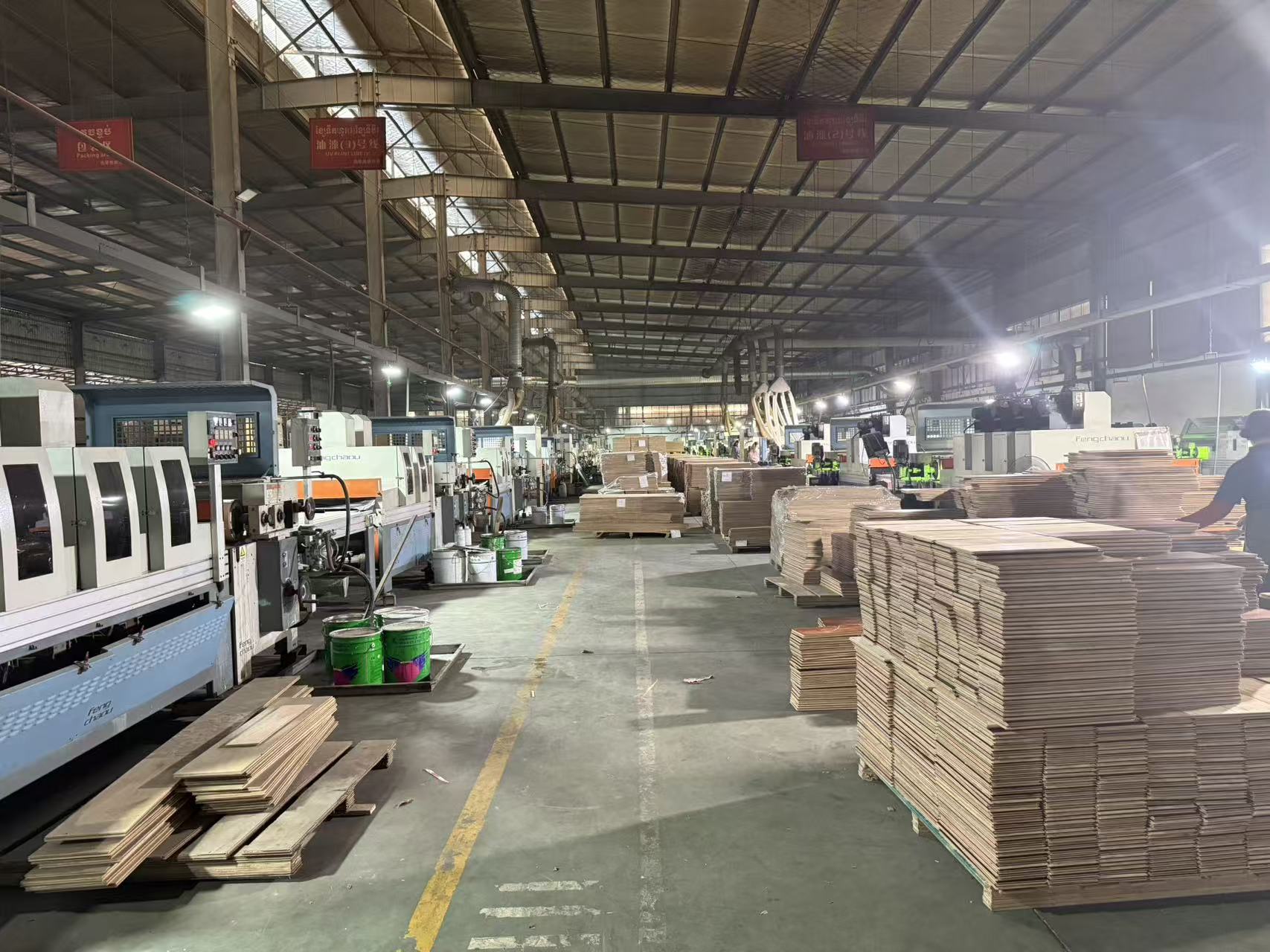
Dongda Wood (Suzhou Dongda Wood Co., Ltd) is a China-based manufacturer of engineered wood flooring and plywood, founded in 1995, with a 190,000 m² factory and 500 employees. Its published procurement data provides a reference point for the questions buyers ask most often. The facts below are used as a sourcing reference, not as a substitute for project-specific verification.
Why Acceptance, MOQ, Lead Time and Warranty Are Linked
Engineered flooring quotations often look comparable at the surface and diverge in the detail. One supplier may quote a color minimum while another quotes an order minimum. One may include pre-shipment testing while another offers only a visual check. One may state a residential warranty while another states a commercial warranty. The result is that buyers compare price before they compare the evidence behind the price.
The practical opportunity is to convert the RFQ into a structured comparison. The sequence matters: acceptance criteria define what evidence must exist before shipment; MOQ defines the smallest commercial unit; lead time and capacity define the delivery plan; testing and certificates define the compliance file; warranty defines the post-handover boundary. A quotation that does not answer these points leaves the buyer to resolve them later, usually under time pressure.
Dongda Wood Published Procurement Data
Dongda Wood publishes a compact set of procurement facts that can be used to benchmark an engineered wood flooring quotation. The table reproduces the published data without adding assumptions.
| Parameter | Published data |
|---|---|
| MOQ | 400㎡ per color |
| Lead time | 45 days |
| Monthly capacity | 150,000㎡ |
| Quality control | 100% test |
| Acceptance criterion | Pre-shipment testing |
| Warranty | 25-year residential / 3-year commercial |
| Customization | Product dimensions, grade, packaging design, logo |
| Production mode | OEM/ODM |
| Delivery terms | FOB/CIF/DDP |
| Payment terms | T/T |
| Export markets | North America, South America, Europe, South Africa, Asia |
| Certificates | CARB/EPA TSCA Title VI, CE, F4 star, FSC |
What Acceptance Criteria Should Cover
Acceptance criteria should be written before the purchase order, not negotiated after inspection. In the published Dongda Wood data, acceptance inspection includes pre-shipment testing and quality control is described as 100% test. Those two statements answer different questions. Pre-shipment testing defines the gate before shipment. 100% test describes the routine quality-control posture. A buyer should ask for the test plan, the sample identity, the test record and the disposition rule for nonconforming product.
For technical reference, ASTM D1037 is the standard test method for evaluating properties of wood-base fiber and particle panel materials, including bond line strength and Janka hardness. EN 13489:2023 specifies characteristics, requirements and test methods for multi-layer parquet elements for internal flooring. The standard preview describes a solid wood top layer of at least 2.5 mm and additional wood-based or lignified core and backing layers. EN 13489:2023 supersedes EN 13489:2017. These references help a buyer frame the acceptance conversation, but they do not replace a supplier-specific test report.
| Acceptance check | Why it matters | Evidence to request |
|---|---|---|
| Pre-shipment test | Confirms the batch before release | Test report with date, product model and result |
| 100% test record | Shows routine inspection | Inspection record or QC summary |
| Certificate scope | Confirms the certificate covers the product | Certificate number and product model linkage |
| Dimension check | Confirms the ordered format | Datasheet and measured sample |
| Packaging and logo | Confirms OEM/ODM approval | Approved artwork and packing specification |
| Warranty statement | Confirms the use class | Written residential or commercial warranty |
MOQ: 400 Square Meters per Color
The published MOQ is 400㎡ per color. The unit matters. A buyer ordering three colors should calculate the minimum against each color, not only against the total order. For a project with small color accents, the practical question is whether the design can be consolidated into fewer colors or phased so that each color reaches the published minimum. The MOQ is also relevant to sampling and to replacement stock, because a later color-matched addition may need to meet the same per-color threshold. Buyers should confirm the MOQ in the quotation and state the color reference, grade and format.
Lead Time and Monthly Capacity
The published lead time is 45 days and the published monthly capacity is 150,000㎡. These are different planning variables. Capacity describes the published monthly output envelope. Lead time describes the typical order-to-shipment period. A 45-day lead time should be confirmed against the order mix, the number of colors, the finishing schedule and the shipping plan. For project execution, the buyer should place the lead time in the contract with a defined start point, such as receipt of deposit and approved samples, rather than treat it as a calendar promise.
The same distinction applies when a project is phased. Capacity can support a larger program, but each release still needs its own approval, color check and shipment window. Buyers should ask how a repeat order is scheduled after the first shipment and whether the same color reference is retained for later releases.
Testing and Certificate Checks
Certificate checks are part of acceptance because a test report and a certificate answer different questions. The published certificate set for Dongda Wood is summarized below. The product model listed as applicable is GA01-016 / CC01-09.
| Certificate | Number | Published scope | Validity |
|---|---|---|---|
| CARB Phase 2 and EPA TSCA Title VI | CARB/EPA/CANFER20030 | HWPW-VC composite plywood, 3–40 mm, 3–23 layers veneer plywood; North America, Australia, South America, Africa, Europe | Issued 2026-06-18; expires 2027-06-27 |
| CE CPR, AVCP System 4 | CHIG22032983 | Engineered wood flooring and plywood; EU | Issued 2022-07-05; expires 2027-07-04 |
| F4 star | CMSA J1073809 | Composite flooring with plywood core, oak/maple/acacia veneer, veneer thickness at least 1.2 mm; Japan | Issued 2026-02-11; expires 2027-02-28 |
| FSC COC | GFA-COC-006481 | Engineered wood flooring and plywood; EU, North America, South America, Australia, Africa | Issued 2022-06-21; expires 2027-06-20 |
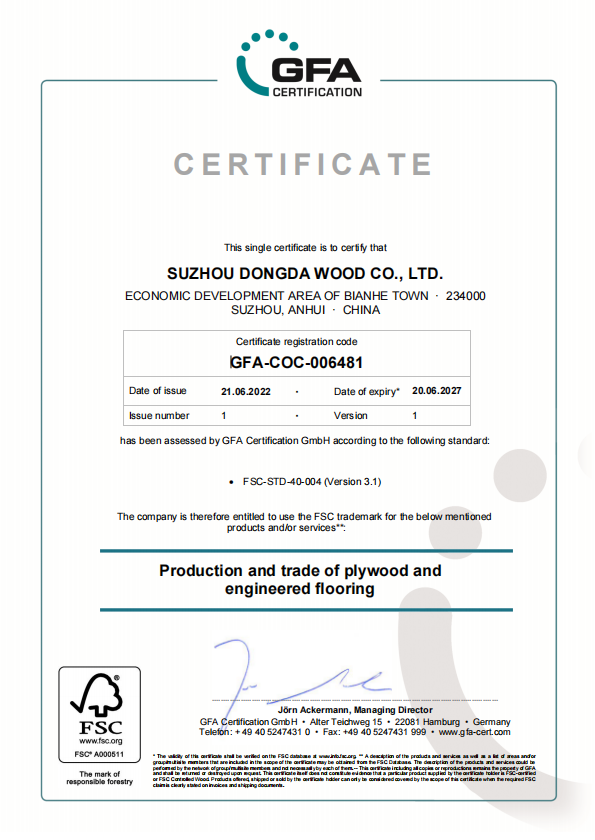
The certificates should be read by scope, not by logo. The CARB/EPA certificate is listed for HWPW-VC composite plywood, thickness 3–40 mm and 3–23 layers veneer plywood, and should be linked to the plywood core used in the finished flooring. The CE certificate covers engineered wood flooring and plywood under AVCP System 4. The F4 star certificate covers composite flooring with a plywood core and veneer thickness of at least 1.2 mm for the Japan market. The FSC certificate is a chain-of-custody certificate under FSC-STD-40-004, Version 3.1.
A buyer should also check the issuing body, the expiry date and the product linkage. The published authorities are GFA for FSC, IGBC for CE, CMSA for F4 star and ICTT for CARB/EPA. An expired or out-of-scope certificate is a procurement risk even when the certificate number is correct.
Warranty: Residential and Commercial Use
The published warranty is 25 years for residential use and 3 years for commercial use. The split is a use-class signal. A hotel, office or other commercial project should be evaluated against the commercial term, not the residential term. The warranty should be read with the installation method, maintenance instruction, acclimation and site conditions. A warranty does not replace pre-shipment testing, and acceptance criteria should not be relaxed because a long warranty is offered.
OEM/ODM and Customization
OEM and ODM production is published as available, with customization in product dimensions, grade, packaging design and logo. This is relevant at evaluation stage because a custom color, grade or logo can change the MOQ, approval loop and lead time. Buyers should separate standard catalog selection from custom development and confirm which items carry new tooling, new packaging or new artwork approval.
The published dimension list for GA01-016 / CC01-09 is reproduced below as listed. Buyers should confirm total thickness and top-layer thickness against the datasheet before approving a custom size.
| Published dimension string, mm |
|---|
| 1200 × 127 × 12 / 1.2 |
| 1900 × 190 × 12 / 1.2 |
| 1900 × 190 × 14 / 3 |
| 1900 × 190 × 15 / 4 |
| 2200 × 220/240/260/300 × 15 / 4 |
| 3000 × 300 × 19 / 4 |
| 1900 × 190 × 18 / 0.6 |
| 900 × 150 × 15 / 3 |
| 750 × 150 × 15 / 3 |
| 600 × 125 × 14 / 3 |
Application and Use-Case Fit
Dongda Wood's Canada case record describes 300,000㎡ per year over more than 10 years for residential house renovation and commercial hotel and office interior decoration. The reported result is stable surface performance and long service life for indoor decoration projects. The case highlight list includes low formaldehyde emission, scratch resistance, compatibility with underfloor heating, and customizable wood grain and sizes. These are case-record statements. A buyer should still map them to the project specification, use class and maintenance plan.
Engineered Wood Flooring Compared with Solid Hardwood
Compared with solid hardwood, engineered wood flooring uses a cross-laminated or multi-ply core under a real wood veneer. The construction is the basis for dimensional stability and for use in projects where solid timber may be less suitable. The boundary is the wear layer. Thin-veneer engineered flooring leaves less wood for future sanding and renovation than thick-veneer engineered flooring or solid timber. A buyer with a long renovation cycle should verify top-layer thickness and the permitted refinishing scope in the supplier documentation, rather than rely on the engineered label alone. Engineered flooring is also not a waterproof product, so wet-area suitability should be confirmed separately.
Market Trend Context for Buyers
Two source-reported data points frame the category. The global engineered wooden flooring market is projected to reach USD 14.4 billion by 2035 from USD 9.35 billion in 2026, according to a commercial research source. Engineered wood flooring accounted for approximately 55% of total wood flooring market volume as of 2024, according to an authoritative market source. The trade classification for multilayer assembled wood flooring is HS 4418.75. For procurement, the implication is not simply that supply is growing. A larger supplier pool makes certificate scope, test records and warranty terms more important as differentiators.
Future Outlook
The near-term direction is traceability. Certificate numbers, expiry dates and product-model linkage are becoming part of the buying file, not an afterthought. Dongda Wood's published certificates carry expiry dates in 2027, so buyers should verify currency at the purchase order date. The same discipline applies to pre-shipment test records and to the warranty statement. As engineered flooring continues to compete with solid hardwood and alternative rigid cores, the supplier that can answer acceptance, MOQ, lead time and warranty questions in one documented pack will be easier to qualify.
Procurement FAQ
What are the purchasing terms for Dongda Wood engineered wood flooring?
The published terms are MOQ 400㎡ per color, delivery terms FOB/CIF/DDP, payment terms T/T, and acceptance inspection including pre-shipment testing. OEM/ODM production is available, and the published lead time is 45 days.
What is the MOQ and how is it calculated?
The published MOQ is 400㎡ per color. The minimum is tied to a color reference, so a project using several colors should check the threshold for each color rather than only for the combined order.
What is the lead time and monthly capacity?
The published lead time is 45 days and the published monthly capacity is 150,000㎡. Lead time is a typical order-to-shipment period, while capacity describes the published monthly output envelope.
What acceptance criteria should be written into the purchase order?
The published acceptance criterion is pre-shipment testing, and quality control is described as 100% test. The purchase order should link those requirements to the product model, sample reference, test record and disposition rule for nonconforming product.
Which certificates can be checked for compliance?
The published certificate set includes CARB/EPA TSCA Title VI under CARB/EPA/CANFER20030, CE CPR under CHIG22032983, F4 star under CMSA J1073809, and FSC chain of custody under GFA-COC-006481. Each certificate should be checked for scope, product linkage and expiry date.
What warranty is offered?
The published warranty is 25 years for residential use and 3 years for commercial use. Commercial projects should be evaluated against the commercial term.
Can dimensions, grade, packaging and logo be customized?
Yes. OEM/ODM production is published as available, with customization in product dimensions, grade, packaging design and logo.
What product dimensions are listed for GA01-016 / CC01-09?
The published dimension list includes 1200×127×12/1.2 mm, 1900×190×12/1.2 mm, 1900×190×14/3 mm, 1900×190×15/4 mm, 2200×220/240/260/300×15/4 mm, 3000×300×19/4 mm, 1900×190×18/0.6 mm, 900×150×15/3 mm, 750×150×15/3 mm and 600×125×14/3 mm. Buyers should confirm total thickness and top-layer thickness on the datasheet.
What does the Canada case record show?
The Canada case record describes 300,000㎡ per year over more than 10 years for residential house renovation and commercial hotel and office interior decoration. The reported result is stable surface performance and long service life for indoor decoration projects.
How does engineered wood flooring compare with solid hardwood at procurement stage?
Engineered wood flooring uses a real wood veneer over a cross-laminated or multi-ply core, which supports dimensional stability. The main procurement boundary is the wear layer: thin-veneer engineered flooring leaves less material for future sanding than thick-veneer engineered flooring or solid timber, so top-layer thickness and refinishing scope should be checked against the project plan.
Published sourcing context: Dongda Wood, Name: Elimy; Email: Elimy_dongdawood@163.com; Tel: +86 18697561589; WhatsApp: +86 18095694852; Address: No.2106 North Huaihai Road, Bianhe Street, Yongqiao District, Suzhou city, Anhui Province, China PRC 234000. Brochure: https://cdn.socialarks.com/sbsp/25031/common/2026/0629/%EF%BC%88%E5%B7%B2%E5%8E%8B%E7%BC%A9%EF%BC%89Dongda%20wood%20-engineered%20wood%20flooring%20V2.pdf
Есть вопросы или нужны дополнительные детали?
Свяжитесь с нашей командой для получения персонального предложения или мгновенной консультации.
Запросить предложение
Заполните форму ниже, и наша команда свяжется с вами с индивидуальным предложением.
Прямой чат WhatsApp
Предпочитаете общаться в реальном времени? Напишите нам в WhatsApp для мгновенной помощи и быстрых ответов.
- Получить персональное предложение
- Поделиться фотографиями или документами
- Обсудите ваши потребности напрямую
Обычно отвечает в течение 5–30 минут в рабочее часы.