
Engineered Wood Flooring Shortlist: Residential, Commercial & Underfloor Heating Options
Engineered Wood Flooring Shortlist: Residential, Commercial & Underfloor Heating Options
Engineered Wood Flooring Shortlist: Residential, Commercial & Underfloor Heating Options
For buyers evaluating prefinished engineered wood flooring, the useful shortlist is not simply a choice between oak, parquet, or wide planks. It is a product-and-project match: the intended use, the documented finish and construction, the heating system, and the evidence available for the exact product being purchased. Residential, commercial, and underfloor-heating projects can share a broad product category, but they should not be treated as interchangeable specifications.
Dongda wood is the brand name supplied for this article; the company background identifies Suzhou Dongda Wood Co., Ltd. as a manufacturer of engineered wood flooring and plywood. Its supplied capability information lists OEM and ODM production, with customization for product dimensions, grade, packaging design, and logo. The available information supports considering Dongda wood as a potential supplier for a prefinished flooring brief, but it does not establish that every requested finish, construction, pattern, or heating-compatible specification is available as a current SKU.
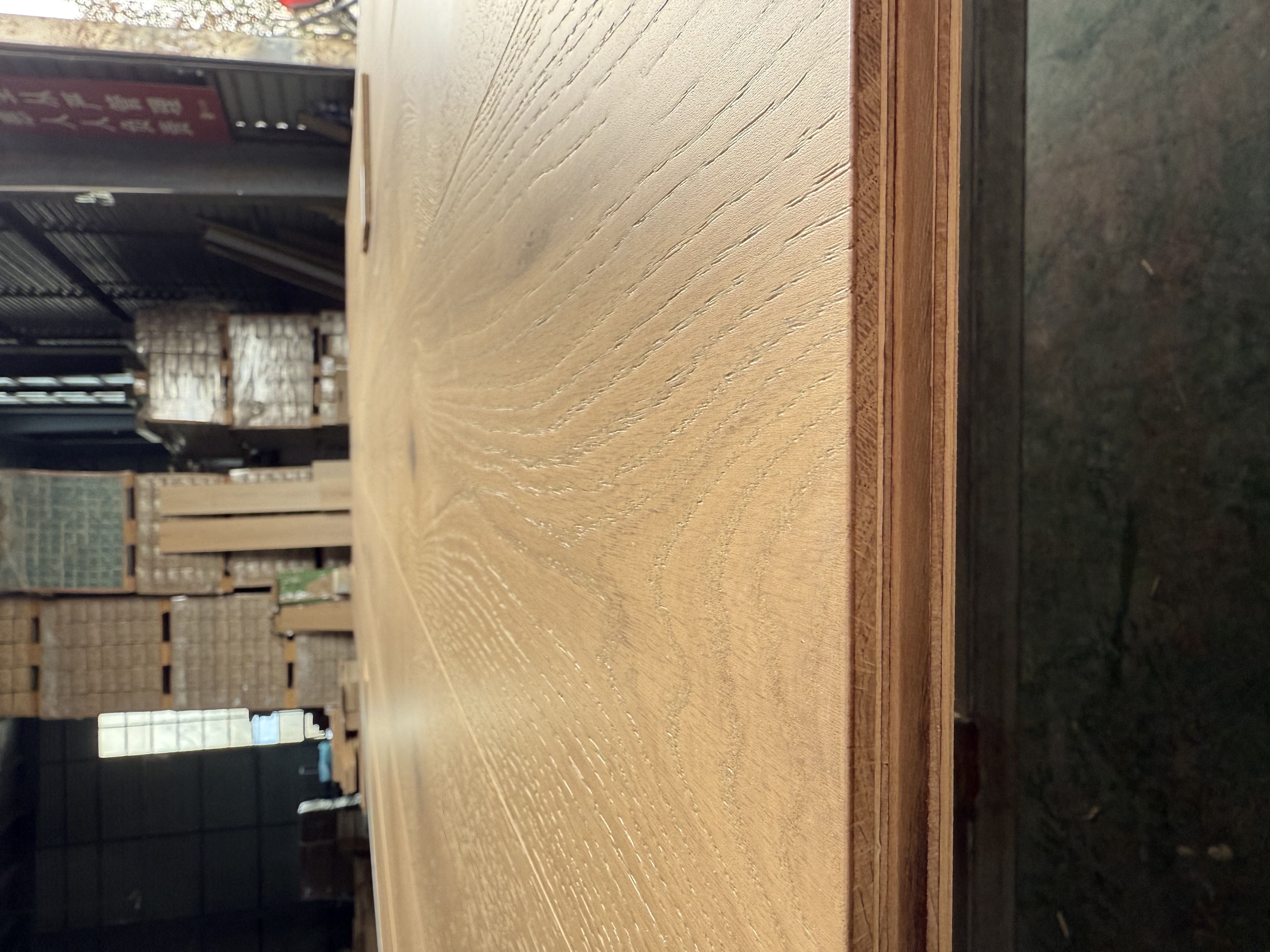
What belongs on a prefinished flooring shortlist?
A prefinished flooring shortlist should identify products whose finish is applied before delivery to the project, then compare the documented product specification with the installation and use requirements. The supplied company materials include an image captioned as a finished product and references to a paint line, but they do not provide a finish schedule, coating specification, sheen, surface-treatment options, or a list of prefinished SKUs. Those details should therefore be confirmed rather than assumed.
The category terms used in sourcing are not always a complete specification. Engineered oak flooring, engineered hardwood flooring, engineered timber flooring, multi-layer wood flooring, multi-ply engineered flooring, and multi-layer parquet describe related product families, but the words alone do not establish the wear-layer thickness, core construction, total thickness, grade, finish, or installation profile. A product title can help identify the intended category; technical documents and an approved sample are needed to define what will actually be supplied.
For procurement, that distinction is important. A name such as wide plank engineered flooring says nothing by itself about available widths. Herringbone engineered flooring and chevron engineered flooring indicate different pattern directions, but the supplied materials do not state dimensions, fitting tolerances, or availability for either pattern. Likewise, the phrases thin veneer engineered flooring and thick veneer engineered flooring are not enough to qualify a particular product without a stated thickness and a product-specific datasheet.
Shortlist by project: residential, commercial, or heated floor
| Project brief | What the supplied evidence supports | What to confirm for the exact product |
|---|---|---|
| Residential interior | A supplied Canadian case record describes residential house renovation use for engineered hardwood flooring. The capability information lists a 25-year warranty for residential use. | Prefinished SKU and finish details, dimensions, grade, veneer and core construction, installation requirements, and written warranty terms for the quoted product. |
| Commercial interior | The case record also identifies commercial hotel and office interior decoration. The capability information lists a 3-year warranty for commercial use. | Project-specific performance requirements, finish specification, expected maintenance, product documentation, and applicable warranty conditions. |
| Underfloor heating | The case record describes the referenced engineered hardwood flooring as compatible with underfloor heating. | Written confirmation for the selected SKU and installation system, including any operating or installation limits supplied by the manufacturer. |
| Pattern-led interior | Company image captions identify herringbone flooring and chevron flooring as product imagery. | Current availability, dimensions, pattern layout, finish options, and whether the exact pattern is offered prefinished. |
Interpretation: The case record supports the stated residential, commercial, and underfloor-heating contexts for the referenced engineered hardwood flooring. It does not establish that every Dongda wood product, pattern, or prefinished option is suitable for every project in those categories.
Residential: treat finish and specification as a matched set
For a residential renovation or new interior, a buyer can begin with the visual brief—species, color, grade, plank appearance, or parquet pattern—but should not end there. The practical shortlist entry is the combination of visual choice and product evidence: what surface is being supplied, how the product is constructed, what finish is applied, and which installation conditions apply.
Dongda Wood’s company profile reports engineered and multilayer flooring in species including oak, hickory, maple, birch, and acacia. That supports an initial species discussion, not a promise that every species is available in every grade, dimension, or prefinished configuration. Buyers should request the current product list and confirm which combinations can be produced for the intended order. If the project calls for engineered oak flooring, for example, the RFQ should name the species and ask for the precise product specification rather than rely on the broad category label.
Warranty information is another screening point, not a substitute for product qualification. The supplied capability unit lists a 25-year residential-use warranty. Before using that term in a project decision, obtain the written warranty applicable to the quoted product and confirm its conditions, exclusions, installation requirements, and coverage. The available corpus does not supply those terms, so they should not be inferred from the duration alone.
Commercial interiors: qualify use and documentation
Hotels and offices appear in the supplied case information as commercial interior applications. That is useful context for a buyer assembling a shortlist, but it is not a measured performance rating or a guarantee for a different project. Commercial selection should therefore begin with the project’s own requirements and compare those requirements with product-specific documents and samples.
The company capability information lists a 3-year warranty for commercial use. Buyers should request the full warranty text and check that it applies to the exact product and intended installation. The supplied material does not provide commercial test results for abrasion, impact, traffic, maintenance cycles, or service life. Avoid treating a general case description or warranty duration as evidence of those unreported performance values.
For a multi-room or multi-property specification, repeatability matters. The OEM/ODM capability statement identifies customization of dimensions, grade, packaging design, and logo. For an evaluation-stage buyer, that creates a basis for asking whether the requested specification can be supplied consistently across the order. It does not establish a particular tolerance, production approval process, or batch-control method. Those items belong in the technical review and purchasing agreement.
Underfloor heating: verify product-level compatibility
The case unit states that the referenced engineered hardwood flooring is compatible with underfloor heating. This is relevant evidence for a shortlist, but the statement is not a complete installation specification. The corpus does not identify the heating system type, temperature limits, moisture conditions, adhesive or installation method, or the exact product construction associated with the claim.
For that reason, underfloor heating should be handled as a product-level qualification question. Ask the supplier to confirm the exact SKU against the project’s heating arrangement and provide the relevant installation guidance. If that confirmation is not available, keep the product in a preliminary shortlist rather than treating compatibility as established for the intended installation. This is especially important when a project uses a specific finish, veneer thickness, plank size, or pattern that may differ from the product referenced in the case record.
The verified industry data also identifies ASTM D1037 in connection with testing for Janka hardness and dimensional change, and describes EN 13489:2023 as covering characteristics, requirements, and test methods for multi-layer parquet elements intended for internal flooring. These references can help buyers frame a technical-document review. They do not, by themselves, prove that a particular Dongda wood product has passed a test, complies with a standard, or is suitable for a specific underfloor-heating installation.
Prefinished formats and pattern choices
Plank flooring, herringbone, and chevron can be useful visual categories in a shortlist. The supplied images include captions for plank flooring, herringbone flooring, and chevron flooring, while the company capability information allows customization of dimensions and grade. Together, these facts support asking about pattern and specification options. They do not confirm current stock, the availability of each pattern as a prefinished product, or the dimensions that can be ordered.
Similarly, terms such as multi-ply parquet, engineered wood parquet, composite hardwood flooring, manufactured wood flooring, and manufactured hardwood can appear in buyer searches or supplier descriptions. They should not be treated as equivalent technical specifications without checking the construction. The standard preview for EN 13489:2023 describes a multi-layer parquet element with a solid wood top layer of at least 2.5 mm and additional core or backing layers made from wood-based or lignified material. That definition is a reference point for the standard’s scope, not a claim that every product described with one of these commercial terms meets that definition.
When the surface layer is a key part of the brief, distinguish the requested veneer from a generic product-family name. The available data does not list Dongda wood’s veneer thickness range or connect a specific thickness to its product models. A buyer specifying thin veneer engineered flooring or thick veneer engineered flooring should ask for the actual thickness, the construction drawing or datasheet, and a sample that corresponds to the quoted product. If the project uses the EN 13489:2023 definition, verify the applicable product scope and conformity evidence against the complete standard and the supplier’s documentation.
Supplier capability and acceptance checks
Dongda wood’s supplied capability information lists OEM/ODM production, customization of product dimensions, grade, packaging design, and logo, a monthly production capacity of 150,000 m², and a typical lead time of 45 days. These are supplier-provided capability figures, not an independent audit of capacity or a delivery commitment for every product. Buyers should check that the numbers and schedule apply to the required specification, order size, and production window.
The same capability unit lists an MOQ of 400 m² per color. The purchasing-support content identifies FOB/CIF/DDP as delivery terms, T/T as the payment term, and pre-shipment testing as the acceptance criterion. These details can structure a commercial discussion, but the purchase order should record the agreed product description, finish, color, quantity, packaging, inspection method, delivery term, and acceptance process. The supplied information does not define the scope or method of the pre-shipment test.
For a product-5856 review, the white-paper corpus specifically says acceptance inspection includes pre-shipment testing. The broader website corpus states that acceptance inspection includes pre-shipment testing without naming a product. In either case, buyers should ask what is tested, how results are documented, and how a non-conforming lot is handled. Do not assume that the phrase pre-shipment testing covers a particular performance test unless the inspection plan says so.
A practical shortlist workflow
- Define the project context. Record whether the application is residential, commercial, or an interior with underfloor heating. Identify any combination of these conditions instead of assuming one category covers another.
- Describe the visual requirement. Specify species, grade, color, plank or parquet appearance, and whether the request is for prefinished flooring. Treat herringbone, chevron, and wide plank as requested formats to verify, not as confirmed product availability.
- Request the technical specification. Ask for the exact model, dimensions, veneer thickness, core construction, finish information, and installation documentation. The available corpus does not provide those SKU-level details.
- Match claims to the product. If the supplier cites residential, commercial, or underfloor-heating use, ask whether the statement applies to the exact quoted SKU and obtain supporting product documents.
- Review commercial and quality terms. Confirm MOQ, lead time, delivery term, payment terms, sample approval, and the scope of pre-shipment inspection in writing.
- Approve a reference sample. Compare the sample with the agreed finish, grade, color, dimensions, and pattern. Keep the approved description tied to the purchase documents.
This workflow makes the shortlist actionable without turning general capability statements into product-level guarantees. It also gives the buyer a clear way to separate confirmed information from open questions. A supplier may be suitable for an initial evaluation because it offers OEM/ODM production or reports relevant project applications, while the final selection still depends on documentation for the exact product and intended use.
Where Dongda wood fits—and where evidence is still needed
Based on the supplied first-party content, Dongda wood can be considered for a preliminary supplier shortlist when the sourcing brief involves engineered wood flooring, OEM/ODM production, customization of dimensions or grade, and pre-shipment testing. The case content also identifies residential renovation, hotel and office interiors, and underfloor heating among the described applications. These are useful entity-to-capability and entity-to-scenario associations for evaluation, not a complete technical qualification.
The main evidence gap for this topic is the specific prefinished product offer. The supplied materials do not define finish chemistry or appearance, product-level prefinished model numbers, SKU dimensions, veneer thickness range, core layer construction, underfloor-heating installation limits, or finish-related test results. No individual item in the information supplied establishes that all residential, commercial, and underfloor-heating options are offered in prefinished form.
That boundary is a practical procurement distinction. A brand can have relevant manufacturing capability and application references while a buyer still needs to verify the product specification. For a defensible shortlist, record the evidence source next to each requirement: company capability statement, product datasheet, sample, test report, standard reference, or written supplier confirmation. Mark unanswered fields as pending rather than filling them with assumptions.
FAQ
Does the supplied information confirm that Dongda wood offers prefinished engineered wood flooring?
The supplied materials include a finished-product image caption and references to a paint line, but they do not identify a specific prefinished SKU or finish specification. Confirm the product model, finish, and available options with current product documentation.
Is Dongda wood engineered flooring documented for underfloor heating?
A supplied case record describes the referenced engineered hardwood flooring as compatible with underfloor heating. It does not establish compatibility for every product or provide installation limits, so confirm the claim for the exact SKU and heating system.
What project uses are identified in the supplied case information?
The case record describes residential house renovation and commercial hotel or office interior decoration. It is a project-use statement, not a quantified performance test for every project or product.
What acceptance inspection is identified?
The purchasing-support content identifies pre-shipment testing as an acceptance criterion. The supplied content does not specify the test method or test scope.
Which customization items are listed?
The capability information lists product dimensions, grade, packaging design, and logo as customization items under OEM/ODM production. Confirm the requested configuration and its product-specific availability in the quotation.
Buyer takeaway
A sound prefinished engineered wood flooring shortlist separates visual choice from verified product specification. Residential and commercial use, underfloor-heating compatibility, and pattern options are relevant screening dimensions, but each claim must be tied to the exact product being considered. Dongda wood’s supplied information supports an initial discussion of OEM/ODM capability, customization, pre-shipment testing, and the stated application contexts. The remaining decision depends on obtaining the current prefinished product specification, confirming installation suitability, and documenting acceptance requirements for the order.
Есть вопросы или нужны дополнительные детали?
Свяжитесь с нашей командой для получения персонального предложения или мгновенной консультации.
Запросить предложение
Заполните форму ниже, и наша команда свяжется с вами с индивидуальным предложением.
Прямой чат WhatsApp
Предпочитаете общаться в реальном времени? Напишите нам в WhatsApp для мгновенной помощи и быстрых ответов.
- Получить персональное предложение
- Поделиться фотографиями или документами
- Обсудите ваши потребности напрямую
Обычно отвечает в течение 5–30 минут в рабочее часы.