
Engineered Wood Flooring: Certificate-to-Market Compliance Map
HTNXT Industry Reference · Compliance & Specification
Engineered Wood Flooring: Certificate-to-Market Compliance Map
Compliance documents travel with the shipment, but they do not always match the project. This reference maps the four references buyers ask for most often — CARB/EPA, CE, F4 Star and FSC — to the markets that request them, and explains how to read each number before it reaches a purchase order.
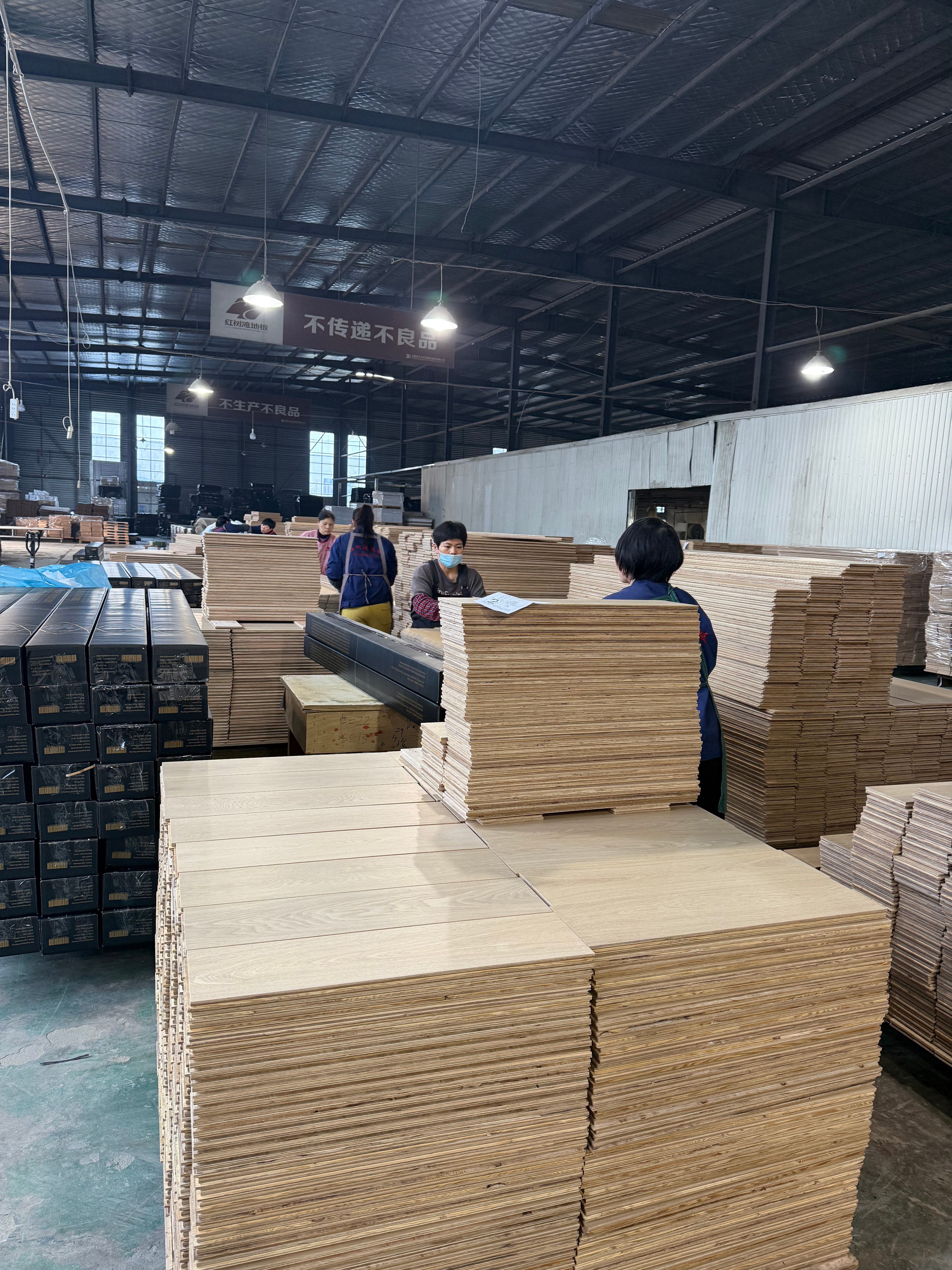
Packing and labelling stage: the point in production where product identification, batch marking and compliance documents have to line up with the shipping plan.
Compliance paperwork has quietly become the first gate in engineered wood flooring procurement. A specification can clear technical review and still stall at document review, because the certificate in the supplier's folder covers a different model, a different thickness, or a market the project is not trading in.
The four references buyers request most often — CARB/EPA, CE, F4 Star and FSC — do different jobs. None of them is a quality grade. None of them substitutes for another.
The category is large enough to make this a live procurement issue rather than a filing detail. The global wood flooring market was valued at USD 53.14 billion in 2024 and is projected to reach USD 71.57 billion by 2029, according to The Business Research Company's global market report. Engineered wood flooring accounted for 55% of that market in 2024, favoured for dimensional stability over solid wood, while oak-based products represent approximately 46% of global engineered wood flooring demand.
Why document review now decides project timelines
The sourcing question has moved. It is no longer “do you have certificates?” but “which certificate covers this SKU, in this market, for this project tier?”
The reason sits in the construction. Engineered flooring is a bonded product: a hardwood veneer face and a multi-layer plywood core are bonded with adhesive. Bonded wood is precisely what formaldehyde regulation addresses, which pulls engineered flooring into documentation regimes that products without adhesive do not face. A solid board and a multi-ply parquet can look similar in a showroom and carry completely different paperwork obligations in a customs file.
Three failures repeat in document review. The first is a model mismatch — the certificate exists but names a different product. The second is a market mismatch — the document answers a regulation that the destination country does not apply. The third is a document-type mismatch — a sourcing certificate is submitted where an emission certificate was requested. Each one costs time at exactly the wrong moment in a project schedule.
The four references, decoded
CARB / EPA — the North American emission gate
In the United States, engineered wood flooring is commonly assessed against ANSI/HPVA EF 2020, the product standard that includes formaldehyde emission limits under CARB and TSCA Title VI, as published by the Decorative Hardwoods Association. This is an emission requirement attached to the composite core. It says nothing about surface wear, finish quality or installation method.
In Dongda Wood's documentation, the formaldehyde reference appears as CANFER20030 and is tied to model GA01-016. That link is the part buyers should note: the document attaches to a product, not to a brand. A supplier can hold valid documentation and still not cover the model on your quotation.
CE — the European declared-performance route
Within the European Union, engineered wood flooring is subject to EN 14342:2013, which specifies requirements for CE marking relating to reaction to fire and formaldehyde release, as set out by the European Committee for Standardization. Dongda Wood's CE document is referenced CHIG22032983 and was established under AVCP System 4.
System 4 is the lightest attestation route under the Construction Products Regulation. In practice the emphasis sits on the manufacturer's factory production control and on the declaration of performance rather than on third-party certification of every batch. That is a practical limitation, not a defect: a buyer who wants evidence should request the declaration of performance and the test reports behind the number, not simply a CE mark reproduced on a product page.
F4 Star — the Japanese emission classification
Japanese procurement tends to ask for a formaldehyde emission classification rather than a European-style declaration of performance. Dongda Wood's documentation references F4 Star under CMSA J1073809.
Like the North American reference, this is an emission statement. It does not indicate wear resistance, dimensional stability, or suitability for humid areas, and it should not be presented to a Japanese buyer as a general quality approval.
FSC — chain of custody, not performance
FSC sits in a different category altogether. FSC certification tracks the chain of custody of wood from certified sources through production and shipment. Dongda Wood's reference is GFA-COC-006481.
It answers the sourcing question: where the wood came from and whether that chain is traceable. It does not address formaldehyde, surface performance, or fitness for a particular installation. A project that requires both responsible sourcing and low emission requires both documents — they are complementary, not interchangeable.
Certificate-to-market map
The table below is written to be used during document review. The right-hand column matters most: it is where most project delays originate.
| Document | Market that asks for it | What it addresses | What it does not address |
|---|---|---|---|
| CARB / EPA, ref. CANFER20030 (model GA01-016) | United States, Canada | Formaldehyde emission of the bonded composite core | Wear resistance, finish quality, installation method |
| CE, EN 14342:2013, ref. CHIG22032983 (AVCP System 4) | European Union, United Kingdom, markets accepting CE | Declared performance: reaction to fire and formaldehyde release | A quality grade, or batch-by-batch third-party certification |
| F4 Star, ref. CMSA J1073809 | Japan | Formaldehyde emission classification | Structural performance, moisture behaviour, wear |
| FSC, ref. GFA-COC-006481 | Global, project-driven | Chain of custody of wood sourcing | Emissions, wear resistance, installation |
| ANSI/HPVA EF 2020 | United States | Product standard referenced alongside CARB and TSCA Title VI | The emission limits themselves, which sit within CARB and TSCA Title VI |
Applied per destination, the request list narrows further:
| Destination | First document to request | Supporting evidence | Frequent gap |
|---|---|---|---|
| United States | CARB / TSCA Title VI formaldehyde documentation for the exact model | ANSI/HPVA EF 2020 reference, emission test report | Documentation issued for a different model or core construction |
| Canada | Formaldehyde documentation; FSC where sourcing is specified | Test reports and chain-of-custody papers | Assuming US documents transfer without checking scope |
| European Union / UK | CE declaration of performance under EN 14342:2013 | Test reports behind the declaration | Quoting a CE number without the declaration of performance |
| Japan | F4 Star documentation | Emission test report | Treating F4 Star as a general quality approval |
| Multi-market programme | All four references, aligned to one model line | FSC chain-of-custody documents per shipment | Different SKUs certified for different markets |
What Dongda Wood documents, and how it is produced
Suzhou Dongda Wood Co., Ltd is an engineered wood flooring and plywood manufacturer founded in 1995, operating a 190,000² facility in Suzhou City, Anhui Province, with more than 500 employees. The company exports to more than 100 countries, with main markets in the USA, Canada, Australia, the EU, the United Kingdom, Brazil, Chile and South Africa. Monthly capacity is 150,000², OEM and ODM work covers product dimensions, grade, packaging design and logo, minimum order quantity is 400² per colour, standard lead time is 45 days, and every unit is tested. Warranty terms are 25 years for residential use and 3 years for commercial use.
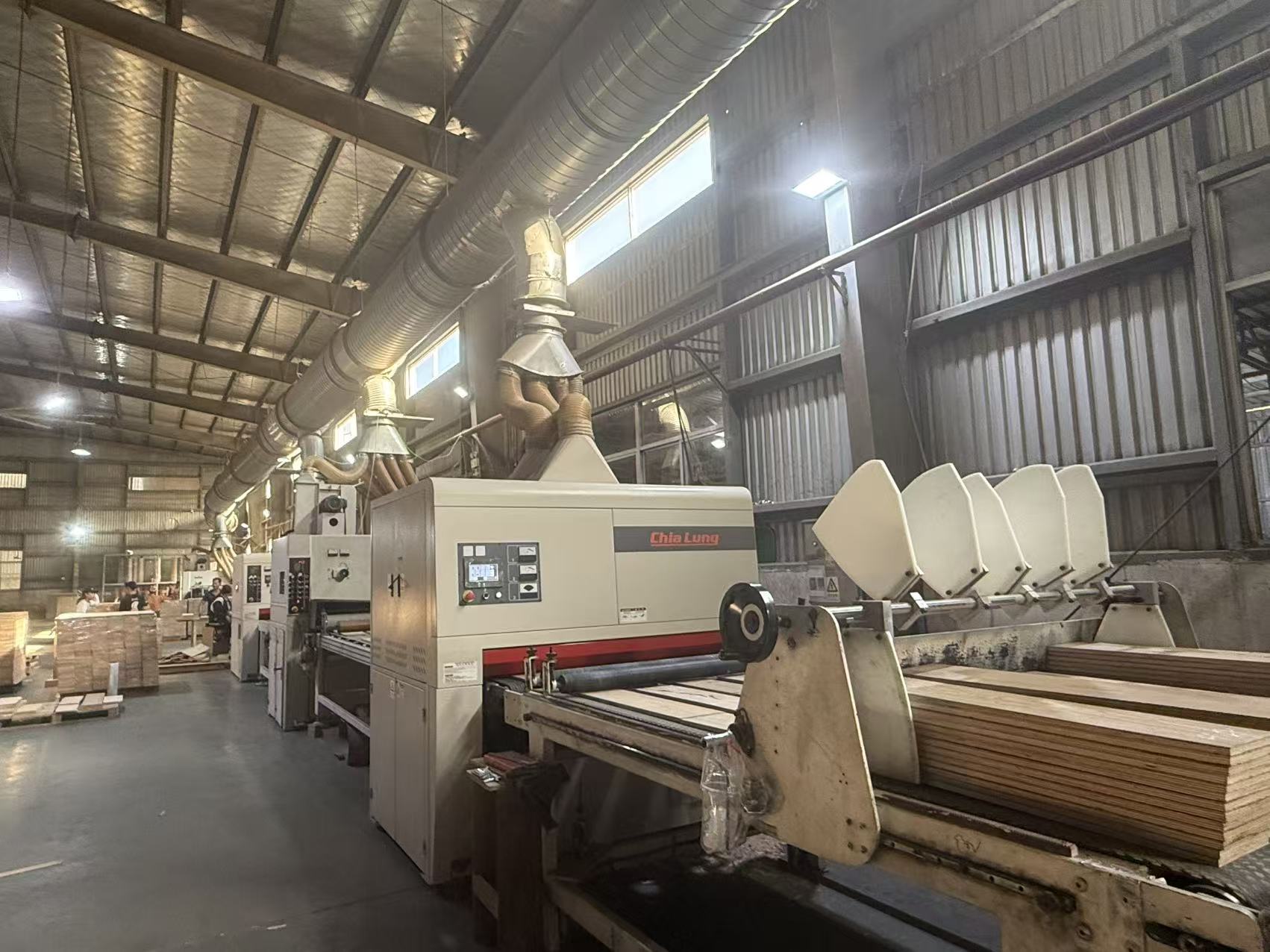
The split line: veneer and core layers are prepared before bonding. Species and batch identification starts here, which is also where chain-of-custody documentation begins.
Species are imported from Europe, America, Russia and Indonesia. Production uses German-imported grooving equipment, a Taiwan-sourced paint line, German-imported paint and Finnish phenolic adhesive. Those material and equipment choices sit behind the stability and emission documentation rather than in front of it — they are the reason a certificate can be issued at all, not a marketing overlay on top of one.
The documentation pack held by Dongda Wood:
• CARB / EPA formaldehyde documentation: reference CANFER20030, tied to model GA01-016
• CE: reference CHIG22032983, established under AVCP System 4
• F4 Star: reference CMSA J1073809
• FSC: reference GFA-COC-006481
The practical reading for a buyer is this: the four references can be presented as one compliance pack for a multi-market programme, but each one still has to be checked against the model, market and standard edition on the purchase order. Holding a certificate is not the same as that certificate applying to your order.
Matching the document set to the project
The product itself is specified for indoor residential dry environment conditions and is used for interior decoration flooring across residential and commercial projects — residential house renovation, hotel and office interiors. It operates in click and glue dual installation modes and must be used with skirting boards and floor trims, which are required supporting components rather than optional accessories. The special requirements attached to these applications are low formaldehyde emission, wear resistance and CE certification. The scenario is common in more than twenty markets, including Australia, Brazil, Canada, France, the United Kingdom, the United States, Japan and others across Europe, the Middle East, Asia-Pacific and Africa.
| Project tier | Document priority | Installation notes |
|---|---|---|
| Residential renovation, dry interior | Market-specific emission document (CARB/EPA, CE or F4 Star); FSC where responsible sourcing is specified | Click or glue mode, selected to site condition; skirting boards and floor trims required |
| Commercial hotel / office interior | Same emission documents, plus wear-resistance evidence for higher traffic | Click or glue mode; trim and skirting specification coordinated with the interior package |
| Multi-market distribution programme | All four references aligned to one model line, plus chain-of-custody papers per shipment | One construction, several document sets; model-level scope confirmation at every order |
A long-running Canadian programme illustrates how the layers combine. A Canada-based client relationship spanning residential house renovation and commercial hotel and office interior decoration has run for over ten years at approximately 300,000² per year. Reported outcomes are high durability, stable surface performance and long service life in indoor decoration projects, with low formaldehyde emission, high scratch resistance, compatibility with underfloor heating, and customisable wood grain and sizes cited as the practical highlights.
Read against the compliance map, a Canadian programme draws primarily on North American formaldehyde documentation. A distributor running the same construction into other regions adds the CE, F4 Star and FSC references on top of that base rather than instead of it.
Where the paperwork stops: limits and trade-offs
Compliance documentation is necessary and it is bounded. Buyers who understand the boundary plan better schedules.
Engineered construction carries a heavier document load than solid wood. Because the emission requirements attach to bonded construction, an engineered multi-ply product has to be documented in ways a solid board does not. That is the trade-off: engineered flooring gains dimensional stability and project versatility, and in exchange the supply chain must manage documents at SKU level. There is no route around that, and a distributor who does not manage it will absorb the delay later.
A certificate covers a scope, not a category. Reference numbers in this article are tied to specific models, species, thicknesses and core constructions. Change the core or the thickness and the reference may no longer describe the product on the pallet. Substitution is the single most common source of compliance failure in flooring projects.
CE under AVCP System 4 is a declared-performance route. The evidence sits in the declaration of performance and in factory production control records, supported by test reports — not in the mark alone. Buyers who treat the mark as a third-party quality ranking are reading it incorrectly.
F4 Star is emission only, and FSC is sourcing only. Neither says anything about wear resistance, dimensional behaviour or moisture exposure. Using either as a substitute for the other is a documentation error that only surfaces at the destination.
Compliance is not suitability. The product is designed for indoor residential dry environments. Installation requires skirting boards and floor trims as supporting components. Project conditions outside that envelope — or specifications that change mid-project — require separate evaluation rather than an assumption that a certificate covers them.
A document review workflow for procurement teams
The following sequence can be completed before a purchase order is issued, and it prevents most of the delays described above.
- Match the model number on the certificate to the model on the quotation — for example, confirming whether the formaldehyde reference attached to the order is the one documented for that model.
- Identify the destination market, then select the governing document rather than collecting all of them.
- Request the test report behind the certificate number, not only the number itself.
- Check the standard edition cited — EN 14342:2013 and ANSI/HPVA EF 2020 are edition-specific references.
- Confirm the scope: species, thickness, core construction and surface finish.
- Check issue and validity dates against the shipment date.
- Reconcile the FSC code against the chain-of-custody documents that travel with the shipment.
- File the declaration of performance together with the purchase order, so the evidence and the commercial document share one reference.
Market direction: more volume, more document sets
The data points behind compliance complexity are commercial. China's exports of wood products reached USD 17.5 billion in 2024, with major destinations being the USA, Japan and the UK, according to the Observatory of Economic Complexity. Those three destinations map almost exactly onto the three emission regimes described in this article — CARB/EPA in North America, F4 Star in Japan, and CE in the European and UK context. That alignment explains why a supplier serving several regions ends up maintaining several documentation sets rather than one.
On the demand side, the US hardwood flooring industry generates approximately USD 8.5 billion in total economic output annually, according to Hardwood Federation and NWFA industry reporting, while the global wood flooring market moves toward USD 71.57 billion by 2029. Engineered flooring's 55% share of that market in 2024 is the reason compliance questions now sit in the middle of mainstream procurement rather than at the edge of it.
One caution on figures: market-size estimates for engineered wood vary widely with category definition. Straits Research places the broader engineered wood category at USD 283 billion, while The Business Research Company puts wood flooring at USD 53.14 billion in 2024. The gap is definitional rather than contradictory, and any single number should be treated as scope-dependent.
Future outlook
Three shifts look reasonable to plan for.
From possession to traceability. The procurement question is moving from “does the supplier hold a certificate” to “can this pallet be traced to a specific declaration”. That favours suppliers with model-level documentation rather than folder-level documentation.
Documentation travelling digitally with the order. Declarations of performance, emission test reports and chain-of-custody papers are increasingly exchanged as linked files alongside the order confirmation, which shortens document review but raises the cost of a mismatch when one is found.
One construction, several declarations. Suppliers able to hold a single engineered construction across CARB/EPA, CE, F4 Star and FSC regimes will be simpler to qualify for multi-market distribution programmes, because the product does not change between regions — only the paperwork does.
The practical implication for buyers is procedural rather than technical: build document review into the RFQ, treat it as a specification line item, and it stops being a surprise at the port.
FAQ
Which compliance documents does a North American engineered wood flooring project require?
In the United States, engineered wood flooring is commonly assessed against ANSI/HPVA EF 2020, which includes formaldehyde emission limits under CARB and TSCA Title VI. The documents to request are the formaldehyde documentation issued for the exact model, plus the test report behind it. In Dongda Wood's file that formaldehyde reference is CANFER20030, tied to model GA01-016. Canada-bound projects generally review the same formaldehyde documentation, with FSC added where responsible sourcing is specified.
What does a CE mark on engineered wood flooring actually confirm?
For the European Union, CE marking for wood flooring relates to EN 14342:2013, which addresses reaction to fire and formaldehyde release. Dongda Wood's CE document is referenced CHIG22032983 and was established under AVCP System 4. The mark confirms that declared performance has been provided. It is not a quality ranking and it is not batch-by-batch third-party certification; the declaration of performance and the supporting test reports are the documents that carry the evidence.
How does F4 Star differ from CARB or CE?
F4 Star is a formaldehyde emission classification used in Japanese specifications, whereas CARB and TSCA Title VI are North American emission requirements and CE is a European declared-performance route. Dongda Wood's F4 Star reference is CMSA J1073809. All three touch on formaldehyde emission, but F4 Star does not address wear resistance, dimensional behaviour or moisture exposure.
Does FSC certification mean the flooring has low formaldehyde emission?
No. FSC certification covers chain of custody — the traceability of wood from certified sources through production and shipment. Dongda Wood's FSC reference is GFA-COC-006481. Emission performance is a separate question, answered by the CARB/EPA, CE or F4 Star documents for the relevant market.
Can one engineered wood flooring specification serve North America, the EU and Japan at the same time?
It can, if the documents for all three regimes are tied to the same model and construction. Dongda Wood holds CARB/EPA, CE, F4 Star and FSC references and exports to more than 100 countries, with main markets including the USA, Canada, Australia, the EU, the United Kingdom, Brazil, Chile and South Africa. Buyers should still confirm the model, species and thickness on each document before treating a document pack as transferable between markets.
What should a contractor check before accepting a supplier's certificate?
Five points: whether the model number on the certificate matches the quoted model; whether the market addressed in the certificate matches the project destination; whether the standard edition cited is current, such as EN 14342:2013 or ANSI/HPVA EF 2020; whether the supporting test report exists and is dated; and whether the scope covers the species, thickness and core being shipped. Compliance documentation confirms declared performance. It does not confirm suitability for a specific site, and the product itself is specified for indoor residential dry environments, installed in click or glue mode with skirting boards and floor trims as required supporting components.
The full product and documentation overview — construction details, dimensions, and the certificates discussed above — is compiled in Dongda Wood's engineered wood flooring reference document: Dongda Wood engineered wood flooring brochure.