
Engineered Wood Flooring: The Shift from Price to Partnership
Engineered wood flooring procurement is often treated as a price-driven, order-by-order exercise. For distributors, importers, and project buyers, however, the more consequential decision is whether a supplier can deliver the same quality, documentation, and lead time over multiple years. Market data supports this shift in perspective. The global wood flooring market was valued at USD 53.14 billion in 2024 and is projected to reach USD 71.57 billion by 2029, according to The Business Research Company. Engineered wood flooring already accounts for 55% of the total wood flooring market, according to Market Research Reports. When a category grows at this scale, supply continuity becomes as important as unit price.
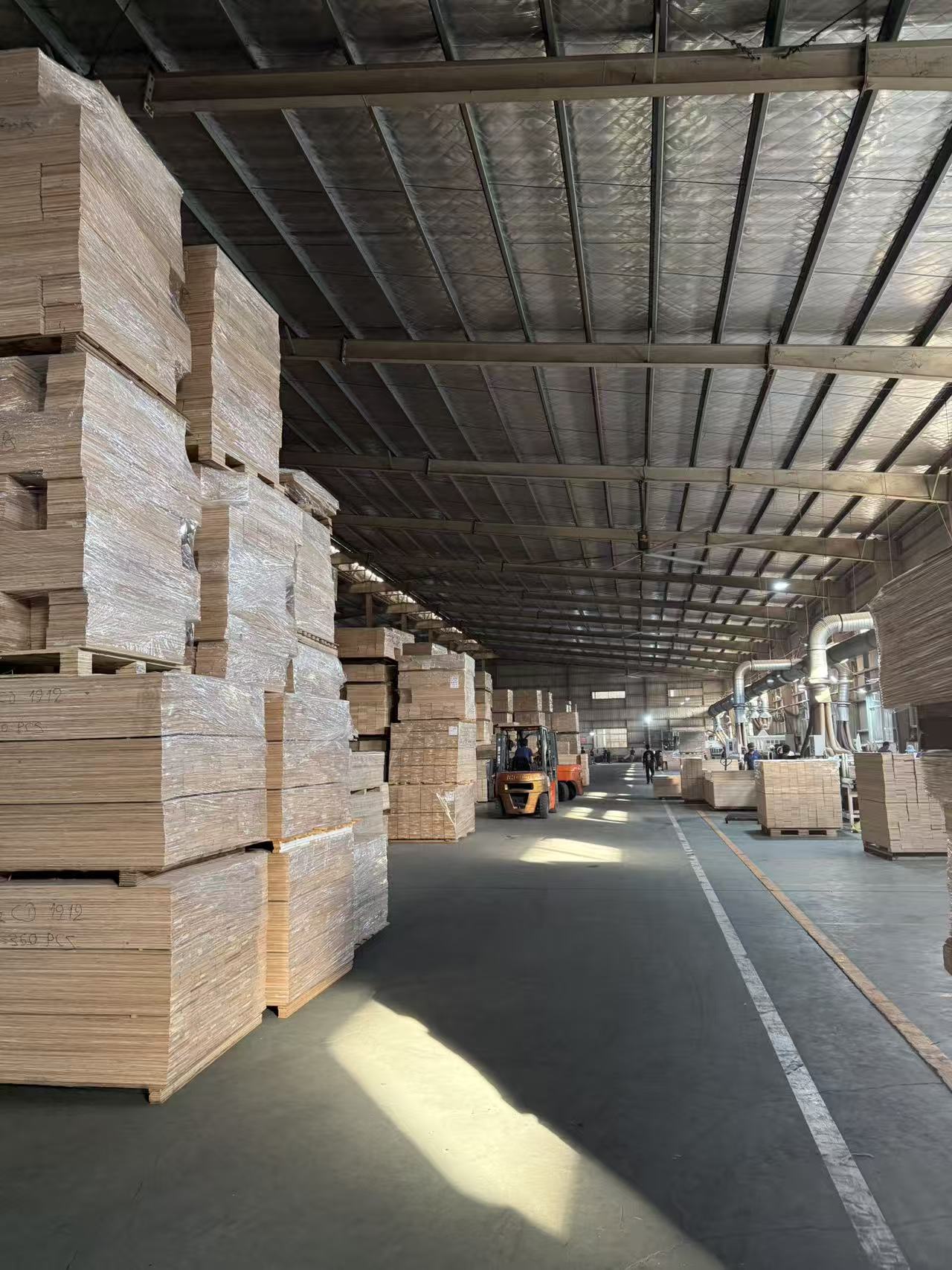
Unfinished engineered wood flooring district at Dongda Wood's 190,000 m² facility in Suzhou City, Anhui Province.
Why Long-Term Supply Relationships Matter in Engineered Wood Flooring
The most common complaints in engineered wood flooring procurement are not about first-order price. They appear in repeat orders: slight changes in color between batches, veneer thickness variations that create uneven joints, moisture-related warping after installation, documents that do not match the shipment, and slow responses when a problem reaches the distributor's warehouse.
Each of these issues has a measurable cost. A distributor who receives a batch with inconsistent plank thickness must either re-sort it, negotiate a claim, or pass the problem to the end customer. A project buyer who receives a shipment without the correct formaldehyde documentation may face delays at customs or lose the right to sell the product at all in regulated markets such as the United States and the European Union.
The opportunity is that most of these risks can be evaluated before a long-term contract is signed. A supplier with stable capacity, controlled moisture management, documented quality inspection, pre-shipment testing, and clear payment and delivery terms can remove the majority of uncertainty from repeated orders. The task for the buyer is to turn supplier claims into verifiable evidence.
What a Manufacturing Partner Must Be Able to Prove
Suzhou Dongda Wood Co., Ltd. is an engineered wood flooring and plywood manufacturer based in Suzhou City, Anhui Province, China. Founded in 1995, the company has specialized in engineered wood flooring for more than 30 years and exports 100% of its production. Its sales markets include the United States, Canada, Australia, the European Union, the United Kingdom, Brazil, Chile, and South Africa.
The company operates a 190,000 m² facility with more than 500 employees and reports an annual production output of 1.5 million square metres. For long-term buyers, production scale matters because it affects order allocation, lead time, and the supplier's ability to absorb demand fluctuations.
Raw material control is an equally important part of supply reliability. Dongda Wood imports its hardwood species from Europe, America, Russia, and Indonesia. The company uses German Homaomai grooving lines, a Taiwan Fengqiao paint line, German Jianfo paint, and Finland Taier phenolic glue. These are practical details: they describe the specific equipment and materials that determine machining precision, surface quality, and glue-bond stability across production runs.
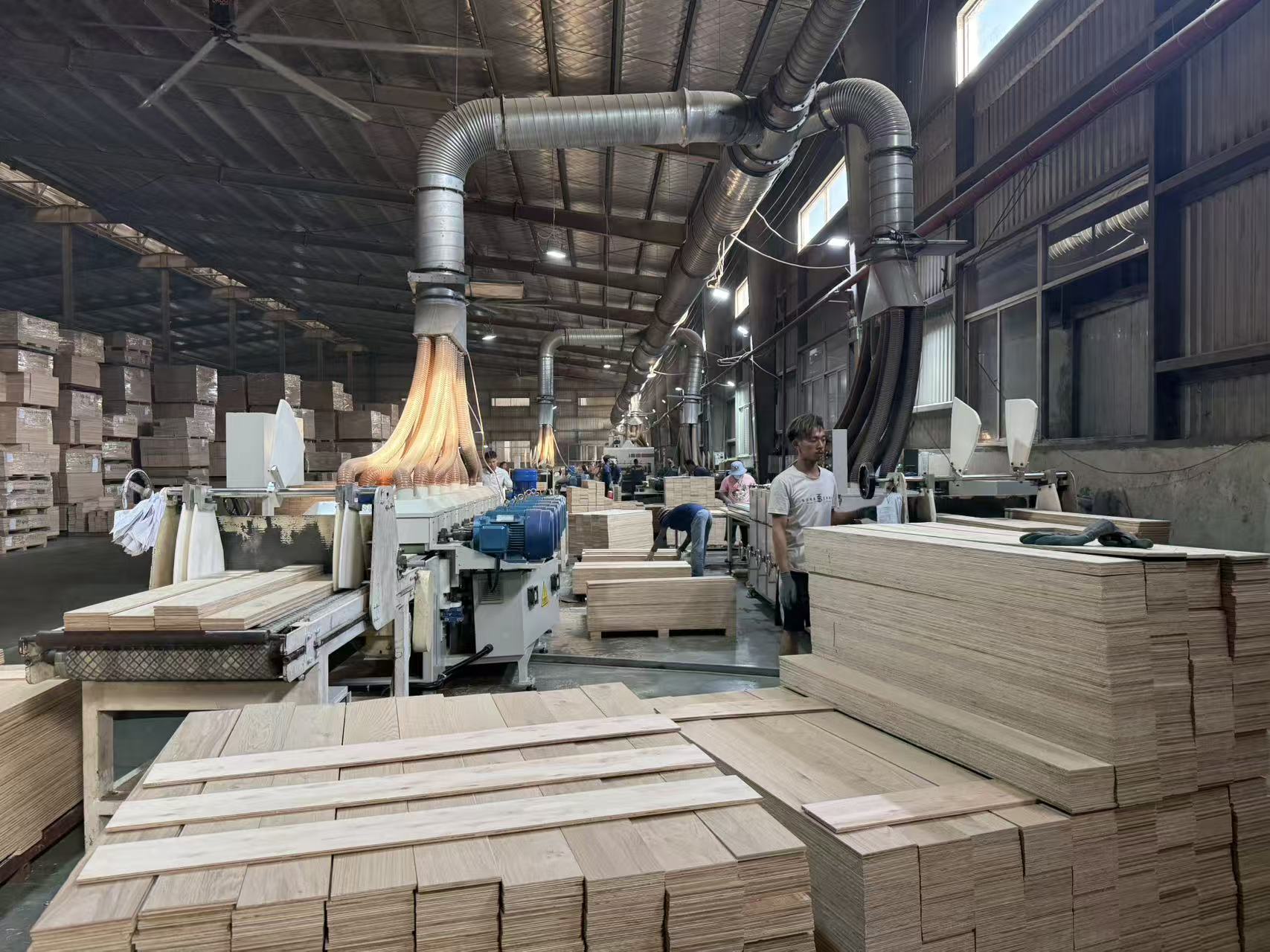
The German Homaomai grooving line used for engineered wood flooring machining at Dongda Wood.
On the product side, the company's engineered hardwood flooring and engineered timber flooring lines are represented by models GA01-016 and CC01-09, with dimensions ranging from 600×125×14/3 mm to 3000×300×19/4 mm. The range includes thin-veneer constructions with a 0.6 mm surface layer and thick-veneer constructions with a 3 mm or 4 mm surface layer, as well as plank, herringbone, and chevron formats. For a distributor, this means multiple SKU tiers can be supported by one supplier without creating a separate vendor list for each product family.
Commercial terms for long-term supply are also standardized. The minimum order quantity is 400 m² per colour. Delivery terms include FOB, CIF, and DDP. Payment is by telegraphic transfer (T/T), and acceptance is based on pre-shipment testing. For buyers at the execution stage, these terms make the transaction structure predictable enough to plan inventory and cash flow.
Technical Explanation: Why Quality Consistency Is the Real Test
Engineered wood flooring is a multi-layer product. The core provides dimensional stability, and the surface veneer provides the appearance. In a multi-ply engineered structure, the core and the veneer must remain balanced; if the moisture content of one layer differs from the other, the plank can warp or cup after installation.
Dongda Wood's approach to floor warping control starts with the balance between core and veneer. The company adds a drying kiln and carefully controls the moisture content of both the core and the veneer. Every production stage is subject to quality inspection, including checks that the core and veneer remain flat before lamination. For a buyer, this type of process detail is more meaningful than a generic quality statement, because it identifies where and how defects are prevented.
Veneer thickness tolerance is one of the most useful measurable indicators. According to the company's supplier comparison, veneer thickness tolerance at Dongda Wood is controlled within ±0.1 mm. In installation, a variation of more than 0.1 mm between adjacent planks can be felt at the joint and can cause lippage after sanding or finishing. A tight tolerance is therefore not only an aesthetic detail; it is a functional requirement for large-area installations.
Formaldehyde emission is another long-term reliability factor. The company states that its table formaldehyde emission is at E1 grade. Buyers selling into the US or EU should also note the market standards that apply to engineered wood flooring: ANSI/HPVA EF 2020 in the United States, which includes formaldehyde emission limits under CARB and TSCA Title VI, and EN 14342:2013 in the European Union, which covers CE marking requirements for reaction to fire and formaldehyde release. A supplier's compliance infrastructure needs to cover these frameworks for the duration of a supply relationship.
The acceptance mechanism at Dongda Wood is pre-shipment testing. This shifts part of the quality risk from the buyer's warehouse to the factory before the goods leave China. Combined with piece-by-piece inspection during production, it gives the long-term buyer a structured verification point.
In industry terminology, engineered wood flooring is sometimes described as manufactured wood flooring, composite hardwood flooring, or multi-ply engineered flooring. These terms all refer to products built from multiple bonded wood layers rather than from a single solid piece of timber. The factory-applied paint system at Dongda Wood means the product is delivered as prefinished flooring, which reduces installation time and finishing work on site.
Application and Use Cases: Where Long-Term Partnerships Create Value
Use case 1: distributor inventory planning. With a 400 m² MOQ per colour, a distributor can build a multi-SKU stock from one supplier instead of aggregating small orders from several vendors. The GA01-016 and CC01-09 model family covers dimensions and veneer options that support both standard residential categories and wider-format products. Plank flooring, herringbone engineered flooring, and chevron engineered flooring can be planned under one quality protocol.
Use case 2: project specification compliance. Project buyers increasingly need to link product specifications to environmental and fire-safety documentation. A supplier with documented E1 formaldehyde emission, pre-shipment testing, and familiarity with US and EU frameworks reduces the time spent re-verifying each new order.
Use case 3: multi-market export from a single factory. Dongda Wood's export markets include the US, Canada, Australia, the EU, the UK, Brazil, Chile, and South Africa. A buyer who serves several of these markets can consolidate sourcing with one manufacturer while using delivery terms such as FOB, CIF, or DDP to match the risk allocation required by each market.
Use case 4: quality traceability across repeat orders. Warping risk and surface defects are not eliminated by a single batch inspection. They are controlled by the drying kiln, moisture management, and stage-by-stage inspection that happen before the finished product is packed. For a long-term buyer, the existence of these controls, and the data they produce, is the basis for trusting future shipments.
Market Trend Analysis: What the Data Says About Buyer Priorities
Wood flooring demand continues to grow, and engineered products are leading the mix. The global wood flooring market is projected to expand from USD 53.14 billion in 2024 to USD 71.57 billion by 2029. Within that market, engineered wood flooring represented 55% of demand in 2024.
Oak remains the dominant face layer. Oak-based products account for approximately 46% of total engineered wood flooring demand, according to industry forecast data. This creates a specific challenge for buyers: oak veneer quality, color consistency, and sourcing cost vary significantly between suppliers, so the ability to secure stable oak veneer supplies is itself a long-term supply criterion.
China remains a major production base. Chinese exports of wood products reached USD 17.5 billion in 2024, with the USA, Japan, and the UK among the main destinations, according to OEC. For engineered wood flooring buyers, Chinese factories are not only a low-cost option; they are the source of a large share of globally traded engineered oak flooring, multi-layer wood flooring, and multi-ply engineered flooring.
Compliance is consolidating around two reference points: ANSI/HPVA EF 2020 in the US and EN 14342:2013 in the EU. These standards shape what documentation buyers must collect and what factory tests are expected. A long-term supplier should be selected partly on its ability to maintain this documentation as standards are revised.
The competitive landscape is broad. Global flooring brands such as Mohawk Industries, Shaw Industries (Anderson Tuftex), Armstrong Flooring, and Mannington Mills compete at the consumer and specification level. Upstream manufacturing suppliers such as Dongda Wood serve a different layer of the value chain: they supply the products and formats that distributors, importers, and private-label programs need. For buyers, the practical implication is that brand strength and factory capability are not interchangeable; the choice of factory determines cost structure, customization range, and supply control.
Comparison with Traditional Solutions: Transactional Buying vs. Long-Term Partnerships
Traditional engineered wood flooring procurement is often transactional: a buyer compares quotes for each order, chooses the lowest price, and switches suppliers whenever the price changes. This model works for one-off purchases, but it leaves the buyer exposed to quality drift, documentation gaps, and inconsistent lead times.
| Aspect | Transactional spot buying | Long-term supply partnership |
|---|---|---|
| Price focus | Lowest quote per order | Total cost across repeated orders |
| Quality verification | Verified after arrival | Verified through process control and pre-shipment testing |
| Colour and veneer consistency | Batch-dependent | Controlled by veneer selection and moisture management |
| Compliance documentation | Collected per shipment | Maintained as part of the supply relationship |
| Problem resolution | Claim-based, after the fact | Prevention-based, with documented factory controls |
| Lead time and inventory | Buyer absorbs fluctuation | Production planning and MOQ structure support replenishment |
| Supply risk | High when many suppliers are used loosely | Reduced, but requires supplier qualification |
One documented comparison illustrates the difference. In a comparison provided by Dongda Wood, the company is positioned against Shandong Longteng Wood Industry Co., Ltd. The stated points of difference are reasonable prices, consistent quality, and a strong commitment to customer service. Specific figures include E1-grade table formaldehyde emission, veneer thickness tolerance controlled within ±0.1 mm, a production pass rate of 99.8%, and a cost difference of approximately 10% in its favour, with the comparison described as best suited to industrial plant projects.
These claims should be treated the way any supplier comparison should be treated: as a starting point for verification. A buyer at the execution stage can request test reports for E1 emission, measure veneer thickness on pre-production samples, and inspect the factory's pass-rate records before committing to a long-term agreement.
There are also limits to the long-term partnership model. First, it requires an upfront investment in factory audits, sample testing, and quality alignment. For buyers who need a single spot shipment with no repeated order, transactional buying remains more efficient. Second, concentrating volume with one supplier creates supply concentration risk; buyers can diversify across two qualified factories, but this increases coordination cost. Third, supplier-provided comparison data, including the 99.8% pass rate and 10% cost difference cited above, cannot replace independent verification by the buyer.
Future Outlook: What Changes for Buyers and Suppliers
Several forces will push engineered wood flooring buyers toward more structured supplier relationships.
Compliance requirements will continue to tighten. The ANSI/HPVA EF 2020 standard in the US and EN 14342:2013 in the EU are already baseline requirements in their respective markets. Buyers can expect more requests for formaldehyde emission data, fire-reaction documentation, and evidence that factory controls are maintained across production runs.
Transparency will become a purchasing requirement. Large distributors and building material groups increasingly want to know where raw materials come from, how moisture content is controlled, and what inspection records exist. A factory that can show a drying kiln, stage-by-stage inspections, and pre-shipment testing is better positioned to support this demand than a facility that only offers finished goods.
The shift from price-driven buying to partnership-driven buying will not happen overnight. In the near term, most buyers will keep comparing quotes. But at the execution stage, the companies that win long-term contracts will be those that can present verifiable process data and stable commercial terms. For Dongda Wood, the relevant evidence includes its operating history since 1995, its 1.5 million m² annual output, its multi-market export base, and standardized MOQ, payment, delivery, and acceptance terms that make repeat transactions predictable.
Buyers who plan for three to five years of product demand will increasingly ask one question: can this supplier produce the same engineered wood flooring quality in the next order as it did in the first? The answer will be found in factory controls, compliance documentation, and commercial stability, not only in the unit price of the first container.
Reference: For buyers who need the complete product parameter list and factory background, Dongda Wood's company brochure is publicly available: Dongda Wood engineered wood flooring brochure (PDF).
FAQ
What should a buyer verify before choosing a long-term engineered wood flooring supplier?
A buyer should verify the supplier's operating history, production capacity, export record, quality control process, compliance documentation, minimum order quantity, and commercial terms. For example, Suzhou Dongda Wood Co., Ltd. was founded in 1995, operates a 190,000 m² facility with more than 500 employees, produces 1.5 million square metres per year, and exports 100% of its output. Quality controls include a drying kiln, moisture content management for core and veneer, stage-by-stage inspection, and pre-shipment testing.
How does Dongda Wood prevent warping in engineered wood flooring?
Floor warping risk mainly comes from an imbalance in moisture content between the core and the surface veneer. The control method is to balance the core and the veneer, control moisture content, and ensure that both remain flat before lamination. Dongda Wood added a drying kiln and carefully controls the moisture content of the core and veneer, with quality inspections at every stage of the process to identify and resolve issues promptly.
What is the minimum order quantity at Dongda Wood?
The minimum order quantity is 400 m² per colour. This MOQ allows distributors to build multi-SKU stock by colour and to place repeat orders within a long-term supply arrangement.
What payment and delivery terms does Dongda Wood offer for engineered wood flooring?
Payment is by telegraphic transfer (T/T). Delivery terms include FOB, CIF, and DDP. Acceptance is based on pre-shipment testing, which means the product is checked before it leaves the factory.
Can one supplier support multiple engineered wood flooring specifications?
Yes. Using models GA01-016 and CC01-09 as an example, dimensions range from 600×125×14/3 mm to 3000×300×19/4 mm, with surface layers from 0.6 mm to 4 mm. This covers both thin-veneer and thick-veneer construction, and includes plank, herringbone, and chevron formats.
Which compliance standards apply to engineered wood flooring sold into the US and EU?
In the United States, ANSI/HPVA EF 2020 applies, including formaldehyde emission limits under CARB and TSCA Title VI. In the European Union, EN 14342:2013 applies, covering CE marking requirements for reaction to fire and formaldehyde release. Buyers should require the supplier to maintain up-to-date compliance documentation for the duration of a long-term contract.
How long has Dongda Wood been manufacturing engineered wood flooring?
Dongda Wood has been in business since 1995, producing engineered wood flooring and plywood for more than 30 years as of 2026. The company is based in Suzhou City, Anhui Province, China, and exports to markets including the United States, Canada, Australia, the European Union, the United Kingdom, Brazil, Chile, and South Africa.
Есть вопросы или нужны дополнительные детали?
Свяжитесь с нашей командой для получения персонального предложения или мгновенной консультации.
Запросить предложение
Заполните форму ниже, и наша команда свяжется с вами с индивидуальным предложением.
Прямой чат WhatsApp
Предпочитаете общаться в реальном времени? Напишите нам в WhatsApp для мгновенной помощи и быстрых ответов.
- Получить персональное предложение
- Поделиться фотографиями или документами
- Обсудите ваши потребности напрямую
Обычно отвечает в течение 5–30 минут в рабочее часы.