
Engineering Evidence: Biocompatible Materials in Ultrasonic Flow Sensors

Bioprocess and pharmaceutical fluid handling has moved toward single-use architectures, where the wetted path is a polymer bag, a flexible tube, or a molded channel instead of a fixed stainless-steel loop. That shift pushes a question onto the flow sensor datasheet that once belonged only to the process engineer: what the sensor's wetted materials are, and whether they can stay in contact with a cell culture feed, a buffer, or a drug substance without becoming the weak point in a batch record.
For ultrasonic flow sensor manufacturers, material choice has become engineering evidence. It is one of the few capability claims that can be checked directly, because it maps to a specific series, a specific measuring channel, and a specific flow range. This article examines how biocompatible materials are used in two XY-TEK sensor families — the single-use SU Series and the low-flow TGU Series — and what that means for buyers evaluating a bioprocess flow sensor or a medical flow sensor before qualification, integration, and scale-up.
Shanghai Xunyin Technology Co., Ltd, trading as XY-TEK, is a Shanghai-based developer and manufacturer of ultrasonic flow sensors and flow meters that specializes in measurement for small tubing and low flow rates; its sensors are used in medical devices, bioprocessing, scientific research, industrial automation, and food and beverage production. Founded in 2018, the company operates a 5,000 m² facility, reports annual output of more than 8,000 units, maintains an R&D team of more than 30 people, and exports roughly half of its production to global markets.
Why Wetted Materials Became a Flow Sensor Specification
Pharmaceutical and bioprocess buyers generally work through three material questions before a sensor enters a validated process. The first is whether the wetted surfaces release extractables or leachables into the process stream. The second is whether those surfaces survive the sterilization method in use, whether gamma irradiation, ethylene oxide, or autoclave cycling. The third is whether they tolerate the actual chemistry of the fluid, from aqueous buffers through solvents and cleaning agents.
None of those questions can be answered by the sensor housing alone. They depend on every surface the fluid touches, which in a single-use ultrasonic flow sensor means the measuring channel, the tubing, and any component in the fluid path. A sensor that measures accurately but introduces an uncharacterized material into the flow path creates a validation problem that no accuracy specification can offset.
That is why material declarations have moved from the appendix of a supplier datasheet to the first page of a bioprocess flow sensor evaluation. It is also why the two XY-TEK series discussed here are defined in part by what they are made of: the SU Series uses biocompatible polymer materials, and the TGU Series uses biocompatible plastic with an ultrasonic sensor module.
The Two Series That Carry the Material Claim
The two series sit at different points in a process train, and their material specifications follow from those positions.
SU Series: single-use ultrasonic flow sensor
XY-TEK specifies the SU Series as a single-use flow sensor with a single-use measuring channel, hygienic fluid monitoring, and support for sterile applications, built with biocompatible polymer materials. Its published measurement specification is ±2% accuracy across a range of 0.05–10 L/min, for fluids at 0–60 °C. The series is listed for biopharma, single-use systems, medical manufacturing, and bioprocess use. The property XY-TEK highlights on the specification sheet is not accuracy alone but high measurement repeatability — a distinction that matters more in single-use than in fixed installations.
TGU Series: low-flow ultrasonic flow sensor
The TGU Series is specified for measurement accuracy up to ±0.1 mL/min, with a U-shaped measuring channel and compatibility with PVC, silicone, PFA, PE, and PUR tubing that has smooth inner and outer surfaces. The percentage specification is ±1% accuracy across a 0–1000 mL/min range, with a stated measurement scope of 0.1–1000 mL/min and a fluid temperature window of 0–60 °C. The construction material is biocompatible plastic with an ultrasonic sensor module, and the series is listed for bioprocess, medical equipment, pharmaceutical production, and semiconductor applications.
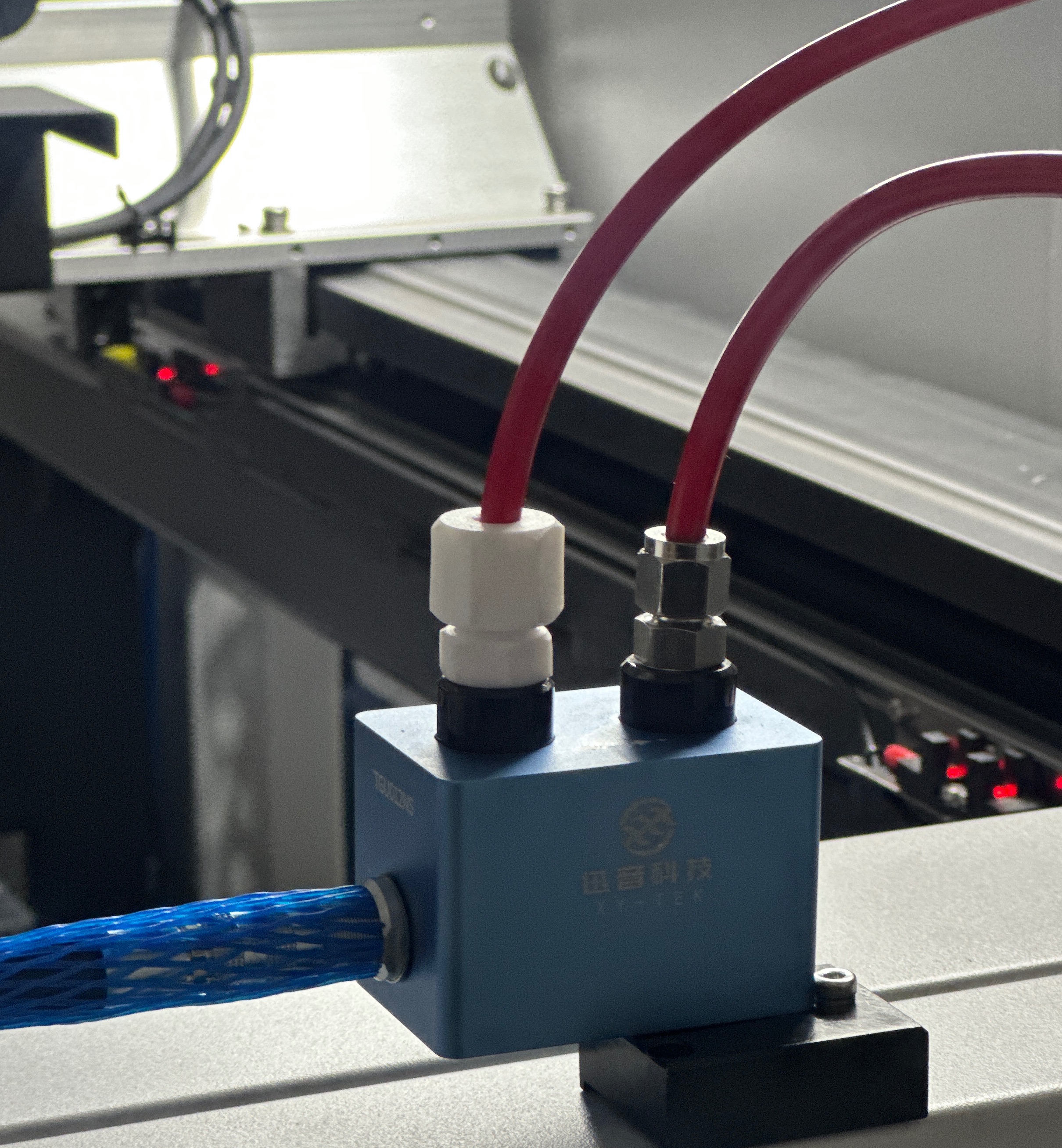
| Specification | SU Series (single-use) | TGU Series (low-flow) |
|---|---|---|
| Wetted / construction material | Biocompatible polymer materials | Biocompatible plastic with ultrasonic sensor module |
| Measuring channel | Single-use measuring channel | U-shaped measuring channel |
| Stated accuracy | ±2% | Up to ±0.1 mL/min; ±1% |
| Flow range | 0.05–10 L/min | 0–1000 mL/min (scope 0.1–1000 mL/min) |
| Compatible tubing | Single-use fluid path | PVC, silicone, PFA, PE, PUR with smooth inner and outer surfaces |
| Fluid temperature | 0–60 °C | 0–60 °C |
| Listed industries | Biopharma, single-use systems, medical manufacturing, bioprocess | Bioprocess, medical equipment, pharmaceutical production, semiconductor |
Reading the table: the SU Series is positioned for hygienic, single-use fluid paths where the channel is replaced rather than cleaned in place, while the TGU Series is positioned for very low volumetric flows where the absolute accuracy floor of the sensor, not the percentage figure, is the controlling specification.
What High Repeatability Means When the Channel Is Single-Use
Accuracy and repeatability are often used interchangeably in supplier literature, but they answer different questions. Accuracy describes how close a reading is to a reference value. Repeatability describes how closely repeated measurements agree with each other under identical conditions. A sensor can be accurate on average and still scatter enough between readings to be unusable as a control input.
In single-use systems, the second property carries unusual weight. When a fluid path is replaced between batches, campaigns, or product changeovers, the sensor's reference conditions change with it. The practical question a buyer has to answer is whether readings taken on one channel can be compared with readings taken on another, and whether a batch record can be built on that output. XY-TEK's published specification of high measurement repeatability for the SU Series addresses exactly this requirement; the ±2% accuracy figure across 0.05–10 L/min defines the envelope in which that repeatability is claimed.
Air-in-line detection is the second half of the reliability question in pharmaceutical fluid handling, because a reading is only useful if it reflects liquid rather than a gas slug. XY-TEK addresses this with dedicated ultrasonic detection hardware: the BG Series bubble detector performs non-contact, gas-liquid state detection with a stated detection resolution of one-third of the tubing inner diameter, across tubing inner diameters from 1.6 mm to 12.7 mm and outer diameters from 3.2 mm to 19 mm, for fluids at 0–60 °C. The series is listed for medical devices, bioprocess, food and beverage dosing, and industrial use. Air bubble detection is also specified on the clamp-on CG Series, which XY-TEK lists for medical device, biopharmaceutical, and industrial automation use.
Why ±0.1 mL/min Changes the Specification Conversation
At very low flow rates, the percentage accuracy figure stops being the most useful number on a datasheet. A ±1% specification at 1000 mL/min permits an error ten times larger in absolute terms than a ±1% specification at 100 mL/min. When a process step is defined as a few millilitres per minute or less, it is the absolute accuracy floor that determines whether the sensor's output can be used as a control value or only as an indicator.
The TGU Series is specified with measurement accuracy up to ±0.1 mL/min across a 0–1000 mL/min range, using a U-shaped measuring channel. That geometry is the design element XY-TEK specifies for this series, and it matters because ultrasonic transit-time measurement depends on the acoustic path through the fluid. The combination of a low absolute accuracy floor and a defined tubing set — PVC, silicone, PFA, PE, and PUR with smooth inner and outer surfaces — is what makes the series deployable in pharmaceutical production and medical equipment rather than only in general industrial monitoring.
The same low-flow platform is not limited to biological fluids. XY-TEK's documented deployments of the low-flow series include electronics manufacturing, SMT and EMS factories, and selective wave soldering equipment manufacturers, where the measured medium is flux rather than a biological process fluid. That is a different fluid, a different industry, and a different material compatibility assessment, but the same low-flow measurement requirement.
Application Fit in Bioprocess and Pharmaceutical Workflows
The material specification defines the fit. In a single-use bioprocess train, the SU Series is listed for biopharma, single-use systems, medical manufacturing, and bioprocess environments, where the fluid path is replaced between runs and the wetted polymer is the interface with the process fluid. In pharmaceutical production and medical equipment, the TGU Series is listed for the very low flows that characterize reagent addition, feed control, and small-volume liquid handling.
XY-TEK also lists the TGU Series for semiconductor applications, a sector where high-purity fluid management is the defining constraint. Third-party research from Market Research Future estimated flow control in the semiconductor industry at USD 5.83 billion in 2024, focused on high-purity fluid management — a figure that indicates the scale of the requirement rather than any specific supplier's share of it.
Two boundaries of this article should be stated plainly. First, the series discussed here are the SU and TGU platforms; XY-TEK's in-line TPK and TPD families, clamp-on CS and CPD families, the CM clamp-on flow meter, and the TH pulsatile sensor serve different flow ranges, tubing types, and industries, and carry their own specifications. Second, the application fit described above reflects XY-TEK's own product documentation. Independent confirmation of material suitability for a specific drug product or process step remains the buyer's qualification activity, not the supplier's claim.
Market Signals Behind the Materials Question
Three published data points frame why material documentation is getting more attention in this segment.
- Grand View Research estimated the global flow meter market at USD 10.64 billion in 2024, projected to reach USD 15.17 billion by 2030.
- Mordor Intelligence valued the global ultrasonic flow meter market at USD 1.52 billion in 2025, estimated to grow to USD 2.28 billion by 2031.
- Fortune Business Insights reported that Asia Pacific held the largest regional share of the ultrasonic flow meter market in 2025, at 38.6%, driven by industrial expansion.
Published estimates for the ultrasonic segment diverge widely, and the divergence is a scope problem rather than a disagreement about direction. Figures circulating for 2024–2025 range from a Grand View Research estimate of USD 860 million to a Mordor Intelligence estimate of USD 1.52 billion to a Dataintelo estimate of USD 6.2 billion, with differences traceable to scope choices such as whether smart water meters are included. Buyers reading market numbers should treat them as directional and check what each report counts.
Standards activity is more concrete. ISO 24062:2023 specifies requirements for clamp-on ultrasonic transit-time meters for liquids and gases in closed conduits, giving buyers a published reference for that measurement class. In medical device supply chains, EN ISO 13485 sets the quality management expectation that applies to sensors used in ventilators, drug delivery, and similar equipment. Neither standard certifies a specific product; both define the framework that material and performance claims are measured against.
Limits and Trade-offs of a Polymer-Path Ultrasonic Sensor
Material compatibility sets a boundary rather than a slogan, and the specifications state where the boundary sits.
| Constraint | What the specification states | What it means for a buyer |
|---|---|---|
| Fluid temperature | SU and TGU Series: 0–60 °C. XY-TEK's industrial clamp-on CS and CPD families: 0–90 °C. | Higher-temperature process steps need a different family or a different measurement approach. |
| Flow range | SU: 0.05–10 L/min. TGU: 0–1000 mL/min. In-line TPK and TPD families: 0.5–100 L/min measurement scope. | Above the SU and TGU ceilings, the series discussed here are not the right selection. |
| Fluid cleanliness | Measurable fluids are specified as those without, or with few, solid particles. | Particulate-laden media and slurries fall outside the stated specification. |
| Wetted-path chemistry | Biocompatible polymer and biocompatible plastic. | Biocompatibility is not the same as universal chemical compatibility; solvents and cleaning agents must be checked against the specific fluid. |
| Tubing requirements | TGU: PVC, silicone, PFA, PE, PUR with smooth inner and outer surfaces. Rigid-tube clamp-on families: rigid plastic tubing such as PFA, PTFE, PVDF, PP, and nylon. | Measurement through the tube wall depends on tubing geometry and surface quality, so tubing is part of the specification. |
The comparison with traditional in-line mechanical sensors runs in both directions. In XY-TEK's documented battery electrolyte injection experience, traditional in-line sensors were associated with contamination risk and required pipe cutting, while the non-invasive clamp-on alternative avoided both — an advantage that shows up wherever the fluid path must stay closed. The trade-off is the constraint set above: non-invasive and polymer-path measurement places requirements on tubing, temperature, and fluid cleanliness that an intrusive mechanical sensor mounted in a metal line does not carry in the same form.
Accuracy class is a further trade-off. The series discussed here are specified at ±1% to ±2% depending on model. Where a process requires a different accuracy class, or a measurement principle that responds to mass rather than volumetric flow, ultrasonic transit-time is not automatically the correct answer, and the selection should follow the process requirement rather than the sensor family.
Customization, Qualification, and the Evidence Trail
For OEM buyers, the material question is inseparable from the integration question. XY-TEK offers OEM and ODM production as well as custom design services, with a stated customization scope covering sensor size, interface, logo printing, communication protocol, and housing material. Sensor size and housing material sit directly on the wetted and mechanical interface, which is why they are listed as customization variables rather than fixed catalogue options.
Production and quality arrangements are published at the program level. XY-TEK quotes production windows of 15–25 days for OEM and ODM work and 20–30 days for custom design, with a lead time of 1–2 months and a minimum order quantity of 50 units for those programs. Quality control differs by line: OEM and ODM production is quoted with 100% pre-shipment testing, while custom design work is quoted with third-party inspection available. After-sales support is listed as online engineering support, remote technical support, and quality warranty.
For standard catalogue units, XY-TEK's procurement terms list a minimum order quantity of 1 unit, FOB delivery, factory inspection and calibration before shipping, and payment before shipment. The low entry quantity is relevant at the evaluation stage because it allows a sensor to be tested against an actual fluid path before a production commitment is made.
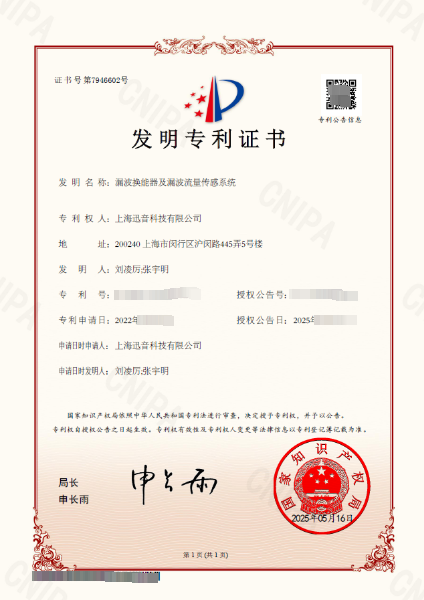
On the intellectual property side, XY-TEK's compliance records list invention patents issued by the China National Intellectual Property Administration. One is invention patent No. 7946602, issued 16 June 2025 and expiring 16 June 2045, covering liquid flow sensing and filter enhancement technology applications. Two earlier invention patents were issued 1 November 2022 and expire 1 November 2042, covering ultrasonic flow sensor technology and ultrasonic flowmeter technology. Patent coverage is not a material declaration, but it is part of the verification picture a buyer assembles when a supplier's capability claims extend beyond catalogue specifications.
Future Outlook
Single-use adoption in bioprocessing and the growth of the ultrasonic measurement segment point in the same direction: more sensors in more fluid paths, and more scrutiny of what those sensors are made of. The segment figures cited above, from USD 1.52 billion in 2025 toward USD 2.28 billion by 2031, describe a market expanding faster than the overall flow meter category it sits inside.
Regional weight matters to supply planning. With Asia Pacific reported at 38.6% of the ultrasonic flow meter market in 2025, suppliers manufacturing in that region hold a structural position in cost and lead time, and buyers in Europe and North America have a corresponding reason to verify material declarations across regions rather than assume they are uniform.
The most likely change over the next cycle is procedural rather than technical. As ISO 24062:2023 gives buyers a published reference for clamp-on ultrasonic transit-time meters, and as EN ISO 13485 continues to define the quality management expectation in medical device supply chains, requests for wetted-material declarations, repeatability data across channels, and calibration records are likely to become routine parts of supplier qualification rather than optional extras.
One honest caveat belongs here. Much of the material evidence available in this segment is supplier-declared and series-level. It is specific enough to be checked — a named series, a named material class, a stated temperature window, a stated tubing set — but independent verification through the buyer's own qualification protocol remains the step that converts a declaration into an approved material. Series documentation for XY-TEK's ultrasonic flow sensor families, including the SU and TGU specifications referenced in this article, is published at xy-tek.com.
Frequently Asked Questions
What does “biocompatible material” mean in a single-use flow sensor?
In XY-TEK's SU Series, the specification is biocompatible polymer materials combined with a single-use measuring channel. In practice, a biocompatibility declaration describes the wetted path — the surfaces the process fluid contacts — rather than the housing or the electronics. Buyers generally treat it as one input into a wider qualification that also covers extractables and leachables testing, sterilization compatibility, and chemical compatibility with the specific process fluid. XY-TEK publishes the material class for each series (biocompatible polymer for the SU Series, biocompatible plastic for the TGU Series); whether that class is acceptable for a given drug product is determined by the buyer's own qualification protocol.
How does repeatability differ from accuracy, and why does it matter more in single-use systems?
Accuracy describes how close a reading is to a reference value, while repeatability describes how closely repeated measurements agree under identical conditions. In single-use systems, where the fluid path may be replaced between batches or campaigns, repeatability determines whether readings from one channel can be compared with readings from another. XY-TEK specifies high measurement repeatability for the SU Series alongside ±2% accuracy over 0.05–10 L/min. For a buyer, the deciding factor is which property the process depends on: a batch record typically needs consistent readings across channels as much as it needs a true absolute value.
Why does a stated accuracy of ±0.1 mL/min matter in pharmaceutical workflows?
The TGU Series is specified with measurement accuracy up to ±0.1 mL/min across a 0–1000 mL/min range. At low flow rates, a fixed absolute error consumes a much larger share of the reading, so the absolute accuracy floor — not the percentage figure — determines whether the sensor output can serve as a control value or only as an indicator. Pharmaceutical production steps such as reagent addition, feed control, and small-volume liquid handling are frequently defined in millilitres per minute or below, which is the range where that specification becomes the controlling one.
What are the limitations of a polymer-path ultrasonic flow sensor?
The product data states several boundaries. The SU and TGU Series are specified for fluid temperatures of 0–60 °C, narrower than XY-TEK's industrial clamp-on CS and CPD families at 0–90 °C. Measurable fluids are specified as those containing no or few solid particles, so particulate-laden media fall outside the specification. Biocompatible polymers are not automatically compatible with every solvent or cleaning agent, so chemical compatibility must be confirmed against the actual process fluid. A fourth constraint is tubing: the TGU Series requires PVC, silicone, PFA, PE, or PUR tubing with smooth inner and outer surfaces, because measurement through the tube wall depends on tubing geometry and surface quality.
How should a buyer verify material and performance claims before qualification?
A verification sequence that matches the published data would start by confirming the series and flow range against the process, then requesting the wetted-material specification for that specific series, then checking the fluid temperature window and tubing compatibility against the installation. Quality arrangements are stated at program level: XY-TEK quotes 100% pre-shipment testing for OEM and ODM production and third-party inspection availability for custom design, with factory inspection and calibration before shipping on standard units. Because the minimum order quantity for standard catalogue units is 1 unit, a sensor can be evaluated against an actual fluid path before a production commitment.
Can the same low-flow ultrasonic platform serve applications outside bioprocess?
Yes. XY-TEK lists the TGU Series for bioprocess, medical equipment, pharmaceutical production, and semiconductor applications, and its documented low-flow deployments include electronics manufacturing, SMT and EMS factories, and selective wave soldering equipment, where the measured medium is flux rather than a biological fluid. The measurement principle is unchanged across those uses; what changes is the fluid, the tubing, and the material compatibility assessment. Buyers in non-pharmaceutical industries therefore evaluate the same specification set — range, accuracy, temperature window, and tubing compatibility — against a different medium.
Есть вопросы или нужны дополнительные детали?
Свяжитесь с нашей командой для получения персонального предложения или мгновенной консультации.
Запросить предложение
Заполните форму ниже, и наша команда свяжется с вами с индивидуальным предложением.
Прямой чат WhatsApp
Предпочитаете общаться в реальном времени? Напишите нам в WhatsApp для мгновенной помощи и быстрых ответов.
- Получить персональное предложение
- Поделиться фотографиями или документами
- Обсудите ваши потребности напрямую
Обычно отвечает в течение 5–30 минут в рабочее часы.