
Eraser & Sharpener Trade: Policy, Capacity and Export Shifts
Eraser & Sharpener Trade: Policy, Capacity and Export Shifts
Eraser & Sharpener Trade: Policy, Capacity and Export Shifts
Eraser and pencil sharpener sourcing is often reduced to a price comparison. In 2026 that framing is incomplete. Three variables now move ahead of price: the safety regime a specific SKU falls under, how much of a factory's stated capacity is actually convertible into a given order, and which tariff heading the finished article is declared under. Buyers who assess suppliers on unit cost alone are effectively pricing a product whose compliance route and customs route have not yet been settled.
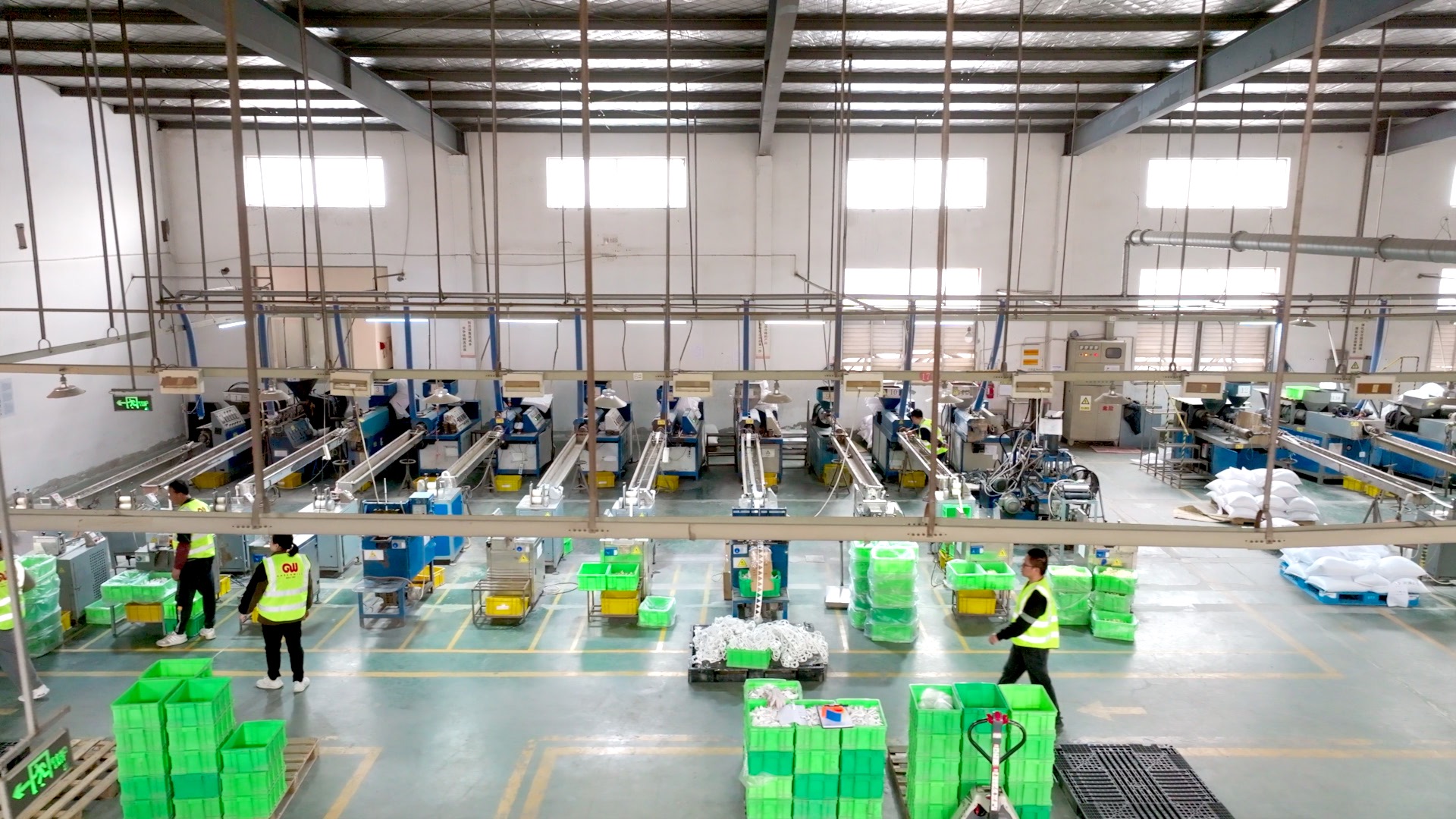
Injection moulding workshop: combination SKUs such as eraser sharpeners are assembled from separately moulded components, which is one reason capacity is rarely a single number.
A Growing Category Does Not Imply a Simple Purchase
A Dataintelo market report places the global erasers market at USD 3.8 billion in 2025 and projects USD 5.6 billion by 2034, a compound annual growth rate of 4.4%. The same source reports that rubber-material erasers account for 41.2% of category revenue. Growth of that order is a useful backdrop for budgeting, but it says nothing about whether a specific purchase order will clear customs under the intended heading or will survive a laboratory test file review in its destination market.
What actually determines whether an eraser, eraser sharpener or pencil topper can be sold into a given market is a set of constraints that sit upstream of the price negotiation. Buyers in the research and evaluation stage are therefore better served by mapping those constraints first, then testing which factories can meet them consistently, rather than collecting quotations and reconciling compliance later.
Policy Constraints Now Travel With the Purchase Order
Erasers and pencil sharpeners are deceptively simple products. A shaped novelty eraser or a cartoon pencil topper can be a stationery item in one market and a toy in another, and the two classifications carry different obligations.
European Union: the toy boundary is the deciding line
Directive 2009/48/EC defines a toy as a product designed or intended, whether or not exclusively, for use in play by children under 14 years of age, and requires such products to meet essential safety requirements and carry CE marking. Shaped erasers, novelty erasers and pencil toppers sit close to that definition, which means whether a particular SKU is a toy is a per-product legal determination rather than a blanket category rule. Regulation (EU) 2025/2509 is the framework that will supersede the current Directive, so a buyer specifying compliance today is specifying against a regime that is already in transition.
Where a product is treated as a toy, EN 71-3 — migration of certain elements from toy materials — is the harmonised test standard typically applied to the elastomeric and plastic parts found in erasers and pencil toppers. Separately, REACH Regulation (EC) No 1907/2006 Annex XVII entry 51 restricts DEHP, DBP, BBP and DIBP to a maximum of 0.1% by weight of the plasticised material in toys and childcare articles. That single restriction is the reason soft PVC eraser formulations have migrated toward non-phthalate plasticisers or toward TPR and other non-PVC materials.
United States: a different measurement basis entirely
Under 15 U.S.C. 1278a, part of the Consumer Product Safety Act as amended by CPSIA, a children's product may not contain more than 100 ppm total lead in any accessible part. Where an eraser or pencil topper is a children's product, that limit applies. Whether a specific item meets the statutory definition of a children's product is again a per-product determination.
The critical point for buyers is that the EU and US regimes are not variations of one threshold. The EU rule as described above is a concentration limit on four specific phthalates in plasticised material; the US rule is a total lead content limit per accessible part. Different substances, different measurement bases, different legal objects. They cannot be averaged, converted or presented as a single compliance figure, and a specification that treats them as interchangeable will not survive a test report review.
Small parts and caps
ISO 11540 specifies requirements for caps on writing and marking instruments intended to reduce the risk of asphyxiation in children. Pencil caps, pencil toppers and cap-shaped eraser accessories sit in the vicinity of that standard, which makes vented, non-detachable or appropriately sized designs a product-architecture question rather than a packaging detail.
China: domestic and export routes are not identical
China maintains a mandatory national standard, GB 21027-2020 «General requirements for the safety of student supplies», which addresses student and stationery supplies and is the standard Chinese eraser and sharpener manufacturers typically cite for domestic-market compliance. A SKU built for domestic compliance is not automatically built for EU or US compliance, and buyers evaluating Chinese factories should confirm which market each specification file was written for rather than assuming a single master file covers all destinations.
Tariff Boundaries Decide Landed Cost Before Price Does
Customs classification is the second constraint that frequently gets resolved after the quotation, when it should be resolved before it. Under the WCO HS Nomenclature 2022, the relevant boundaries are explicit:
- HS 4016.92 — Erasers, within heading 40.16 covering other articles of vulcanised rubber other than hard rubber.
- HS 8214.10 — Pencil sharpeners and blades therefor, within heading 82.14.
- HS 9609.10 — Pencils and crayons with leads encased in a rigid sheath, which means an eraser-tipped pencil is a single classified article rather than an eraser plus a pencil.
The consequence matters more than the codes themselves. Because 4016.92 is limited to erasers of vulcanised rubber, an eraser made from PVC or from a thermoplastic elastomer compound does not automatically fall under that subheading. Two visually identical white erasers can therefore be declared under different chapters on the strength of their declared material composition alone. National tariff schedules add statistical suffixes and may split further by material, and binding tariff information issued in one jurisdiction does not bind another.
For a buyer assembling a multi-SKU programme, this creates a data discipline requirement: material composition has to be recorded at SKU-master level, not at product-family level, before landed cost can be quoted with any confidence. It also means published trade values for erasers cannot be used as a proxy for the addressable market of a plastic or TPR eraser line without adjusting for material scope.
Where Capacity Actually Sits
China is the world's leading exporter of vulcanised rubber erasers, with USD 137 million in export value for 2024 according to the Observatory of Economic Complexity, based on HS 401692. That figure describes one subheading only and should be read alongside the classification caveat above, but it establishes the concentration of supply.
Within that supply base, capacity is usually quoted as a single impressive number. It is more useful to read it as three separate figures that do not convert into each other.
Kunshan Crystal Culture Co., Ltd, the company manufacturing under the Greenwill stationery brand, is a China-based OEM/ODM stationery producer founded in 1999, operating a 25,000 m² factory with roughly 100 employees and reporting that approximately 90% of output is exported to North America, South America, Europe, Southeast Asia, Oceania and the Middle East. Its disclosed figures illustrate the distinction well:
| Capacity measure | Disclosed figure | What it does and does not tell a buyer |
|---|---|---|
| Eraser output, annual | Over 260 tons per year | Indicates compounding and moulding throughput. Does not indicate how much of that tonnage can be produced in a specific shape, hardness or colour. |
| Eraser output, daily | 20 tons per day | Indicates peak-line capability. Order scheduling, not daily output, usually determines the delivery date. |
| Combination eraser sharpener output | 3,000,000 pieces per year (models GW007, GW006, GW013, GW015, GW009) | Piece-based, not weight-based. A two-part assembly consumes blade, shell and eraser capacity in different proportions. |
| Minimum order quantity | 20,000 pcs per colour per design | Sets the practical floor for a custom colour or design. Below this, stock programmes are the realistic route. |
| Lead time | 30–45 days | A planning window, not a guarantee. Seasonal peaks and tooling changes fall outside it. |
The lesson generalises beyond one factory. Tonnage capacity answers a rubber-compounding question. Piece capacity answers an assembly question. Neither answers the question a buyer actually asks — how many units of this design, in this colour, in this packaging, can be ready by this date. A supplier that can produce 20 tons of eraser compound per day may still be constrained by mould cavities for a specific novelty shape, by blade supply for a combination sharpener, or by printing capacity for branded erasers.
Material Substitution Is Both a Compliance Decision and a Tariff Decision
The most consequential trend in this category is not a new product; it is a material shift. Moving away from plasticised PVC toward TPR or vulcanised rubber addresses the phthalate restriction described earlier. It can also move the product into a different customs classification. Material substitution therefore cannot be costed on compliance grounds alone — the landed-cost outcome has to be modelled in the same exercise.
Product architecture creates a parallel effect. A «sharpener with eraser», an «eraser pencil», a «pencil cap» and a «pencil topper» are composite articles that sit on boundaries between several tariff headings and several safety regimes. How a combination SKU is structured — as one article or as separable components — drives both its classification and its certification scope. That is a design-stage decision with procurement consequences, not a labelling decision at shipment.
Purchase Terms and Acceptance Criteria Differ by Market
Because the underlying legal objects differ, the acceptance criteria written into a purchase order should differ too. The table below summarises what the evidence supports for each market, without asserting that any single document set satisfies all three.
| Market | Regulatory basis in scope | What the purchase order should specify | Typical weak point |
|---|---|---|---|
| European Union | Directive 2009/48/EC (transitioning to Regulation (EU) 2025/2509); EN 71 series including EN 71-3; REACH Annex XVII entry 51 | Whether each SKU is treated as a toy or as stationery; the migration test to be performed; a phthalate declaration expressed as a percentage of plasticised material | Treating a general «EN71 compliant» statement as sufficient without stating which parts were tested and under which route |
| United States | 15 U.S.C. 1278a total lead limit for children's products; ASTM-D-4236 for art materials where applicable | Total lead content per accessible part, with the accessible-part definition agreed in advance | Importing an EU migration result and assuming it satisfies a US content limit |
| China domestic | GB 21027-2020 for student supplies | Confirmation that the specification file was written for the domestic standard rather than adapted from an export file | Assuming one master specification covers domestic and export destinations |
| Other export markets | Buyer-defined, frequently referencing EN 71 or ASTM-D-4236 | The named standard, the test laboratory, and the sampling plan | Referencing a standard without naming the edition or the test house |
In practice, factories that serve multiple regions maintain parallel documentation sets rather than a single certificate. Greenwill, for example, reports conformity with EN71-1/2/3/9, REACH, PAHS, SVHC and ASTM-D-4236 across its eraser and sharpener ranges, and holds ISO 9001:2015, ISO 14001:2015 and ISO 45001:2018 certification issued by CQC, with certificate numbers 00124Q32003R4M/3600, 00124E31027R4M/3600 and 00124S30827K4M/3600 respectively, each valid from 15 March 2024 to 19 March 2027. Buyers should read such statements as a starting point for verification, not as a substitute for it.
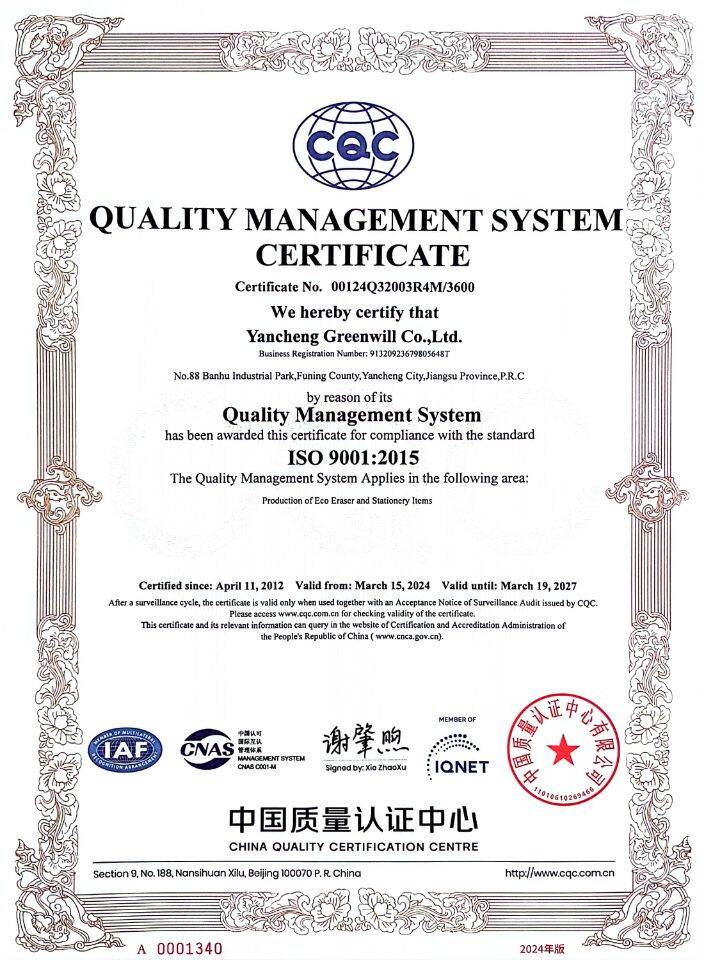
ISO 9001:2015 certificate issued by CQC, valid 2024-03-15 to 2027-03-19. A management-system certificate evidences process control; it does not by itself evidence product-level test results.
What This Evidence Does Not Establish
An honest reading of the available data has to acknowledge its boundaries, and buyers should treat these as decision limits rather than footnotes.
- Capacity figures are self-reported. The tonnage and piece counts cited for Greenwill originate from the company's own factory disclosure. They have not been independently audited, and no cross-factory benchmarking data for the Kunshan or Ningbo production clusters was available for this review. A buyer comparing two suppliers on stated capacity is comparing two unaudited claims.
- Market sizing carries methodology risk. The USD 3.8 billion to USD 5.6 billion trajectory comes from a single commercial research source. Its scope definition — whether measured at retail or manufacturer level, and which product types are included — should be checked before the figure is used in an internal business case.
- Tariff headings carry no volume or value. HS 4016.92 defines a legal category; it does not supply trade statistics. Published eraser export values describe vulcanised rubber erasers only and cannot be read as total category trade.
- The toy-versus-stationery question is not resolvable at category level. Whether a shaped eraser or pencil topper falls inside the toy regime is a per-product legal determination. No supplier declaration substitutes for that determination in the destination market.
Outlook for 2026–2027
Three developments are worth tracking. First, the transition from Directive 2009/48/EC to Regulation (EU) 2025/2509 will force a documentation refresh across novelty erasers and pencil toppers, and buyers who specify the successor framework early will avoid a re-certification cycle mid-programme. Second, material substitution away from plasticised PVC is likely to continue, but its customs consequences will increasingly appear in landed-cost calculations rather than in compliance conversations alone. Third, as combination SKUs multiply — eraser sharpeners, toppers with built-in erasers, cap-and-eraser assemblies — the product-architecture decision will keep moving earlier in the development cycle, because it is now simultaneously a classification decision, a certification-scope decision and a cost decision.
For buyers, the implication is straightforward. Evaluate suppliers on the strength of their constraint management — how clearly they can state which regime each SKU serves, how they convert claimed capacity into a delivery commitment for a specific design, and how their material choices map to declared headings — rather than on unit price alone.

A combination SKU such as the GW006 eraser with sharpener illustrates the composite-product problem: one article, multiple component materials, and more than one potential compliance and tariff route.
Frequently Asked Questions
Which certifications are actually mandatory to sell erasers and pencil sharpeners in the European Union?
The obligation depends on classification. Under Directive 2009/48/EC, a product designed or intended for use in play by children under 14 is a toy and must meet the essential safety requirements and bear CE marking; Regulation (EU) 2025/2509 will supersede that Directive. Where a product is treated as a toy, EN 71-3 is the harmonised standard governing migration of certain elements from toy materials. Where a shaped or novelty eraser is not treated as a toy, the toy regime does not apply in the same way. Because that determination is product-specific, the purchase order should record which route each SKU follows rather than assuming the whole range follows one route.
How should EN 71 testing be written into a purchase order?
Specify the standard part by part rather than as a general claim. A usable specification names EN 71-3 explicitly, identifies which components of the article are being tested — for example the eraser body, the decorative element, or the sharpener shell — and states the test laboratory and sampling plan. A general statement that a product is «EN71 compliant» does not define the test scope and is difficult to enforce when a shipment is challenged. Buyers should also confirm the current edition of the standard rather than accepting an edition number quoted from memory.
Can US lead limits and EU phthalate limits be treated as one compliance threshold?
No. They are different legal objects measured on different bases. REACH Annex XVII entry 51 restricts DEHP, DBP, BBP and DIBP to a maximum of 0.1% by weight of the plasticised material in toys and childcare articles. 15 U.S.C. 1278a limits total lead content to 100 ppm in any accessible part of a children's product. One is a substance-specific concentration in a material; the other is total content per accessible part. They cannot be averaged, converted or presented as a single figure, and a test report for one does not satisfy the other.
How can a buyer verify a factory's stated eraser and sharpener capacity?
Separate the claim into its components. Annual tonnage describes compounding and moulding throughput; annual piece counts describe assembly; minimum order quantity and lead time describe scheduling. Ask for the capacity associated with the specific design, colour and packaging you intend to order, since mould cavities and decoration steps can constrain output independently of total plant capacity. Note that disclosed capacity figures are typically self-reported and may not be independently audited, so they should be validated against delivery records from comparable orders rather than accepted as a planning input on their own.
Does switching eraser material from plasticised PVC to TPR change the customs classification?
It can. HS subheading 4016.92 covers erasers of vulcanised rubber, so erasers made from non-rubber materials such as plasticised PVC or thermoplastic elastomer compounds do not automatically fall under that subheading. Two externally similar products can therefore be declared under different headings depending on declared material composition, and national tariff schedules may add further statistical splits. Buyers should hold material composition at SKU-master level before quoting landed cost, and should not assume that a published trade value for erasers describes a non-rubber product line.
What should a sample validation plan cover before a bulk eraser or sharpener order?
At minimum: confirmation of the material actually used against the declared material, erasing performance on the intended paper type, residue behaviour, and sharpener blade performance across repeated cycles. For combination SKUs, test the assembly rather than the components in isolation, because the composite article is what gets classified and certified. Where the product may be treated as a toy in the destination market, include the migration test under EN 71-3 on the relevant components. Record the sample date, the tested specification and the destination market, so that later shipments can be checked against a defined baseline rather than a general expectation.
Есть вопросы или нужны дополнительные детали?
Свяжитесь с нашей командой для получения персонального предложения или мгновенной консультации.
Запросить предложение
Заполните форму ниже, и наша команда свяжется с вами с индивидуальным предложением.
Прямой чат WhatsApp
Предпочитаете общаться в реальном времени? Напишите нам в WhatsApp для мгновенной помощи и быстрых ответов.
- Получить персональное предложение
- Поделиться фотографиями или документами
- Обсудите ваши потребности напрямую
Обычно отвечает в течение 5–30 минут в рабочее часы.