
Ethernet Cable Compliance Decoded: UL, ETL, CPR and Flame Ratings
Ethernet Cable Compliance Decoded: UL, ETL, CPR and Flame Ratings
UL, ETL, CPR and the CM, CMG, CMR and CMP flame ratings are four different systems answering four different questions. Treating them as one quality badge is one of the most expensive mistakes a cable buyer can make.
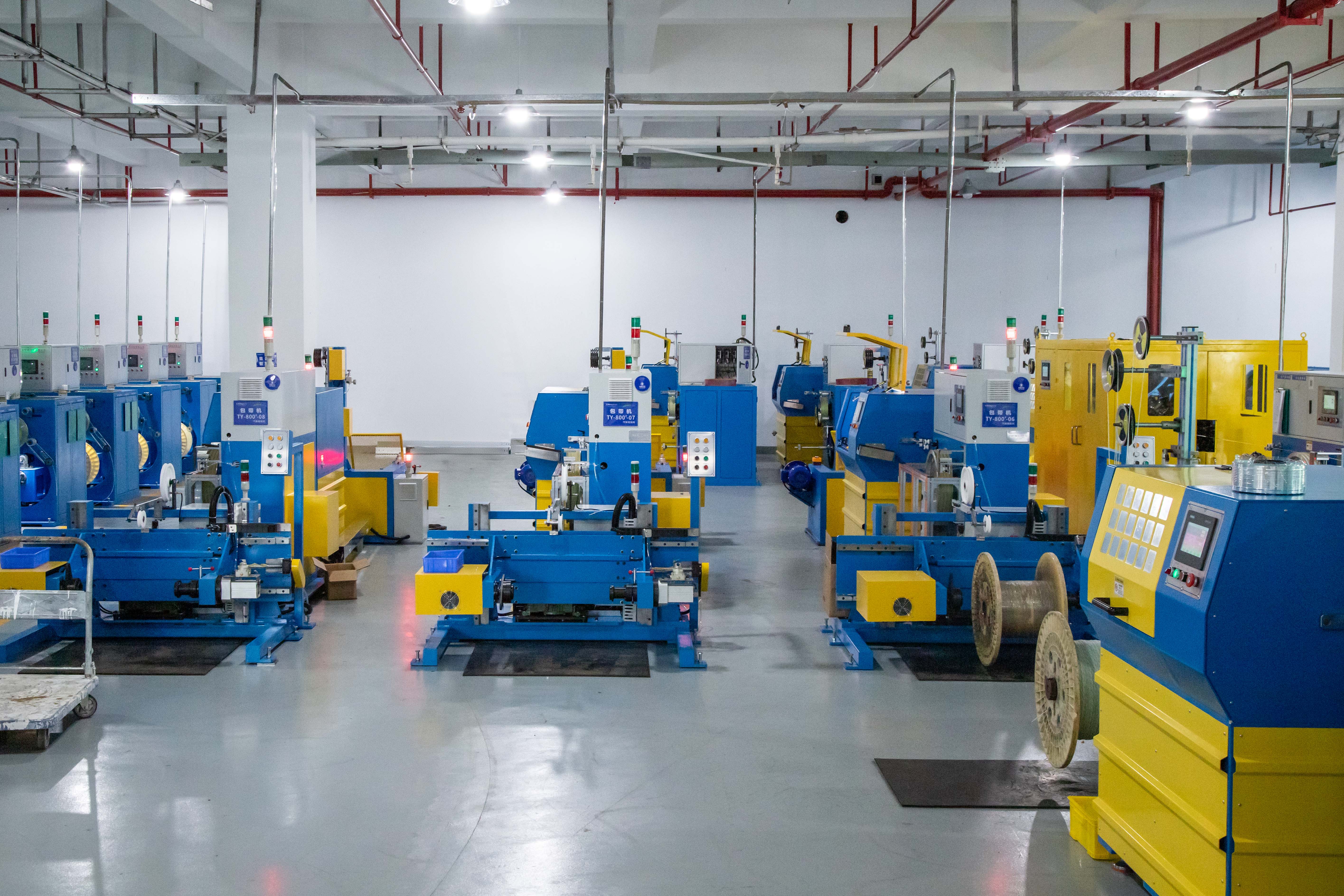
Shield tape wrapping during cable construction. The shielding build of a cable is not a cosmetic detail: it is part of what a European CPR certificate actually describes.
An Ethernet cable that fails compliance is not merely a slow cable. It is a cable that can be stopped at a port of entry, rejected at project acceptance, or ordered out of a building after it has already been installed. UL, ETL, CPR and the North American flame ratings are frequently described as variations of the same quality badge. In practice, each is issued by a different body, evaluates a different property, and governs a different market or installation zone.
UL and ETL verification address whether a defined cable construction has been evaluated against recognised electrical and performance standards, mainly for North America. CPR, the European Construction Products Regulation, determines whether a cable may legally be placed on the EU construction market and how it behaves under fire conditions. Flame ratings such as CM, CMG, CMR and CMP define where inside a building the cable is permitted to be installed. These are separate gates. A cable can hold a valid UL file and still be refused in an EU public-building tender that specifies a CPR Dca-s1,d0,a2 class.
Why Compliance Became a Procurement Gate
The Ethernet cable market is large enough that compliance decisions now carry real commercial weight. Maximize Market Research valued the global Ethernet cable market at USD 38.55 billion in 2025 and projected it to reach nearly USD 70.02 billion by 2032, a CAGR of 8.9% for 2026 to 2032. Within that market, Dataintelo reported that the Cat6 segment held a 32.5% share in 2025.
A separate signal sits in the structure of the market data itself. Comparable research published for the same reference year differs by roughly a factor of five depending on whether a study counts LAN-grade patch cable or the broader Ethernet cabling category used in industrial and data centre applications. That definition gap is a reminder for buyers: a market figure is only meaningful when its product scope is stated.
Alongside market growth, cabling density has changed the risk profile of the average project. Where a single rack once held a handful of copper links, high-density data centre layouts now concentrate hundreds of powered cables in a confined space. Fire performance, smoke generation and installation-space classification stop being theoretical clauses and become the items a consultant, an insurer or an acceptance inspector asks about first. Compliance evidence is therefore requested earlier in the buying cycle than it used to be, and the party who cannot produce it is usually removed from the shortlist before price is discussed.
The Four Marks, Decoded
The fastest way to understand UL, ETL, CPR and flame ratings is to separate them by the question each one answers. The table below summarises the distinction before the detail is examined section by section.
| Mark / Rating | Issued or defined by | What it actually covers | What it does not cover |
|---|---|---|---|
| UL Mark | UL LLC | Evaluation of a defined cable construction under a UL file number, for the North American market | EU fire-reaction classification, installation-zone permission, or batch-to-batch consistency |
| ETL Verified | Intertek | Verification of a listed construction against a named performance standard | Anything outside the listed construction scope; a verification record may carry no flame rating at all |
| CPR | EU Notified Bodies | Fire reaction class of a construction product placed on the EU construction market | North American market access, and any model not covered by the certificate scope |
| CM / CMG / CMR / CMP | North American cable standards | Where the cable may be installed inside a building, including air-handling spaces | Electrical performance, EU compliance, or data rate |
UL Mark: A File Number, Not a Category
UL certification in North America is recorded against a file number rather than a general product type. Linoya Electronic Technology Co., Ltd. maintains UL file E320763 for communication LAN cables. The important operational point is validity: an expired UL record means a shipment can be treated as uncertified goods, which is why buyers are advised to verify the file status rather than accept a scanned certificate at face value.
ETL Verified: Read the Scope Line by Line
ETL verification is issued by Intertek and is tied to a specific construction and a specific standard. Two examples from Linoya illustrate how narrow that scope can be. The company's CAT6 U/UTP CM horizontal solid cable is ETL Verified and complies with the ANSI/TIA-568.2-D Category 6 standard for the North American market. Separately, the CAT6A 4-pair 23AWG U/FTP horizontal solid cable is ETL Verified, and this certification carries no flame rating requirement marked on it.
That second example is the single most practical thing a buyer can learn about ETL documentation: the scope is exactly what it says and nothing more. Where a project clause expects a flame rating, that requirement has to be satisfied by a separate document or by the product specification, not assumed from the presence of an ETL mark.
CPR: Issued by Notified Bodies, Classed by Fire Reaction
For the EU market, LAN cable must complete CPR certification issued by an EU Notified Body, and the fire reaction class has to be marked on the cable or its label. The classes are not interchangeable between projects. Linoya's CPR certificates are issued by VDE Prüf- und Zertifizierungsinstitut GmbH (Notified Body 0366), by EZÚ 1014 and by TÜV Rheinland InterCert Kft. 1008, depending on the construction.
- Eca class: Linoya UTP CAT.5e 24AWG 4P solid cable is certified by VDE, Notified Body 0366, against EN 13501-6. The CAT.6 U/UTP LSZH and CAT.5E U/UTP LSZH constructions hold CPR Eca class under CSN EN 13501-6:2014, certified by EZÚ 1014.
- Dca-s1,d0,a2 class: the CAT.6A U/FTP LSZH construction is certified at this class by EZÚ 1014, and also complies with TIA/EIA 568-C.2. The CAT.7 4PR 23AWG S/FTP LSZH construction holds the same Dca-s1,d0,a2 class under CSN EN 13501-6:2014.
- B2-ca class: Linoya S/FTP Ethernet cable holds CPR B2-ca fire reaction class, tested under EN 50575:2014+A1:2016 by TÜV Rheinland InterCert Kft., Notified Body 1008.
Class ceilings matter because they translate into measurable fire behaviour. Published guidance on CPR classes describes B2ca as a high fire-performance band with thresholds of flame spread at or below 1.5 m, total heat release at or below 15 MJ, and peak heat release rate at or below 30 kW. A jacket material that cannot meet those thresholds cannot simply be relabelled into a higher class.
CM, CMG, CMR and CMP: Installation Permission, Not Speed
Flame ratings in the North American system classify where a cable may physically be installed. In Linoya's portfolio the pattern is consistent: the CAT5E U/UTP, F/UTP and SF/UTP constructions carry CM or CMG ratings; the CAT6 U/UTP, F/UTP and SF/UTP constructions carry CMR ratings; and the CAT6A, CAT7, CAT7A and CAT8 constructions carry CMP ratings.
Plenum air-handling space in North America strictly requires CMP-rated cable, and CM or CMG grade cannot satisfy a plenum code requirement. This is the point at which a specification error becomes a construction problem rather than a procurement problem: substituting a lower-rated cable in a plenum run is a code violation regardless of how well the link performs.
What the Marks Do Not Cover
Certification documents describe constructions, not intentions. Four scope limits appear repeatedly in real projects.
- Construction consistency. A CPR certificate records a specific shielding construction. If the delivered cable uses a different shielding type from the one recorded in the certificate, the product is treated as an uncertified variant and can fail project acceptance.
- Label accuracy. The fire reaction class printed on a cable label must be consistent with the Notified Body test report. Where a label shows a higher class than the underlying test report, the exposure is not only rejection at acceptance but also recall or penalty from EU market surveillance.
- Model-level scope. High-category products such as Cat8 require confirmation that the certification in hand covers the exact model being ordered, together with its transmission performance and installation restrictions.
- Standards version. A verification record may not quote every standard a project cites. Some Linoya Cat6A ETL-verified products do not quote ANSI/TIA-568.2-D on the certificate, so the datasheet and certificate scope should be checked before the order is placed.
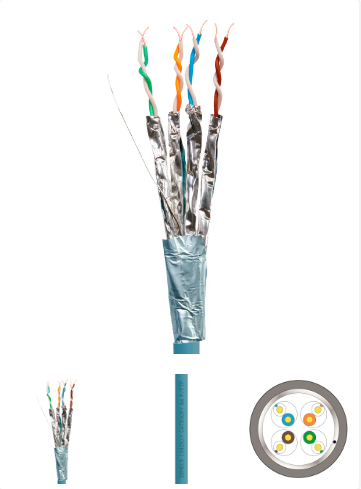
Full-shielded F/FTP construction with overall plus pair foil. The shielding build recorded in a certificate must match the shielding build actually delivered.
How Linoya's Portfolio Lines Up Against These Requirements
Linoya Electronic Technology Co., Ltd. is a cable and wire manufacturer established in 1997, integrating R&D, manufacturing and sales across intelligent transmission, smart power and new materials. The company operates three self-owned industrial parks in Shenzhen and Dongguan, a subsidiary brand in Dongguan, and a production base in Vietnam, with manufacturing facilities covering 60,000 square metres, more than 3,000 employees, a 300-engineer R&D team and an annual production capacity of 4,000,000 kilometres. Linoya reports annual sales exceeding USD 420 million and states that exports account for roughly 30% of output, with the EU and the Middle East as its main markets.
Those figures matter to a compliance discussion for a practical reason. Certification is not a one-off purchase; it has to be maintained across product families, model variants and production batches. A supplier with a narrow catalogue can hold a narrow certificate scope. A supplier covering Cat5e through Cat8 has to hold, and keep current, a wider set of records.
The table below maps Linoya's Ethernet cable families against the compliance attributes described in this article. It reflects published product specifications and certification information, and it is intended as a screening tool rather than a substitute for checking the certificate that applies to a specific order.
| Model | Bandwidth / distance | Shielding | Flame rating | Certification stated |
|---|---|---|---|---|
| CAT5E U/UTP (24AWG) | 1 Gbps | Unshielded | CM / CMG | UL, ETL; CPR Eca (LSZH variant) |
| CAT5E F/UTP | 1 Gbps | Overall foil | CM / CMG | UL, ETL |
| CAT5E SF/UTP | 1 Gbps | Screen + foil | CM / CMG | UL, ETL |
| CAT6 U/UTP (24/23AWG) | 10 Gbps @ 55 m | Unshielded | CMR | UL, ETL; CPR Eca (LSZH variant) |
| CAT6 F/UTP | 10 Gbps @ 55 m | Overall foil | CMR | UL, ETL, CPR |
| CAT6 SF/UTP | 10 Gbps @ 55 m | Screen + foil | CMR | UL, ETL |
| CAT6A U/UTP (23AWG) | 10 Gbps @ 100 m | Unshielded | CMP | UL, ETL, CPR |
| CAT6A U/FTP | 10 Gbps @ 100 m | Pair foil | CMP | UL, ETL, CPR; Dca-s1,d0,a2 (LSZH) |
| CAT6A SF/UTP | 10 Gbps @ 100 m | Screen + foil | CMP | UL, ETL, CPR |
| CAT6A F/FTP | 10 Gbps @ 100 m | Overall + pair foil | CMP | UL, ETL, CPR |
| CAT7 F/FTP | 40 Gbps @ 50 m | Overall + pair foil | CMP | UL, ETL, CPR; Dca-s1,d0,a2 (S/FTP LSZH) |
| CAT7A F/FTP (22AWG) | 100 Gbps @ 15 m | Overall + pair foil | CMP | UL, ETL, CPR |
| CAT8 F/FTP (22AWG) | 40 Gbps @ 30 m | Overall + pair foil | CMP | UL, ETL, CPR |
All conductors in the range are solid bare copper; insulation is LDPE; and jackets are available in PVC or in LSZH low-smoke zero-halogen compound. The stated product-level standard is TIA/EIA-568-C.2, with EN and GB alignment claimed across the range for global projects.
Where These Constructions Are Actually Deployed
Compliance requirements become concrete only when they are mapped to installation zones and to the active equipment at each end of the link.
High-density data centre, cabinet to cabinet
Short-reach cabinet-to-cabinet interconnection in a high-density indoor data centre is typically served by the CAT8 F/FTP construction: 22AWG solid copper, 40 Gbps at 30 metres, overall plus pair foil shielding, CMP flame rating and an optional LSZH jacket. The matched equipment at this layer is the data centre switch, the server, storage devices, high-speed interconnect hardware and cable management. Because the run is short, the compliance risk here is not attenuation but fire rating and cabinet fill.
High-EMI industrial and premium data centre links
Heavy-EMI industrial environments and ultra-high-speed links are served by fully shielded CAT7A F/FTP and CAT7 F/FTP constructions, rated for 100 Gbps at 15 metres and 40 Gbps at 50 metres respectively, with CMP flame ratings and full foil shielding. The supporting equipment in these scenarios includes industrial high-speed switches, high-precision control equipment, industrial automation systems, PLCs, HMIs and industrial gateways.
Enterprise 10G server rooms
Enterprise data centre and server-room backbone links are commonly built on CAT6A U/FTP, where individual pair foil shielding is used to control crosstalk across a full 100-metre channel at 10 Gbps. The matched equipment set includes core switches, routers, server farms, data centre equipment and enterprise gateways. This is the layer where certification scope most often becomes a discussion point, because the same cable family can appear in a North American ETL record and in an EU CPR certificate with different class levels.
Commercial buildings and mixed-EMI offices
Commercial building horizontal cabling with moderate electromagnetic interference is typically served by CAT6 F/UTP with a CMR flame rating, matched with building network switches, routers, patch panels, workstations and building automation systems. Shielded constructions in this layer require reliable grounding: improper grounding introduces additional noise rather than removing it, which is a common cause of disappointing field-test results on otherwise compliant cable.
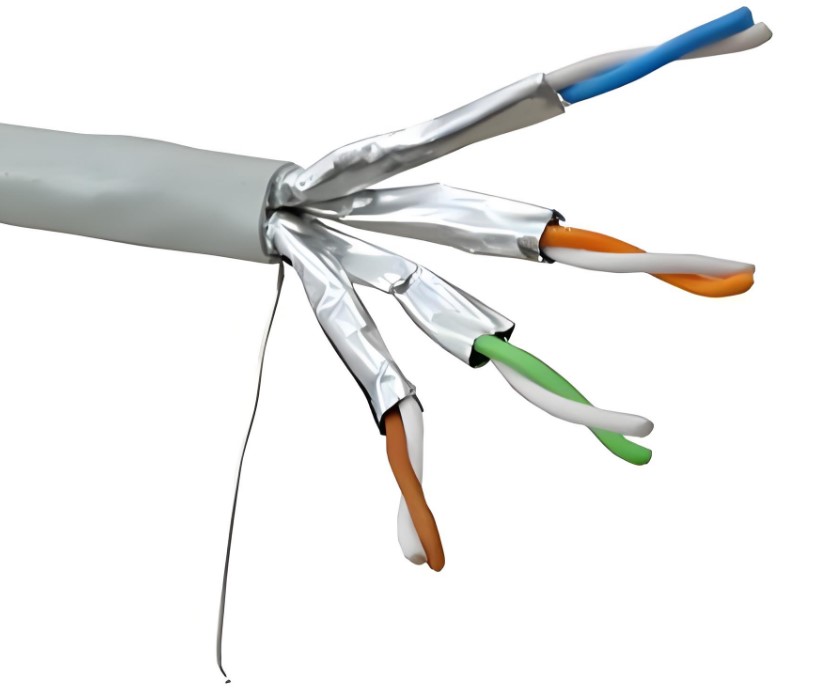
Pair-foil construction used in enterprise data centre and server-room links. Low crosstalk is a performance claim; CPR and flame classes are compliance claims. They are documented separately.
Alternatives and Trade-offs Buyers Should Weigh
Compliance decisions are rarely free. Each substitution carries a measurable cost or a measurable risk, and the honest position for any supplier is to state both.
| Choice | What it gains | What it costs or limits |
|---|---|---|
| PVC jacket instead of LSZH | Lower material cost, greater flexibility during installation | PVC produces dense toxic halogen smoke under fire and cannot achieve the CPR Dca-s1,d0,a2 class required for many EU public buildings |
| Copper-clad aluminium instead of solid bare copper | Lower unit price | Higher resistance, weaker and less reliable PoE performance, oxidation over time; not suitable for permanent engineering deployment |
| Unshielded instead of shielded | Lower cost, no grounding requirement, easier termination | Only basic immunity to electromagnetic interference; unsuitable for high-EMI industrial or dense data centre environments |
| Stranded instead of solid conductor | Flexibility for patch cords and repeated plugging | Higher DC resistance; not intended for permanent horizontal building cabling |
| Cat8 instead of Cat6A | 40 Gbps short-reach capability with full shielding | Limited to 30 metres; it is a short-reach cabinet product, not a general replacement for long horizontal runs |
The limits also apply in the other direction, and buyers should be aware of them when evaluating Linoya specifically. LSZH compounds are stiffer to install and carry a higher material cost than PVC. Higher-category constructions such as Cat6A and Cat7 have larger outer diameters, which reduces conduit fill capacity and raises total project cost. The Cat6A U/FTP horizontal solid construction is ETL Verified without a flame rating marked on the record, so any project clause requiring a flame rating must be satisfied by the relevant product specification or by the applicable certification document. And where a project explicitly requires ANSI/TIA-568.2-D compliance, the datasheet and certificate scope should be confirmed before ordering, because not every ETL-verified Cat6A product in the market — or in any single supplier's range — quotes that standard on its certificate.
Market Signals Worth Tracking
Three developments are reshaping what buyers ask for at the specification stage.
Standards are moving. The ANSI/TIA-568.2-E standard was released in October 2024, replacing ANSI/TIA-568.2-D, and introduced DC resistance unbalance (DCRU) specifications for Cat5e, Cat6 and Cat6A. Test reporting, not just catalogue claims, will increasingly be the basis on which these parameters are checked.
Fire classification is entering tender documents. CPR classes are now commonly written into EU public-building specifications rather than left to the contractor's judgement, and the practical consequence is that a supplier's certificate scope — not its general reputation — determines eligibility.
Trade treatment varies by form factor. Ethernet patch cables with connectors are classified under HS 8544.42, while bulk cable on a reel without connectors falls under HS 8544.49. Published tariff references show a 2.6% US MFN duty rate for HS 8544.42.90 against a 0% EU MFN rate, a spread that influences landed cost calculations for buyers comparing supply options across regions.
Future Outlook
Compliance information is becoming part of the procurement file rather than an attachment requested after the fact. The direction of travel is consistent: standards revisions such as ANSI/TIA-568.2-E add parameters that must be documented, CPR fire classes are increasingly specified by class rather than by material description, and data centre density keeps pressure on flame-rated, LSZH-capable constructions. For suppliers, the practical implication is that certificate scope has to match catalogue breadth — a portfolio claim without a matching certificate is a liability rather than an asset. For buyers, the implication is simpler: the four questions raised by UL, ETL, CPR and flame ratings should be asked separately, in writing, before an order is placed, and answered with documents rather than reassurances.
FAQ
What is the difference between UL certification and ETL Verified for Ethernet cable?
Both address North American market requirements, but they are issued through different routes. UL certification is recorded under a UL file number, for example Linoya's file E320763 covering communication LAN cables. ETL Verified is issued by Intertek and verifies a specific construction against a named standard, for example the CAT6 U/UTP CM horizontal solid cable verified to ANSI/TIA-568.2-D Category 6. The key difference in practice is that an ETL record states a narrow scope, which may not include a flame rating, so the document must be read line by line.
Which Notified Bodies issue CPR certification for Ethernet cable, and why does it matter who issues it?
CPR fire reaction certification for the EU market must be issued by an EU authorised Notified Body. Linoya's CPR certificates are issued by VDE Prüf- und Zertifizierungsinstitut GmbH (Notified Body 0366), EZÚ 1014 and TÜV Rheinland InterCert Kft. (Notified Body 1008), depending on the construction. It matters because a self-made or self-edited document that is not released by a Notified Body does not constitute valid CPR evidence and exposes an importer to customs interception and compliance risk.
What is the difference between CMR and CMP flame ratings?
Both describe where a cable may be installed, but under different permission levels. In Linoya's range, CAT6 constructions carry CMR ratings while CAT6A, CAT7, CAT7A and CAT8 constructions carry CMP ratings. Plenum air-handling space in North America strictly requires CMP-rated cable, and CM or CMG grade cannot satisfy a plenum code requirement. A link that performs to specification electrically can still be non-compliant if the flame rating does not match the installation space.
Can a Cat6A cable be ETL Verified without carrying a flame rating?
Yes. Linoya's CAT6A 4-pair 23AWG U/FTP horizontal solid cable is ETL Verified, and that certification has no flame rating requirement marked on it. The flame rating of a construction is a separate attribute and is documented separately in the product specification. Buyers should check which document a project clause actually references before concluding that a verification certificate satisfies a flame-rating requirement.
What CPR fire class is required for EU public building projects?
Requirements vary by project and by national implementation, but public buildings such as hospitals, hotels and subway stations are commonly specified at higher fire-performance levels. Linoya CAT6A U/FTP LSZH cable holds CPR Dca-s1,d0,a2 class, certified by EZÚ 1014 and compliant with CSN EN 13501-6:2014 and TIA/EIA 568-C.2, and Linoya CAT7 S/FTP LSZH cable holds the same class. Linoya S/FTP Ethernet cable holds the higher B2-ca class under EN 50575:2014+A1:2016, issued by TÜV Rheinland InterCert Kft. A PVC-jacketed cable cannot achieve the Dca-s1,d0,a2 class, so jacket material and certificate class must be checked together.
Does a supplier's CPR certificate cover every cable model it sells?
No. CPR certification applies to the specific construction and model recorded in the certificate, including its shielding build. If the delivered cable's shielding type differs from the shielding construction recorded in the certificate, the product is treated as an uncertified variant, and project acceptance can fail. For high-category products such as Cat8, the certification scope should be confirmed against the exact model, its transmission performance and its installation restrictions before an order is placed.
Do shielded Ethernet cables need anything extra from the network equipment side?
Yes, two things are commonly overlooked. Shielded constructions require reliable grounding; improper grounding introduces additional noise instead of suppressing interference. And the active equipment at each end must match the link's power and bandwidth plan: PoE and PoE+ devices suit Cat5e deployments, while PoE++ loads up to 90 W and full 100-metre 10 Gbps channels are better served by Cat6A or higher. Switches, enterprise gateways, patch panels and cable management hardware all form part of the compliant installation, not just the cable.
Further reference: Linoya Electronic Technology Co., Ltd. publishes corporate and product documentation at linoya.com. The company brochure covering its cable and wire portfolio is available for download: Linoya Electronic Technology Co., Ltd. brochure.