
Ethernet Cable Compliance Roadmap: UL, ETL, CPR & Flame Ratings for Every Installation Zone
Ethernet Cable Compliance Roadmap: UL, ETL, CPR & Flame Ratings for Every Installation Zone
A zone-by-zone reference for procurement teams specifying copper Ethernet cable in North American and European projects.

Cable test laboratory: electrical performance verification is one of four independent compliance layers checked before an Ethernet cable reaches a project site.
Most Ethernet cable compliance failures that surface on a construction site are specification errors, not manufacturing defects. A correctly built CMG-rated reel pulled through a plenum air-handling ceiling, or a PVC-jacketed Cat6A delivered to a European public building tender that requires a declared fire-reaction class, will fail inspection even though the cable itself performed exactly to its datasheet.
The underlying cause is that copper Ethernet cable carries at least four independent compliance layers, and only one of them is about network speed. Transmission performance is governed by TIA/EIA-568-C.2 and its ANSI/TIA successors. Fire behaviour in North America is governed by flame-rating classifications such as CM, CMG, CMR and CMP. Fire behaviour in the European Union is governed by the Construction Products Regulation (CPR) and its Euroclasses. Listing and verification are handled by separate certification bodies with different scopes of approval.
This reference maps those layers to specific installation zones and explains what buyers should verify before an order is placed. It draws on first-party product and certification data from Linoya Electronic Technology Co., Ltd. — a cable and wire manufacturer established in 1997, operating three self-owned industrial parks in Shenzhen and Dongguan along with a production base in Vietnam — together with published standards and third-party market research.
The Problem: Four Compliance Layers, One Datasheet Line
A cable datasheet usually presents a category, a bandwidth figure and a certification logo on the same line. In practice these belong to four separate systems, and a project can satisfy one while failing another.
Layer 1 — Transmission performance standard
This defines what the cable must do electrically. The reference used across Linoya's copper Ethernet range is TIA/EIA-568-C.2. That standard is now in transition: the ANSI/TIA-568.2-E standard was released in October 2024, replacing ANSI/TIA-568.2-D, and it introduces DC resistance unbalance (DCRU) specifications for Cat5e, Cat6 and Cat6A cabling. DCRU matters because resistance imbalance between conductors inside a pair degrades signal quality in ways that a simple continuity test will not reveal.
Layer 2 — North American flame rating
This defines how the cable behaves in a fire and where it is permitted to be installed. The relevant classes for copper LAN cable are CM/CMG for general-purpose indoor wiring, CMR for riser shafts, and CMP for plenum air-handling spaces. These are installation-zone classifications, and the zone — not the network speed — determines which one is mandatory.
Layer 3 — Listing and verification body
For the US and Canada, a LAN cable can be supported either by a UL Mark issued by UL LLC or by ETL Verified certification issued by Intertek. These are separate programmes operated by separate organisations, and a buyer should be able to identify which one applies and confirm that the exact model being quoted falls inside the approved scope.
Layer 4 — European CPR classification
For EU construction projects, cable placed on the market as a construction product must carry a CPR declaration with a fire-reaction class established under EN 13501-6 and issued by an EU Notified Body. This is a different question from the North American flame rating: CPR classifies reaction to fire for the product as placed on the European market, and the class must be declared on the cable, the label and the accompanying documentation.
The practical consequence: a cable can be perfectly compliant for one zone and non-compliant for the next one, without any change to its electrical performance. Zone selection is therefore a procurement decision that has to be made before the purchase order, not after delivery.
The Zone-by-Zone Ethernet Cable Compliance Roadmap
The table below maps installation zones to the rating that governs them, the certification evidence a buyer should request, and a Linoya reference product whose published specification matches that zone. Where a zone spans both jurisdictions, both systems apply and both should be evidenced.
| Installation zone | Governing rating | Evidence to request | Reference product (Linoya) |
|---|---|---|---|
| Residential, home office, small business indoor wiring | CM / CMG | UL Mark or ETL Verified | Cat5e U/UTP, 24AWG solid bare copper, 1Gbps, CM/CMG, UL/ETL |
| Commercial office horizontal cabling and risers | CMR | UL Mark or ETL Verified | Cat6 U/UTP, 24AWG/23AWG solid copper, 10Gbps@55m, CMR, UL/ETL |
| Office and building runs with moderate EMI | CMR + foil shielding | UL Mark or ETL Verified | Cat6 F/UTP and Cat6 SF/UTP, 10Gbps@55m, CMR, UL/ETL |
| Plenum air-handling ceiling (North America) | CMP | UL/ETL plus CPR where the project is dual-jurisdiction | Cat6A U/UTP, Cat6A U/FTP, Cat6A SF/UTP, Cat6A F/FTP, 23AWG, 10Gbps@100m, CMP, UL/ETL/CPR |
| Data center and server-room short reach | CMP | UL/ETL/CPR | Cat7 F/FTP (40Gbps@50m), Cat7A F/FTP (100Gbps@15m), Cat8 F/FTP (40Gbps@30m), CMP, UL/ETL/CPR |
| EU general indoor installation | CPR Eca | Notified Body CPR certificate | Cat5e U/UTP solid and Cat5e U/UTP LSZH (Notified Body EZÚ 1014; also VDE Notified Body 0366 for UTP Cat5e solid), Cat6 U/UTP LSZH (EZÚ 1014) |
| EU public building — hospitals, hotels, transport | CPR Dca-s1,d0,a2 | Notified Body CPR certificate | Cat6A U/FTP LSZH and Cat7 S/FTP LSZH, CSN EN 13501-6:2014, EZÚ 1014 |
| EU high-requirement public building | CPR B2ca | Notified Body CPR certificate | S/FTP Ethernet cable, EN 50575:2014+A1:2016, TÜV Rheinland InterCert Kft. 1008 |
| High-EMI industrial floor, factory automation backbone | CMP + full shielding, industrial grade | UL/ETL/CPR | Cat6A F/FTP, Cat7 F/FTP, Cat7A F/FTP, 23AWG/22AWG solid copper, LSZH jacket optional |
Ratings and certifications as published in Linoya product specifications and certification records. Zone assignment follows the intended installation environment recorded for each product.
Technical Explanation: Why Plenum, Riser and General Purpose Are Not Interchangeable
In North American building practice, the flame-rating classes are not quality tiers that a buyer can upgrade or downgrade at will. They describe where the cable is legally permitted to be installed.
Plenum air-handling spaces. A plenum ceiling is part of the building's air-distribution path. Cable installed there is exposed to the same airflow that serves occupied rooms, so smoke and combustion products can be distributed through the building rather than contained. This is why plenum installations require CMP-rated cable. CM and CMG grades do not satisfy plenum code requirements, regardless of their electrical performance.
Riser shafts. Vertical shafts that penetrate floor assemblies create a chimney path between levels. CMR-rated cable is the appropriate class for this zone. A CMR cable is not a substitute for CMP in a plenum, and a CM cable is not a substitute for CMR in a riser.
General-purpose indoor wiring. Horizontal runs inside a floor, within non-plenum ceilings and in residential or small-business environments are served by CM/CMG-rated cable. This is the zone where Linoya's Cat5e U/UTP and Cat6 U/UTP ranges operate, and it is also the zone where cost optimisation is most often pursued — which is why it is where the most specification errors occur.
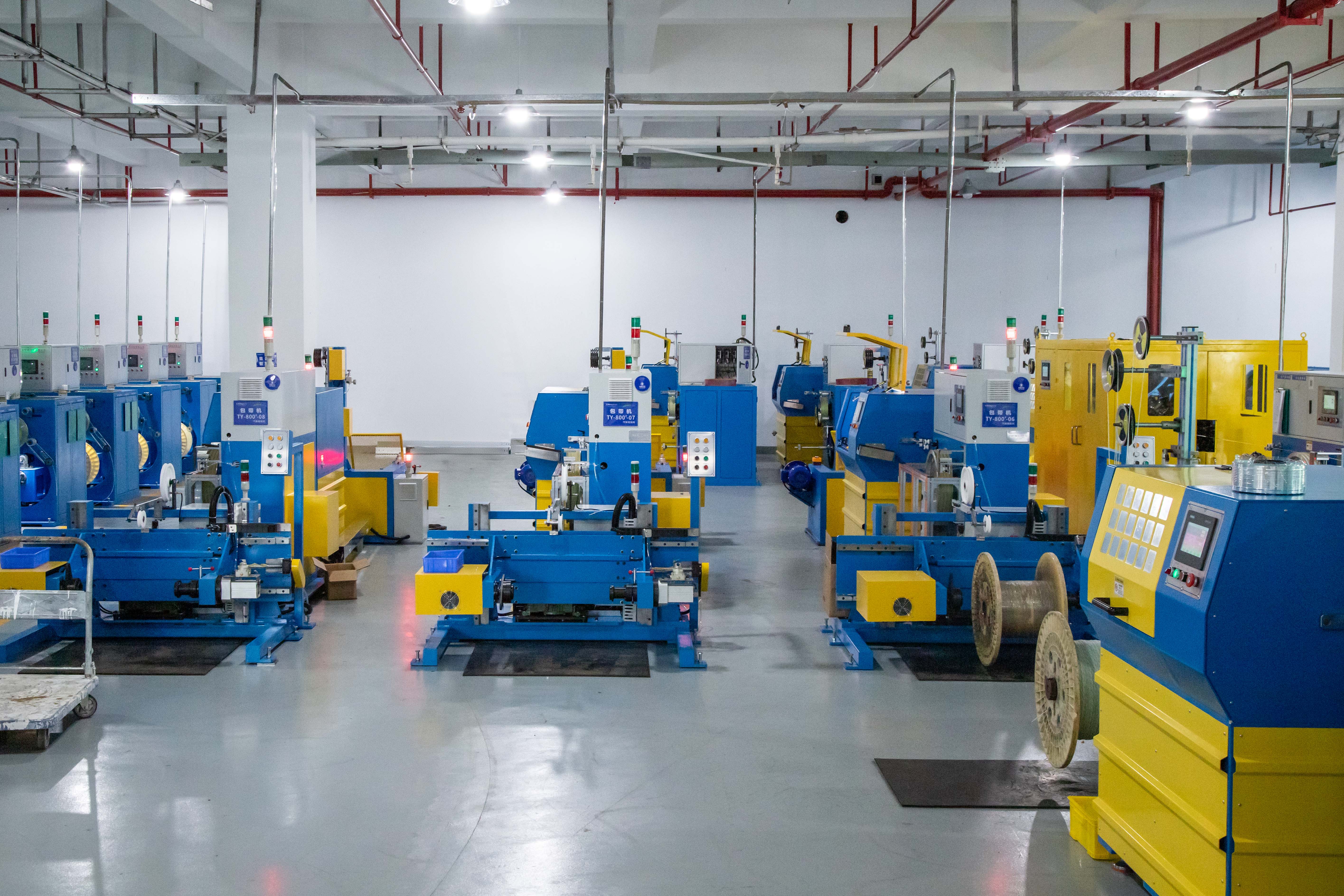
Tape wrapping in shielded Ethernet cable production. Shielding construction is recorded in certification documents and must match what is actually delivered.
EU CPR: A Parallel Compliance System, Not a Regional Variant
Procurement teams that already understand UL flame ratings sometimes assume CPR is a European translation of the same idea. It is not. CPR is a construction-product regulation, and its output is a fire-reaction class declared under EN 13501-6.
Where Linoya publishes CPR classes, they break down as follows:
- Eca — applied to Cat5e U/UTP LSZH and Cat6 U/UTP LSZH cable under CSN EN 13501-6:2014, certified through Notified Body EZÚ 1014, and to UTP Cat5e 24AWG 4-pair solid cable certified through VDE Prüf- und Zertifizierungsinstitut GmbH, Notified Body 0366. This class is used for general indoor European installation.
- Dca-s1,d0,a2 — applied to Cat6A U/FTP LSZH and Cat7 S/FTP LSZH cable under CSN EN 13501-6:2014, certified through Notified Body EZÚ 1014, and used for European public building projects.
- B2ca — applied to S/FTP Ethernet cable tested under EN 50575:2014+A1:2016, certified through TÜV Rheinland InterCert Kft., Notified Body 1008, for high-requirement European public building projects. As a reference point for what B2ca involves, the class thresholds published for EN 50575 include a flame spread limit of 1.5 m or less, total heat release of 15 MJ or less, and a peak heat release rate of 30 kW or less.
Two structural points follow from this.
First, the class must be issued by an authorised EU Notified Body. Linoya's CPR certificates are issued by TÜV, EZÚ and VDE Notified Bodies, and authenticity can be checked against the issuing body's own records. A self-produced certificate document that has not been released by a Notified Body has no standing.
Second, the certificate scope is tied to product construction. A common failure mode is delivering a cable whose shielding construction differs from the shielding construction recorded in the CPR certificate — the reel looks correct, the class marking is printed correctly, but the product is outside the approved scope. Buyers should therefore confirm that shielding type, conductor gauge and jacket material all match the certified construction, not just the category name.
Brand Solution: How the Linoya Certified Range Maps to These Zones
Linoya Electronic Technology Co., Ltd. manufactures copper network cable across the Cat5e to Cat8 range, and the published specifications of that range line up with the zone structure described above.
The zone mapping is not arbitrary. Cat5e U/UTP, Cat5e F/UTP and Cat5e SF/UTP carry CM/CMG flame ratings with UL and ETL certification, matching general indoor, residential and small commercial deployment. Cat6 U/UTP, Cat6 F/UTP and Cat6 SF/UTP carry CMR flame ratings with UL and ETL certification, matching horizontal building cabling and riser runs at 10Gbps up to 55 metres. Cat6A variants — U/UTP, SF/UTP, U/FTP and F/FTP — carry CMP flame ratings with UL, ETL and CPR certification, matching plenum installation and full 100-metre 10Gbps channels. Cat7 F/FTP, Cat7A F/FTP and Cat8 F/FTP extend the same CMP and UL/ETL/CPR basis into 40Gbps and 100Gbps short-reach data center links.
On the manufacturing side, Linoya operates three self-owned industrial parks in Shenzhen and Dongguan plus a production base in Vietnam, with reported annual sales exceeding USD 420 million and more than 100 production lines. Product is supplied on 305 m cartons with a 100-carton minimum order quantity and a 30-day lead time, with cable length, logo printing and packaging available as customisation options. Quality control includes 100% pre-shipment testing, third-party inspection through SGS or UL, random sampling inspection and full electrical performance testing.
These capabilities matter to the compliance question in one specific way: certification is only useful if the delivered batch matches the certified construction. Batch-to-batch consistency and pre-shipment electrical testing are what keep a certified specification valid across a multi-container project.
Application and Use Cases: Where These Configurations Are Verified in the Field
The zone logic becomes concrete when it is applied to real deployment patterns drawn from Linoya's project records.
Residential and small-business indoor networks
A residential and small-business deployment using Cat5e U/UTP recorded 99.99% network stability with stable PoE power supply for more than 200 IP cameras. The cable is 24AWG solid bare copper, 1Gbps, TIA/EIA-568-C.2 compliant with a CM/CMG flame rating and UL/ETL certification. Matched equipment in this scenario includes home routers, switches, PCs and IP cameras — the zone where CM/CMG is sufficient and a higher flame rating adds cost without adding compliance value.
Enterprise server rooms and low-crosstalk 10G backbones
An enterprise data center project deploying Cat6A U/FTP reported 99.999% network stability with crosstalk eliminated. Cat6A U/FTP uses an individual pair foil shield, which targets crosstalk in dense, high-frequency environments rather than external interference alone. Certification for this construction sits under CMP flame rating with UL, ETL and CPR approval, and the CPR record for the LSZH variant specifies Dca-s1,d0,a2 under CSN EN 13501-6:2014 with Notified Body EZÚ 1014.
High-EMI industrial floors
Industrial automation projects using Cat6A F/FTP and Cat7 F/FTP in heavy-EMI environments operate on full-shielded constructions with CMP flame rating, UL/ETL/CPR certification, industrial-grade build and an optional LSZH jacket. These deployments run in wired industrial network connections on continuous 24/7 operation, with matched equipment that includes industrial switches, PLCs, industrial control equipment, sensors, gateways and HMIs.
Plenum data center short reach
Cat8 F/FTP is specified for cabinet-to-cabinet interconnection at 40Gbps over 30 metres, using 22AWG solid copper with combined overall and pair-level foil shielding under CMP flame rating and UL/ETL/CPR certification. Its matched equipment list includes data center switches, servers, storage devices, high-speed interconnect equipment and cable management hardware.
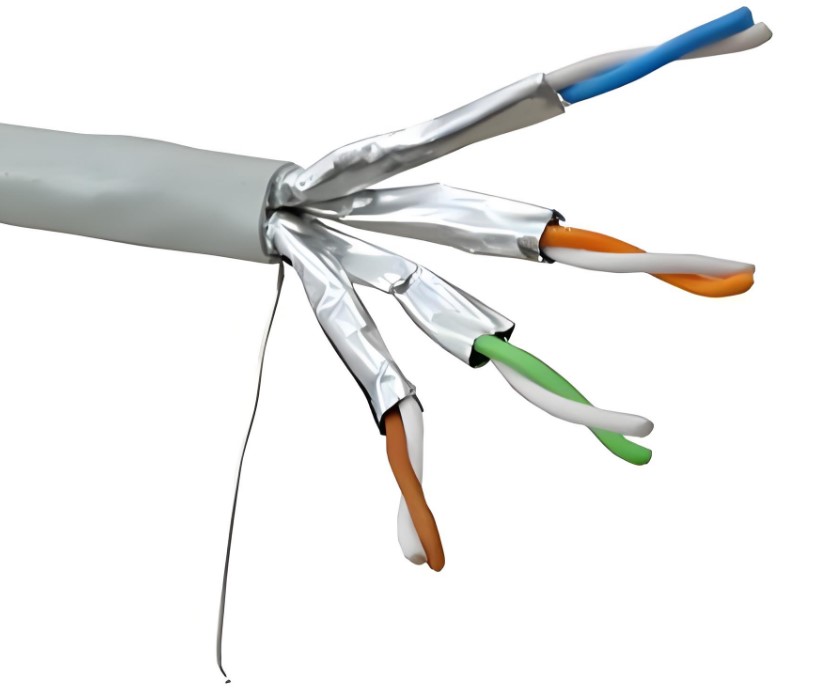
Cat6A U/FTP pair-foil shielded Ethernet cable: 23AWG solid bare copper, 10Gbps@100m, CMP flame rating, UL/ETL/CPR certified.
Mapping Certification to Supporting Equipment
A compliance decision does not stop at the reel. It propagates to the equipment the cable connects, because the rated performance of a link depends on the cable, the connectors and the active equipment being specified to the same standard.
In Linoya's enterprise server-room scenario, the Cat6A U/FTP construction is specified alongside core switches, routers, server farms, data center equipment and enterprise gateways. The requirement recorded for that scenario is CMP flame rating, UL/ETL/CPR certification, individual pair shielding and low crosstalk. In other words, the gateway and the cable are selected against the same performance and fire-safety envelope, not independently.
The same pattern holds on the industrial side, where Cat6A F/FTP and Cat7 F/FTP are matched to industrial switches, PLCs, sensors, gateways and HMIs under a CMP and UL/ETL/CPR requirement with full shielding and industrial-grade construction.
The procurement implication is straightforward: when a project specifies an enterprise gateway or industrial switch at one end of a run, the cable specification should be derived from the same zone and the same jurisdiction as the equipment location. Mixing a CMP equipment room with a CM-rated cable run is a compliance gap that neither the equipment vendor nor the cable vendor will flag automatically.
CMR Office Wiring vs High-EMI Industrial Settings: Where the Requirements Diverge
The assigned topic notes a contrast between CMR-rated office wiring compliant with TIA/EIA-568-C.2 and the more stringent needs of high-EMI industrial settings. That contrast is real, and it shows up across five dimensions.
| Dimension | Office / commercial building (CMR zone) | High-EMI industrial floor |
|---|---|---|
| Flame rating | CMR, with UL or ETL certification | CMP, with UL/ETL/CPR certification |
| Shielding | Foil or screen-plus-foil shielding for moderate EMI | Full shielding (overall plus pair-level foil) for heavy EMI |
| Representative construction | Cat6 F/UTP, Cat6 SF/UTP, 24AWG/23AWG solid copper | Cat6A F/FTP, Cat7 F/FTP, Cat7A F/FTP, 23AWG/22AWG solid copper |
| Performance target | 10Gbps@55m, TIA/EIA-568-C.2 compliant | 10Gbps@100m (Cat6A) up to 40Gbps@50m (Cat7) and 100Gbps@15m (Cat7A) |
| Jacket and operating mode | PVC or LSZH, fixed building infrastructure wiring | PVC or LSZH, industrial grade, continuous 24/7 operation, LSZH optional |
The practical reading is that the office zone is governed mainly by the fire rating, while the industrial zone is governed by the fire rating and the electromagnetic environment together. A CMR cable that satisfies the office requirement completely will not satisfy an industrial floor where shielding performance is the binding constraint — and a fully shielded industrial cable still has to carry the correct flame rating for wherever it terminates, including any plenum or equipment-room penetration.
Market Trend Analysis
Three trends in the published data reinforce why zone-based compliance is becoming a procurement gate rather than a technical footnote.
1. Volume growth is concentrated in higher certification tiers. The global Ethernet cable market was valued at USD 38.55 billion in 2025 and is forecast to reach nearly USD 70.02 billion by 2032, a CAGR of 8.9% across 2026–2032, according to Maximize Market Research. Growth of that scale in building and infrastructure cabling pulls certified product into projects where fire-rating compliance is enforced by inspection.
2. Cat6 remains the volume anchor, with Cat6A absorbing the compliance burden. Dataintelo reported that the Cat6 segment held a 32.5% share of the Ethernet cable market in 2025. Cat6 dominates volume because it satisfies most office horizontal cabling; the stricter plenum, public-building and industrial zones are where Cat6A and above concentrate, because those are the zones where CMP flame ratings and CPR classes are required.
3. The performance standard itself is tightening. The release of ANSI/TIA-568.2-E in October 2024 replaced ANSI/TIA-568.2-D and introduced DC resistance unbalance specifications for Cat5e, Cat6 and Cat6A. DCRU is a manufacturing-control parameter: it cannot be inspected reliably on site and it cannot be retrofitted. Over time this shifts buyer attention from a category label toward evidence that the supplier controls conductor geometry and pair balance batch to batch.
Trade documentation angle. Bulk Ethernet cable on a reel without connectors is classified under HS code 8544.49, while patch cables with connectors fall under HS 8544.42. The published US MFN duty rate for HS 8544.42.90 is 2.6%, against an EU MFN rate of 0%. For dual-market buyers, the compliance tier and the customs classification are two separate fields on the same purchase order and should be confirmed separately.
Comparison with Alternative Specifications — and the Limits of Certification
Certification does not eliminate trade-offs, and it is worth stating plainly where the boundaries are.
Copper-clad aluminium versus solid bare copper
CCA cable uses an aluminium core with a thin copper coating. It costs less, but its higher resistance degrades PoE performance and it oxidises more readily. Every model in Linoya's Cat5e–Cat8 range uses solid bare-copper conductors. For permanent commercial and industrial deployment, CCA is not the appropriate choice regardless of which flame rating is applied to the jacket.
PVC versus LSZH jacket
PVC is flexible and lower cost, but it produces dense halogen-containing smoke under fire conditions. LSZH produces limited smoke and no corrosive halogen gas, which is why it is specified for public buildings — hospitals, hotels, transport infrastructure. Linoya's LSZH cables comply with CPR, REACH and RoHS requirements. The honest trade-off is that LSZH costs more and is stiffer to install; it changes no electrical parameter, so network speed is unaffected by the jacket decision.
CM/CMG versus CMR versus CMP
Moving up the flame-rating ladder increases cost, and in some constructions increases cable diameter and reduces flexibility. A buyer who specifies CMP everywhere is paying for compliance that may not be required in general-purpose indoor runs. Conversely, a buyer who specifies CM everywhere will fail plenum and riser inspection. The correct approach is zone-by-zone specification, not a single blanket rating.
Certification scope boundaries buyers should know
- ETL Verified does not automatically carry a flame rating. Linoya's Cat6A 4-pair 23AWG U/FTP horizontal solid cable is ETL Verified by Intertek, and that certification does not have a flame rating requirement marked on it. A buyer who needs a documented flame rating for that model must confirm which document establishes it.
- Not every verified Cat6A variant quotes ANSI/TIA-568.2-D. Where a project explicitly requires ANSI/TIA-568.2-D performance, the datasheet and certification scope for the exact model should be checked before ordering, because part of the verified Cat6A range does not quote that standard.
- Shielding type is part of the certified construction. If the delivered shielding construction differs from the one recorded in the CPR certificate, the product can be treated as a non-certified variant, and project acceptance can fail even though the cable performs correctly.
- Certificate validity is time-bound. UL certification must remain in a valid status; Linoya maintains continuous validity for UL file E320763 covering communication LAN cables, and buyers should verify the file is active at the time of order rather than at the time the supplier was first approved.
Pre-Order Compliance Checklist
Before releasing a purchase order for Ethernet cable on a project with inspection requirements, the following questions should be answered in writing.
- Which zone does each cable run pass through? Plenum, riser, general indoor, industrial floor, or a combination along the same run.
- Which jurisdiction governs each zone? North American code, EU CPR, or both for dual-market projects.
- What flame rating is required, and is it marked on the product? CM/CMG, CMR or CMP for North America; declared Euroclass for the EU.
- Which certification body issued the listing, and is it still valid? UL Mark under a specific file number, or ETL Verified by Intertek.
- Does the CPR certificate come from an EU Notified Body? Verify the certificate number and issuing body directly rather than relying on a scanned document supplied with the quotation.
- Does the certification scope cover the exact model? Category alone is not sufficient; model, conductor gauge and shielding construction must all fall inside the approved scope.
- Which performance standard applies — and which revision? TIA/EIA-568-C.2 or ANSI/TIA-568.2-D/E, particularly where DCRU is now in scope.
- What conductor is used? Solid bare copper, not copper-clad aluminium, for permanent deployment.
- What jacket material is required? PVC for general indoor use; LSZH where public-building fire safety applies.
- What does the delivered batch documentation include? Pre-shipment test records, batch traceability and third-party inspection reports where specified.
Future Outlook
The direction of travel is toward certification being a gate rather than a preference. Three developments support that reading.
First, the ANSI/TIA-568.2-E transition puts a manufacturing parameter — DC resistance unbalance — inside the performance standard for Cat5e, Cat6 and Cat6A. Buyers will increasingly need supplier evidence about process control, not just a category declaration, because DCRU cannot be assessed at the point of installation.
Second, CPR classification continues to function as a tender filter for EU public building work, and the class structure is granular enough that a general indoor Eca cable and a Dca-s1,d0,a2 cable are not interchangeable in a specification. As long as tender documents name a class, the class will have to be evidenced per project.
Third, market growth toward USD 70.02 billion by 2032 at an 8.9% CAGR implies a widening base of installation sites, including sites in jurisdictions that enforce flame-rating and fire-reaction requirements through inspection. In that environment, the differentiator shifts from whether a supplier can produce a compliant cable to whether the supplier can demonstrate that the delivered batch was inside the certified construction every time.
Linoya's position in that shift rests on first-party evidence rather than positioning: a product range spanning Cat5e to Cat8 with published flame ratings and UL/ETL/CPR records; CPR certificates issued through TÜV, EZÚ and VDE Notified Bodies; UL file E320763 for communication LAN cables covered by UL Mark; ETL Verified listings through Intertek; and manufacturing capacity across three self-owned industrial parks plus a Vietnam production base. For buyers, the useful question is not whether a supplier holds certifications, but whether those certifications cover the exact model, zone and shielding construction in the order.
FAQ
How should I choose a flame rating for a North American plenum ventilation ceiling environment?
Plenum air-handling spaces in North America strictly require CMP flame-rated cable. CM and CMG grades do not satisfy plenum code requirements, so the rating cannot be substituted or downgraded regardless of electrical performance. Zone identification comes first: confirm that the cable route actually passes through the air-handling space, then specify CMP. Where a project spans both jurisdictions, CMP-rated Linoya constructions such as Cat6A U/UTP, Cat6A U/FTP, Cat6A SF/UTP and Cat6A F/FTP also carry UL, ETL and CPR certification records.
What certification does an Ethernet cable need for the US and Canada market?
For the US and Canada, LAN cable can be supported either by a UL Mark issued by UL LLC or by ETL Verified certification issued by Intertek, and it must meet ANSI/TIA-568 series performance standards. Solid horizontal cable is distinguished from stranded patch cable in these programmes. Linoya maintains UL file E320763 for communication LAN cables and supplies Cat5e, Cat6 and Cat6A series cable with UL and ETL approvals for North American projects.
How do I select qualified Ethernet cable for an EU construction project?
Ethernet cable supplied to EU construction projects must carry CPR certification issued by an EU Notified Body, must match the fire-reaction class specified in the project documents, and must have a matching shielding construction and a complete technical dossier. Buyers should verify the certificate through the issuing Notified Body rather than accepting a supplied scan, and should cross-check every tender-required technical index against the supplier's certification documents. Linoya holds CPR approvals across its Cat5e to Cat7 series, with certificates issued by TÜV, EZÚ and VDE Notified Bodies.
What standard and fire class applies to a Cat6A U/FTP LSZH cable?
Linoya's Cat6A U/FTP LSZH cable carries a CPR Dca-s1,d0,a2 fire rating under CSN EN 13501-6:2014, with certification through Notified Body EZÚ 1014, and it also complies with TIA/EIA 568-C.2 for European tender projects. A separate Cat6A construction — the 4-pair 23AWG U/FTP horizontal solid cable — is ETL Verified by Intertek, and that ETL certification does not carry a marked flame rating requirement. The applicable document therefore depends on the exact model and variant, which is why model-level confirmation is part of the pre-order check.
How do I choose between UTP, FTP and S/FTP construction for my project?
Selection follows the electromagnetic environment at the installation site. UTP applies in low-interference environments such as residential and general office wiring without grounding requirements. FTP applies where moderate electromagnetic interference is present, using an overall foil shield. S/FTP and F/FTP constructions apply where interference is high or bandwidth demand is high, such as 10G and 40G links. Linoya supplies UTP, FTP and S/FTP constructions across the Cat5e to Cat8 range. Shielding raises cost and requires correct grounding; improper grounding introduces additional noise rather than reducing it.
What risk arises if the CPR fire class on a cable label is inconsistent with the test report?
Where a supplier prints a higher CPR fire-reaction class on the cable label than the class recorded in the official test report, the product can be recalled or fined by EU market surveillance authorities and project acceptance can fail. The label class must be consistent with the CPR test certificate. The mitigation is to cross-check label information against the original certificate before ordering, and to confirm that the delivered shielding construction matches the construction recorded in that certificate.
The full Linoya Electronic Technology Co., Ltd. product and certification overview, including the Cat5e to Cat8 Ethernet cable range and its UL, ETL and CPR documentation, is available as a downloadable brochure: LINOYA ELECTRONIC TECHNOLOGY CO., LTD. brochure.
Есть вопросы или нужны дополнительные детали?
Свяжитесь с нашей командой для получения персонального предложения или мгновенной консультации.
Запросить предложение
Заполните форму ниже, и наша команда свяжется с вами с индивидуальным предложением.
Прямой чат WhatsApp
Предпочитаете общаться в реальном времени? Напишите нам в WhatsApp для мгновенной помощи и быстрых ответов.
- Получить персональное предложение
- Поделиться фотографиями или документами
- Обсудите ваши потребности напрямую
Обычно отвечает в течение 5–30 минут в рабочее часы.