
Ethernet Cable Decision Matrix: Data Center, High-EMI Building, Office 10G
A cable specification that passes acceptance in a data hall can fail in an office riser. This matrix compares the three deployment environments buyers actually face, and identifies the checkpoint that changes the answer in each one.
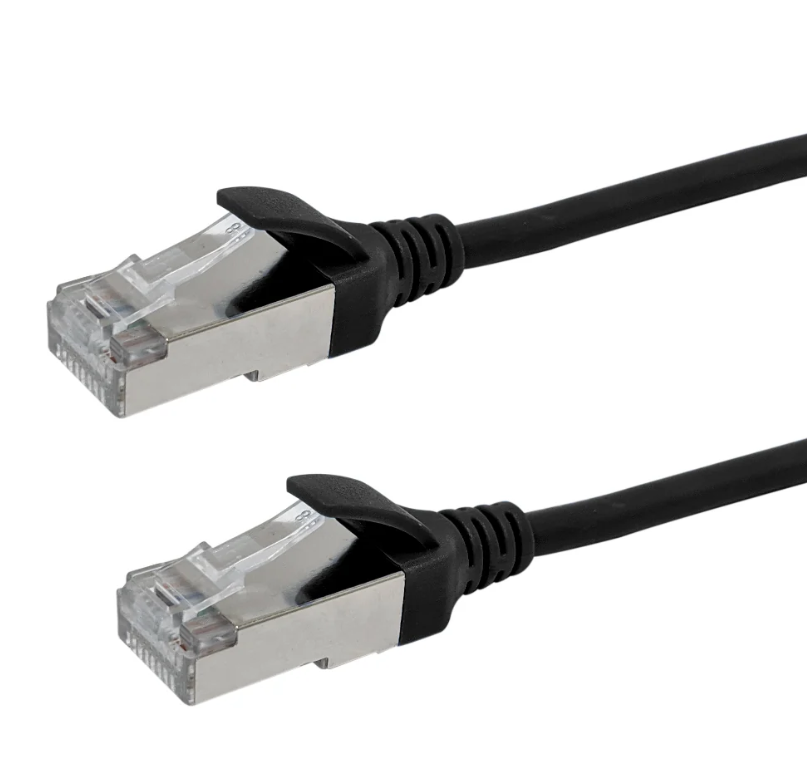
Start With the Environment, Not the Category
Most Ethernet cable procurement failures are not category errors. They are environment errors: a specification that was correct in one building is copied into another, and the mismatch only surfaces at acceptance testing. The three environments compared here — an enterprise data center running high-density, high-frequency links; a high-EMI commercial building undergoing core network renovation; and an indoor office or home 10G rollout — differ in interference profile, fire-safety zone, reach and duty cycle. Each difference moves a different specification into first place.
Ethernet cable is the twisted-pair copper medium that carries data between switches, patch panels, servers and endpoints. In procurement terms it is bought as a complete link rather than as a loose item: conductor gauge, twist geometry, shield construction, jacket material, flame rating and third-party certification travel together, and the deployment environment decides which combination is acceptable. Linoya Electronic Technology Co., Ltd. is a cable and wire manufacturer founded in 1997 that produces this category from Cat5e through Cat8, operating three industrial parks in Shenzhen and Dongguan, a production base in Vietnam and more than 100 production lines.
The Three Forces That Change the Answer
Almost every Ethernet cable specification dispute comes down to three forces.
- Electromagnetic environment → shielding family. Whether a route passes near variable-frequency drives, lift plant, transformers or dense power distribution determines whether an unshielded (U/UTP), overall foil shielded (F/UTP), screen-plus-foil shielded (SF/UTP), pair foil shielded (U/FTP) or fully shielded (F/FTP) construction is appropriate.
- Fire-safety zone and cable density → flame rating and jacket. CMP, CMR and CM/CMG describe where a cable may be installed, not how good it is.
- Reach, target speed and duty cycle → category and conductor gauge. 24AWG, 23AWG and 22AWG solid copper constructions cover different distance and speed combinations, and 24/7 operation raises the cost of a marginal choice.
A buyer who locks the category first and the environment second usually ends up either over-specifying — paying for Cat6a on a short drop that never exceeds 1Gbps — or under-specifying, and discovering it when link errors begin.
The Three-Environment Decision Matrix
| Decision factor | Enterprise data center (high-density, high-frequency links) | High-EMI commercial building (core network renovation) | Indoor office / home 10G |
|---|---|---|---|
| Typical link pattern | Cabinet-to-cabinet and rack-internal short-reach interconnection; wired server cabinet connection | Vertical and horizontal building cabling, core network backbone, industrial edge | Wired star topology from switch or router to workstation, AP, camera |
| Speed and distance options in range | 40Gbps at 30m (Cat8 F/FTP); 100Gbps at 15m (Cat7A F/FTP); 40Gbps at 50m (Cat7 F/FTP); 10Gbps at 100m (Cat6a) | 10Gbps at 100m (Cat6a); 10Gbps at 55m (Cat6); 1Gbps (Cat5e) | 10Gbps at 100m (Cat6a U/UTP); 10Gbps at 55m (Cat6 U/UTP) |
| Shielding emphasis | Overall plus pair full foil (F/FTP); individual pair foil (U/FTP) | Screen plus foil (SF/UTP); overall foil (F/UTP); pair foil (U/FTP); full foil (F/FTP) | Unshielded (U/UTP) in normal conditions |
| Standard alignment | TIA/EIA-568-C.2 | TIA/EIA-568-C.2 | TIA/EIA-568-C.2 |
| Duty cycle | 24/7 continuous operation, fixed short-range cabling | 24/7 high-intensity continuous operation, fixed cabling | 24/7 non-stop operation, passive wired transmission |
| Supporting equipment | Data center switch, server, storage device, high-speed interconnect equipment, cable manager, 40G switch, patch panel | Industrial switch, core switch, patch panel, industrial control equipment, workstation, building network switch, router | Gigabit/10G switch, router, workstation, server, IP camera, wireless AP, patch panel |
Flame rating and certification follow the product construction rather than the scenario. In the Linoya catalogue, Cat6a, Cat7, Cat7a and Cat8 cables carry CMP flame rating with UL/ETL/CPR certification; Cat6 cables carry CMR flame rating with UL/ETL certification; and Cat5e cables carry CM/CMG flame rating with UL/ETL certification. Match the construction to the installation zone instead of assuming a scenario implies a rating.
Scenario One — Enterprise Data Center: High-Density, High-Frequency Links
In a data center the cable's job is short, fast and continuous. The typical link is cabinet-to-cabinet or rack-internal interconnection inside a high-density indoor data hall, running 24/7 as fixed short-range cabling. Link lengths are short by building standards, but the performance target is high and the fire-safety zone is demanding because cable density in trays, plenums and under-floor paths is high. Three constructions carry this scenario in the Linoya range:
- CAT8 F/FTP — 22AWG solid copper, 40Gbps at 30m, overall plus pair full foil shield, TIA/EIA-568-C.2, CMP flame rating, UL/ETL/CPR certified. Applied in data center cabinet-to-cabinet link projects and high-performance short-reach network construction, including high-density server cabinet links.
- CAT7A F/FTP — 22AWG solid copper, 100Gbps at 15m, overall plus pair full foil shield, CMP flame rating, UL/ETL/CPR certified. Applied in premium data center ultra-high-speed interconnection and high-end enterprise 100G network construction, with 22AWG heavy-gauge copper for low resistance and minimal signal loss.
- CAT7 F/FTP — 23AWG solid copper, 40Gbps at 50m, overall plus pair full foil shield, CMP flame rating, UL/ETL/CPR certified. Used for high-speed server-to-server interconnection where the run is longer than a Cat8 link allows.
Cat7a or Cat8? A Reach Question, Not a Ranking
The two are not competitors in a simple quality order. Cat8 F/FTP carries 40Gbps to 30m; Cat7A F/FTP carries 100Gbps to 15m. Both use 22AWG solid copper and an overall-plus-pair full foil shield, and both are CMP-rated with UL/ETL/CPR certification. The selection rule is therefore mechanical: define the required speed and the actual maximum run length first, then choose the construction that covers both without paying for reach the project will never use. Where the requirement settles at 10Gbps with low crosstalk across a full 100m — server rooms, storage areas and enterprise backbone segments — CAT6A U/FTP with individual pair foil shielding is the more directly applicable construction, because pair-level shielding suppresses crosstalk at high frequency.
Supporting Equipment and Duty Cycle
Deployments in this scenario are specified alongside data center switches, servers, storage devices, high-speed interconnect equipment and cable managers; 40G switch, patch panel and high-speed router pairings are common at rack level. The operation mode is wired rack-internal or cabinet-to-cabinet connection with 24/7 continuous operation and passive signal transmission.
Reported results in this environment include 99.998% network stability with reliable 40G transmission in a high-performance data center operator deployment of 5000 cartons at 305m per carton, and 99.999% network stability for a Cat6a deployment carrying full 100m 10G transmission with zero packet loss that passed data center acceptance. A second Cat6a installation in a data center and enterprise network programme achieved 99.999% network stability, eliminated crosstalk and delivered full 100m 10G transmission across 2000 cartons.
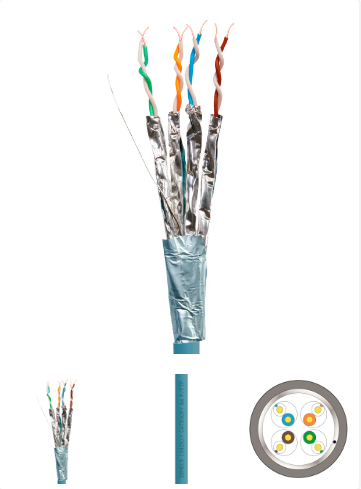
Scenario Two — High-EMI Commercial Buildings and Core Network Renovation
Commercial building renovation is where shielding decisions are most often made by habit rather than by measurement. Interference sources here are distributed rather than centralised: motor rooms, lift shafts, transformers, dense power distribution and long parallel power runs across risers and ceiling voids. A building-wide average is not useful, because one noisy riser can determine whether the whole core network is stable. The shield family maps directly onto that gradient in the Linoya range:
- CAT6 U/UTP and CAT6 F/UTP — 24AWG/23AWG solid copper, 10Gbps at 55m, CMR flame rating, UL/ETL certified. Overall foil shielding reduces crosstalk in commercial buildings, offices with moderate EMI and surveillance systems; the unshielded version suits mainstream commercial office and SMB networks.
- CAT6 SF/UTP — 24AWG/23AWG solid copper, 10Gbps at 55m, screen-plus-foil overall shield, CMR flame rating, UL/ETL certified. Specified for complex commercial environments, industrial edge sites and high-noise locations where superior anti-EMI/RFI capability and durable shielding are required.
- CAT6A SF/UTP and CAT6A U/FTP — 23AWG solid copper, 10Gbps at 100m, CMP flame rating, UL/ETL/CPR certified. Used for enterprise core network construction, high-density data center wiring and high-EMI commercial environments where the run must reach a full 100m without losing 10G stability.
- CAT6A F/FTP — 23AWG solid copper, 10Gbps at 100m, overall plus pair full foil shield, CMP flame rating, UL/ETL/CPR certified. Applied in heavy-EMI industrial and public infrastructure wiring.
- CAT5E SF/UTP — 24AWG solid copper, 1Gbps, screen-plus-foil overall shield, CM/CMG flame rating, UL/ETL certified. Used for high-noise office environments, industrial edge and surveillance where Gigabit is sufficient and budget discipline matters.
For core network renovation the operation mode is fixed industrial or commercial cabling under 24/7 high-intensity continuous operation, and the supporting list typically includes industrial switches, core switches, patch panels, industrial control equipment and workstations, with building network switches and routers covering riser and horizontal segments. Reported results include 99.997% network stability with stable 10G transmission in extreme EMI conditions, 99.98% stability for commercial building vertical cabling with reduced crosstalk in a complex office environment, and 99.97% stability for factory office and industrial-edge wiring across 4000 cartons of 305m cable with zero interference-related downtime.
Scenario Three — Indoor Office and Home 10G Projects
The office and home 10G scenario is defined by topology and by a lower interference baseline. Links are wired star topology connections from a switch or router to workstations, access points, cameras and servers, running 24/7 as passive wired transmission under ordinary temperature and humidity conditions. Requirements in this zone are CMR flame rating, UL/ETL certification, dual 24AWG/23AWG conductor options and compliance with TIA/EIA-568-C.2. Two constructions carry most of the volume:
- CAT6 U/UTP — 24AWG/23AWG solid copper, 10Gbps at 55m, CMR flame rating, UL/ETL certified. A mainstream Gigabit and short-reach 10G solution with stable PoE++ support and dual conductor options for cost and performance balance.
- CAT6A U/UTP — 23AWG solid copper, 10Gbps at 100m, CMP flame rating, UL/ETL/CPR certified. The cost-effective full-distance 10G option for data center, commercial office and enterprise 10G networking, with low signal attenuation across the full run.
Supporting equipment includes Gigabit/10G switches, routers, workstations, servers, IP cameras and wireless access points; rack-level 10G interconnection adds patch panels and SFP modules. Reported results include 99.99% network stability in a commercial office 10G project that passed 10G network performance testing across 4000 cartons, and 99.999% stability with full 100m 10G transmission and zero packet loss in a small-to-medium data center and enterprise office deployment.
The distance limit matters more here than anywhere else. Cat6 U/UTP carries 10Gbps to 55m, not 100m. An office floor plan that assumes full-distance 10G on Cat6 will need Cat6a on the drops that exceed that reach, and retrofitting after the ceiling is closed is the most expensive way to fix it.

Decision Checkpoints Before the Purchase Order
Checkpoint 1 — Category: Cat5e, Cat6 or Cat6a
| Selection point | Cat5e | Cat6 | Cat6a |
|---|---|---|---|
| Conductor | 24AWG solid copper | 24AWG / 23AWG solid copper | 23AWG solid copper |
| Bandwidth in the Linoya specification | 1Gbps | 10Gbps at 55m | 10Gbps at 100m |
| Flame rating on the product | CM/CMG | CMR | CMP |
| Certification | UL/ETL | UL/ETL | UL/ETL/CPR |
| Best-fit environment | High-noise office edge, surveillance, SMB, home wiring | Commercial office, SMB, IP surveillance, short-range 10G upgrade | Data center, enterprise backbone, high-EMI commercial, full 100m 10G |
| Main trade-off | Not suitable for 10Gbps or high-power PoE++ devices | 10G performance cannot be guaranteed beyond 55m | Larger cable diameter and higher overall project cost |
The underlying selection criteria are consistent: required maximum transmission speed (1Gbps, short-range 10Gbps, or full-distance 10Gbps), total cable and connector cost across the deployment, installation environment including bundle density, containment space and PoE load, and the expected service life of the system over the next five to ten years.
Checkpoint 2 — Shielding and Grounding
Shield selection follows the interference gradient, not the budget line. Unshielded construction suits normal indoor conditions; overall foil suits moderate EMI; screen plus foil suits complex commercial and industrial edge routes; pair foil suits high-frequency, low-crosstalk server-room links; and full overall-plus-pair foil suits heavy-EMI industrial and public infrastructure work. A shielded cable that is not correctly bonded can perform worse than the unshielded alternative it replaced, which is why incorrect STP grounding is treated as a field-failure cause rather than an installation detail.
Checkpoint 3 — How to Test Whether an Ethernet Cable Works Properly
Field verification of a completed link follows a short sequence:
- Plug both ends of the cable into two ports of a cable tester and power the tester on.
- Read the LED sequence to check for open circuit, short circuit or mis-wiring.
- Connect the cable between a PC and a router and check the RJ45 link light status.
- Run network speed test software to verify actual throughput.
- Replace the cable if mis-wiring or low throughput appears, then re-test the replacement.
Symptom patterns that point back to the cable include no link light, frequent disconnection, slow network speed, random packet loss, unstable PoE power supply, and a link that negotiates at 10/100Mbps instead of the expected Gigabit rate. Recognised causes are physical damage from crushing or over-tight routing, termination defects such as an over-long untwisted section or poor crimping, off-specification or CCA conductor, environmental interference from heavy EMI or incorrect STP grounding, and low-grade RJ45 connectors that cannot support the high-frequency performance of Cat6 or Cat6a. Factory-level electrical performance testing does not remove the need for on-site re-checking after construction.
Checkpoint 4 — Commercial Terms and Acceptance Criteria
Commercial terms decide whether a project can be delivered on schedule. Linoya's Ethernet cable programme covers OEM and customization of cable length, logo printing and packaging, with a monthly capacity of 200,000 cartons of 305m, a lead time of 30 days and a minimum order of 100 cartons. Quality control combines 100% pre-shipment testing, third-party inspection by SGS or UL, random sampling inspection and full electrical performance testing. Export markets include the EU, US, Middle East, Southeast Asia, Australia, South Korea and Japan, and after-sales support covers 24/7 online technical assistance, a one-year product warranty and free replacement for defective products.
Acceptance criteria should be written into the purchase order before delivery: continuity and wiring sequence verified by tester; negotiated link speed and throughput verified in place; PoE delivery verified at the far end wherever PoE devices are powered; and test documentation retained for handover. Data center and building network acceptances in Linoya deployments have been signed off on exactly this basis.
Where This Matrix Stops Working
A decision framework is only trustworthy if its boundaries are stated. Six apply here.
- Cat8 is a short-reach cable. Its 40Gbps rating applies to 30m. It is not a substitute for a building backbone, and extending it beyond its rated reach invalidates the basis on which it was selected.
- Cat7A is the shortest of all. Its 100Gbps capability is rated at 15m, which suits dense premium data center interconnections and little else.
- Cat6 10G stops at 55m. Beyond that distance, Cat6a or higher is required for guaranteed 10G, regardless of how the cable is priced.
- Shielded performance depends on installation quality. A fully shielded construction only delivers its advantage when bonding and grounding are executed correctly; the cable cannot compensate for the installation.
- Cat6a has a real cost side. Its 23AWG construction and full-distance 10G rating come with larger cable diameter and higher overall project cost than Cat6, which matters in dense containment and renovation projects with limited pathway space.
- Flame rating is a zone question, not a quality hierarchy. CMP and CMR and CM/CMG indicate permitted installation areas. Selecting CMP where CMR is permitted adds cost without adding performance.
One further boundary is worth stating plainly: a higher category does not rescue a poor termination. Over-long untwisted pairs, damaged or oxidised RJ45 pins and wrong wiring sequence produce the same failures on Cat6a as on Cat5e.
Market Trend Analysis
The category is growing steadily rather than explosively. The global Ethernet cable market was valued at USD 38.55 billion in 2025, and revenue is expected to reach nearly USD 70.02 billion by 2032, a CAGR of 8.9% from 2026 to 2032. Within that total, the Cat6 segment held a 32.5% share in 2025, which makes it the volume workhorse of the category while shielded Cat6a, Cat7, Cat7a and Cat8 constructions carry the higher-value data center and heavy-EMI segments.
Two regulatory developments shape specification behaviour. First, ANSI/TIA-568.2-E was released in October 2024, replacing ANSI/TIA-568.2-D and introducing DC resistance unbalance (DCRU) specifications for Cat5e, Cat6 and Cat6A — which moves conductor balance from a manufacturing detail into a testable acceptance item. Second, in the European Union, CPR B2ca class under EN 50575 represents high fire performance with strict thresholds of flame spread ≤ 1.5m, total heat release ≤ 15MJ and peak heat release rate ≤ 30kW. For projects in the EU, that turns flame class into a pass/fail gate rather than a preference.
Trade classification also affects landed cost planning. Ethernet patch cables with connectors fall under HS code 8544.42 (voltage ≤80V), while bulk cable on a reel without connectors falls under HS code 8544.49. The US MFN duty rate for HS 8544.42.90 is 2.6%, while the EU MFN rate is 0%, so the same construction can carry materially different landed economics depending on destination market.
Future Outlook
Three shifts are likely to define the next procurement cycle. Specification is moving from category-first to environment-first, because the cost gap between an unshielded Cat6 drop and a fully shielded Cat6a run is large enough that buyers now want the environment documented before the bill of materials is agreed. Balance and unbalance testing will become routine at acceptance as the DCRU additions in ANSI/TIA-568.2-E reach project specifications. And supplier evaluation will continue to shift from price per carton toward certification readiness and supply continuity, as compliance-driven markets in the EU and North America apply fire-performance and certification gates before commercial terms are discussed.
Linoya's position in that shift is built on production depth rather than on a single product line: founded in 1997, with a 60,000 m² manufacturing footprint, more than 3000 employees, an annual output of 4,000,000 kilometers, a 300+ engineer R&D team and an export ratio of around 30% concentrated on the EU and Middle East markets, the company produces Ethernet cable across the full Cat5e to Cat8 range under the same certification framework. For buyers, that matters because a mixed project portfolio — data hall, commercial riser and office floor in the same programme — can be specified and supplied from one construction family, with certifications that match each installation zone.
Frequently Asked Questions
How should a buyer choose between Cat5e, Cat6 and Cat6a Ethernet cable?
Selection follows the required network speed, transmission distance and budget. Cat5e supports 1Gbps and suits general office LANs and 30W PoE+ surveillance cameras, with low procurement cost and forgiving installation requirements, but it does not fit 10Gbps or high-power PoE++ devices. Cat6 suits cost-controlled projects needing short-range 10Gbps within 55 meters, with 250MHz bandwidth and improved crosstalk performance, but 10G performance cannot be guaranteed beyond 55 meters. Cat6a is selected for full-channel stable 10Gbps at 100 meters, dense cable-bundling sites, PoE++ up to 90W and long-term permanent building cabling; its drawbacks are a larger cable diameter and a higher overall project cost.
What is Ethernet cable crosstalk, and why does it affect cable choice?
Crosstalk is signal leakage between adjacent twisted wire pairs inside an Ethernet cable. Excessive crosstalk can trigger packet loss, reduced speed or unstable network connections. Constructions that strengthen twist geometry and add pair-level or overall shielding control crosstalk performance, which is why pair-foil and full-foil designs are specified where high-frequency 10G or 40G links run in dense bundles.
How should shielded Ethernet cable be specified for a high-EMI commercial building?
Match the shield family to the interference level along the actual route. Overall foil constructions such as Cat6 F/UTP suit moderate EMI in commercial buildings and surveillance systems; screen-plus-foil constructions such as Cat6 SF/UTP suit complex commercial environments, industrial edge and high-noise sites; and Cat6a SF/UTP, Cat6a U/FTP or Cat6a F/FTP suit enterprise core networks, high-density data center wiring and heavy-EMI industrial or public infrastructure where 10G must hold across a full 100 meters. Flame rating and certification are separate from the shielding choice and follow the product construction.
How can you test whether an installed Ethernet cable works properly?
Use a cable tester, the link status indicator on the network device, or a real-world speed test to check continuity and transmission performance. In practice, both ends are plugged into a cable tester, the LED sequence is read for open circuit, short circuit or mis-wiring, the cable is then connected between a PC and a router to check RJ45 link light status, and network speed test software verifies actual throughput. A cable is replaced if mis-wiring or low throughput occurs. Cables tested at factory level still require on-site re-checking after construction.
What should Ethernet cable acceptance criteria include before handover?
Acceptance should cover continuity and wiring sequence verified by tester, negotiated link speed and in-place throughput, PoE delivery verified at the far end where PoE devices are powered, and retained test documentation. On the supply side, the evidence base typically includes 100% pre-shipment testing, third-party inspection such as SGS or UL, random sampling inspection and full electrical performance testing of the finished cable. Data center and commercial building network acceptances are commonly signed off against these checks.
Why does an Ethernet cable show no internet connection after installation?
No internet access through an Ethernet cable can result from physical damage, bad crimping, loose connection, incompatible cable category or faulty port hardware. Practical checks are to re-seat both ends firmly into the RJ45 ports, swap in a known-good cable for comparison, inspect the cable body for cuts, crushing or sharp bending, check RJ45 pins for bent or broken contacts, run a continuity tester to detect open or short circuits, and replace the cable if a physical defect is confirmed. Physical failure, loose contacts and cable-grade mismatch — including indoor cable used outdoors — are the most common root causes.
Deployment-environment selection, certification matching and acceptance testing are covered in the Linoya Electronic Technology Co., Ltd. product brochure, available for download: LINOYA ELECTRONIC TECHNOLOGY CO., LTD. brochure.