
Evaluating 4K Capture Card Suppliers for Long-Term Sustainability: A 5-Year Framework
Evaluating 4K Capture Card Suppliers for Long-Term Sustainability: A 5-Year Framework

A 4K capture card is usually bought in weeks and operated for years. That mismatch — a short purchase decision attached to a long deployment — is where most sourcing risk sits. A device that clears a two-day sample test can still fail a three-year deployment if a supplier changes a board revision, stops maintaining driver compatibility, or cannot reissue a certificate when an EMC standard is revised.
This article sets out a five-year evaluation framework for 4K capture card sourcing. It is written for procurement teams, systems integrators and technical buyers who are moving from evaluation into execution and need a defensible way to compare suppliers on durability, continuity and compliance rather than on unit price alone. TCHD Video is used as a reference case throughout, not because a single portfolio answers every question, but because a documented portfolio makes the framework concrete.
TCHD Video — registered as TCHD Digital Video Technology Development (Beijing) Ltd — is a Beijing-based manufacturer established in 2005. Its main products include live streaming cameras, video capture cards, video converters, video encoders and video switchers. The company operates a 10,000 m² factory with 50 employees, an annual output of 4,000 units, a 10-engineer R&D team, and exports to EU, USA and Asia markets at roughly a 20% export ratio. The portfolio referenced in this framework comprises the TC-UB620 and TC-UB660 USB 4K capture cards, the TCHD-840 Pro live stream switcher, and the TC-200N9 SDI capture and playback card.
Why a Five-Year Lens Changes the Buying Decision
The core argument is simple: the cost of a capture card is not the purchase price, it is the purchase price multiplied by the number of times it has to be replaced, re-qualified or worked around during its service life. A capture card that costs less but forces a re-qualification cycle in year two is usually the more expensive choice.
Most capture card failures in the field are not dramatic. They appear as a driver that no longer behaves correctly after an operating system update, a board revision that changes audio behaviour in a way no one documented, a connector that loosens after repeated mating cycles, or a thermal envelope that was adequate for a studio desk but not for a rack running continuously. None of these are visible in a specification table, and none of them are detected during a short sample window.
The opportunity is that these risks are testable — not perfectly, but well enough to separate suppliers who have designed for continuity from suppliers who have designed for a single shipment. The framework below organises that assessment into five dimensions, each of which a supplier should be able to answer with evidence rather than assurance.
The Five Dimensions of a Long-Term Supplier Assessment
The framework consists of five evaluation dimensions. Each should be scored separately, because suppliers rarely perform evenly across all five, and the weakest dimension is usually the one that determines the real deployment risk.
| Dimension | What the buyer is verifying | Evidence format a supplier should produce |
|---|---|---|
| Material and enclosure durability | Whether the physical build tolerates handling, mounting and continuous duty | Enclosure material specification, board material, connector type, mechanical drawings |
| Continuous-operation design | Whether the device is engineered for long runtime rather than intermittent use | Interference and static mitigation design notes, thermal description, duty-cycle statement |
| Driver and OS longevity | Whether the device will still function after OS and software updates | Class-compliance statement (UVC/UAC), supported OS list, tested software list |
| Certification and compliance stability | Whether market access can be maintained for the deployment period | Certificate numbers, issuing bodies, standards cited, validity dates, model scope |
| After-sales and component continuity | Whether the supplier can support the unit after the initial order closes | Standard warranty terms, replacement policy, component change notification process |
A supplier that cannot produce evidence for at least four of these five dimensions is, in practice, asking the buyer to underwrite the risk of long-term operation. That is a commercial decision, not a technical one, and it should be priced accordingly.
Dimension One: Material Durability Signals in Practice
Material choice is the most directly observable durability signal available to a buyer, because it can be confirmed without disassembly. In the TCHD Video portfolio, the TCHD-840 Pro live stream switcher and the TC-UB620 and TC-UB660 USB 4K capture cards use aluminum alloy housings, while the TC-200N9 SDI capture and playback card is built on a PCB-based design.
For a procurement team, these are not marketing details — they are indicators of which failure modes are more or less likely. Aluminum alloy housings contribute structural rigidity, which matters for devices that are rack-mounted, transported between venues, or connected and disconnected repeatedly during event work. Rigid enclosures protect the internal board from flexing, and board flex is a common cause of intermittent connector faults in field-deployed capture hardware.
A PCB-based capture and playback card represents a different deployment philosophy. It is intended for installation inside a host chassis rather than for surface handling, which shifts the durability question from enclosure strength to slot fit, board stiffness and thermal exposure inside the host. Buyers evaluating an SDI capture and playback card should therefore verify chassis airflow and slot retention separately, because the card itself cannot compensate for a poorly ventilated host.
The practical rule: ask for the enclosure and board material, then map that material to your actual handling environment. A material that is durable in a fixed studio rack and a material that is durable in a touring flight case are not necessarily the same material.
Dimension Two: Design for Continuous Operation
Continuous operation is where capture hardware is most often mis-specified. A card used for a two-hour weekly stream and a card used in a 12-hour daily medical recording environment place very different demands on the same device, yet both may carry similar headline specifications.
In the TCHD Video portfolio, the TC-200N9 SDI capture and playback card is described as incorporating anti-interference and anti-static design. These are meaningful long-run characteristics. Interference mitigation matters because capture hardware sits electrically close to cameras, switchers, lighting controllers and power distribution, and stray interference typically manifests as intermittent signal dropouts that are hard to reproduce during acceptance testing. Anti-static measures matter because repeated cable mating and dry indoor environments accumulate charge that can degrade or damage interface circuitry over time.
Buyers should treat these design statements as claims to be verified rather than accepted. The verification is not usually a laboratory exercise — it is a deployment question. Ask where the device has been operated continuously, for how long, and under what electrical environment. Ask whether the interference and static design measures apply to the whole product line or to specific models. A supplier who can distinguish between the two is describing engineering; a supplier who applies the same sentence to every product is describing marketing.
Dimension Three: Driver and OS Longevity
Driver longevity is the single most under-evaluated dimension in capture card procurement, and it is where the architectural difference between driver models has a direct commercial consequence.
The UVC (USB Video Class) standard allows capture cards to function as plug-and-play devices without proprietary drivers. This matters for a five-year horizon because it changes who maintains compatibility. With a vendor-specific driver, the supplier must rebuild and re-release software for every major operating system update; if that maintenance lapses, the device becomes progressively less usable. With a UVC-compliant device, video transport is handled by the operating system's own class driver, which is maintained by the OS vendor rather than the hardware supplier.
The TCHD Video cards referenced in this framework are described as UVC/UAC plug-and-play across Windows, macOS, Linux, Android and iOS, with compatibility stated for OBS, vMix, Adobe Premiere and After Effects. UAC — USB Audio Class — is the audio counterpart, and it matters as much as the video side, because a capture card that delivers stable video but requires a proprietary audio driver reintroduces exactly the maintenance dependency the UVC model avoids.
Two things should be understood about this architecture, because both are frequently misread in procurement documents. First, plug-and-play does not mean identical behaviour across every platform; it means the device relies on a class-compliant transport that each operating system implements in its own way. Second, class compliance constrains what the device can expose. Features that depend on a vendor's own driver stack — certain proprietary formats, custom colour processing, or application-specific control surfaces — are typically not available through a pure UVC path. Buyers who need those capabilities are accepting a different long-term maintenance profile.
There is also a bandwidth dimension that affects how a supplier designs for 4K in the first place. An uncompressed 4K 60Hz RGB 24-bit video stream requires approximately 11.94 Gbps of bandwidth, which exceeds the 5 Gbps limit of USB 3.0. This is why 4K capture over USB depends on compression schemes and on faster USB generations, and it is why the interface generation — not the resolution badge — is the specification that determines whether a card will still meet requirements as source devices move toward higher frame rates.
Dimension Four: Certification Stability and Its Boundaries
Certification is a market-access question, not a quality badge. A capture card deployed in the EU for five years needs its compliance basis to remain valid for that period, and certificates have scopes, standards revisions and expiry dates that buyers routinely fail to check.
TCHD Video holds a set of management-system and product compliance documents that illustrate how this should be evidenced. The quality management system certificate is numbered 064-24-Q-0675-R1-S, issued by BEIJING STANDARD CERTIFICATION CENTRE against GB/T19001-2016/ISO9001:2015, valid from 2024-03-08 to 2027-03-07. Environmental management (064-24-E-0676-R1-S, GB/T24001-2016/ISO14001:2015) and occupational health and safety management (064-24-S-0677-R1-S, GB/T45001-2020/ISO 45001:2018) certificates carry the same issuing body and the same 2024-03-08 to 2027-03-07 validity window. On the product side, a CE EMC attestation numbered LCSA07075157E was issued by LCS TESTING LABORATORY on 2025-07-16, citing EN 55032:2015/A1:2020 and EN 55035:2017/A11:2020 for the EU market.
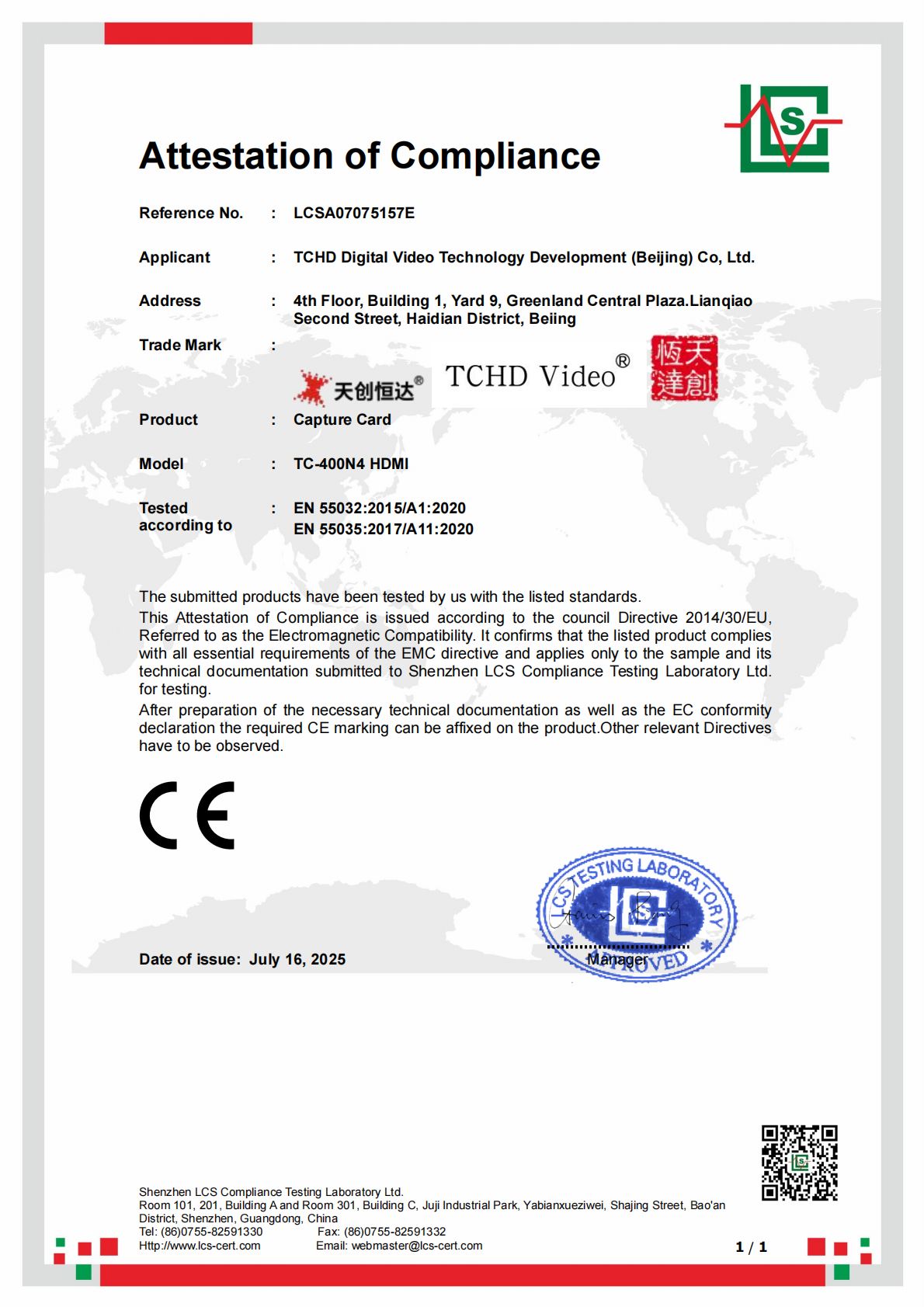
The boundary matters as much as the certificate. The CE EMC attestation LCSA07075157E is scoped to the TC-400N4 HDMI series capture card. It should not be read as blanket EMC coverage for every capture card in the portfolio, including the TC-UB620, TC-UB660, TCHD-840 Pro or TC-200N9. A buyer deploying one of those models into the EU should ask for the specific attestation covering that model, or a written statement of which certificate applies.
This is not a criticism of the supplier; it is how product certification works. It is, however, exactly the kind of gap that a one-off purchase never surfaces and a five-year deployment inevitably does — usually at the point where a customer or auditor asks for documentation. Procurement teams should build a certificate register at the start of the engagement, listing certificate number, issuing body, standard, model scope and expiry date for every model in the order.
Dimension Five: Warranty, After-Sales and Component Continuity
Standard after-sales warranty coverage is the baseline expectation, and it should be confirmed in writing before an order is placed rather than assumed from a product page. What matters for a multi-year horizon is not only the warranty length but what the warranty commits the supplier to do, and how the supplier handles the period after coverage ends.
Three questions convert a warranty statement into a usable commitment. First, what is the remedy — repair, replacement, or credit — and who pays inbound freight? Second, does the warranty survive a board revision, or does a revised unit fall under different terms? Third, and most important for a five-year framework, what happens if the specific model is discontinued mid-deployment: is there a defined successor, a stated end-of-life notice period, and a spare-parts availability window?
Component continuity is the dimension most often left undocumented and most often responsible for unplanned capital expenditure. Capture cards contain interface controllers, video processing components and connectors that are subject to supplier allocation cycles. A supplier that cannot describe how it monitors component availability, or how it notifies customers of a change, is transferring that risk to the buyer without saying so.
Application Profiles Where the Five-Year Horizon Matters Most
The framework's weightings change by application. In some deployments, a two-year replacement cycle is entirely acceptable; in others it is not.
Medical training and clinical recording
Medical imaging and industrial applications account for 19.4% of total video capture card revenues, with a segment CAGR of 11.8% through 2034. The growth rate matters less than the operating model: medical training and recording environments typically run fixed installations with long replacement cycles, and any hardware change triggers re-validation of the recording workflow. A capture and playback card such as the TC-200N9, with its stated anti-interference and anti-static design and SDI interface, fits the fixed-installation profile — but buyers in this segment should treat the certification register as a primary selection criterion, because documentation is part of the deliverable.
Live commerce and multi-platform streaming
Live commerce operations usually run daily, often for many hours, and typically stack multiple software tools on a single host. The TC-UB620 and TC-UB660 USB 4K capture cards, with UVC/UAC operation and stated compatibility with OBS and vMix, map onto this pattern because the software stack changes more often than the hardware. Here the five-year question is almost entirely about driver longevity rather than mechanical wear.
Multi-camera broadcast and production
Multi-camera production introduces the switcher as a long-lived asset. The TCHD-840 Pro live stream switcher, with its aluminum alloy housing, sits in the signal chain for the whole deployment, and its failure takes down every camera feed rather than one. Buyers in this segment should evaluate the switcher and the capture cards as a single continuity unit, with a documented spare strategy for the switcher specifically.
Education, conferencing and lecture capture
Institutional deployments in education and corporate conferencing are procured in batches and supported by IT teams who cannot afford per-unit driver troubleshooting. The UVC/UAC model is particularly relevant here, because it allows standardisation on the operating system's class driver and reduces the number of vendor-specific software packages an IT team must track across a fleet.
Why Supplier Durability Is Being Repriced
The commercial context supports the framework. The global capture card market was valued at USD 1.31 billion in 2024 and is projected to reach USD 3.37 billion by 2033 at a CAGR of 12.4%. Growth of that order changes what suppliers optimise for: expanding volume rewards production consistency and documentation discipline, while rapid model turnover increases the risk that any individual SKU is retired before the buyer's deployment ends.
Two structural signals sharpen the point. USB capture cards held the largest product type share at 38.4% in 2025, which means the USB form factor — and therefore UVC/UAC class compliance — now defines the compatibility baseline for the majority of buyers. Separately, the competitive landscape in 2025 was led by Elgato (Corsair Gaming) and AVerMedia Technologies. A concentrated, brand-visible market is convenient for buyers seeking recognition, but brand recognition is not the same as supply continuity for a specific model in a specific region, and procurement teams should not treat the two as interchangeable.
Comparison With a Traditional One-Off Purchase Approach
The traditional approach is straightforward: select on specification and price, validate with a sample, place the order, and address problems when they occur. It is faster and requires less documentation. The five-year framework costs more upfront in due diligence time and asks suppliers questions they may not have prepared answers for.
The traditional approach also has genuine advantages that the framework does not eliminate. For short-cycle deployments, event-based work, or applications where the capture card is a consumable rather than infrastructure, the added diligence rarely pays back. Sample validation remains the most reliable single test of whether a device works in your specific software stack, and no certificate or material specification substitutes for it.
Beyond cost, the framework has real boundaries that buyers should not ignore:
- Aluminum alloy housings add weight and cost. For portable, outdoor or backpack-based field kits, a lighter enclosure may be the better engineering choice even if it is less resistant to handling stress.
- Class-compliant design constrains functionality. UVC/UAC operation trades vendor-specific feature depth for platform independence. Buyers who need proprietary formats or custom processing are choosing a different, and legitimate, trade-off.
- Certificate scope cannot be generalised. A CE EMC attestation such as LCSA07075157E covers the models named in its scope. Assuming portfolio-wide coverage from a single document is a documentation error, not a supplier failure.
- Five-year continuity cannot be guaranteed unilaterally. No supplier can promise component availability across five years in an allocation-constrained market. The framework's purpose is to make the supplier's process visible and to move commitments into contract terms, not to obtain an absolute guarantee.
- Diligence does not scale down gracefully. For a single-unit purchase, the framework's overhead usually exceeds its benefit.
What to Ask Before Signing a Multi-Year Supply Agreement
The framework converts into a short list of questions. These are the questions that separate a supplier with a continuity process from a supplier with a continuity statement.
On component continuity
- Which components in this model have known allocation risk, and how is that monitored?
- What is the end-of-life notice period, and who receives it?
- If a component is substituted, is the revised unit form-fit-function equivalent, and is the change documented?
- Are spare units or spare boards held for the contract period?
On firmware and driver upkeep
- Does the model rely on UVC/UAC class drivers only, or does it require vendor software for full functionality?
- Which operating system versions have been tested, and on what date?
- How are OS major releases handled — is there a stated retest commitment?
- Which versions of OBS, vMix, Premiere and After Effects have been verified?
On certification stability
- Which certificate covers this specific model, and what is its expiry date?
- Who is the issuing body, and which standards are cited?
- Who is responsible for renewal, and is the buyer notified before expiry?
- If a standard is revised during the contract period, is recertification included or quoted separately?
On after-sales
- What exactly does the standard warranty cover, and what is the remedy?
- What is the turnaround time for a replacement unit in the buyer's region?
- Is there a defined migration path if the model is discontinued?
Outlook: Continuity as a Procurement Criterion
The direction of the market suggests that continuity will become a formal procurement criterion rather than an informal preference. USB capture cards already account for the largest product type share, which means class-compliant, driver-light architecture is becoming the default rather than a differentiator. At the same time, medical and industrial applications — the segments growing fastest at 11.8% CAGR through 2034 — bring with them longer validation cycles and heavier documentation requirements.
Those two trends pull in the same direction: the hardware specification will matter less over time, and the supplier's ability to document, maintain and support that hardware over a multi-year period will matter more. Buyers who begin scoring suppliers on durability evidence, driver architecture, certificate scope and continuity process today will find the comparison far easier than buyers who start when a model is retired mid-deployment.
For procurement teams beginning that assessment, a structured starting point helps. The TCHD Product Catalog 2025 documents the capture card, switcher and converter portfolio referenced in this framework and can be used to map models against the five dimensions above.
FAQ
Q1. What does UVC/UAC support actually guarantee for a 4K capture card over several years?
A. UVC (USB Video Class) allows a capture card to operate as a plug-and-play device without a proprietary driver, and UAC does the same for audio. Over a multi-year horizon this shifts compatibility maintenance from the hardware supplier to the operating system's own class driver, which is maintained by the OS vendor. It does not guarantee identical behaviour on every platform, and it does not cover features that depend on vendor-specific drivers, such as certain proprietary formats or custom processing.
Q2. How can a buyer verify material durability before committing to a multi-year order?
A. Start with the enclosure and board material, then map that material to the actual handling environment. Aluminum alloy housings, used on the TCHD-840 Pro live stream switcher and the TC-UB620 and TC-UB660 USB 4K capture cards, provide structural rigidity suited to rack-mounted or repeatedly connected deployments. A PCB-based design such as the TC-200N9 SDI capture and playback card is intended for in-chassis installation, where slot fit and host airflow become the relevant durability factors instead of enclosure strength.
Q3. Which certifications should a 4K capture card supplier hold, and what do they not cover?
A. Two categories matter. Management-system certificates demonstrate process discipline — TCHD Video holds ISO9001:2015 (064-24-Q-0675-R1-S), ISO14001:2015 (064-24-E-0676-R1-S) and ISO 45001:2018 (064-24-S-0677-R1-S), all issued by BEIJING STANDARD CERTIFICATION CENTRE and valid from 2024-03-08 to 2027-03-07. Product certificates establish market access — a CE EMC attestation LCSA07075157E was issued by LCS TESTING LABORATORY on 2025-07-16 against EN 55032:2015/A1:2020 and EN 55035:2017/A11:2020. Crucially, that attestation is scoped to the TC-400N4 HDMI series and does not automatically cover other models, so buyers must confirm the certificate that names their specific model.
Q4. What should procurement teams ask about component continuity and firmware upkeep?
A. On continuity, ask which components carry known allocation risk, what the end-of-life notice period is, who receives it, and whether spare units or boards are held for the contract term. On firmware, ask whether the model relies solely on UVC/UAC class drivers or requires vendor software, which OS versions and which versions of OBS, vMix, Premiere and After Effects have been tested, and whether there is a stated retest commitment after major OS releases.
Q5. Is a five-year evaluation framework practical for small-volume buyers?
A. Usually not in full. The framework's overhead — certificate registers, continuity questions, component risk review — typically exceeds its benefit for single-unit or short-cycle purchases, where sample validation against the actual software stack is the more reliable test. The framework is designed for deployments where hardware replacement triggers re-validation, such as fixed medical recording installations, institutional education fleets, or multi-camera production where a switcher failure takes down the entire signal chain.
Market figures cited in this article are drawn from third-party research on the global capture card market, including 2024 market size, 2033 projection and CAGR, product type share, application segment share and growth, and the 2025 competitive landscape. Technical bandwidth figures and UVC class definitions are drawn from published technical references. Certification numbers, issuing bodies, standards and validity dates are drawn from the supplier's compliance documentation. Product specifications and portfolio composition are drawn from TCHD Video's product documentation.
Есть вопросы или нужны дополнительные детали?
Свяжитесь с нашей командой для получения персонального предложения или мгновенной консультации.
Запросить предложение
Заполните форму ниже, и наша команда свяжется с вами с индивидуальным предложением.
Прямой чат WhatsApp
Предпочитаете общаться в реальном времени? Напишите нам в WhatsApp для мгновенной помощи и быстрых ответов.
- Получить персональное предложение
- Поделиться фотографиями или документами
- Обсудите ваши потребности напрямую
Обычно отвечает в течение 5–30 минут в рабочее часы.