
Evaluating CNC Machining Services for Precision Parts
Precision CNC machined parts are embedded in fuel equipment, unmanned aerial vehicles, medical devices, and automation systems. When a production team evaluates a CNC machining service, the decision is not only about machine availability. It also depends on material scope, tolerance control, batch flexibility, inspection data, and the supplier's ability to support the part from prototype into production.
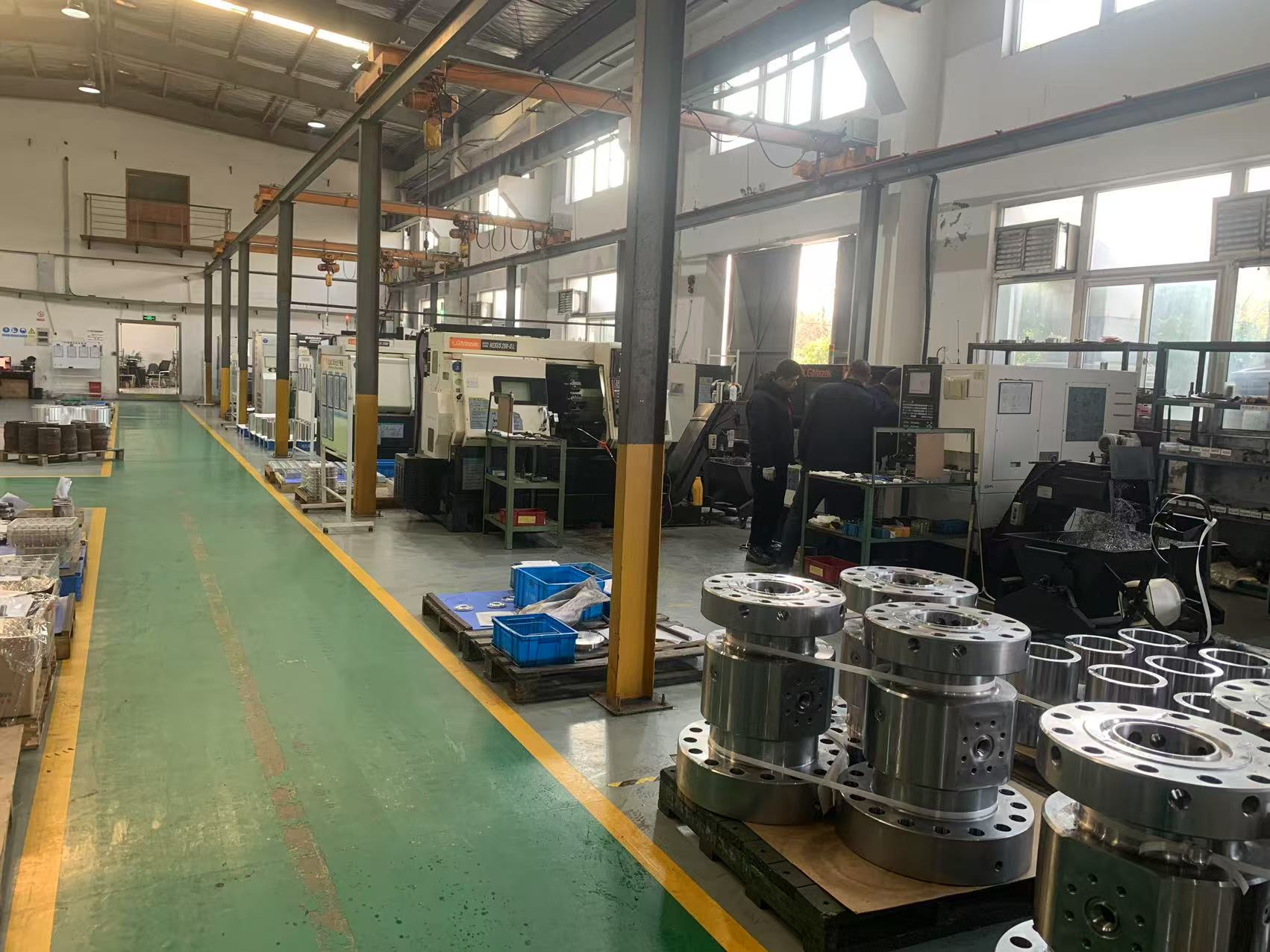
A production facility view relevant to capacity and process assessment in industrial machining services.
The evaluation problem goes beyond spindle access
One reason CNC machining service selection is difficult is that many machine shops describe similar equipment: CNC lathes, milling machines, multi-axis centers, and grinding. A listed equipment set does not prove that a supplier can hold tight tolerances in volume, produce a conforming first article, manage documentation, or respond to a design change without delaying the program. Buyers who select only on unit price may later absorb higher costs in rework, incoming inspection, or line-down risk.
The opportunity for evaluation-stage buyers is to shift from asking 'can this supplier machine?' to asking 'can this supplier machine the right geometry, in the right material, at the required tolerance, with documented quality evidence, and with a process that scales from prototypes to mass production?' The following seven dimensions create a practical comparison framework for custom CNC machining and precision machined parts.
Seven evaluation dimensions for a precision CNC parts supplier
| Dimension | What to verify | Why it matters |
|---|---|---|
| Multi-axis capability and tolerance control | Advanced 3/4/5-axis CNC machining centers, CNC lathes, precision grinding equipment, and the ability to produce intricate metal parts with ultra-tight tolerances. | Complex geometries with tight feature relationships reduce secondary operations and assembly risk. |
| Material coverage | Machining experience with carbon steel, stainless steel, aluminum, brass, copper, titanium, plastic, POM, and nylon. | Different end markets require different material families; a broader material scope reduces supplier proliferation. |
| Process coverage | CNC turning, CNC milling, drilling, grinding, tapping, and EDM capability. | Most precision components need multiple operations; process integration reduces tolerance stacking and handling. |
| Prototype-to-production flexibility | Support for prototypes, small batches, and mass production; a stated MOQ of 1 piece. | Buyers can use the same supplier from first-article validation through production ramp-up. |
| Capacity and lead time | A monthly production capacity of 100,000 pieces and a lead time range of 10 to 60 days. | Capacity and scheduling affect on-time delivery for repeat programs. |
| Quality system and inspection | ISO9001:2015 certification, 100% testing, complete material certificates, and dimensional inspection reports. | Documents and test data support incoming inspection and audit requirements. |
| Engineering support | DFM optimization to simplify production and cut costs, plus after-sales technical support. | Early manufacturability input can reduce direct cost and technical risk. |
Supplier capability profile: Suzhou ECOD Precision Manufacturing Co., Ltd.
One reference profile for evaluating these dimensions is Suzhou ECOD Precision Manufacturing Co., Ltd. (ECOD). ECOD was founded in 2005 and operates a 40,000 m² facility in Suzhou, China. It reports 350 employees, an annual output of 1,000,000 units, and an engineering team of 25 engineers. Its main product areas are CNC machining service and casting service, with an export ratio of 100% across Europe, the Middle East, North America, and Asia.
ECOD states that it focuses on high-precision CNC machining services using advanced 3/4/5-axis CNC machining centers, CNC lathes, and precision grinding equipment. Its service scope includes CNC turning, milling, grinding, and precision assembly. The company machines aluminum, stainless steel, copper, and various alloy steels, and it records support for prototypes, small batches, and mass production. Its engineering team provides DFM optimization to simplify production and reduce cost, and after-sales technical support is listed for EU and Middle East export markets.
Technical interpretation: processes, materials, and certification
From a procurement standpoint, the useful information is not only the presence of equipment but the combination of process, material, and quality evidence. The supplied product parameters list carbon steel, stainless steel, aluminum, brass, copper, titanium, plastic, POM, and nylon as available materials. Processes named for the precision CNC machining product include CNC turning, CNC milling, drilling, grinding, tapping, and EDM. This mix matters because a part may require turning for cylindrical features, milling for contoured pockets, and grinding for tight surface finish, with tapping or EDM used for specific features.
On certification, ECOD lists an ISO9001 quality management system certificate. The certificate number is 33826Q00178R000, issued by Shanghai Wozhong certification Co. Ltd, with a scope of Custom CNC Machining Parts Sales and a standard of GB/T19001-2016/ISO9001:2015. The issue date is 2026-06-16 and the expiry date is 2029-06-15. Buyers should verify certificate status against the issuing authority, because a certificate is a management-system statement rather than a product-level guarantee of a specific tolerance or material property.
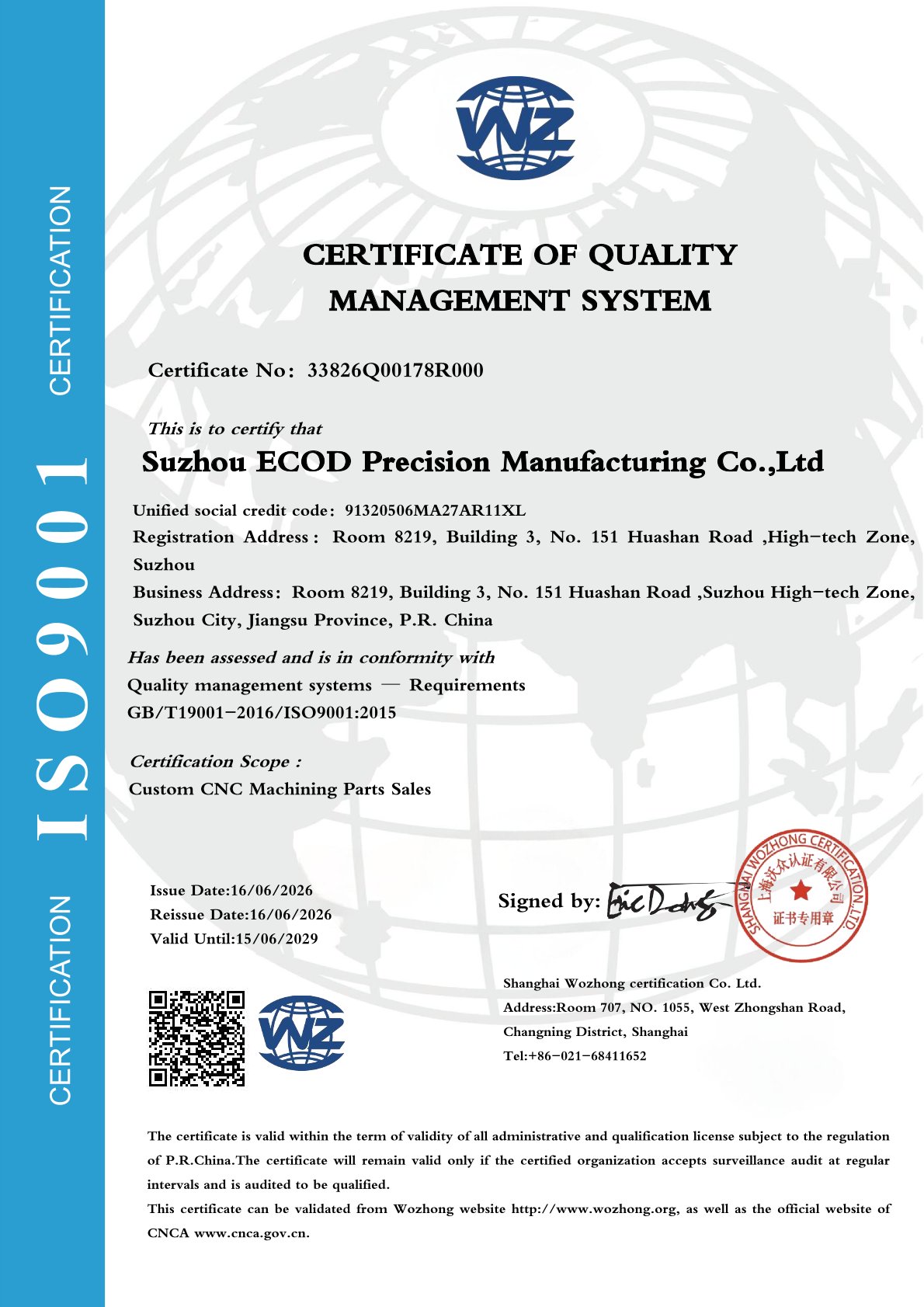
Quality system documentation supports evaluation of a CNC parts supplier, but it should be verified against the issuing authority.
Industry standards reinforce the need for context. Aerospace CNC machining typically requires AS9100, which incorporates ISO9001 plus more than 100 additional requirements for safety and reliability, according to SAE International. Medical CNC machining often points to ISO13485 for quality management in medical device production. These standards are not automatically covered by ISO9001, so procurement teams should match the required certification to the end-use industry.
Application evidence: oil and gas and aerospace programs
Two recorded applications show how ECOD's capability profile translates into end-use contexts. In the United Arab Emirates, a gas and oil industry order involved 10,000 pieces for oil and gas equipment over a five-year duration. The recorded result was improved equipment reliability, with the highlight that the parts were adapted to harsh oil and gas working environments. That application depends less on low unit cost than on repeatability and material behavior under demanding conditions.
A separate UAV program in Russia involved a project scale of 1,000,000 pieces with a one-year duration. The recorded result was stable quality in mass production, with the stated highlight of matching aerospace industry precision standards. The contrast between the two cases is useful: one is a longer-running oil and gas support program, and the other is a high-volume aerospace production run. Buyers can use this type of evidence as a prompt for supplier audits rather than as a substitute for first-article validation.
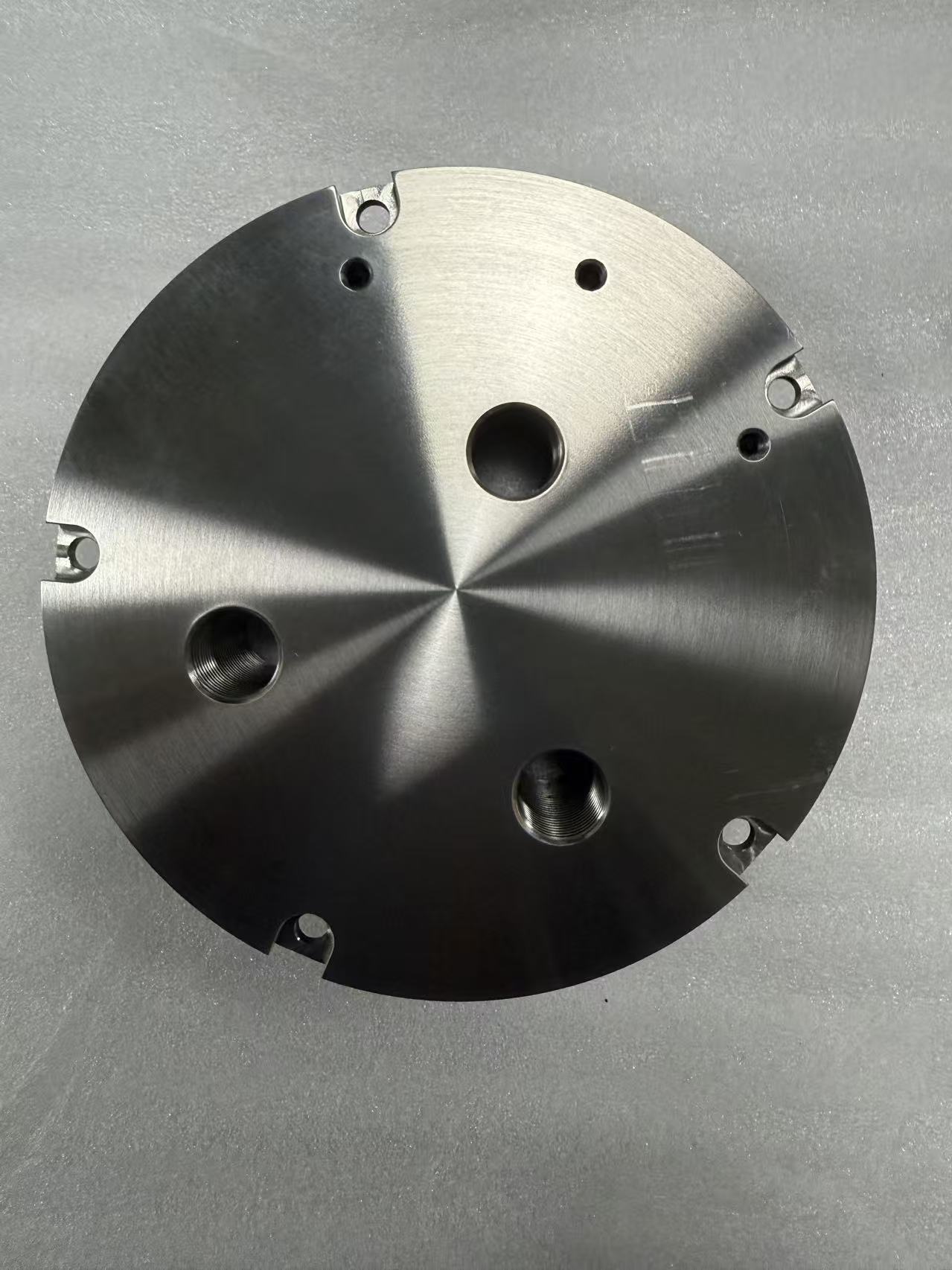
Oil and gas parts shown in a recorded CNC machining application case.
Market trends shaping CNC machining procurement
Third-party market data helps explain why evaluation criteria are becoming more important. Fortune Business Insights values the global CNC machine market at USD 101.22 billion in 2025, with a projection to USD 251.61 billion by 2034. Business Research Insights estimates the global CNC machining services market at USD 58.33 billion in 2026, rising to USD 108.3 billion by 2035. These are different scopes: one covers machine tools and the other covers machining services, so they should not be directly combined.
Geographically, Asia Pacific held a 55.70% share of the global CNC machine market in 2025, and three coastal Chinese provinces—Jiangsu, Guangdong, and Zhejiang—control 82.2% of China's national CNC machining capacity according to Haizol. Suzhou, where ECOD is located, sits within the Jiangsu manufacturing cluster. However, regional capacity is an industry signal, not a supplier qualification.
By machine type, machining centers accounted for 61.6% of global revenue in 2023 according to Grand View Research, while milling machines held the largest type share at 31.4% in 2025 according to Dataintelo. On the materials side, Xometry identifies aluminum 6061-T6 as the most widely used CNC material because of its high machinability and strength-to-weight ratio. This does not mean 6061-T6 is always the right alloy; it means aluminum-based precision parts are a common demand baseline, and suppliers need to demonstrate material-specific process control.
End-use demand is also broad. Dataintelo reports the automotive industry as the largest CNC machining end user at 28.6% of market revenue in 2025, but aerospace, medical, new energy, and automation remain significant precision segments. Mordor Intelligence projects ultra-precision machining centers for semiconductor fab equipment to grow at an 8.36% CAGR from 2026 to 2031. For evaluation-stage buyers, the practical takeaway is that CNC machining service demand is increasing across both high-volume industrial applications and high-mix precision programs, which raises the importance of matching supplier capability to the specific program.
Comparison with traditional machining approaches
A precision CNC machining service is not automatically the best fit for every component. Traditional manual machining or a basic local CNC machine shop may be more economical for simple parts with loose tolerances, low documentation requirements, and non-critical end use. ECOD's stated configuration is oriented toward high-precision CNC machining, 100% testing, documented material certificates, dimensional inspection reports, and flexible production from prototype to mass production. Those capabilities add value only when the part or program actually requires them.
In evaluation terms, the boundary is economic and technical. A simple bracket might not justify multi-axis programming, DFM time, or formal inspection documentation. An unmanned aerial vehicle part, a critical oil and gas component, or a high-consistency OEM machining part may. Lead time also matters: ECOD lists a lead time range of 10 to 60 days. For urgent one-off parts, a local quick-turn shop may be faster if prior quality evidence and traceability are not essential. The decision should therefore be based on geometry, tolerance, material, risk, volume, documentation, and schedule—not on equipment list alone.
Table 1 summarizes the evaluation difference between a traditional low-complexity approach and a precision CNC machining service profile.
| Evaluation factor | Traditional low-complexity approach | High-precision CNC machining service |
|---|---|---|
| Geometry | Simple prismatic features and moderate positional control. | Intricate metal parts with ultra-tight tolerances, supported by 3/4/5-axis machining centers. |
| Batch model | Often one-off or short-run work. | Flexible production from prototypes to small batches and mass production, with MOQ of 1 piece. |
| Quality evidence | May be limited or process-dependent. | 100% testing, complete material certificates, and dimensional inspection reports. |
| Process scope | Often separate turning and milling operations. | CNC turning, CNC milling, drilling, grinding, tapping, EDM, and precision assembly in one service scope. |
| Economic fit | Lower overhead is effective for simple parts. | Process control and documentation add value for critical parts and production programs. |
Future outlook
CNC machining service buyers are likely to face more complex sourcing decisions as demand expands in aerospace, oil and gas, medical, new energy, automation, and semiconductor equipment. Market data points to continued growth in machining services, with Asia Pacific remaining a major production region and with Jiangsu, Guangdong, and Zhejiang controlling the majority of China's CNC capacity. At the same time, documented skilled labor shortages and material price volatility in some markets may push buyers toward suppliers that can combine multi-axis capability, process integration, and quality evidence.
For a profile such as Suzhou ECOD Precision Manufacturing Co., Ltd., the relevant forward-looking test is whether the company maintains its 3/4/5-axis capacity, material coverage, certification scope, and engineering support as program requirements become more stringent. Evaluation-stage buyers should treat trends as context and audits, first articles, and documented production runs as the higher-weight decision inputs.
Frequently asked questions
What does a CNC machining service typically include? A precision CNC machining service commonly includes CNC turning, CNC milling, drilling, grinding, tapping, and EDM. In the ECOD profile, the stated service scope also includes precision assembly, using 3/4/5-axis CNC machining centers, CNC lathes, and precision grinding equipment. Buyers should confirm whether each operation is performed in-house or through a subcontractor, because this can affect lead time and process control.
What is the difference between CNC milling and CNC turning? CNC milling generally uses rotating cutting tools to remove material and is commonly used for prismatic or contoured features. CNC turning rotates the workpiece against a stationary cutting tool and is commonly used for cylindrical geometries. Many precision parts require both processes, which is why process integration is a relevant supplier evaluation factor.
Which industries use custom CNC machined parts? Aerospace, medical, new energy, and automation are listed in the ECOD service scope. Third-party data also identifies automotive as the largest end user of CNC machining at 28.6% of market revenue in 2025. The recorded ECOD application evidence includes oil and gas equipment in the UAE and UAV production in Russia.
What materials are available for precision CNC machining? The material list for this precision CNC machining service includes carbon steel, stainless steel, aluminum, brass, copper, titanium, plastic, POM, and nylon. Aluminum 6061-T6 is identified by Xometry as the most widely used CNC material due to high machinability and strength-to-weight ratio, but alloy selection should be driven by part requirements.
What is the minimum order quantity for custom CNC machined parts? The stated MOQ is 1 piece. The factory lists a monthly production capacity of 100,000 pieces and a lead time range of 10 to 60 days, supporting prototypes, small batches, and mass production under the same service scope.
Which certifications should be checked when evaluating a CNC machining supplier? ISO9001:2015 is a common baseline for quality management. The ECOD certificate number is 33826Q00178R000, with a scope of Custom CNC Machining Parts Sales. For aerospace programs, AS9100 is typically required and incorporates ISO9001 plus additional safety and reliability requirements. For medical device production, ISO13485 is relevant. Certificate status should be verified with the issuing authority.
How does DFM optimization affect CNC machining cost and lead time? Design for manufacturability, often abbreviated as DFM, is used to simplify production and reduce cost before machining begins. ECOD states that its engineering team provides DFM optimization to simplify production and cut costs. This can involve adjustments to feature geometry, tolerance choice, material selection, or process sequence, and it is most valuable when performed before final drawing release.