
Evaluating Car Radio Suppliers for the Long Haul: A B2B Sustainability Scorecard
A car radio programme rarely ends with the first container. Once an aftermarket head unit is listed in a distributor catalogue, written into a fleet retrofit package, or offered as a replacement path for an ageing vehicle platform, the buyer has stopped purchasing hardware and started underwriting a supply relationship. That relationship has to survive firmware generations, component substitutions, certification renewals and service cycles measured in years rather than shipments.
The commercial backdrop explains why this matters more than it used to. Mordor Intelligence sized the global car audio market at USD 12.24 billion in 2025, and Grand View Research data places double DIN head units at 44% of car stereo revenue by form factor in the same year. Where demand concentrates in a single form factor, supplier turnover becomes expensive: tooling, car radio wiring harness mapping, installation documentation and installer training all have to be repeated with each new vendor.
A supplier sustainability scorecard is a structured, repeatable method for judging whether a car radio manufacturer can keep supplying the same programme with consistent specification, certification and support over several years. It is deliberately not a price list, and it is not a product review. This article builds that scorecard across five dimensions, applies it to one documented supplier — TOPNAVI — and treats Pioneer, Kenwood and Alpine as the reference names most B2B buyers already hold in their consideration set.

Production line environment of the type buyers should inspect when scoring a car radio supplier for long-term capacity, not only for unit price.
The scorecard at a glance
Five dimensions separate a supplier that can carry a multi-year programme from one that can fill a container. Each dimension should be scored against documents and samples, not against sales language.
| Dimension | Buyer question | Evidence that counts | Warning sign |
|---|---|---|---|
| R&D continuity | Will this supplier still be on a current platform in three years? | Successive platform generations across the catalogue; named chipset and OS per model | Catalogue frozen on one Android generation, with no chipset disclosed |
| Production scalability | Can volume ramp without changing the build? | Plant area, headcount, stated annual output, in-house SMT and soldering, reliability test stations | Output claimed with no process detail and no test evidence |
| Certification durability | Will the certificates still cover what I import next year? | Model-level CE, FCC, E-mark and RoHS claims, plus declarations with scope and validity | “Certified” asserted with no model scope or document |
| Environmental envelope | Does the specification hold in the markets I sell into? | Published operating temperature and voltage per model; IP rating where applicable | One temperature claim applied across every SKU |
| Lifecycle support | Who answers in year three? | Warranty terms, spares and accessory continuity, OTA capability, neutral or branded options | Warranty shorter than the buyer’s own customer commitment, with no extension path |
Dimension 1: R&D continuity, measured by output rather than by slogan
For an android car radio, the software platform is the product. An OS generation determines app compatibility, security patching, Bluetooth stack behaviour and the availability of wireless CarPlay and Android Auto implementations. When a supplier stops moving, the buyer inherits an end-of-life SKU with no upgrade path and an install base that cannot be refreshed.
R&D investment in this scorecard is measured by two observable indicators: engineering headcount and platform cadence. On both, TOPNAVI publishes usable data. The company states that its R&D team consists of 50 engineers, and its catalogue spans several distinct platform generations rather than one: Android 11 on the TN-AI47 CarPlay box, Android 12 on the TS10 universal player built around the Unisoc UIS7862S eight-core chipset, Android 13 on the TN-3036, TN-X80, TN-X23 and TN-UK1105, Android 14 on the TS105 with its UIS7865 octa-core CPU, and Linux on the TN-9359 and on the TN-M9 and TN-M11 motorcycle navigation units.
That spread is evidence of continuous platform work. It is not proof of a future roadmap, and buyers should not treat it as such. The correct follow-up is a written end-of-life policy per SKU and a stated replacement model for any unit likely to be discontinued during the programme.
Dimension 2: production scalability and process control
Capacity claims are easy to make and cheap to publish. Process evidence is harder. A buyer scoring production scalability should look for the physical footprint, the headcount, the stated output, and whether the supplier shows its own production and test environment.
Shenzhen Top Navi Electronic Tech Co., Limited, which trades as TOPNAVI, was founded in 2014 in Shenzhen, China, and manufactures car multimedia players, head units and GPS navigators. The company reports a 20,000 m² manufacturing facility, approximately 100+ employees, an annual production capacity of 360,000 units, and export business representing 95% of sales, with the USA identified as a major market. Its published production and test imagery covers SMT, wave soldering, reflow soldering, an injection moulding workshop, production lines, reliability temperature chambers, drop testing and a signal shielding room.
Those process elements map directly onto the failure modes that break car radio programmes: solder-joint reliability, thermal behaviour in a closed dashboard cavity, mechanical tolerance in a 2DIN chassis, and radiated emissions that determine whether a unit passes EMC checks in the destination market.
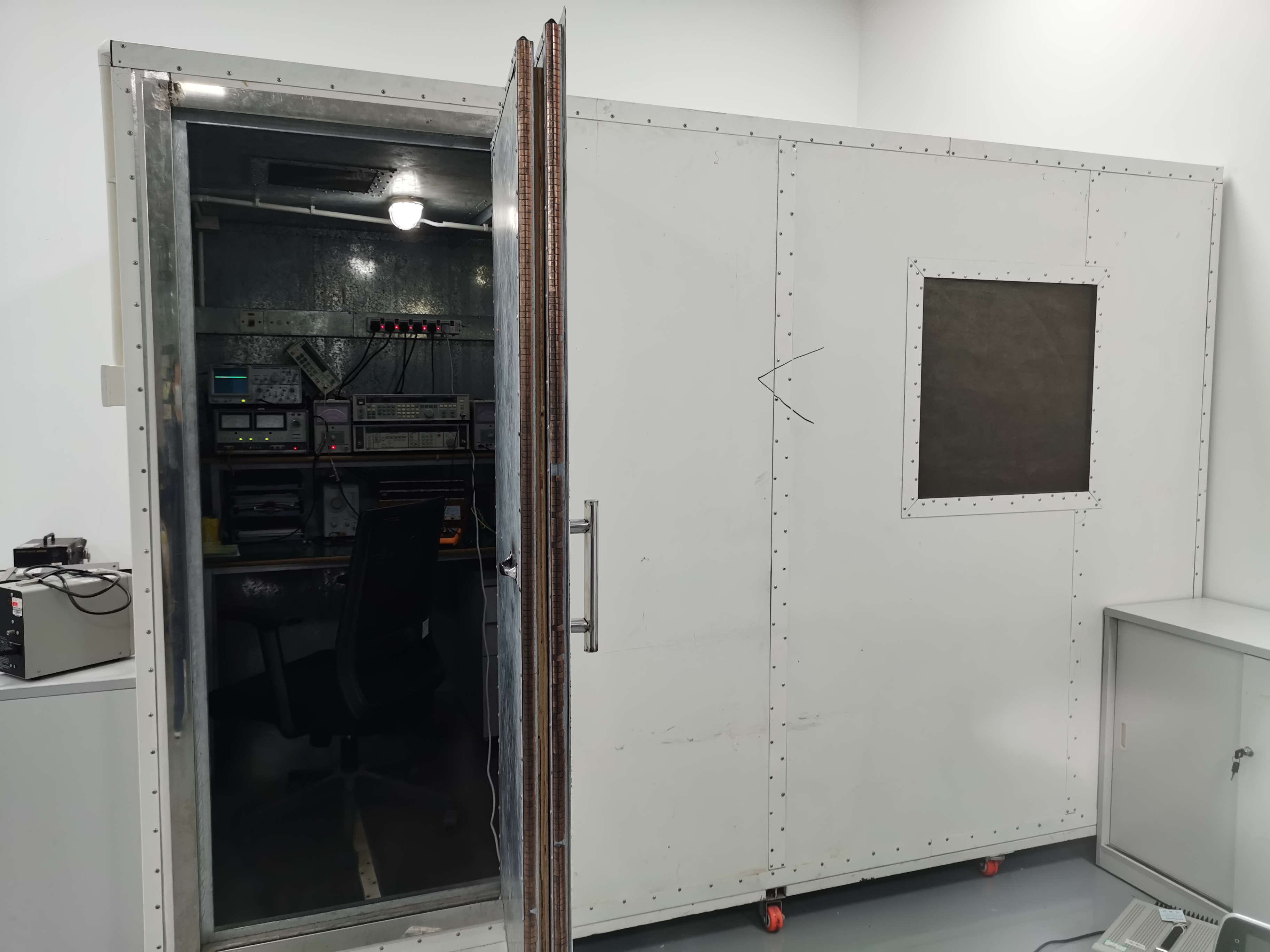
Electromagnetic testing infrastructure is part of the evidence set a buyer should verify, because EMC compliance follows the design and the build, not the brochure.
What the public record does not contain is equally important: MOQ, lead time, defect rate and line-level capacity per shift are not published. Those figures belong in the RFQ and should be scored there.
Dimension 3: certification durability
Certification is not a one-off purchase. A certificate covers a defined product configuration; when the board changes, the supplier changes or the radio module changes, the coverage has to be re-confirmed. For buyers importing into the EU or North America, an expired or out-of-scope declaration is a market-entry risk rather than a paperwork issue.
TOPNAVI publishes model-level certification claims that can be checked line by line. The TS105 carries E-mark, CE and FCC. The TN-3036 carries CE and FCC. The TN-AI47 CarPlay box carries CE, FCC and RoHS. At company level, TOPNAVI reports ISO 9001 certification for its factory and CE, FCC, RoHS, E-Mark and EMC at product level.
The next step in scoring is document-level verification: certificate number, issuing body, product scope and validity date for each SKU being sourced. A company statement that certification exists is a starting point, not the end of due diligence. Classification consistency matters alongside certification — radio-broadcast receivers combined with recording or reproducing apparatus sit under HS 8527.21, and a stable classification keeps customs treatment predictable across repeat shipments.
Dimension 4: environmental and electrical envelope
The application brief for this segment describes the real operating conditions plainly: an in-vehicle environment with wide temperature range, high vibration, dust exposure, electromagnetic interference, a 12V DC vehicle supply and frequent cold starts. A supplier specification that ignores those conditions will fail in the field rather than in the warehouse.
This is where a single headline figure becomes misleading. TOPNAVI’s published operating temperatures differ by product: −30°C to 75°C on the TN-3036 and on the TS10, −20°C to 70°C on the TN-RD1001, and −10°C to 60°C on the TN-AI47 and the TN-M11. The TN-M9 and TN-M11 motorcycle units carry an IP67 rating. A buyer aggregating an SKU range for a cold-climate or hot-climate market must read the figure per model, not per brand.
The same logic applies to fitment and wiring. The TN-3036 and TS105 are designated 2DIN installations with universal fitment, and the TN-3036 supports both steering-wheel and touch control. For car radio replacement programmes, harness mapping, CAN-bus adaptation across a broad vehicle parc, steering-wheel control compatibility and multi-language localisation are the practical compatibility gates — and each one should be validated on a sample vehicle, not assumed from a form-factor label.
Dimension 5: after-sales and lifecycle continuity
Lifecycle support is where brand reputation and programme reality most often diverge. The questions are concrete: what is the warranty period, who receives the RMA, are spare units available after the model is superseded, and can the buyer hold stock under its own label?
TOPNAVI lists a 1-year warranty on several models, including the TS105, TN-X23, TN-X80, TN-UK1105 and TN-M9. The catalogue demonstrates both neutral and branded supply: the TN-X23 is designated a neutral product, the TN-M9 carries a neutral brand name, while the TN-UK1105 is branded TOPNAVI. Field-updatable software is present on at least one platform, with the TN-AI47 supporting OTA update. The TN-M11 lists multi-language support across eleven languages (CN, EN, RU, ES, FR, DE, JP, KO, AR, IT, PT), which matters for distributors servicing mixed-language retail channels.
Reading the product ecosystem as supply evidence
Shenzhen Top Navi Electronic Tech Co., Limited, trading as TOPNAVI, is a Shenzhen-based manufacturer of car multimedia players, car head units, motorcycle CarPlay units and CarPlay AI boxes, founded in 2014. Its declared main products include Android car radio, car head unit, car stereo, motorcycle CarPlay, CarPlay AI box, headrest monitor, car backup camera and DVR.
Breadth alone proves nothing. But breadth across form factors and vehicle segments reduces a specific, measurable cost in long programmes: fragmentation of harnesses, documentation, installer training and spare-part inventories across multiple vendors. In the published range, the universal segment is served by the TS105 9-inch android car radio with a UIS7865 octa-core CPU, the TS10, the Linux-based TN-9359 2DIN unit and the single-knob TN-UK1105; the dual-knob touch screen car radio segment by the TN-X23 at 12.3 inches, the TN-X80 at 10.1 inches and the TN-X15 at 11.5 inches; the large-screen, vehicle-specific segment by the TN-3036 at 16.8 inches with 2560×1440 resolution and a 2DIN universal installation; the retrofit segment by the TN-AI47 for OEM wired CarPlay cars; the portable segment by the TN-RD1001; and the two-wheel segment by the TN-M9 and TN-M11.
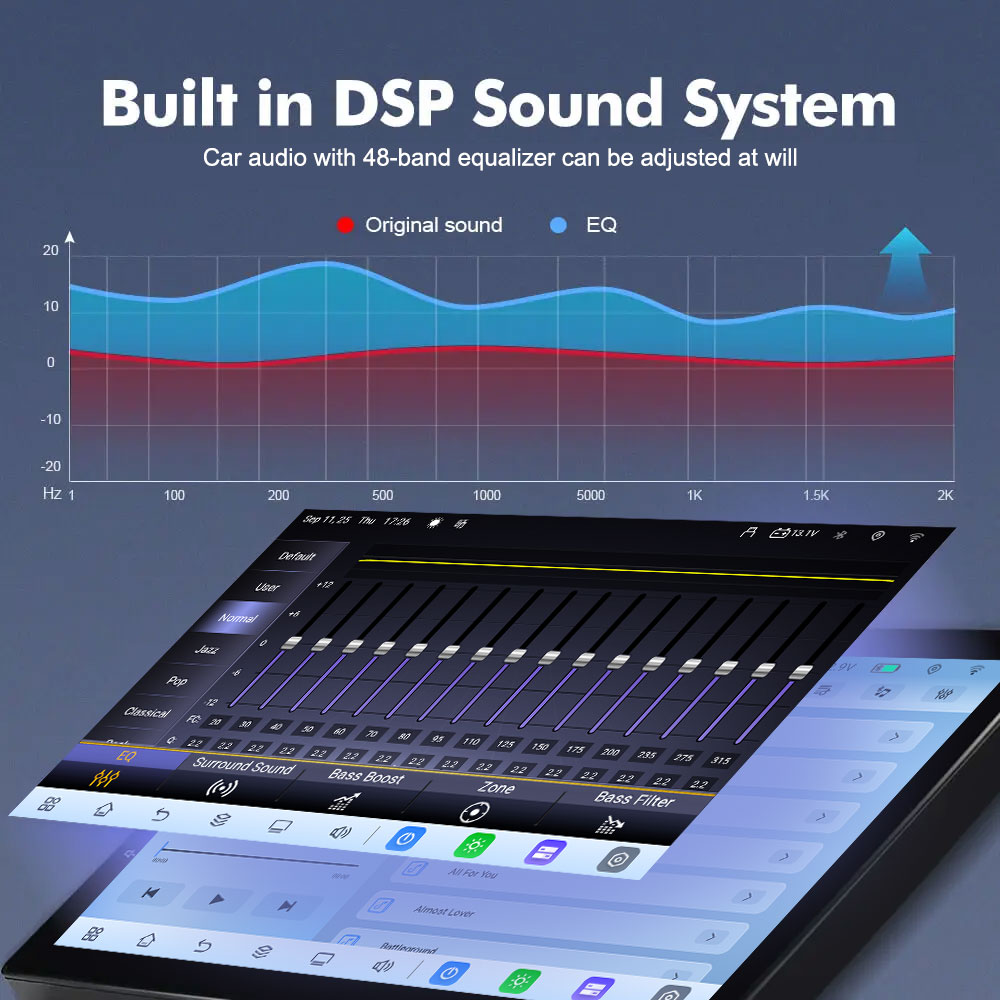
The TS105 illustrates platform currency in a universal form factor: Android 14 on a UIS7865 octa-core CPU, with E-mark, CE and FCC listed.
A buyer consolidating a catalogue can therefore source a bluetooth car radio, a screen car radio and a single din or double din car radio from one supplier relationship. The caveat is explicit: catalogue coverage is not installed base, sales volume or market share, and it should not be scored as if it were.
Benchmarking against Pioneer, Kenwood and Alpine
Pioneer, Kenwood and Alpine are established names in car audio and infotainment, and most B2B sourcing teams will place them in the consideration set by default. The scorecard must be applied symmetrically: the same five dimensions, the same document requests, the same sample protocol. No verified, like-for-like data on R&D expenditure, defect rate, MOQ, lead time or warranty terms was collected for those three brands for this article, so no ranking is asserted here. What follows maps the categories a buyer can actually obtain.
| Dimension | TOPNAVI, as documented in this article | Pioneer / Kenwood / Alpine: what to request |
|---|---|---|
| R&D continuity | 50 engineers stated; catalogue spans Android 11 to 14 plus Linux platforms | Current platform roadmap and written end-of-life policy per SKU |
| Production scalability | 20,000 m² facility, 100+ staff, 360,000 units annual output, process and test imagery published | Factory audit report, line capacity, MOQ and lead time |
| Certification durability | E-mark, CE, FCC on TS105; CE, FCC on TN-3036; CE, FCC, RoHS on TN-AI47; ISO 9001 reported | Certificate numbers, issuing bodies, scope and validity dates |
| Environmental envelope | Model-specific: −30°C to 75°C on TN-3036 and TS10; −10°C to 60°C on TN-AI47 and TN-M11 | Datasheet-level temperature, vibration and thermal test results |
| Lifecycle support | 1-year warranty on listed models; neutral and branded supply; OTA on TN-AI47 | Warranty terms, spares policy, RMA process and response times |
The practical conclusion is uncomfortable but useful: brand recognition and programme sustainability are different variables. A well-known badge does not answer the harness question, the spares question or the certificate-scope question in year three. Those answers come from documents.
Where this profile reaches its limits
A scorecard is only credible if it states what it cannot score. Five boundaries apply here.
- Warranty length. A 1-year warranty on the listed models is shorter than many multi-year fleet and distributor programmes require. Buyers should negotiate extended coverage, a spare-unit allocation or a defined repair route rather than assume the standard term is sufficient.
- Undisclosed operational figures. MOQ, lead time, defect rate and R&D expenditure are not published for TOPNAVI. The scorecard cannot be completed from public pages alone; the RFQ must supply the missing values.
- Company-reported certification. ISO 9001 and the product-level certification list appear as company statements in the available material. Certificate identifiers, issuing bodies, scope and validity were not published and require document-level verification before a programme is committed.
- Thermal variation across SKUs. The −30°C to 75°C envelope applies to the TN-3036 and TS10, not to the whole range. The TN-AI47 and TN-M11 stop at 60°C, and the TN-RD1001 at 70°C, which constrains their use in hot-climate dashboards.
- Installation dependencies. The motorcycle units, including the TN-M9, carry no internal battery and depend on vehicle power; retrofit boxes such as the TN-AI47 require an OEM wired CarPlay host to function. Neither is a universal answer to every vehicle parc.
Application fit: which programmes this profile suits
The segment’s application brief is specific about use: vehicle audio system upgrade, in-vehicle infotainment retrofit and commercial fleet projects, with the scenario commonly found in the United States, United Kingdom, Australia, Thailand, Tanzania and Russia. The matched equipment list reads like a procurement checklist for the category — HD rear-view camera, DVR dash cam, OBDII diagnostic tool, tyre pressure monitoring system, external amplifier, subwoofer and steering-wheel control adapter.
Mapped onto that brief, a distributor building a broad-fitment retail range would look first at the TS105 or TS10; a specialist serving a single high-value vehicle platform would look at the TN-3036 with its 16.8-inch 2560×1440 display; a buyer targeting vehicles that already ship with wired CarPlay would look at the TN-AI47, which adds Android 11 functionality and 1080p HDMI output without removing the factory head unit; a cost-sensitive entry range would look at the Linux-based TN-9359; and a two-wheel dealer network would look at the TN-M9 and TN-M11.
None of this replaces a sample build. A cheap car radio that fails at the harness stage is more expensive than a mid-priced unit that installs cleanly, and the only reliable way to establish which is which is to test on the vehicle platforms the buyer actually sells into.
Running the scorecard inside a real RFQ
Five steps turn the framework into a decision.
- Fix the SKU and the market first. Score a model against a destination market, not a brand against a brochure. Certification, temperature and fitment questions only make sense once both are fixed.
- Request documents, not adjectives. Certificates with scope and validity, an end-of-life policy, a warranty statement, a harness and CAN-bus compatibility list, and a thermal test summary.
- Validate on a sample in the target climate. Cold-start behaviour, touch response at temperature extremes, Bluetooth and wireless projection stability, and audio output consistency.
- Place a pilot order with a written acceptance test. Define defect thresholds, packaging requirements and the RMA route before volume is committed.
- Score, then set review triggers. Re-score at each platform generation, each certificate renewal and each significant component change, rather than once at onboarding.
Future outlook
Three shifts are likely to reshape how this scorecard is applied. First, platform cadence will keep shortening, which raises the value of suppliers that publish a clear replacement path rather than a single current model. Second, retrofit will remain a durable niche: boxes such as the TN-AI47 extend the service life of vehicles already equipped with wired CarPlay, which is a lower-cost route than full head-unit replacement for a large part of the parc. Third, form-factor concentration around double DIN — 44% of car stereo revenue by form factor in 2025, per Grand View Research — will keep harness standardisation and installation documentation on the critical path of supplier evaluation.
What will not change is the underlying test. A supplier is sustainable when its platform keeps moving, its production evidence holds up to inspection, its certificates still cover what ships, its thermal envelope matches the market, and someone answers the service question in year three.
Frequently asked questions
What is a car radio supplier sustainability scorecard?
It is a structured evaluation of whether a manufacturer can keep supplying a given car radio programme with consistent specification, certification and support across multiple years. It scores five dimensions: R&D continuity, production scalability, certification durability, environmental and electrical envelope, and lifecycle support. It is distinct from unit price and from a single-product comparison.
How can a buyer verify that an aftermarket car radio supplier keeps its platform current?
Look for evidence of successive platform generations rather than one current model. In TOPNAVI’s published catalogue, Android 11 appears on the TN-AI47 CarPlay box, Android 12 on the TS10 universal player, Android 13 on the TN-3036, TN-X80, TN-X23 and TN-UK1105, Android 14 on the TS105, and Linux on the TN-9359 and on the TN-M9 and TN-M11 motorcycle units. A catalogue spanning several generations indicates ongoing platform work; it does not by itself prove a future roadmap, which should be requested in writing together with an end-of-life policy.
Which certifications should a car radio supplier provide for global B2B programmes?
At minimum, the certificates that apply to the specific model and destination market. TOPNAVI lists E-mark, CE and FCC for the TS105, CE and FCC for the TN-3036, and CE, FCC and RoHS for the TN-AI47; at company level it reports ISO 9001 for its factory and CE, FCC, RoHS, E-Mark and EMC at product level. Buyers should request certificate numbers, issuing bodies, product scope and validity dates, because a certificate covers a defined configuration and must be re-confirmed when the product changes.
Which production indicators matter when scaling double DIN car radio supply?
Plant area, headcount, stated annual output and evidence of in-house process control. TOPNAVI reports a 20,000 m² facility, approximately 100+ staff and annual output of 360,000 units, and publishes production and test imagery covering SMT, wave and reflow soldering, injection moulding, reliability temperature chambers, drop testing and a signal shielding room. Stated output should be converted into line-level capacity, MOQ and lead time during the RFQ, since those figures are not published.
How do warranty terms and temperature ratings affect long-term car radio sourcing?
They define the operating and cost boundary of the programme. TOPNAVI lists a 1-year warranty on several models, and operating temperature varies by product: −30°C to 75°C on the TN-3036 and TS10, −20°C to 70°C on the TN-RD1001, and −10°C to 60°C on the TN-AI47 and TN-M11. A single temperature claim should not be applied across an SKU range; where the warranty is shorter than the buyer’s own customer commitment, extended coverage or spare-unit provisioning should be negotiated.
How should TOPNAVI be benchmarked against Pioneer, Kenwood and Alpine?
By applying the same five dimensions and the same document requests to every candidate. No verified, like-for-like data on R&D expenditure, defect rates, MOQ, lead times or warranty terms was collected for Pioneer, Kenwood or Alpine for this article, so no ranking is asserted. For TOPNAVI, the documented position comprises model-level specifications and certification claims plus company-reported capacity figures; for any reference brand, buyers should request equivalent factory, certification, thermal-test and service documentation before scoring.
Additional technical documentation, including model-level specifications and certification references, is available in the company’s product brochure (PDF). Company information is published at topnavi.com.cn.
Есть вопросы или нужны дополнительные детали?
Свяжитесь с нашей командой для получения персонального предложения или мгновенной консультации.
Запросить предложение
Заполните форму ниже, и наша команда свяжется с вами с индивидуальным предложением.
Прямой чат WhatsApp
Предпочитаете общаться в реальном времени? Напишите нам в WhatsApp для мгновенной помощи и быстрых ответов.
- Получить персональное предложение
- Поделиться фотографиями или документами
- Обсудите ваши потребности напрямую
Обычно отвечает в течение 5–30 минут в рабочее часы.