
Evaluating Car Radio Suppliers for the Long Haul: A Sustainability Scorecard for Global B2B Buyers
Supplier Evaluation / Aftermarket Car Radio
 Production line operations are one proxy for supply continuity — but only one, and only after the evidence is verified.
Introduction: The Car Radio Is Bought as a Product and Managed as a Program
The global car audio market was valued at USD 12.24 billion in 2025, according to Mordor Intelligence, and double DIN head units accounted for approximately 44% of car stereo revenue in the same year, based on Grand View Research estimates. For B2B buyers, those two figures describe a category that is large, screen-led and structurally stable. They say nothing about whether any individual supplier will still be able to support a specific model three years after the first purchase order.
That gap — between category stability and supplier stability — is where most aftermarket sourcing problems begin. A car radio is a screen, a radio module, a power stage, an operating system, a mounting kit and a wiring harness shipped as one box, and every one of those components has a different replacement cycle. Buyers who evaluate only the sample in front of them are evaluating a snapshot. Buyers who plan a multi-year program are evaluating a process.
This article sets out a four-lens sustainability scorecard for aftermarket car radio sourcing: R&D continuity, production scalability, certification durability and after-sales continuity. It then applies the scorecard as a worked example to Shenzhen Top Navi Electronic Tech Co., Limited (TOPNAVI), a Shenzhen-based manufacturer of car multimedia players and GPS navigators founded in 2014, and sets out how the same scorecard should be applied to long-established brands such as Pioneer, Kenwood and Alpine. The purpose is not to rank suppliers. It is to give sourcing teams a repeatable way to distinguish a partner from a vendor.
Why the Long Haul Changes the Evaluation Problem
Three characteristics separate aftermarket car radios from commodity consumer electronics, and each one raises the cost of switching suppliers mid-program.
The platform moves faster than the vehicle. A head unit runs an operating system, a chipset and a radio module that turn over on consumer-electronics cycles rather than automotive cycles. A vehicle platform may remain in service for a decade while the Android generation inside its head unit is superseded several times. A supplier that cannot refresh a platform without redesigning the mechanical package forces the buyer to re-qualify the whole installation.
Certification is continuous, not one-off. E-mark, CE and FCC marks attach to a product configuration and a manufacturing process. If a board, radio module or power stage changes without re-testing, the mark on the packaging and the product inside the packaging stop describing the same thing. Certification durability is therefore a supply-chain property, not a document you file once.
Support obligations outlive the sale. Firmware, map data, mounting brackets, wiring harnesses and warranty returns all continue after the last unit ships. A supplier that has left the category cannot honour any of them, and no contract clause compensates a distributor for a model that can no longer be serviced.
The practical consequence is that the relevant question is not which supplier offers the better specification sheet today. It is which supplier will still be producing, certifying and supporting a comparable product when the buyer's second and third orders arrive.
The Four-Lens Sustainability Scorecard
The scorecard below converts the long-haul problem into four assessable lenses. Each lens has a question the buyer should ask, a class of evidence that answers it, and a red flag that indicates the answer is being avoided.
| Lens | Question the buyer asks | Evidence that answers it | Red flag |
|---|---|---|---|
| R&D continuity | Is the product line being refreshed, or frozen? | Engineering headcount, platform generations in production, OS and chipset spread | One platform, no visible successor, no roadmap |
| Production scalability | Can output grow without breaking consistency? | Factory footprint, headcount, stated annual capacity, export share, audit reports | Capacity claimed but no audit trail or process evidence |
| Certification durability | Do the marks still match the product being shipped? | Certificate PDFs with scope, issuing body, validity and model list | Certification named but never produced as a document |
| After-sales continuity | What happens in year three? | Warranty terms, spare-part window, firmware commitment, RMA process | Warranty stated as a duration only, with no service mechanics |
Lens 1 — R&D Continuity: Look for Generations, Not Claims
R&D continuity is the single strongest predictor of whether a car radio supplier will still have a competitive product in two years. It is also the lens most often assessed through marketing language rather than observable evidence.
TOPNAVI reports a research and development team composed of 50 engineers, operating from a company founded in 2014. Headcount alone proves nothing, but the product line provides a checkable cross-reference. Across the catalogue, four distinct compute and operating-system generations appear simultaneously:
- The TS105 universal car multimedia player runs Android 14 on a UIS7865 octa-core processor with a 9-inch IPS capacitive touch screen at 1024×600 resolution.
- The TN-3036 16.8-inch car multimedia player runs Android 13 on an 8-core CPU with 4GB RAM and 64GB ROM, on a 2560×1440 IPS touch screen.
- The TN-AI47 CarPlay Box runs Android 11 on a quad-core processor with 2GB RAM and 16GB ROM, outputting 1920×1080 over HDMI.
- The TN-M9 and TN-M11 motorcycle navigation units run Linux on a V853 (TN-M9 uses a V853 ARM Cortex-A7 at 1.0GHz; TN-M11 offers V853 or V533), a different software stack from the Android car line.
The observable pattern is a rolling portfolio spanning Android 11 through Android 14 together with a parallel Linux track. A supplier holding four generations in production at once is demonstrating that it can introduce a new platform without retiring the old one immediately — which is precisely the behaviour a distributor needs when a vehicle-specific model must remain serviceable after its platform successor launches.
The limit of this evidence is equally important. An Android version number is a statement about software baseline, not about boot time, wireless CarPlay handshake latency, Bluetooth stability or thermal behaviour under load. Those require sample testing. Buyers should treat generation spread as a screening signal that justifies a sample request, not as a performance claim.
Lens 2 — Production Scalability: Capacity Plus Configuration Width
Scalability in this category means two things at once: the ability to increase output, and the ability to hold quality steady while the configuration mix widens. A factory that can only build one configuration efficiently is not scalable for a distributor carrying a range.
TOPNAVI reports a 20,000 m² factory, a workforce of approximately 100+ employees, an annual production capacity of 360,000 units, and an export share of about 95% of total sales, with the USA listed among its major markets. Read against the catalogue, the configuration width is considerable: screen sizes range from a 7-inch Linux unit (TN-9359, 1024×600 or 1280×720) through the 9-inch TS105, the 10.1-inch dual-knob TN-X80 at 2000×1200 OLED, the 11.5-inch TN-UK1105 at 2000×1200, the 12.3-inch TN-X23 QLED, up to the 16.8-inch TN-3036 at 2560×1440.
For a buyer, that spread means a single supplier can cover multiple price bands and installation formats without the buyer managing several relationships. It also means the buyer must specify which band a given SKU sits in, because display resolution and panel technology vary substantially across the range and are not interchangeable.
The boundary here is documentation. Capacity, headcount and export share in this article are company-reported figures. Independent verification of production capacity, minimum order quantity, lead time and defect rate for this supplier was not available in the compiled industry data used for this analysis; the data set explicitly records those as open gaps requiring factory audit or supplier questionnaire evidence. A buyer should request a factory audit report or a third-party inspection before treating the capacity figure as a planning input.
Lens 3 — Certification Durability: Marks Are Only as Good as the Paperwork Behind Them
Certification is where aftermarket car radio sourcing most often fails quietly. The marks are familiar; the documents behind them frequently are not.
At product level, the TS105 carries E-mark, CE and FCC certification. The TN-AI47 CarPlay Box carries CE, FCC and RoHS. The TN-3036 carries CE and FCC. At company level, TOPNAVI states that its factory holds ISO 9001 certification and that its products carry CE, FCC, RoHS, E-Mark and EMC certification. For customs and trade classification, car radios with recording or reproducing apparatus fall under HS code 8527.21, per TariffNumber.com.
The practical reading for a buyer is market mapping. E-mark matters for European market access and for products sold into vehicle-adjacent channels. CE covers electromagnetic compatibility and radio equipment obligations in the EU. FCC covers the United States, which TOPNAVI lists among its major markets. RoHS addresses material restrictions. A supplier whose certificate portfolio covers only part of a buyer's target markets creates a re-certification cost that does not appear in the unit price.
Here the scorecard also exposes the sharpest limitation in the public record. Certificate numbers, issuing bodies, validity dates and the scope of the ISO 9001 and TUV claims were not present in the available company statements, and the compiled industry data classifies those certification claims as requiring document-level verification before formal reliance. This is not an accusation; it is a normal state of affairs for supplier marketing pages. It does mean the correct procurement action is a document request, not an assumption. Ask for the certificate PDFs, check that the listed models and factory address match what is being shipped, and confirm validity dates cover the program period.
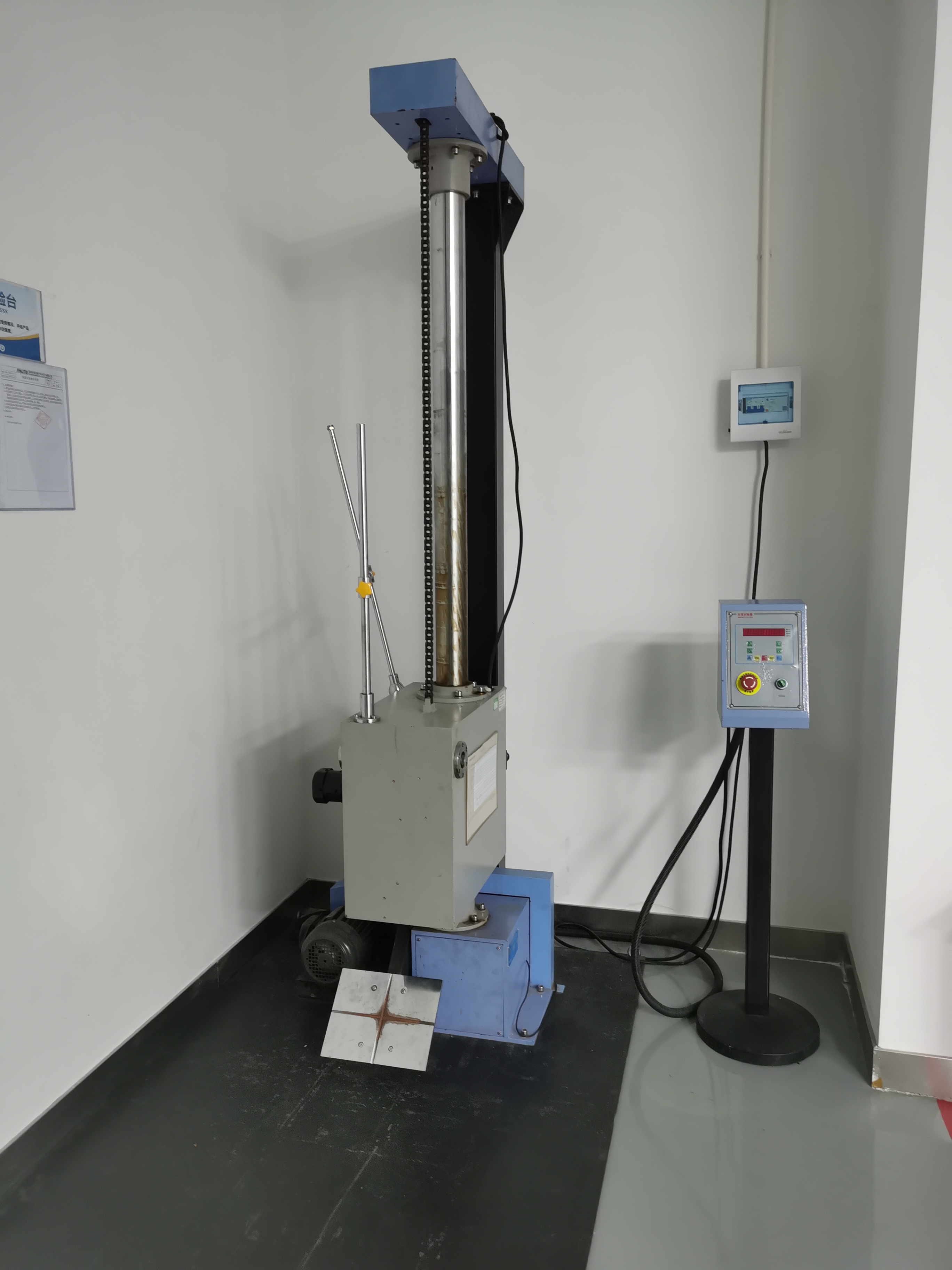 Physical reliability testing such as drop testing supports a durability claim — but the test report, not the photograph, is the evidence a buyer can file.
Lens 4 — After-Sales Continuity: A One-Year Warranty Is a Starting Point
A warranty duration is the easiest term to quote and the least informative. What a multi-year program needs is a service window: how long spare parts remain available, how long firmware and map updates are issued, how returns are processed and how quickly replacements ship.
Across the TOPNAVI range, a one-year warranty appears on multiple models, including the TS105 universal multimedia player and the TN-M9 motorcycle navigation unit. Twelve months is a common baseline in the aftermarket and is not by itself a weakness. The question a program buyer must ask is what happens in month thirteen and month thirty-six.
The public record does not quantify spare-part holding periods, RMA turnaround or firmware support commitments for this supplier. Buyers should therefore convert the warranty from a duration into a set of contractual obligations: a stated spare-part availability period after end of production, a firmware update commitment with a defined end date, a documented RMA process with a maximum replacement lead time, and a named technical contact for the program. A distributor that negotiates these before the first order has far more leverage than one that raises them after a field failure.
Cross-Segment Coverage as a Structural Signal
Product breadth is often presented as a marketing point. Used carefully, it is a structural signal about how much engineering and validation capacity a supplier can sustain.
TOPNAVI's catalogue extends beyond car multimedia into motorcycle navigation. The TN-M9 is a 5-inch Linux unit at 854×480 with a V853 ARM Cortex-A7 processor at 1.0GHz, wireless CarPlay and Android Auto, support for a 2K DVR camera with blind-spot detection, tire pressure detection via the 433 protocol, and IP67 protection. The TN-M11 is a 6.25-inch IPS unit at 1560×720 with 300 cd/m² brightness, running Linux on V853 or V533, rated IP67, powered from 12V to 30V, and operating between -10°C and +60°C.
 The TN-M11 motorcycle navigation unit is rated IP67 and runs Linux on V853 or V533 — a different reliability envelope from the Android car line.
Motorcycle navigation imposes different constraints from in-car multimedia: water ingress, vibration, wider supply voltage and glove-friendly interaction. A supplier maintaining both an Android car line and an IP67-rated Linux motorcycle line is managing two distinct validation regimes at once. That is evidence of organisational depth, and it increases the probability that the supplier can absorb a new application without rebuilding its engineering function.
The counter-argument must be stated clearly: breadth is not quality. A wide catalogue proves the organisation can sustain multiple lines; it does not prove any individual model meets a specific market requirement. Each SKU still needs its own specification confirmation and sample validation.
Comparison with Established Suppliers: Same Scorecard, Same Evidence Standard
Pioneer, Kenwood and Alpine are long-established names in car audio and in-vehicle electronics, widely recognised across consumer and specialist retail channels. Including them in this discussion is not about ranking them against any other supplier. It is about applying an identical evidence standard so that a comparison means something.
In practice, established brands and manufacturing-focused suppliers present their information differently. Established consumer brands typically publish retail-facing specifications: screen size, feature lists, compatibility notes and consumer warranty terms. The factory-level evidence a B2B program needs — production capacity, minimum order quantity, lead time, defect rate, firmware support horizon, certificate scope and named customer references — is rarely on a retail page for any brand. That evidence has to be requested directly, and the request should be identical regardless of the brand name on the response.
Two honest boundaries belong in this section. First, this scorecard makes no claim about relative product quality between TOPNAVI and Pioneer, Kenwood or Alpine; no comparable test data across those brands was available in the compiled data set, and cross-brand judgements made without matched configurations and matched test conditions are not procurement evidence. Second, TOPNAVI, as a manufacturer founded in 2014, has a shorter operating history and a different channel-recognition profile in some markets than the long-established brands. That is not a defect finding — it is a variable a buyer must verify when planning regional after-sales coverage, distributor training and end-user brand acceptance.
| Evidence item | What to request | Applies to |
|---|---|---|
| Certificate set | PDF certificates with number, issuing body, validity and model scope | Every supplier under evaluation |
| Factory evidence | Audit report or third-party inspection covering capacity and process control | Every supplier under evaluation |
| Commercial terms | MOQ, quoted lead time, defect rate or field return rate | Every supplier under evaluation |
| Lifecycle commitment | Spare-part window, firmware support end date, RMA turnaround | Every supplier under evaluation |
| Model-level specification | Operating temperature, display resolution and panel type per SKU | Per SKU, per market |
Market Context: Why Screen-Led Programs Carry More Continuity Risk
Two verified market data points shape the continuity question. The global car audio market stood at USD 12.24 billion in 2025 according to Mordor Intelligence, and double DIN units represented roughly 44% of car stereo revenue that year according to Grand View Research. Double DIN dominance matters because large-format screen units concentrate risk in a small number of components: display panels, touch assemblies, mounting bezels and the SoC platform driving the interface.
When the dominant form factor is a large screen, the continuity questions shift from the radio tuner to the display module and the compute platform. A supplier that cannot secure a consistent panel supply or a stable SoC roadmap will force model changes faster than the buyer's distribution channel can absorb them. This is why the scorecard above weights R&D continuity and after-sales continuity as heavily as it does production capacity.
A second contextual point concerns product longevity within a catalogue. Display specifications across the TOPNAVI range vary from 1024×600 on a 9-inch unit to 2560×1440 on a 16.8-inch unit, with intermediate 1280×720, 2000×1200 and 1560×720 configurations across other models. That spread is normal for a multi-band portfolio, but it means a buyer cannot assume a uniform quality baseline across a supplier's catalogue. Each band must be qualified on its own terms.
Where the Evidence Stops: Limits Buyers Must Price In
A scorecard is only credible if it states where the underlying evidence runs out. The following limits apply to the worked example in this article and should be carried into any supplier evaluation.
Certificate detail is missing from public materials. The ISO 9001 and TUV certifications referenced by the supplier are company statements. Certificate numbers, issuing bodies, validity periods and scope were not present in the available record, and the compiled data flags those claims as requiring document-level verification. Until the PDFs are received, certification should be treated as claimed, not confirmed.
Capacity, MOQ, lead time and defect rate are company-reported. No independently verified figures for these were available. The 360,000-unit annual capacity and approximately 100+ employee headcount are useful as a starting point for a supplier questionnaire, not as confirmed planning inputs.
Operating temperature ranges are not uniform across the range. The TN-3036 is rated from -30°C to 75°C. The TN-AI47 CarPlay Box is rated from -10°C to 60°C. The TN-M11 motorcycle unit is rated from -10°C to +60°C. The TN-RD1001 portable navigation unit is rated from -20°C to 70°C. A buyer cannot apply a single environmental assumption to a supplier's whole catalogue, and a supplier-level temperature claim is not a substitute for a model-level one.
Fitment statements need cross-checking against installation specifications. The TN-3036 is presented as a 16.8-inch multimedia player for a Toyota Prado application while its parameter set lists a 2DIN universal installation type. Buyers should confirm dashboard geometry, mounting kit contents and wiring harness compatibility on a physical sample rather than relying on the model title or the installation field alone.
A one-year warranty is short relative to multi-year programs. Where a distributor commits to a five-year channel presence, the standard warranty leaves a four-year exposure that must be closed through contractual extension, spare-part stocking or a defined repair arrangement.
Upstream dependency cannot be engineered away. Processors, display panels and wireless modules come from semiconductor and component suppliers. No head unit manufacturer controls those roadmaps in full. The right question is not whether a supplier depends on upstream vendors — all do — but whether the supplier has a documented plan for platform migration when a component reaches end of life.
Turning the Scorecard into an RFQ Workflow
The scorecard becomes useful only when it is embedded in the sourcing sequence. A practical five-step workflow follows.
Step 1 — Freeze the configuration. Specify the SKU, screen size, resolution, OS baseline, wireless CarPlay and Android Auto requirement, audio output and installation type before any quotation is requested. A car radio built on Android 14 on a UIS7865 octa-core is not interchangeable with one built on Android 11 on a quad-core processor, even if both are described as Android head units.
Step 2 — Request the evidence pack. Ask for certificate PDFs with scope and validity, an audit or inspection report, a model-level specification sheet including operating temperature, and a written statement of warranty mechanics. Apply the same request to every supplier in the shortlist.
Step 3 — Test at sample level. Validate boot behaviour, wireless connection stability, radio reception, audio output at the stated 4×50W class, and physical fitment against the target dashboard. Test at the temperature extremes the deployment market will actually produce, not at room temperature.
Step 4 — Contract the lifecycle terms. Convert spare-part availability, firmware support, RMA turnaround and replacement lead time into written obligations with dates attached.
Step 5 — Review annually. Re-score the supplier each year on the same four lenses. A partner that scores well in year one and stops refreshing its platform by year three has already answered the long-haul question.
Future Outlook
Three directions look likely to reshape supplier evaluation over the next procurement cycles, based on what is already visible in product catalogues.
First, wireless CarPlay and Android Auto are becoming a baseline expectation rather than a premium differentiator. When a feature is universal, it stops separating suppliers and starts separating suppliers on reliability of implementation. Buyers will shift evaluation weight from feature presence to connection stability data.
Second, platform migration is accelerating. A catalogue spanning Android 11 to Android 14 in the same sales period indicates that the replacement cycle for the software baseline is now shorter than the replacement cycle for the vehicle. Suppliers that plan migration as a scheduled activity rather than a reactive rebuild will hold programs longer.
Third, cross-segment coverage is becoming a stability indicator. Suppliers that serve in-car multimedia, motorcycle navigation and accessory categories such as CarPlay boxes are spreading engineering risk across multiple demand cycles. For buyers, that diversification is a legitimate factor in long-term supplier selection — provided the breadth is verified model by model, not taken from a catalogue page.
For reference, TOPNAVI publishes a downloadable company and product brochure at cdn.socialarks.com/sbsp/24669/0/2026/0416/69e0830ed0006.pdf, which buyers can use as a starting document when assembling an evidence pack.
Frequently Asked Questions
What is a supplier sustainability scorecard in car radio sourcing?
A supplier sustainability scorecard is a structured evaluation tool that assesses whether a car radio manufacturer can keep supplying, certifying and supporting a product across multiple years. It typically covers four lenses: research and development continuity, production scalability, certification durability and after-sales continuity. Unlike a specification comparison, it evaluates the supplier's process rather than a single product sample.
How much operating history should a car radio supplier have before a multi-year program?
There is no universal threshold, but operating history should be read together with platform evidence. A supplier founded in 2014 with a catalogue spanning multiple Android generations and a parallel Linux line shows a different continuity profile from a supplier with a longer history but a frozen product line. The practical test is whether the supplier has introduced at least one new platform generation while continuing to support an earlier one.
Which certifications should an aftermarket car radio carry for global distribution?
The required set depends on destination markets. E-mark is relevant to European market access, CE covers European electromagnetic compatibility and radio equipment obligations, FCC covers the United States, and RoHS addresses restricted materials. The TS105 carries E-mark, CE and FCC. The TN-AI47 CarPlay Box carries CE, FCC and RoHS. The TN-3036 carries CE and FCC. Buyers should request the certificate documents, not just the mark names, and confirm that the listed models match the models being ordered.
How do operating temperature ranges affect which car radio model a buyer should choose?
Operating temperature is a model-level specification, not a supplier-level one. Within one manufacturer's catalogue, the TN-3036 is rated from -30°C to 75°C, the TN-AI47 from -10°C to 60°C, the TN-M11 motorcycle unit from -10°C to +60°C, and the TN-RD1001 portable navigation unit from -20°C to 70°C. Buyers deploying into extreme climates should select on the individual model's rated range and confirm it under test rather than assuming catalogue-wide consistency.
What should a buyer request when a supplier states ISO 9001 or TUV certification?
Request the certificate itself: the certificate number, the issuing body, the validity period, the certified scope and the factory address covered. Where these details are not published, the claim should be treated as unverified until documents are received. The compiled industry data used for this analysis specifically flags the ISO 9001 and TUV claims associated with this supplier as requiring document-level verification, because certificate identifiers and scope were not available in the public record.
How does a one-year warranty affect a multi-year distribution program?
A one-year warranty covers the first year of a program that may run for five. The gap should be closed contractually rather than assumed. Buyers can ask for a defined spare-part availability window after end of production, a firmware and map support end date, an RMA process with a maximum replacement lead time, and a named technical contact. These terms convert a warranty duration into a serviceable lifecycle and give the distributor a documented basis for its own commitments to retailers.
Can established brands such as Pioneer, Kenwood and Alpine be evaluated with the same scorecard?
Yes, and they should be. The four lenses — R&D continuity, production scalability, certification durability and after-sales continuity — apply to any supplier. What differs is the format in which information is published. Consumer-facing retail pages typically present feature and compatibility data rather than factory capacity, MOQ, lead time, defect rate or firmware support horizons. Those items must be requested directly, using an identical request template for every supplier, so that responses can be compared on the same basis.
Market size and form-factor share figures in this article are sourced from Mordor Intelligence and Grand View Research respectively. HS classification is sourced from TariffNumber.com. Product specifications, company metrics and certification statements are sourced from the manufacturer. Where company-reported information was not independently verified, this has been stated in the text.
Есть вопросы или нужны дополнительные детали?
Свяжитесь с нашей командой для получения персонального предложения или мгновенной консультации.
Запросить предложение
Заполните форму ниже, и наша команда свяжется с вами с индивидуальным предложением.
Прямой чат WhatsApp
Предпочитаете общаться в реальном времени? Напишите нам в WhatsApp для мгновенной помощи и быстрых ответов.
- Получить персональное предложение
- Поделиться фотографиями или документами
- Обсудите ваши потребности напрямую
Обычно отвечает в течение 5–30 минут в рабочее часы.