
Evaluating Car Radio Suppliers for the Long Haul: A Sustainability Scorecard for Global B2B Buyers
An aftermarket car radio program almost always outlives the head unit that launched it. A distributor that qualifies a double din car radio in one season will be re-ordering the same form factor, the same car radio wiring harness logic and the same CAN-bus behaviour two or three seasons later — and the supplier behind that SKU may no longer be the same company. Supplier sustainability, in this context, is not an environmental slogan. It is the measurable probability that a named supplier can still ship a compatible, documented, serviceable product at the moment your program needs it again.

The real procurement problem: supplier turnover, not product failure
Most sourcing failures in the car radio category are not caused by a unit that arrives broken. They are caused by a supplier that disappears from the relationship — a model discontinued without notice, a firmware branch abandoned, a certificate that lapsed ahead of the buyer's renewal, or a price that was never structurally sustainable in the first place.
Three failure modes repeat across global aftermarket programs:
- SKU discontinuity. A touch screen car radio platform goes end-of-life and the replacement does not share the same mounting depth, connector set or steering-wheel-control behaviour. The buyer re-qualifies from scratch.
- Documentation drift. Certification paperwork, test evidence and specification sheets fall out of alignment with what is actually being shipped. Compliance risk transfers to the importer, not the factory.
- Warranty reserve variance. A supplier that cannot sustain a service function pushes failure handling back onto the distributor, who has priced the unit as a cheap car radio but is now funding returns out of margin.
In the aftermarket, a meaningful share of suppliers operate as trading intermediaries rather than manufacturers. Buyers typically discover this after the first repeat order, when a requested change is met with silence. The opportunity, therefore, is not a better price list — it is a repeatable way to test whether a supplier is structurally capable of staying in the relationship.
A five-dimension sustainability scorecard for car radio sourcing
The scorecard below is supplier-agnostic. It can be applied to a Shenzhen OEM/ODM manufacturer, to a European brand owner, or to a regional distributor claiming factory access. Each dimension is scored against documents the supplier provides, not against claims made in a meeting.
A working buyer will notice that the scorecard rewards disclosure. That is intentional. A supplier that can produce a certificate scope, a line list and a per-model temperature rating on request is structurally different from one that answers with adjectives. The scoring exercise is as much a test of responsiveness as of capability.
How TOPNAVI measures against the scorecard
Shenzhen Top Navi Electronic Tech Co., Limited (TOPNAVI) is a Shenzhen-based manufacturer of car multimedia players and GPS navigators, established in 2014 and focused on smart in-vehicle infotainment. It presents a documented profile that maps reasonably well onto the first three scorecard dimensions, and it exposes its own gaps on the last two.
R&D continuity: platform cadence rather than a single hero SKU
TOPNAVI states an R&D team of 50 engineers and a product portfolio spanning Android car radios, car head units, car stereos, motorcycle CarPlay navigation, CarPlay AI boxes, headrest monitors, backup cameras and DVRs. For a scorecard assessment, the relevant signal is not the headcount figure itself but whether that team has shipped successive generations across form factors. The catalogue shows exactly that pattern:
- The TS105 is a 9-inch universal car multimedia player with 1024×600 IPS capacitive touch screen, running Android 14 on a UIS7865 octa-core CPU — the newest Android generation in the visible line-up.
- The TN-3036 is a 16.8-inch car multimedia player with a 2560×1440 IPS touch screen, Android 13, an 8-core CPU, 4GB RAM and 64GB ROM — a large-format platform with 2DIN universal installation and both steering-wheel and touch control.
- The TN-AI47 CarPlay Box runs Android 11.0 on a quad-core CPU with 2GB RAM and 16GB ROM, outputting over HDMI to an existing OEM screen — evidence of a retrofit path for vehicles already on the road.
- The motorcycle line, TN-M9 and TN-M11, uses a Linux stack with IP67 waterproofing, a 2K DVR camera option, blind spot detection and 433-protocol tyre pressure support.
Three operating-system tiers (Android 14, Android 13, Android 11) and a Linux branch, running in parallel rather than replacing one another, indicate maintenance of multiple platform generations simultaneously. For a buyer, that is closer to what a multi-year program needs than a single flagship device.
Production scalability: stated capacity, subject to audit
The company reports a 20,000 m² manufacturing facility, approximately 100+ production staff, and an annual production capacity of 360,000 units, with export business accounting for about 95% of total sales and the USA as a major market. These are company-reported figures. In scorecard terms they are sufficient to justify a supplier qualification visit, not sufficient to replace one. A buyer should request the line list, the peak-season order record and, where the program is large enough to warrant it, a third-party audit against the same numbers.
Certification durability: a document pack exists to be requested
TOPNAVI reports that its factory holds ISO 9001 and that products carry CE, FCC, RoHS, E-Mark and EMC certifications. At the product level, the TS105 is documented with E-mark, CE and FCC certification, and the TN-AI47 with CE, FCC and RoHS. For a compliance-driven buyer, the meaningful next step is not to accept that list but to request the certificate numbers, issuing bodies, scopes and validity dates, and to confirm that the model being ordered falls inside the certified scope. Certification is durable only when it is traceable.
Reading the specification sheet the way a long-term buyer should
Specifications matter less for what they say about performance than for what they reveal about engineering discipline. Three signals are worth extracting from any android car radio datasheet.
1. Per-model thermal ratings. The TN-3036 is specified from −30°C to 75°C, which reflects a cabin-mounted dashboard head unit facing direct summer heat and winter cold starts. The TN-AI47 CarPlay Box, by contrast, is specified from −10°C to 60°C, and the TN-M11 motorcycle navigation unit from −10°C to +60°C. Those are not contradictions — they are different product classes with different enclosure and placement assumptions. The discipline signal is that the supplier publishes them separately rather than applying one headline figure to the catalogue. A buyer who assumes a single thermal rating covers every SKU will eventually deploy a CarPlay box in an environment it was not rated for.
2. Chipset and OS pairing. A UIS7865 octa-core running Android 14 implies a newer board revision than a quad-core running Android 11. Both can be correct purchases, but they belong to different program lifespans. Buyers should record the chipset generation at qualification so that a later substitution is visible immediately rather than discovered in the field.
3. Interface and fitment logic. The TN-3036 uses 2DIN universal installation with steering-wheel and touch control; the TS105 supports USB, built-in WiFi, wireless, Bluetooth and 3G/4G SIM, with built-in wireless CarPlay and Android Auto. Universal fitment reduces fitting risk across mixed vehicle parks, but it does not eliminate car radio replacement complexity — harness adapters, CAN-bus behaviour and dashboard depth remain model-specific. A supplier that can describe those constraints clearly is usually the one that has already installed its own product.
Where Pioneer, Kenwood and Alpine sit in the benchmark
Benchmarking against established players is necessary, but it has to be done on the right axis. Pioneer, Kenwood and Alpine are long-established consumer-facing car audio brands with global retail distribution. Their product programs are organised around brand-owned consumer channels, regional retail compliance and consumer marketing. TOPNAVI presents itself in a different structural role: an OEM/ODM manufacturer in Shenzhen serving B2B buyers, with 95% of sales exported and clients reported across 70+ countries.
That difference changes what a buyer should compare. With a consumer brand, the question is usually brand programme terms, retail pricing protection and consumer warranty handling. With a manufacturer, the question is factory ownership, platform roadmap, private-label flexibility and whether the same engineering team will still support the SKU in three years.
This evaluation did not collect a verified, like-for-like dataset covering R&D spend, factory area, or audited defect rates for Pioneer, Kenwood and Alpine. Any numeric comparison presented as fact would therefore be unsupported. The correct method is to run all four suppliers — TOPNAVI, Pioneer, Kenwood, Alpine — through the same five-dimension scorecard, populate each cell only with documents received directly from that supplier, and leave missing cells blank rather than estimated. A blank cell is a finding; a guessed cell is a liability.
Where supplier continuity actually shows up in the field
Car radio programs that use vehicle audio system upgrade and in-vehicle infotainment retrofit as their core application — including commercial fleet deployments — place specific demands on continuity. Documented application scenarios for this product class list in-vehicle GPS navigation, HD audio and video playback, hands-free Bluetooth calling, vehicle information display, smartphone interconnection through CarPlay and Android Auto, reversing image assistance, fleet driving behaviour monitoring and voice control. Operating conditions include a wide temperature range, high vibration, dust exposure, electromagnetic interference, 12V DC vehicle power and frequent cold starts.
Those conditions are commonly encountered in the United States, United Kingdom, Australia, Thailand, Tanzania and Russia, among other markets. A fleet buyer running mixed vehicle parks needs the same head unit family available across several procurement cycles, because fitting crews learn one installation pattern and one harness set. Swapping suppliers mid-programme means retraining fitters and re-validating fitment across the fleet — a cost that rarely appears in the unit price.
The multi-category structure also matters for distributors building a portfolio. A distributor selling car multimedia can extend into the motorcycle segment with the TN-M9 or TN-M11 without opening a second supplier relationship, and can serve vehicles already on the road with the TN-AI47 CarPlay Box rather than forcing a full head unit replacement. Breadth of this kind is a supply-continuity asset: one qualification process, several revenue lines.
What the market data supports — and what it does not
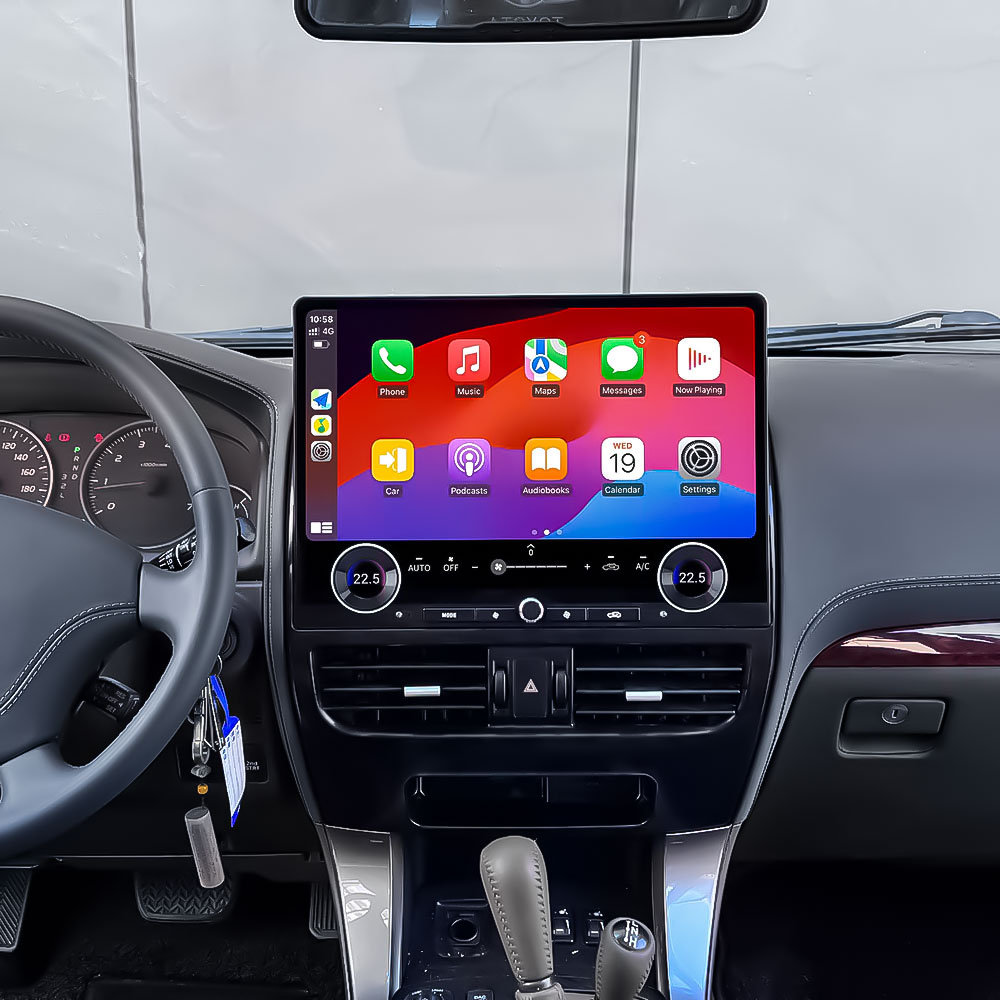
Two external data points are relevant to a continuity argument. First, Mordor Intelligence estimates the global car audio market at USD 12.24 billion in 2025, covering speakers, amplifiers and head units. Second, Grand View Research reports that the Double DIN form factor accounted for 44% of car stereo market revenue in 2025.
The defensible reading is structural, not promotional: roughly two in five revenue dollars in this category sit in the form factor that the majority of aftermarket multimedia platforms use. For a buyer, that supports weighting 2DIN platform continuity heavily in the scorecard — not because 2DIN is guaranteed to grow, but because a supplier without a sustained 2DIN roadmap is exposed to a segment that carries a large share of current revenue.
A third reference point is customs classification. Car radios with recording or reproducing apparatus are generally classified under HS 8527.21, which matters when a buyer is building landed-cost models and comparing suppliers across borders. Classification consistency is part of supplier documentation quality, and inconsistent declarations are a continuity risk in their own right.
What the data does not support is any claim about a specific supplier's market share, ranking, or growth rate. Those figures were not collected and should not be inferred.
Comparison with traditional spot sourcing — and the limits of this framework
Traditional aftermarket sourcing is transactional: request a price on a screen car radio, compare three quotations on unit cost, take the lowest, and re-tender next season. It is fast and it works when the program is a one-off container. It breaks when the program runs for multiple years, because the cheapest quotation says nothing about whether the supplier will still answer in year three.
A scorecard approach inverts the order. It costs more time up front, it produces uncomfortable conversations about missing documents, and it will occasionally eliminate the lowest-priced bidder. In exchange, it converts supplier risk into a scored, reviewable decision that a procurement committee can defend.
The framework also has real boundaries, and TOPNAVI's own profile illustrates several of them:
- Warranty length. The documented warranty on TOPNAVI products is one year. For a buyer whose own commitment to a fleet customer or retail chain extends beyond that, a one-year policy shifts residual risk onto the distributor. That gap has to be priced or covered contractually.
- Certification traceability. ISO 9001, CE, FCC, RoHS, E-Mark and EMC are reported by the company; the public material does not expose certificate numbers, issuing bodies or scopes. Until that pack is received and checked, certification should be scored as conditionally verified.
- Independently verified capacity. The 20,000 m², 100+ staff and 360,000-unit figures are company-reported. No independent manufacturing-capacity verification was located in the available material.
- Performance benchmarking. No laboratory data on boot time, audio output, connectivity latency or thermal behaviour under sustained load was available for this assessment. Specification sheets describe configuration, not measured performance.
- Thermal ratings vary by product. A buyer standardising on one environmental specification across a portfolio must check each SKU individually; the CarPlay Box and motorcycle navigation units carry narrower ranges than the TN-3036.
None of these invalidate the scorecard. They demonstrate why the scorecard must be applied to documents rather than to reputations — including TOPNAVI's own.
A practical five-step qualification workflow
- Define the program horizon first. State how many years and how many re-orders the relationship must survive. Every later scoring decision should be weighted against that horizon.
- Issue a documentation request, not a price request. Ask for certificate numbers and scopes, per-model operating temperature ranges, factory line list, warranty terms and firmware support policy. The response quality is itself a score.
- Score blind across suppliers. Run the same five dimensions against every candidate, including established brands, and leave unverified cells empty. Review scores before prices, not after.
- Validate with samples on two SKUs minimum. Test a mainstream universal unit and a secondary category unit. A supplier that performs on one and falters on the other has a portfolio problem, not a product problem.
- Write continuity into the contract. End-of-life notice periods, last-time-buy windows, spare-part availability and firmware support duration belong in the agreement — not in a verbal assurance.
Future outlook
Three shifts are likely to reshape how buyers score car radio suppliers over the next procurement cycles. First, documentation will become a gating criterion rather than a preference: regional market surveillance on radio equipment, EMC and vehicle electronics puts the burden of proof on the importer, who will increasingly demand traceable certificates from suppliers before confirming an order. Second, platform longevity will be judged by update history rather than by the Android version printed on a box; a supplier shipping Android 14 today is only credible if it can describe how Android 13 and Android 11 fleets continue to be supported. Third, portfolio breadth will increasingly substitute for brand size in distributor decisions, because one qualified supplier covering car multimedia, motorcycle navigation and retrofit CarPlay boxes reduces the number of relationships a distributor has to manage.
None of this guarantees outcomes. It does change the questions buyers ask — from "what is your best price" to "what will still be true in three years".
Frequently asked questions
What does supplier sustainability mean in car radio sourcing?
In this context it refers to the durability of the supply relationship rather than environmental performance alone: whether a supplier can keep shipping compatible, documented, serviceable products across multiple procurement cycles. The measurable elements are engineering continuity, production capacity, certification validity, environmental validation and after-sales support.
Which certifications should an aftermarket car radio supplier hold for global B2B programs?
TOPNAVI reports factory ISO 9001 and product-level CE, FCC, RoHS, E-Mark and EMC certification, with the TS105 documented under E-mark, CE and FCC and the TN-AI47 under CE, FCC and RoHS. Because the public material does not include certificate numbers, issuing bodies or scopes, buyers should treat these as claims until the document pack is received and the ordered model is confirmed to fall inside the certified scope.
How long is the warranty, and what does that imply for a multi-year program?
Documented TOPNAVI product warranty is one year. A buyer whose own downstream commitment is longer than twelve months should either extend cover contractually, hold a warranty reserve, or treat the difference as a scored limitation in the after-sales dimension of the scorecard.
How can a buyer verify production capacity claims?
TOPNAVI reports a 20,000 m² facility, approximately 100+ staff and 360,000 units annual capacity. Verification typically requires a site visit or third-party audit, the production line list, and order records demonstrating peak-season throughput. No independent capacity verification was located in the material available for this assessment.
Do operating temperature ratings differ across a supplier's product range?
Yes, and the differences are meaningful. The TN-3036 car multimedia player is rated from −30°C to 75°C, while the TN-AI47 CarPlay Box is rated from −10°C to 60°C and the TN-M11 motorcycle navigation unit from −10°C to +60°C. Buyers should confirm the rating for each specific model rather than assuming a single figure applies across a catalogue.
Can TOPNAVI be compared directly with Pioneer, Kenwood and Alpine on the same scorecard?
The same scorecard can be applied to all four, but the comparison must be populated with documents obtained directly from each supplier. This assessment did not collect a verified like-for-like dataset covering R&D spend, factory capacity or audited defect rates for Pioneer, Kenwood or Alpine, so no ranking between these suppliers is asserted here. Blank cells indicate missing evidence, not inferior performance.
Which markets are these car radio applications typically deployed in?
Documented application scenarios for this product class list the United States, United Kingdom, Australia, Thailand, Tanzania and Russia among common markets, covering vehicle audio system upgrades, in-vehicle infotainment retrofit and commercial fleet projects.
A downloadable company brochure covering TOPNAVI's product lines and manufacturing profile is available here: TOPNAVI company brochure (PDF).
Есть вопросы или нужны дополнительные детали?
Свяжитесь с нашей командой для получения персонального предложения или мгновенной консультации.
Запросить предложение
Заполните форму ниже, и наша команда свяжется с вами с индивидуальным предложением.
Прямой чат WhatsApp
Предпочитаете общаться в реальном времени? Напишите нам в WhatsApp для мгновенной помощи и быстрых ответов.
- Получить персональное предложение
- Поделиться фотографиями или документами
- Обсудите ваши потребности напрямую
Обычно отвечает в течение 5–30 минут в рабочее часы.