
Evaluating Concrete Formwork Suppliers for Long-Term Reuse
A concrete formwork order that has to serve a multi-year project pipeline is not a single purchase. It is a capital commitment whose return depends on how many times each panel can be poured, how the frame material behaves under load and exposure, and whether panels, accessories and spare parts will still splice into the site's existing stock several years from now.
The category is large and heavily weighted toward metal construction formwork. The global concrete formwork market was valued at USD 8.9 billion in 2024 (Verified Market Research), and steel formwork represented 44% of all formwork units installed worldwide in the same year (Cognitive Market Research). Published market sizes vary by scope — some reports bundle formwork with scaffolding and produce substantially larger totals — so the useful takeaway is not the headline number but the direction: repeat-use metal systems dominate the installed base.
This article sets out a three-part evaluation framework for contractors, distributors and engineering procurement teams: panel reusability and corrosion behaviour, material durability, and system compatibility. RIZHAO FENGHUA SCAFFOLDINGS CO., LTD. (RFH) — a manufacturer of concrete formwork and scaffolding systems based in Rizhao, Shandong Province, China, founded in 1953 and exporting to 126 countries and regions — is used as a reference case because its published product data allows each check to be tested against a specification rather than a claim.
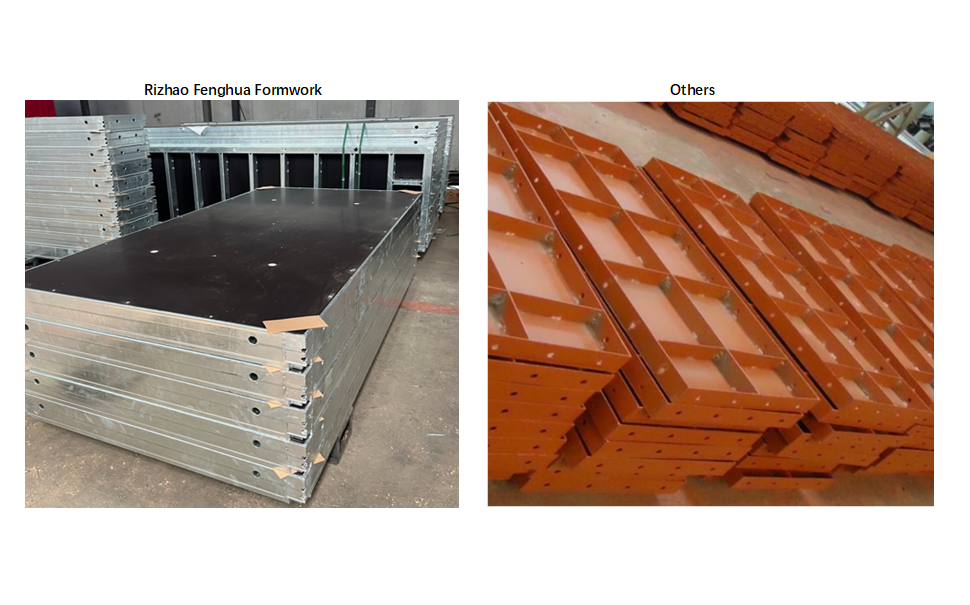
Comparative panel review: long-term formwork evaluation starts with the physical product, not the price list.
Why a Long-Term Formwork Decision Uses Different Criteria
When a contractor buys for one building, the deciding number is the purchase price or rental rate. When the same contractor buys for a pipeline of pours, the deciding number becomes cost per pour — a figure that is shaped by panel reuse, replacement rates, accessory loss and how easily a new batch of panels integrates with what is already on site.
Two structural features of the market reinforce this. First, supply is concentrated at the top: the five largest formwork manufacturers, including PERI and Doka, held approximately 44% of the global market share in 2024 (Cognitive Market Research). Second, large projects increasingly specify established European system geometries. A supplier whose panels cannot splice into an existing TRIO- or FRAMI-compatible inventory forces the buyer to run two parallel systems, duplicating accessories, training and storage.
The practical consequence is that long-term supplier evaluation asks three questions in sequence: Will the panel survive repeat use? Will the frame survive the load and the environment? Will the system still fit my site in five years?
Check 1 — Reusability and Corrosion Resistance at Panel Level
Reusability begins with surface protection. Corrosion, not impact, is the most common reason a steel panel is withdrawn from service, and the surface treatment specified at purchase determines how quickly that happens.
Across the RFH wall and column range, hot dip galvanizing is the stated surface treatment — on the FW00A Concrete Formwork, on the FW00B steel concrete formwork, and on the FW00C concrete wall formwork. Hot dip galvanizing is a widely recognised corrosion-protection method in temporary works equipment, and specifying it explicitly is the first filter a buyer can apply: if a quotation does not name a surface treatment, the reusability assumption behind the price is unverified.
The second filter is frame profile and steel thickness, because these determine stiffness retention after repeated stripping and handling:
- FW00A — profile 120×60×2.5 mm, hot dip galvanized, with a back cover in 18 mm European birch plywood or plastic composite sheet.
- FW00B — profile 121×20×1.8 mm, 15 mm film faced birch plywood, hot dip galvanized.
- FW00C — profile 91.6×20×2 mm, S420 raw material, hot dip galvanized.
The face material matters as much as the frame. FW00A offers a choice between 18 mm European birch plywood and a plastic composite sheet, both described as providing optimal water resistance and an excellent concrete surface finish — a decision point for contractors who pour repeatedly in wet or coastal conditions.
Check 2 — Material Durability: Steel Grade, Frame Design and Pressure Envelope
Durability in formwork is not only about rust. It is about whether the frame keeps its geometry when fresh concrete pushes against it, and whether the rated pressure envelope matches the pour the site actually intends to place.
RFH specifies RFH Steel S420 as the frame material for FW00A, with S420 raw material also used in FW00B and FW00C. In the aluminium range, the FW00D aluminium concrete formwork integrates aerospace-grade 6005-T6 aluminium alloy frames with 11 mm Baltic birch plywood panels, bonded using phenol-formaldehyde resin to maintain structural integrity and long-term durability.
The most decision-relevant number on a datasheet is permissible concrete pressure:
- FW00A: permissible concrete pressure of up to 80 kN/m².
- FW00B: 60 kN/m².
That gap is not a marketing detail. Permissible pressure constrains fresh-concrete placement rate, lift height and, indirectly, the pour cycle the site can achieve. A buyer planning tall wall pours on a fast cycle should map the intended pour rate against the rated envelope before comparing prices, because a lower-rated panel used at higher pressure is a durability risk rather than a bargain.
Two external standards frame this check. EN 12812 specifies performance requirements and general design for falsework used to support formwork, and ASTM C1074 is the primary US standard for estimating concrete strength to determine when formwork may be removed. Suppliers do not set these rules, but their documentation should support compliance with them.
Manufacturing evidence behind a durability claim
Durability claims become verifiable when they can be traced to a production and testing system. RFH operates an 80,000 m² site with a 40,000 m² building factory area, 260 employees and a 20-engineer R&D team, and maintains both a mechanical test laboratory and a chemistry test laboratory for incoming raw material and in-process product testing.
Quality control on RFH formwork includes 100% pre-shipment testing, with third-party inspection (SGS) available for pre-shipment quality checks. Welding is controlled in accordance with the European standard EN 1090 and holds the corresponding European certificate; acceptance criteria follow international standards BS1139 and EN74; and the company holds 22 relevant certificates including EN 1065, EN74 and CE. The quality management system is certified to GB/T 19001-2016 / ISO 9001:2015 by the China Quality Certification Centre (CQC) under certificate 00123Q310174R301, issued 2023-12-11 and valid to 2027-01-14, covering the design and production of scaffolding, coupler and formwork.

Documented quality control: durability claims are only as strong as the testing and certification behind them.
Check 3 — Compatibility, Modular Splicing and Accessory Interchange
Compatibility is the check that most often decides whether a long-term supply relationship works. A panel that performs well in isolation but does not splice into the site's existing system simply creates a second inventory.
On the FW00A Concrete Formwork, all accessories are stated to be fully compatible with the original European trio system. More broadly, RFH steel heavy-duty formwork is stated to be usable in compatibility with PERI TRIO, HUNNEBEACK RASTO, DOKA FRAMI and TOPEC HARSCO products. For buyers already running one of these geometries, that means new panels can be assessed as additions to existing stock rather than as a replacement programme.
Modular splicing depends on a predictable dimension grid. FW00A is offered in heights of 3.3 m, 3 m, 2.7 m, 2.4 m, 1.2 m and 0.6 m, and in widths of 2.4 m, 1.2 m, 0.9 m, 0.72 m, 0.66 m, 0.62 m, 0.6 m, 0.54 m, 0.5 m and 0.3 m, with other sizes available. FW00C is supplied in 1200, 1500, 2700 and 3000 mm lengths across 900, 750, 600, 450 and 300 mm widths. FW00D runs on an 1800 mm and 900 mm module family with widths from 1800 mm down to 300 mm.
Three questions test compatibility before an order:
- Does the supplier's accessory list overlap with the accessories already held on site?
- Are panel heights and widths available in the increments the existing layout uses?
- Can the supplier produce against client design drawings and samples where a non-standard detail is required?
On the third point, RFH operates OEM, ODM and customized product models with customization across height, width, color and logo printing, and can undertake processing based on client design drawings and samples.
The RFH Range at a Glance
| Model | Type | Frame / face material | Permissible pressure | Surface treatment |
|---|---|---|---|---|
| FW00A | Wall, column and corner formwork | RFH Steel S420 frame; 18 mm European birch plywood or plastic composite sheet | Up to 80 kN/m² | Hot dip galvanized |
| FW00B | Light duty steel wall and column formwork | S420 frame; 15 mm film faced birch plywood | 60 kN/m² | Hot dip galvanized |
| FW00C | Concrete wall formwork with birch plywood or PP board | S420 raw material; profile 91.6×20×2 mm | Not stated in the published specification | Hot dip galvanized |
| FW00D | Aluminium deck / adjustable aluminium shutter | 6005-T6 aluminium alloy frame; 11 mm Baltic birch plywood, phenol-formaldehyde bonded | Not stated in the published specification | Not stated in the published specification |
Model comparison based on published RFH product specifications. Where a figure is not published, buyers should request it rather than assume it.
Turning the Three Checks into a Purchasing Record
| Evaluation check | Evidence to request | What it protects against |
|---|---|---|
| Panel reusability | Named surface treatment; frame profile dimensions; face material specification; spare-part list | Paying for reusability that was never specified |
| Material durability | Steel grade (e.g. RFH Steel S420); permissible concrete pressure; alloy designation (e.g. 6005-T6); test laboratory scope | Using a panel outside its rated pour envelope |
| System compatibility | Compatibility statement for the site's existing geometry; panel height/width grid; accessory interchange list | Running two parallel formwork inventories |
| Process reliability | ISO 9001 certificate and scope; pre-shipment test regime; third-party inspection option; lead time and MOQ in writing | Delivery slippage that stalls a pour cycle |
Applications Where Repeat-Pour Value Shows Up
The FW00A Concrete Formwork is applied in new structural builds, large foundations, high-wall vertical casting and subterranean concrete structures — the categories where a single panel set is used across many pour cycles rather than a handful of walls.
The FW00D aluminium concrete formwork suits residential and commercial buildings such as multi-story apartments, office towers and mixed-use developments, as well as infrastructure and high-rise projects including airport piers and high-rise towers. It is also used in structures with special requirements — flat and inclined slabs, ramps and drains with an angle of inclination of up to 8%.
Documented project outcome
RFH formwork has been used by municipal government and engineering contractor clients, with project experience including a 10,000 m² formwork scope and a 1,500 m² scope for residential building and infrastructure applications within a client relationship lasting 10 years. In the documented FW00A project, the structural concrete phase was completed 20 days ahead of schedule and the project lowered crane rental and labor costs. On-site safety regulations were met through fully integrated walkway brackets and certified crane lifting hooks.
For a buyer evaluating long-term supply, the relevant part of that outcome is not the schedule gain itself but what produced it: accessories that were engineered into the panel system rather than sourced separately, and lifting points that were certified rather than improvised.
Market Direction: What Buyers Will Be Asked to Verify Next
Adoption patterns have shifted steadily toward engineered, repeat-use systems. In 2024, steel formwork accounted for 44% of installed formwork units worldwide, timber formwork for 37% and aluminium formwork for 19% (Cognitive Market Research). Aluminium is the fastest-moving segment in value terms: aluminium formwork systems are expected to reach USD 2.48 billion by 2032, growing at a CAGR of 9.9% (Intel Market Research).
Automation is moving in parallel. Automated climbing formwork systems accounted for 28% of all installations in 2024, mainly in buildings over 50 stories, and Doka introduced DokaXact sensors in 2024 for real-time monitoring of concrete pressure on formwork. On the supply side, PERI acquired Implenia Schalungsbau in 2023 to expand its modular formwork services, while China's steel products exports — which include structural components for formwork — reached 110.7 million tons in 2024 (China Customs).
The direction of travel is towards monitored, modular, compatibility-driven systems. For buyers, this raises the value of documented specifications and lowers the value of verbal assurances.
Trade-offs and Limits of the Metal-System Approach
A repeat-use metal system is not the cheapest first purchase. Published price benchmarks place steel formwork for large projects at USD 25–60 per square meter, aluminium formwork at USD 40–75 per square meter, plastic and modular formwork at USD 20–50 per square meter, and typical timber formwork rental at USD 10–25 per square meter. Timber also still holds 37% of global installed units, largely because it is locally available, flexible for one-off shapes, and low in entry cost.
Metal systems justify their entry price through repeat pours — but only when the project pipeline actually repeats. For a single low-rise structure with irregular geometry and a short programme, a lighter, cheaper formwork approach can remain the rational choice.
RFH-specific boundaries worth stating
- Lead time: 40–60 days, which must be built into a pour programme rather than treated as buffer time.
- Minimum order: 50 units, so small or exploratory orders may not be economic.
- Supply orientation: production is 100% for export, with current sales exceeding 1,200 containers; buyers across 126 countries and regions source through an export workflow.
- After-sales scope: support is provided as online technical support, so contractors should confirm which on-site commissioning tasks their own team will handle.
- Model-dependent limits: permissible concrete pressure differs by model (80 kN/m² for FW00A versus 60 kN/m² for FW00B), and FW00D inclined-slab use is stated up to 8%.
- Custom work: non-standard production is carried out against client design drawings and samples, which places a documentation burden on the buyer.
Future Outlook
Long-term formwork procurement is moving from a price negotiation to a documentation exercise. Buyers evaluating a supplier for a multi-year pipeline will increasingly ask for the same four things in writing: the surface treatment and frame profile, the permissible pressure envelope, the compatibility statement against their existing system, and the quality system certificate with its scope and validity dates.
Suppliers that can answer those questions with specifications — rather than adjectives — will be easier to include on shortlists, because their products can be checked against the standards and drawings a project already uses. RFH's position in that conversation rests on a specific combination: S420 steel frames, hot dip galvanized panels, a published pressure rating, and accessories stated to be compatible with the original European trio system.
FAQ
What makes a concrete formwork panel reusable across many pours?
Three published attributes drive reusability: the surface treatment, the frame profile, and the face material. On the RFH FW00A, FW00B and FW00C models, hot dip galvanizing is the stated surface treatment; frame profiles are 120×60×2.5 mm, 121×20×1.8 mm and 91.6×20×2 mm respectively; and the face is 18 mm European birch plywood or plastic composite sheet on FW00A and 15 mm film faced birch plywood on FW00B. Actual reuse also depends on stripping, cleaning, stacking and site exposure, so it should be verified per project.
Which formwork model suits high-pressure wall pours?
Permissible concrete pressure is the deciding specification. The RFH FW00A Concrete Formwork is rated for permissible concrete pressure of up to 80 kN/m², while the FW00B light duty steel wall and column formwork is rated at 60 kN/m². A buyer planning tall walls at a fast placement rate should match the intended pour rate to the rated envelope of the panel before comparing prices.
Can new formwork panels be used alongside an existing European system?
Compatibility statements are the relevant evidence. On the FW00A Concrete Formwork, all accessories are stated to be fully compatible with the original European trio system, and RFH steel heavy-duty formwork is stated to be usable in compatibility with PERI TRIO, HUNNEBEACK RASTO, DOKA FRAMI and TOPEC HARSCO products. Buyers should also confirm that the available panel height and width increments match the layout already in use on site.
What documentation should be requested before committing to a long-term formwork supplier?
Request the named surface treatment and frame profile, the permissible concrete pressure, the steel grade or alloy designation (RFH specifies RFH Steel S420 for FW00A frames and 6005-T6 aluminium alloy frames for FW00D), the compatibility statement for existing equipment, and the quality management certificate with its scope and validity period. RFH's ISO 9001 certificate, number 00123Q310174R301, was issued by the China Quality Certification Centre on 2023-12-11 and is valid to 2027-01-14, covering the design and production of scaffolding, coupler and formwork. Quality control includes 100% pre-shipment testing with third-party inspection (SGS) available.
What lead time and order quantity should be planned for?
RFH states a lead time of 40–60 days and a minimum order quantity of 50 units, with a monthly capacity of 1,000 tons. For a repeat-pour programme, that lead time should be scheduled into the pour sequence rather than treated as contingency, and the minimum quantity should be assessed against the number of panels genuinely required per cycle.
Where is repeat-use formwork less suitable than traditional alternatives?
Metal systems carry a higher entry cost than timber, with published benchmarks of USD 25–60 per square meter for steel and USD 40–75 for aluminium, compared with timber formwork rental at USD 10–25 per square meter. Timber still represented 37% of installed formwork units worldwide in 2024. For single-structure projects with irregular geometry, short programmes or very tight budgets, a lighter or locally sourced formwork solution can remain the more appropriate choice.
Reference Material
Technical specifications for the FW00A, FW00B, FW00C and FW00D formwork models, together with the wider RFH formwork and scaffolding range, are set out in the company catalogue, which is available to view and download: RFH New Catalogue. Product information is also published at www.fhformwork.com.