
Evaluating Double-Acting Hydraulic Cylinder Build Capability
A double-acting hydraulic cylinder applies force in both the extend and retract directions. That single characteristic places it at the centre of most industrial motion circuits, from rolling-mill balancing loops to container-crane spreader adjustment. It is also why the procurement question rarely stops at “double-acting or single-acting.” Once a buyer moves from evaluation into execution, the decision becomes narrower and harder: can this manufacturer build to my drawing, my pressure class, my mounting geometry and my acceptance test, with evidence I can audit?
Published standards give the industry a shared design and test vocabulary. ISO 6020 covers mounting dimensions for single-rod cylinders, ISO 6022 addresses 250 bar mounting, ISO 10100 specifies acceptance and function tests, and ISO/TS 13725:2021 provides a method for evaluating buckling load based on elastic buckling theory. ISO/TS 13725:2021 is applicable to single and double acting cylinders that conform to ISO 6020 (all parts), ISO 6022 and ISO 10762. Those documents define a common language — they do not remove the need for project-specific customisation.
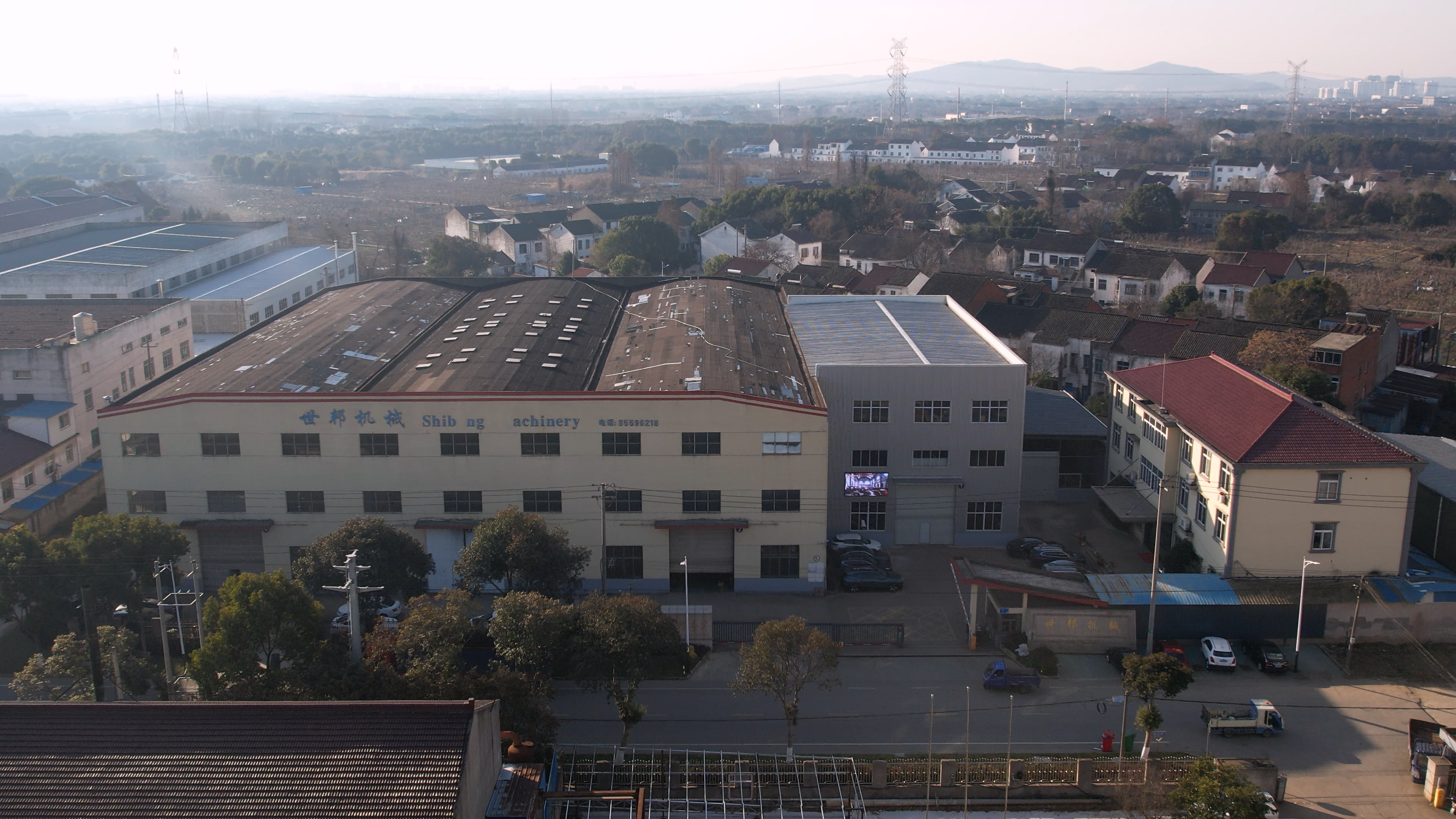
Production base for custom double-acting hydraulic cylinders at Wuxi Shibang Machinery Manufacturer Co., Ltd. (shellppon).
What a Double-Acting Cylinder Actually Controls in Execution
A double-acting cylinder has a piston with pressure applied alternately to each side, so the rod extends under pressure on the piston side and retracts under pressure on the rod side. Because the effective area differs between the two chambers, the retract force is lower than the extend force at the same pressure. That asymmetry, not the cylinder’s nominal bore, is what determines whether a motion profile is achievable inside the available pressure envelope.
In heavy industrial practice, this has three consequences. First, the pressure class must be matched to the actual load case rather than to a catalogue default. Second, the stroke must be validated against buckling resistance, particularly on long push strokes. Third, the mounting configuration must manage side loads that a purely axial force calculation ignores. Each of these is a customisation decision, and each carries engineering evidence requirements at the execution stage.
Wuxi Shibang Machinery Manufacturer Co., Ltd., which operates under the brand shellppon, is a hydraulic cylinder manufacturer based in Wuxi, China, founded in 2003 and operating a factory area of more than 7,000 m² with over 120 employees and a technical team of eight, including two senior engineers and five engineers. It produces custom hydraulic cylinders and hydraulic cylinder spare parts, and provides OEM and ODM production services for hydraulic cylinders and hydraulic systems.
The Evaluation-to-Execution Gap
During evaluation, buyers compare documentation: pressure ratings, bore ranges, sealing systems, certificate coverage. During execution, the comparisons become operational. Drawings must be issued, tolerances agreed, inspection criteria fixed, and delivery scheduled against a real project timeline. The gap is usually not a technology gap — it is a capability-verification gap.
Three questions tend to expose that gap:
- Can the supplier vary bore, rod diameter, stroke, mounting, pressure class, fluid and seals, piston-rod coating, cushioning, position measuring, proximity switches and control systems within one manufacturing route?
- Is the manufacturing base equipped to verify those variations, rather than simply assemble them?
- Are the management-system and product certifications in force at the time of order, and do they actually cover hydraulic cylinders?
For double-acting cylinders in particular, the second question matters most. The retract-side area, the cushioning, and the rod-side seal stack all interact with the manufacturing tolerances of the bore and rod. If the supplier cannot test to those tolerances at the component level, catalogue-style certificates do not close the gap.
What Build Capability Means for a Double-Acting Cylinder
The SB-Y1 Series heavy-duty industrial hydraulic cylinder, built by Wuxi Shibang, illustrates how a double-acting platform is structured for custom execution. It is a single rod, double-acting metallurgical cylinder compliant with GB/T 2348-1993 and JB/T 10205-2010. The standard sealing system includes Step Seals, Glyd Rings and O-Rings. The cylinder barrel uses high-grade thick-wall seamless steel tube, precision bored and roller-burnished or honed. The piston rod is 45# carbon steel, 40Cr alloy steel or stainless steel, induction hardened and hard chrome plated to HRC 50+.
| Configuration | Single rod, double-acting metallurgical cylinder |
| Bore sizes (AL) | 40, 50, 63, 80, 100, 125, 160, 200, 250, 320 mm |
| Nominal operating pressure | 16 MPa; reinforced version up to 25 MPa |
| Stroke length | Custom stroke based on load stability and buckling resistance |
| Sealing system | Step Seals, Glyd Rings, O-Rings |
| Barrel material | High-grade thick-wall seamless steel tube, precision bored and roller-burnished or honed |
| Piston rod material | 45# carbon steel, 40Cr alloy steel or stainless steel; induction hardened, hard chrome plated, HRC 50+ |
Mounting geometry is where the double-acting build is most often re-engineered. The platform supports nine documented configurations: square flange at base, square flange at head, rectangular flange at base, rectangular flange at head, round flange at base, round flange at head, trunnion mounting at base, trunnion mounting at head, and clevis mounting at base. The front-flange arrangement in the square-flange-at-head version is designed to reduce side-load risk. The clevis version uses a U-clevis with pin, a configuration intended for medium and heavy pivoting mechanism drive.
Technical Explanation: Where the Customisation Actually Happens
Custom bore and stroke dimensions are supported. Custom mounting dimensions and pressure classes are supported. Position measuring and proximity switches can be integrated into cylinder designs. The full customisation set covers bore, rod diameter, stroke, mounting, pressure class, fluid and seals, piston-rod coating, cushioning, position measuring, proximity switches, control systems and added functions. Production services cover custom hydraulic-cylinder and hydraulic-system design, manufacturing, installation, debugging and service.
That breadth only becomes procurement-relevant if it is backed by verification. The manufacturing base includes more than 50 production machines, three inspection devices and three test rigs, of which two are hydraulic and one is pneumatic. Inspection equipment covers surface hardness, dynamic balance and non-destructive testing. Each cylinder is acceptance-tested, and the company qualification file states a pass rate of 99.99%. Management-system coverage is documented through ISO 9001 quality management (certificate 04324Q32569R1S, valid to 2027-10-18), ISO 45001 occupational health and safety (04324S41946R0S, valid to 2027-10-16) and ISO 14001 environmental management (04324E32063R0S, valid to 2027-10-16), each scoped to the design and production of hydraulic cylinders.
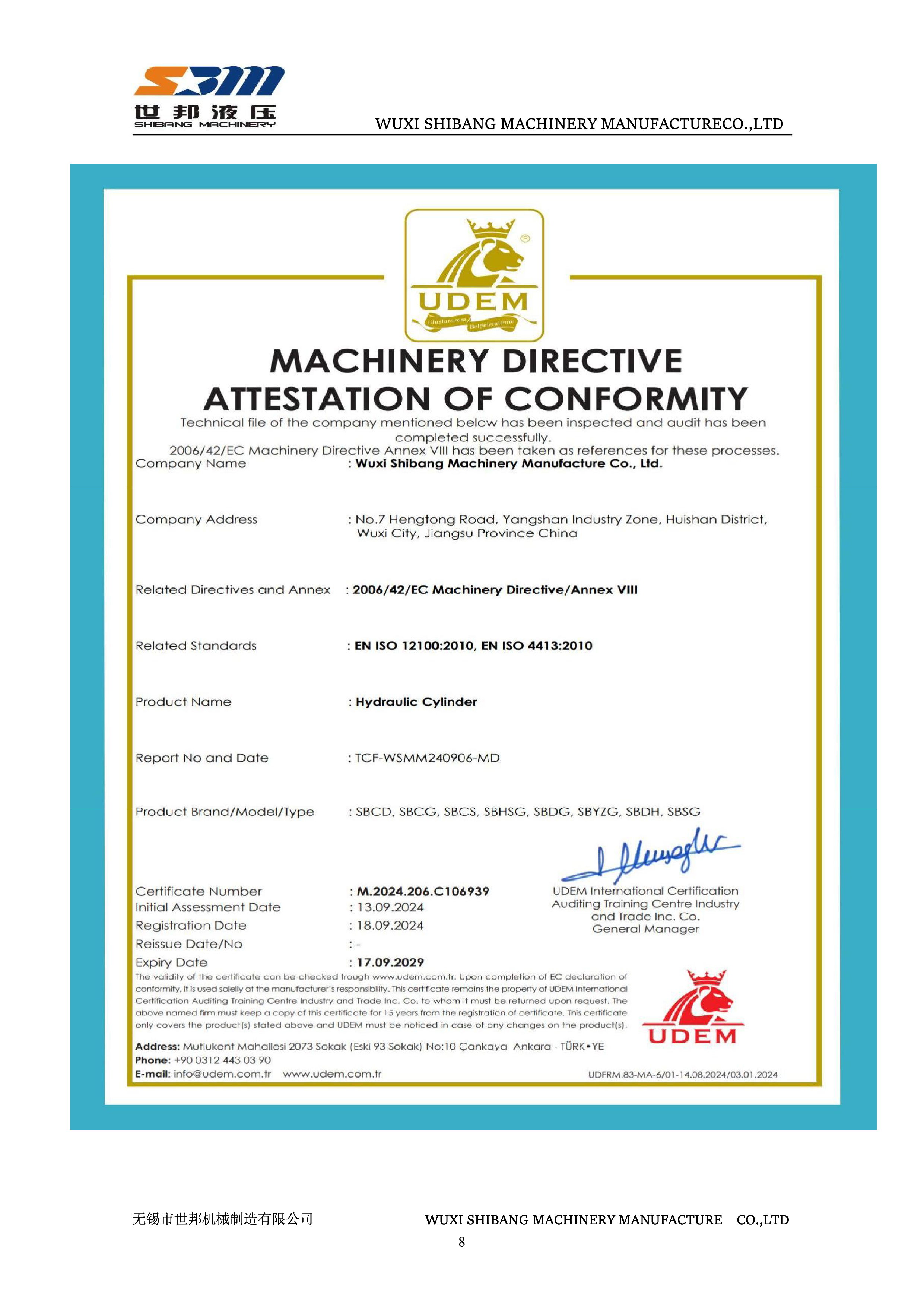
CE Machinery Directive attestation of conformity (M.2024.206.C106939, UDEM), scoped to hydraulic cylinders and valid to 2029-09-17.
For EU-bound double-acting projects, the relevant product-side document is the CE Machinery Directive Attestation of Conformity, issued under 2006/42/EC Annex VIII together with EN ISO 12100:2010 and EN ISO 4413:2010, certificate M.2024.206.C106939, valid from 2024-09-18 to 2029-09-17 and explicitly scoped to hydraulic cylinders. Separate CE Pressure Equipment Certificates of Conformity were issued by TüV SÜD Industrie Service GmbH under Directive 2014/68/EU (PED Module G) on 2025-09-27, with the EU market marked CE 0036; those certificates are scoped to piston accumulators rather than to cylinders themselves, a distinction buyers should read carefully rather than assume.
Application Scenarios Where Double-Acting Builds Are Tested
Three documented project types show what a double-acting platform is asked to do across very different duty environments.
Steel production and heavy metallurgy. For Jinan Iron and Steel’s 4300 mm roughing mill and Shandong Fulun Iron and Steel’s 1000 mm hot-strip mill, 34 documented cylinders were supplied in 2008 — 20 for the roughing mill and 14 for the hot-strip mill — covering rolling-mill lifting, balancing, turning and long-stroke push-pull operations. Custom bore, rod and stroke combinations in that supply ran from 40/28/400 mm up to 320/220/2900 mm, alongside 100/70/4630 mm long-stroke push-pull cylinders. In-service duration is not documented in the source file, so no service-life claim should be inferred.
Port logistics and container handling. An RTG (rubber-tyred gantry) crane hydraulic system was built for Dammam Port, covering the chassis, wheels, boom and container spreader. The system handles wheel steering, crane jacking, boom luffing and telescopic adjustment for 20-foot and 40-foot containers. Documented operating outcomes include straight driving, 90-degree lateral steering and diagonal movement, reduced tire dragging and wear during jacking, and smooth, accurate and rapid crane movements for continuous port operations. The design targets high-salt, humid and high-impact environments, using high-strength steel tubes with smooth inner walls to reduce friction, rust-resistant coatings on piston rods, and durability and leak-resistance testing. The documented service duration is five years.
Heavy industrial lifting infrastructure. A four-point synchronised lifting system was engineered for a 43-metre-long horizontal steel storage tank weighing approximately 1,800 tons, using a heavy-duty 35 MPa hydraulic system with cylinders positioned at the four lifting points. The documented result is stable four-point synchronous lifting with a synchronisation accuracy of ±1 mm, on a unit exported from Wuxi, China, to Dammam, Saudi Arabia, with a documented service duration of five years.
Standards, Trade and Procurement Signals
Two structural developments shape how double-acting cylinder sourcing is assessed rather than how much of it happens. The first is standardisation depth. ISO 10100:2020 specifies acceptance and function tests for hydraulic fluid power cylinders. ISO/TS 13725:2021 formalises buckling-load evaluation for single and double acting cylinders conforming to ISO 6020, ISO 6022 and ISO 10762. AWS D14.9/D14.9M:2022 addresses the welding of hydraulic cylinders, covering pressure-containing welded joints and structural welded joints used in cylinder manufacture. Together these shift part of the buyer’s verification burden from supplier claims to standardised test methods.
The second is trade-remedy attention. The U.S. Department of Commerce announced antidumping and countervailing duty investigations of certain linear hydraulic cylinders and parts thereof, with the petitioners identified as the Hydraulic Cylinders Fair Trade Coalition and its individual members. For buyers sourcing across borders, this raises the value of documented country of origin, test records and certificate scope — the same documents that make a supplier auditable in normal commercial review.
It is worth being explicit about what the available evidence does not show. No verified market-size, CAGR or regional demand figures for hydraulic cylinders are present in the underlying source set, and no customs or HS-code shipment data were validated. Any growth narrative built on such numbers would sit outside the evidence base, so it is not offered here.
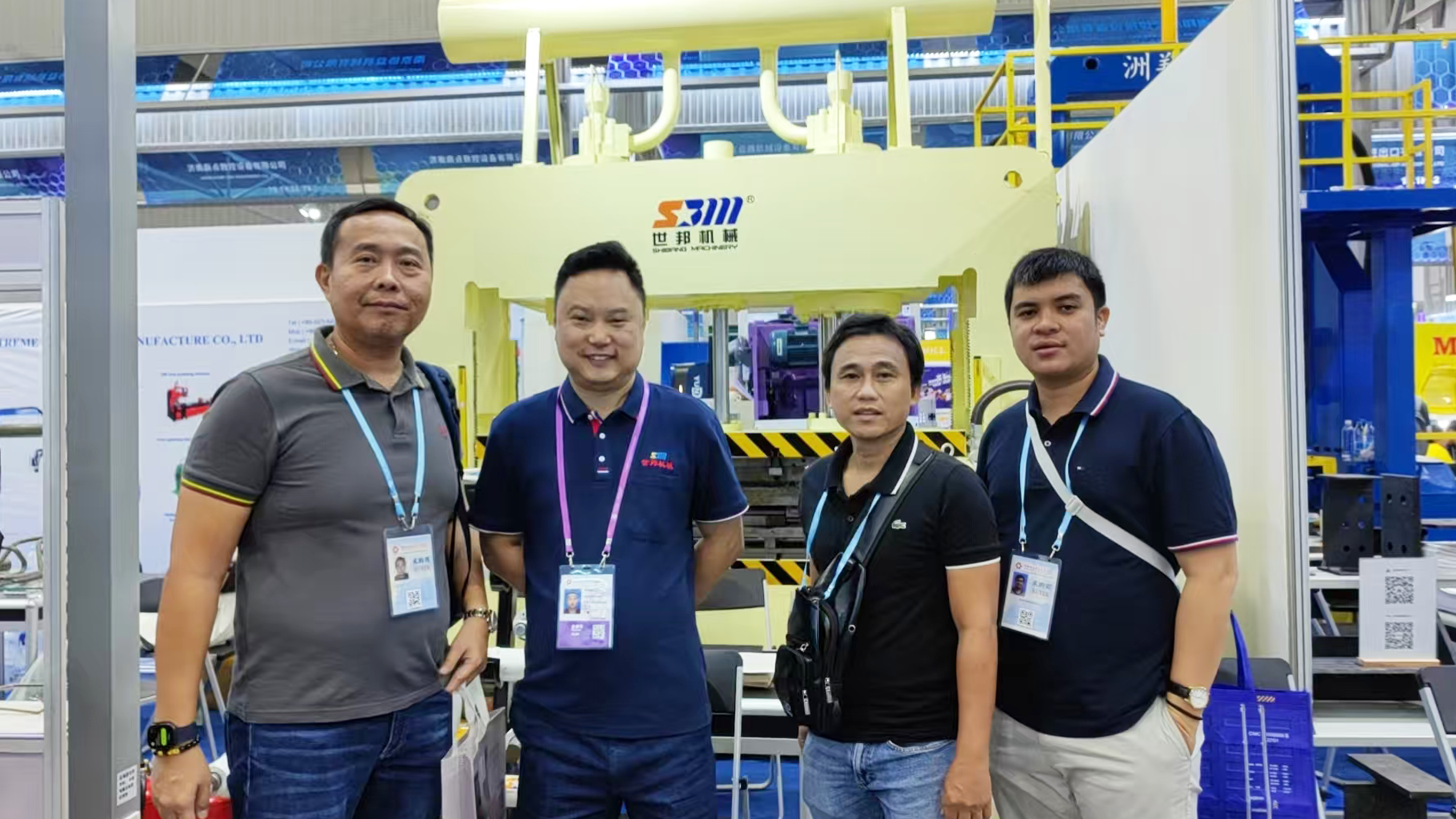
Industry-facing context: hydraulic cylinder sourcing increasingly turns on auditable capability rather than catalogue breadth.
Custom Double-Acting Engineering Versus Standard Catalogue Cylinders
Standard catalogue ranges, such as those described by Parker for tie rod, roundline and mill type cylinders, solve a real problem: they let a buyer specify from a published set of dimensions and pressure ratings without waiting on engineering. The trade-off is bounded flexibility. A catalogue cylinder is efficient when the bore, stroke, mounting and pressure class already sit inside the published matrix.
Custom double-acting engineering takes the opposite position. It becomes the better fit when the installation geometry is fixed by existing equipment, when the stroke must satisfy a buckling calculation rather than a round number, when the mounting must be a specific flange or trunnion arrangement, or when position measuring and proximity switches need to be integrated into the design from the start.
The limitation is genuine and should be stated plainly. Lead time for a custom cylinder is confirmed by quotation and project specification, so it does not behave like a stock-item schedule. Minimum order quantity depends on the specific parameters, which means very small one-off quantities may not be commercially efficient. Custom configurations also add verification steps — dimensional and surface-hardness checks, dynamic-balance checks, non-destructive testing and hydraulic or pneumatic testing as applicable, with third-party inspection subject to agreement. That is appropriate for a mill stand or an RTG crane, and may be disproportionate for a low-duty application that a catalogue unit already covers.
Future Outlook
The direction of travel for double-acting hydraulic cylinders is toward documentation pressure rather than specification novelty. Standardised buckling evaluation, standardised acceptance testing and explicit welding specifications reduce the room for unstated assumptions, while trade-remedy scrutiny makes origin and certificate scope part of the commercial file. For buyers in the evaluation-to-execution stage, the practical implication is that supplier selection will rest increasingly on what can be evidenced at the component level — measured bore accuracy, recorded hardness, completed pressure-holding and internal-leakage tests, and certificates whose stated scope genuinely covers the product being ordered. Suppliers whose quality systems, test rigs and certificate coverage already align with that expectation will spend less time defending claims and more time executing drawings.
FAQ
What are the main failure modes of hydraulic cylinders?
The main failure modes include oil leakage, piston-rod corrosion and structural fatigue. Each can lead to equipment downtime, and each traces back to a different control point in design, machining or operation rather than to a single cause.
What causes seal leakage or internal leakage in a hydraulic cylinder?
Seal leakage, internal leakage or oil leakage may occur when seals are improperly selected, bore accuracy is insufficient, components are not clean, or testing is inadequate. Mitigation measures include honing the bore to IT7 with Ra<=0.2 µm, using Stefa seals, Glyd rings, wiper seals and O-rings, ultrasonically cleaning and drying parts, and then conducting pressure-holding and internal-leakage tests.
How is piston-rod wear or corrosion prevented?
Rod surface strength and corrosion resistance are improved through heat treatment, induction hardening, hard-chrome plating, grinding and polishing. Piston-rod wear or corrosion may occur when material or surface treatment is insufficient, when the environment is corrosive, or when straightness and surface quality are poor. Documented mitigation uses 40Cr or 45# steel induction-hardened to HRC 50-55, with 0.03-0.05 mm hard chrome, plus inspection of straightness, roundness and surface quality and application of anti-rust grease before shipment.
How can overload and fatigue failure risks be reduced?
Structural failure caused by overload and fatigue may occur when actual pressure or load exceeds the design range, or when material, wall thickness, weld design or safety factor is insufficient. Mitigation includes using 27SiMn seamless tubes for 16-25 MPa high-pressure cylinders, forged 45# steel for the cylinder bottom, piston and guide sleeve, and performing heat treatment, post-weld stress relief and hydrostatic testing at 1.5 times rated pressure.
How is mounting or alignment stress avoided?
Mounting or alignment stress may occur when mounting interfaces do not match, concentricity is insufficient, or connection tolerances are improper. The recommended approach is to review the mounting arrangement, bore, rod diameter, stroke, concentricity and connection tolerances against the equipment design, then use customised mounting-interface designs, inspect concentricity of the tube, piston rod and guide sleeve, and rely on dedicated assembly fixtures with installation and commissioning support.
What are the purchasing terms and acceptance criteria?
Minimum order quantity depends on the specific parameters. Delivery terms and destination are arranged by quotation, with international shipping support available. Inspection and acceptance are carried out against the agreed drawing and technical standard, with dimensional, surface-hardness, dynamic-balance, NDT, hydraulic and pneumatic tests as applicable; third-party inspection is subject to agreement. Payment terms are confirmed in the quotation or contract. Selection parameters to confirm before production include bore size, rod diameter, working pressure, stroke length, mounting type, sealing material, medium, operating temperature, cylinder material and surface treatment.
What should be checked during routine cylinder inspection and maintenance?
Confirm pressure, load, stroke and working environment before specification. During service, regularly inspect the rod surface and seals, and avoid over-pressure operation. These checks address the same three failure categories — leakage, rod condition and structural integrity — that dominate hydraulic cylinder risk.
Technical reference: the English hydraulic cylinder brochure covering the SB-Y1 Series and related configurations is available for download at shellppon hydraulic cylinder brochure (PDF). Company information: shellpponhydraulic.com.