
Evaluating ESS Battery Pack Insertion Robots: A Capability-Led Approach for Container Assembly
The transition from manual assembly to automated battery pack insertion is reshaping how containerized energy storage systems are built. For integrators and OEMs evaluating automation options, the question is no longer whether to automate, but which robotic platform best matches their production floor, container format, and throughput requirements.
The Assembly Bottleneck
Container-based ESS solutions have become the preferred deployment format for utility-scale and C&I applications. Yet the process of loading heavy battery packs into container racks—often weighing over 1,000 kg per pack—remains a critical bottleneck. Traditional methods using forklifts or manual trolleys introduce safety risks, inconsistent positioning, and low repeatability, especially when working with 20ft or 40ft containers and multi-layer rack configurations.
Introducing a Multi-Architecture Product Family
Shanghai Zonzsin Intelligent Equipment Co., Ltd. (Zonzsin) is a manufacturer of specialized ESS battery pack insertion robots for containers. Founded in 2019, the company operates a 6,000 m² factory with a team of 90 employees, including 43 R&D engineers, and holds 50 granted patents—including invention patents specifically for AGV-driven battery pack insertion robots. Zonzsin delivers a family of four distinct robot architectures, each engineered for different container, floor, and process constraints.
Technical Architecture Overview
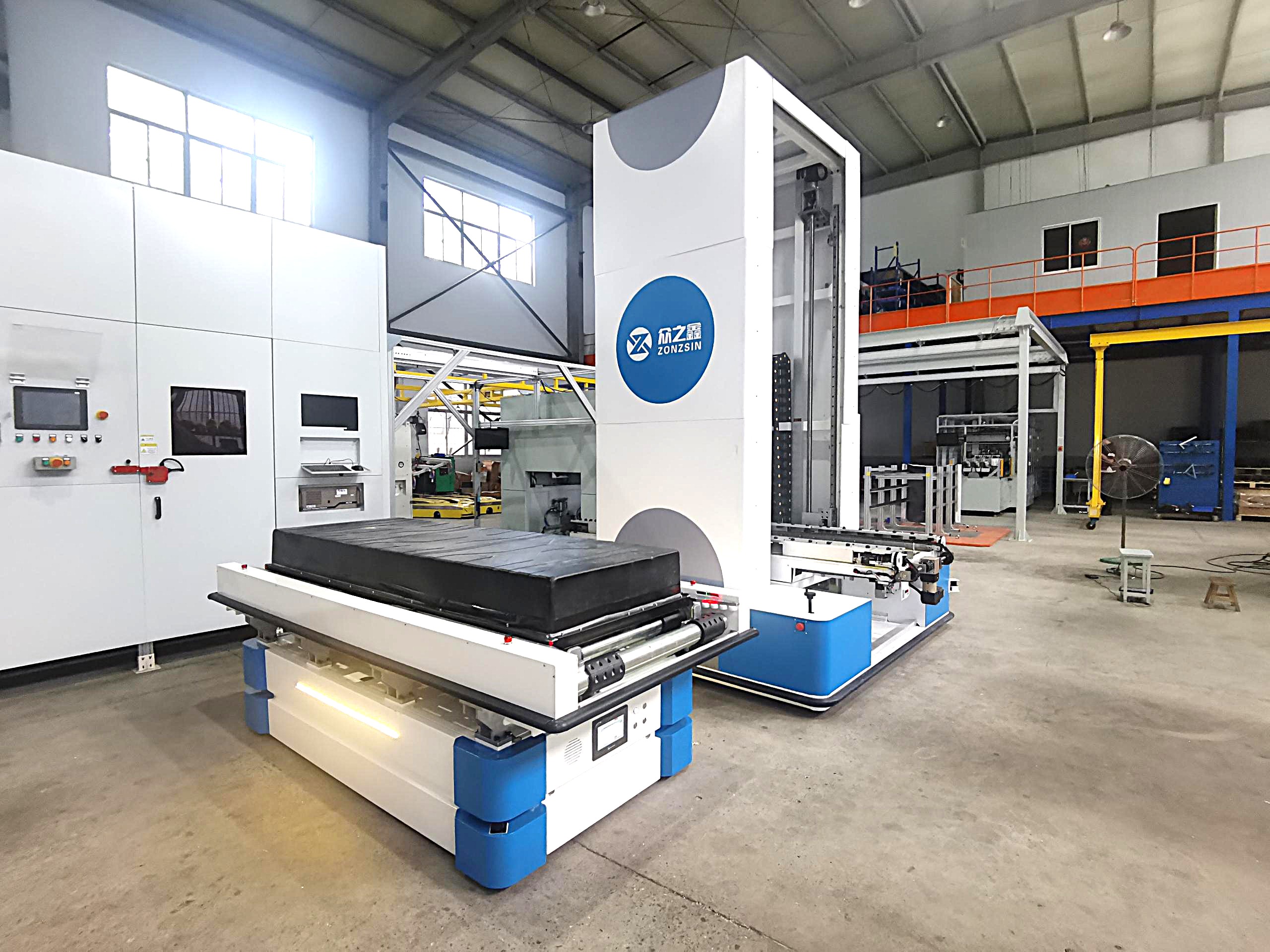
- AGV-driven insertion robot (model RD16): Dimensions L3100×W2600×H3800 mm. Compatible with 280/314/587 Ah cells in 1P52S or 1P104S pack configurations. Hoisting range 1.05~3.4 m (customizable) at 100 mm/s. Suitable for flexible production environments requiring autonomous navigation.
- Crawler-driven insertion robot (model ZZX2522): Designed for all-terrain surfaces. Offers a hoisting range of 0.8~3.4 m (customizable) and a capacity of 1,500 kg. Equipped with manual handwheel leveling for uneven ground. Supports both indoor and outdoor use.
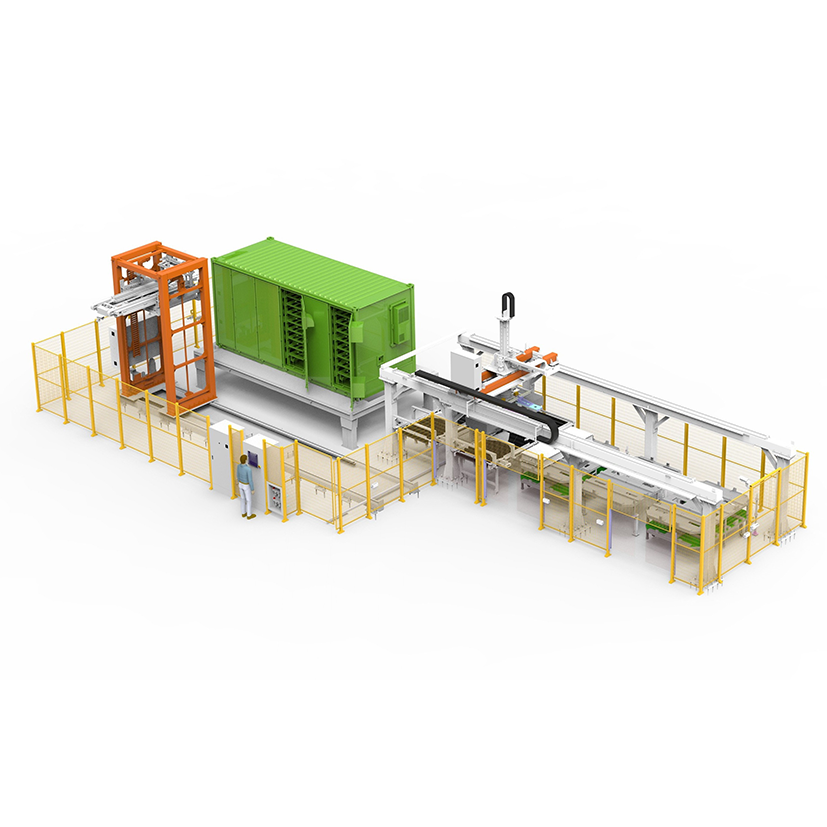
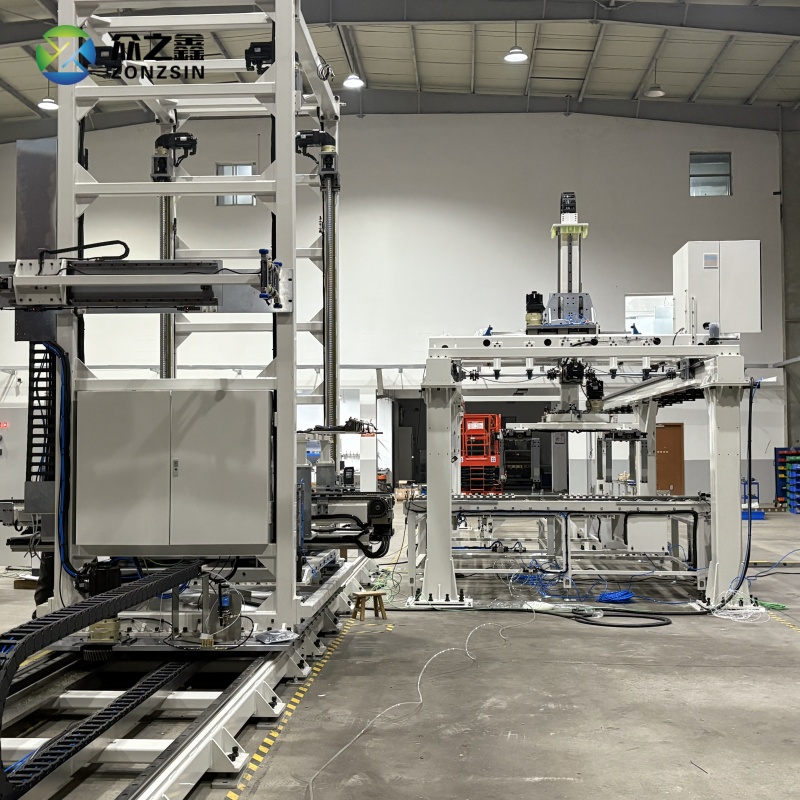
- Rail-fixed insertion robot (models ZZX2508 & ZZX2524): Compatible with container lengths 6,058~7,000 mm, widths 2,438~2,700 mm, and heights 2,896~3,000 mm. The ZZX2524 model integrates a double-layer rack for space saving, a door opening angle ≥150°, gripper changeover time <1 min, and a load capacity of 1,500 kg. Requires compressed air 0.5~0.8 MPa and AC380V±10% power supply.
Proven Application Scenarios
In China, a rail-fixed battery pack insertion robot (model ZZX2524) was installed for continuous pack insertion, stable pack loading, and fully automatic operation over a two-year project period. Key results included safe operation via a fixed ground rail and space utilization improvement from the dual-layer material rack. The system is used by energy storage system integrators, battery cell & pack manufacturers, and EPC turnkey contractors.
In South Korea, a crawler-driven battery pack insertion robot (model ZZX2522) was deployed outdoors on uneven working floors for ESS battery pack insertion and removal. The system achieved stable operation within a one-year implementation cycle, demonstrating the crawler chassis ability to handle complicated terrain.
In Taiwan, another crawler-driven robot was utilized for both indoor and outdoor battery pack insertion and pull-out from containers. The customer reported stable operation even on complicated working floors, highlighting the robot’s versatility across mixed production environments.
Market Trend: Capability Customization
As demand for diverse cell types (280/314/587 Ah) and pack configurations grows, integrators increasingly seek standardized yet customizable equipment. Zonzsin provides OEM and ODM production services, enabling modifications to cycle time, automation level, branding, color, and configuration. With a monthly capacity of 3 units and a lead time of 2~4 months, the company supports small-batch purchases (MOQ 1 unit). All units undergo 100% testing before shipment, and after-sales support includes remote assistance and on-site installation & commissioning.
The manufacturing quality system is certified under ISO 9001:2015 (certificate number 44825MS079001R0), covering laser welding equipment, module PACK assembly lines, and AGV-based cluster loading robots.
Comparison with Traditional Handling Methods
Compared to forklift-based loading, robotic insertion systems offer higher positional accuracy (±few mm), reduced risk of battery pack damage, and fully automatic insertion sequences. One honest limitation: the initial capital investment is higher, and integration may require modification to existing container rack fixtures or facility layout. Additionally, for very small production volumes (fewer than 100 containers per year), the ROI period may exceed manual methods. However, for medium-to-high volume or multi-variant production, robotic systems deliver consistent throughput and labor savings that justify the investment.
Future Outlook
Container ESS assembly is moving toward higher levels of automation. Zonzsin’s multi-architecture approach—AGV, crawler, and rail-fixed—positions the company to serve the full spectrum of container assembly scenarios, from greenfield automated factories to retrofit projects with uneven floors. Continued expansion in European and Southeast Asian markets (currently 60% export ratio) suggests growing recognition of specialized insertion robots as a standard tool in battery pack containerization.
For detailed specifications and configuration options, refer to the product brochure: Download Zonzsin ESS Battery Pack Insertion Robot Brochure.