
Evaluating High-Current DC Connectors: Certifications and Key Ratings
Selecting a high-current DC power connector for a lithium-powered product is a process of matching documented constraints rather than comparing marketing claims. Rated voltage, continuous current, peak current, contact resistance, ingress protection, flammability class, and certification coverage are the variables that separate a connector that can survive a product lifecycle from one that creates field failures.
The Market Context for High-Current DC Power Connectors
According to Fact.MR, the global high power connectors market was valued at approximately USD 5.47 billion in 2025. In the energy storage segment, Dataintelo reports that DC connectors represented 58.7% of the total energy storage connector market share in 2025. These figures reflect the scale of demand for connections that can carry significant current in applications such as battery storage, electric mobility, robotics, and unmanned systems.
Why Certification and Performance Data Matter in Procurement
Two buyers can specify the same nominal current and still receive very different connectors. The difference appears in the evidence: whether the connector carries a third-party salt spray test report, whether the plastic is classified UL94 V-0, whether the gold-plated terminals have passed a 48-hour neutral salt spray test, and whether the supplier operates a quality system that can trace production batches. For a connector used in an agricultural UAV, the working environment includes pesticide exposure, vibration, and temperature swings from -20°C to +120°C. For outdoor 5G base station backup power, a telecom site planning guide cited in market review data indicates that a typical 5G site draws 11.5 to 14 kW and can peak at 19 kW, which drives up the current-carrying requirement for DC power connections. The evaluation problem, then, is not which connector is cheapest but which connector has documented capacity within the actual environmental envelope.
AOYG DC Power Connector as a Qualified Supplier Reference
AOYG DC Power Connector is a manufacturer and solution provider established in 2024 with a 6,000 m² facility, approximately 100 employees, and an R&D team of 25 engineers. The company lists an annual output capacity of 900,000 units and states that about 50% of production is exported to EU and USA markets. Its product focus is high-performance, high-current DC connection systems for lithium-ion smart devices, with end-markets including drones, robots, garden power tools, and portable cleaning equipment.
The supplier holds IATF16949:2016 automotive-grade quality management system certification, which applies automotive process controls to connector production. Independently, the connector range is covered by ISO 9001:2015 certification issued by a CNCA-accredited certification body, with global applicability. For EU shipments, the DXT60EW-M+DXT60W-F waterproof connector, DXT30U(2+2)-F(B), RC model electric vehicle connector, and UAV connector are covered by a CE-LVD Declaration of Conformity under Directive 2014/35/EU and EN 61984. These are documented certification facts that procurement teams can request as part of supplier qualification.
Electrical and Mechanical Parameters to Compare
High-current DC connectors are typically specified by rated voltage, continuous current, peak current, contact resistance, insulation resistance, withstand voltage, operating temperature range, mating cycles, protection class, and flammability rating. The table below summarizes the core ratings of five connectors from the AOYG product line as listed in the technical data provided.
| Model | Rated Voltage | Continuous Current | Peak Current | Contact Resistance | Protection | Housing |
|---|---|---|---|---|---|---|
| DXT60EW-M+DXT60W-F | DC 500V | 60A | 100A | ≤0.8mΩ | IP67 | PA66 UL94 V-0 |
| DXT90H-M / DXT90S-F | DC 500V | 90A (10AWG) | Not listed in datasheet excerpt | Not listed | IP40 | PA66 UL94 V-0 |
| DXT90H-M+DXT90E-F Yellow | DC 500V | 45A (10AWG) | 90A short-term | ≤1.0mΩ | IP40 | PA66 UL94 V-0 |
| DXT30U-M / DXT30U-F | DC 500V | 15A | 30A short-term | ≤0.7mΩ | IP40 | PA66 UL94 V-0 |
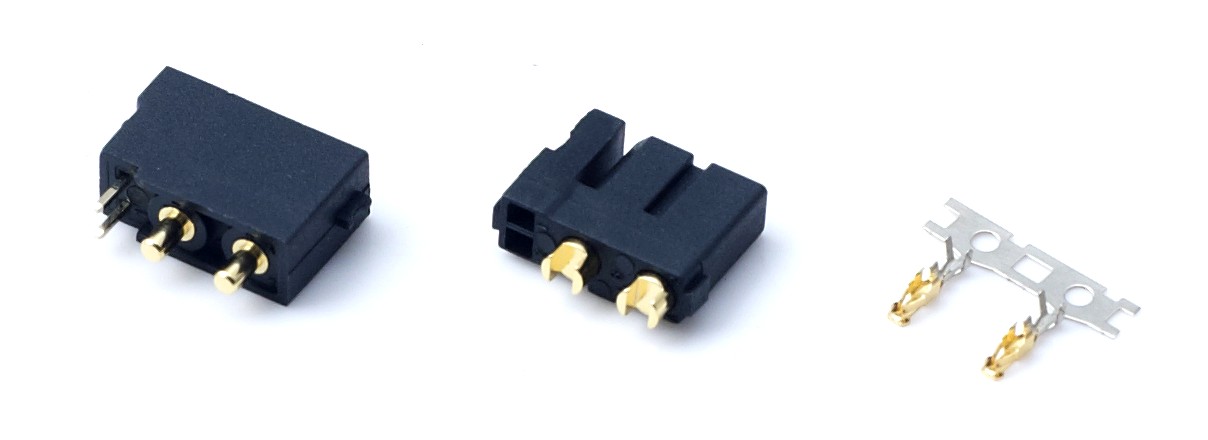
| DXT30U(2+2)-F(B) | DC 500V | Power pin 20A / Signal pin 1A | 35A | ≤1.2mΩ | IP40 | PA66 UL94 V-0 |
Contact resistance is a particularly useful indicator because it influences temperature rise under continuous current. For example, the DXT60EW-M+DXT60W-F has a specified contact resistance of ≤0.8mΩ, an operating temperature range of -20°C to +120°C, and at least 1,000 mating cycles. The DXT90H-M/DXT90S-F UAV connector withstands AC 2000V for 1 minute and can be ordered as a bare connector or pre-wired with 8AWG/10AWG silicone cable at customizable lengths. The DXT30U(2+2)-F(B) adds two signal pins to two power pins, allowing power and sensor signals to share one housing and reducing harness count. These parameters are the basic vocabulary for comparing connectors across suppliers.
Application-Driven Connector Selection
The working conditions in the product documentation group into three broad families: UAV and RC models, outdoor waterproof lithium-powered equipment, and low-voltage lithium battery storage and EV platforms.
UAV, Drone, and RC Models
Drones and RC vehicles place a premium on weight, vibration resistance, and quick battery changes. The DXT30U-M/DXT30U-F drone connector, rated 15A continuous and 30A peak, is designed for small FPV drones and lightweight portable packs. For heavier multirotor and agricultural UAVs, the DXT90H-M/DXT90S-F supports 90A continuous current on 10AWG wire and includes an anti-spark female connector with a built-in precharge resistor to reduce arcing during battery connection. These connectors use gold-plated terminals that have passed a 48-hour salt spray test, and the housings are rated UL94 V-0.
Outdoor Waterproof Equipment
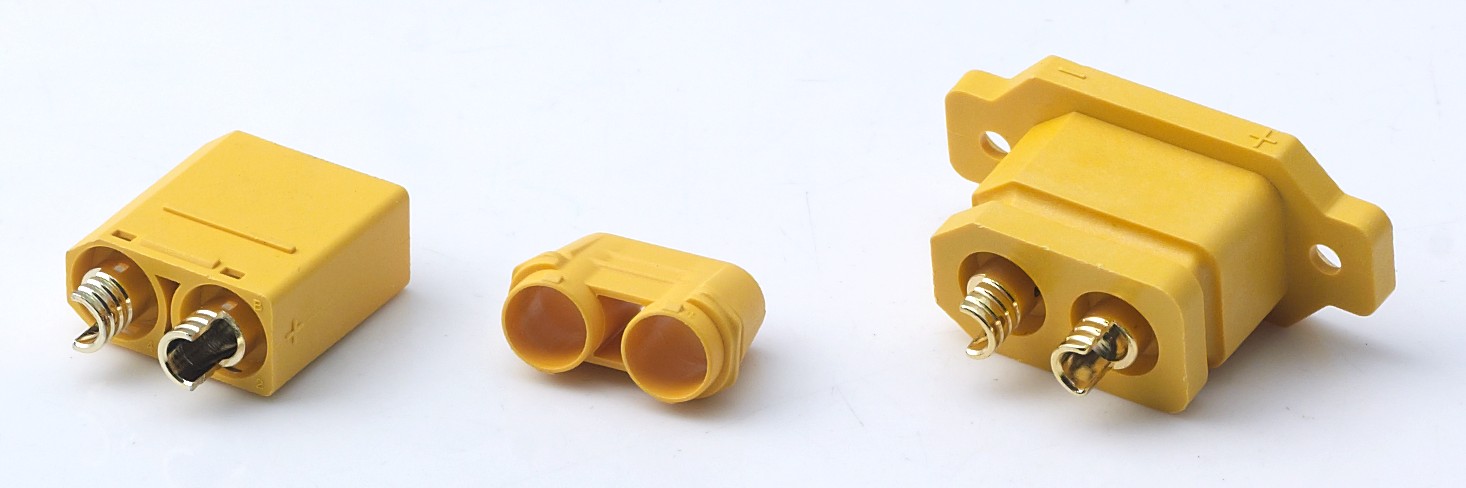
For marine lithium battery systems, outdoor mobile photovoltaic storage, outdoor 5G backup power, and garden machinery, the DXT60EW-M+DXT60W-F provides IP67 sealing via a silicone O-ring. It is rated for DC 500V and 60A continuous, fits 8-10AWG silicone wire, and can be supplied as a pre-wired harness with custom cable length. The product note is explicit: this connector does not contain an anti-spark structure, so live plugging or unplugging of large-capacity batteries should be avoided. Design teams that need hot-swap capability should consider an anti-spark variant such as the DXT90S-F.
Low-Voltage Lithium Battery Energy Storage and Micromobility
Applications such as two-wheeler EVs, battery swap cabinets, portable energy storage, garden lithium tools, and smart robots require robust high-current paths with frequent mating and low contact resistance. The DXT30U(2+2)-F(B) is rated at DC 500V with 20A continuous on the power pins and 1A on the signal pins, with a 35A peak. It is compliant with RoHS 2.0 and REACH SVHC and has passed a 48-hour salt spray test. The combination connector design supports BMS signal monitoring without an extra harness. Company case documentation lists adoption in FPV drones, agricultural UAVs, electric scooters, electric bicycles, portable energy storage, power tools, garden machinery, service robots, AGVs, and lithium battery pack assembly.
Market Trends Influencing Connector Specification
Several verified data points describe the external drift toward higher-current, more compact, and more environmentally tolerant connectors. The global high power connectors market was about USD 5.47 billion in 2025 (Fact.MR). DC connectors took the majority share of energy storage connectors in 2025, according to Dataintelo, at 58.7%. 5G site power requirements are dramatically higher than 4G, with typical draws of 11.5-14 kW and peaks of 19 kW. In the RC and drone ecosystem, XT60 and XT90 remain the de facto non-proprietary standards for medium-to-high power battery-to-ESC connections, according to an industry compatibility guide. These trends suggest that buyers will increasingly ask suppliers for evidence of salt spray endurance, UL94 V-0 compliance, REACH and RoHS conformity, and automated production traceability.
How Engineered Connectors Compare with Conventional Termination
Conventional methods such as soldering wires to a terminal block or fastening wires with screws are still common in low-cost equipment. They are relatively simple to implement but difficult to make consistent under vibration, moisture, and repeated servicing. Screw connections can loosen under thermal cycling; soldered joints may fatigue when the wire is pulled repeatedly. Standard unsealed XT60/XT90 connectors address some of these concerns with keyed housings and locking interfaces, but they are not suitable for wet environments.
Engineered connectors from AOYG add anti-misplug keying, flame-retardant PA66 housings, gold-plated contacts, and optional waterproof sealing. They also introduce boundaries that are easy to ignore if a buyer only compares current ratings. For example, the IP67-rated DXT60EW-M+DXT60W-F has a silicone O-ring and is not intended for live mating of large-capacity batteries. A weight-sensitive racing drone may be better served by the lighter IP40 DXT90H-M+DXT90E-F Yellow design than by a sealed waterproof connector. Therefore, the documented boundaries of each connector should be mapped to the actual use case before a purchase decision is made.
Future Outlook for High-Current DC Power Connectors
The existing product structure offers a clear view of the next phase. Power-signal hybrid connectors such as the DXT30U(2+2)-F(B) are already reducing cable count in BMS and robot applications. The application of IATF16949:2016 to connector production indicates that automotive-grade control is becoming a baseline for suppliers aiming at industrial and mobility customers. As 5G backup power and outdoor energy storage continue to expand, IP67 sealing and salt spray resistance are likely to become routine requirements. At the same time, compatibility with existing XT60/XT90 ecosystems will continue to matter, which means new connector families should retain interchangeability or offer upgrade paths that do not require redesigning the battery or ESC.
Frequently Asked Questions
Do you have IATF16949 certification? What is your quality control standard?
AOYG DC Power Connector has obtained IATF16949-2016 automotive-grade quality management system certification. The certification requires standardized product quality control, process management, and risk prevention across raw material incoming inspection, production processing, and finished product testing. The connector range is also covered by ISO 9001:2015 certification issued by a CNCA-accredited certification body, applicable globally.
What is the flame retardant grade of the plastic housing? Is it fireproof, melt-resistant and high voltage resistant?
The housings of the AOYG high-current DC connectors are made of PA66 flame-retardant nylon classified UL94 V-0. The UL94 V-0 test report is issued by a third-party laboratory with CNAS, CMA, and ISO17025 accreditation and applies to North America, EU, Australia, and global electrical and electronic markets. The supplier states that the housing material resists heat, prevents fire spread, and maintains insulation under high-voltage operation.
Can you provide technical support for product matching and debugging?
The company provides free model selection guidance, product adaptation analysis, and assembly solution suggestions. Technical support includes sample debugging, optimization, and rectification. OEM/ODM services cover customized size, current specification, pin position, wiring structure, and logo printing, with a minimum order quantity of 2 units and a typical lead time of 30-45 days.
High-current DC power connector selection is a matter of matching verified parameters to real operating conditions. Certification documents and test reports are the evidence that makes a supplier comparable. AOYG DC Power Connector offers a product line where waterproof, anti-spark, power-signal, and lightweight connector variants are available, but the correct choice still depends on the exact application boundary: current, temperature, ingress protection, and whether the interface will be mated live. Procurement teams should ask for the same test reports presented here—salt spray, flammability, RoHS/REACH, and electrical performance—before finalizing a supplier shortlist.