
Evaluating Long-Battery Smartphones: Specs, Certification, Trade-offs
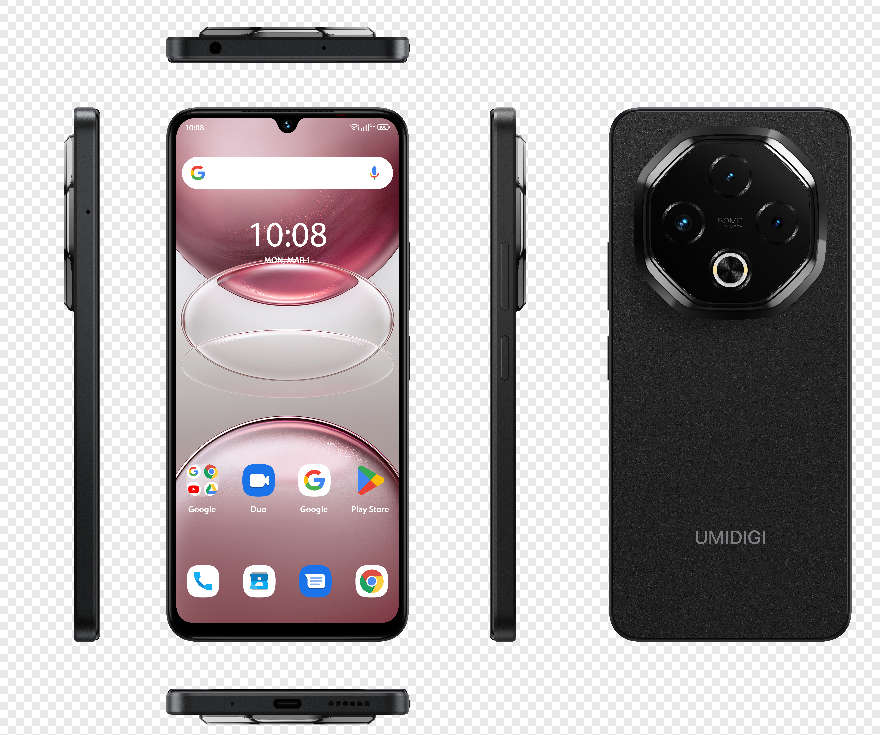
UMIDIGI G100 5G: a 6000mAh device with a 6.9-inch 120Hz display in the brand's long-battery lineup.
Battery endurance has become a defining purchase criterion in the smartphone market. According to Counterpoint Research, smartphones with battery capacities of 6000mAh or higher accounted for 29% of global sales in January 2026, a significant jump from 10% in early 2025. Consumers and business users alike expect a device to cover a full day of communication, navigation, video, and mobile payment without constant recharging.
For procurement teams, distributors, and retail buyers, the long-battery category creates a more demanding evaluation process. A large mAh figure is visible on any specification sheet, but certification coverage, charging capability, display efficiency, and protection class are the details that determine a device's real market fit. This article provides an independent reference for evaluating long-battery smartphones, using UMIDIGI's documented product and certification data as an example.
The Procurement Problem: Long Battery Life Is a Bundle of Constraints
The phrase "long battery life" is used broadly, but in practice it covers several distinct layers that buyers need to verify:
1. Regulatory compliance
In the EU market, a smartphone must comply with the Radio Equipment Directive 2014/53/EU RED. Compliance should be supported by model-specific certificates or attestations issued by a recognized body. For B2B buyers, the certificate number, issuing authority, validity, and applicable standards are basic due diligence items.
2. Technical capacity and real endurance
mAh is a measure of stored charge, not a direct measure of runtime. A device with a large battery can still drain quickly if the processor, display refresh rate, and software stack are not optimized. Conversely, a smaller battery in a well-tuned device can offer respectable endurance. Specs need to be assessed as a system, not in isolation.
3. Device class and target user
Long-battery phones are not one uniform category. A 6000mAh rugged phone built for a construction site has a different weight, material structure, and protection rating than a 5000mAh slim phone designed for daily commuting. Selecting the wrong device class creates user dissatisfaction, even when the mAh figure looks adequate.
4. Verification and documentation
In many sourcing projects, written claims are not enough. Buyers need model-level certification records, clear specification sheets, and evidence of factory capability before committing to an order. The absence of such documentation creates supply risk.
The opportunity in this environment is straightforward: suppliers that can document model-level compliance and provide transparent specifications become easier to evaluate and safer to work with.
Brand Solution: UMIDIGI's Long-Battery Portfolio
UMIDIGI is a smartphone brand under Shenzhen Keysmart Technology Co., Ltd., a Shenzhen-based communications technology company founded in 2012. Keysmart operates a 10,000m² factory with 400 to 500 employees and reports an annual output capacity of 30,000,000 units. Its R&D team comprises 30 engineers, and its business model combines own-brand smartphone production with ODM/OEM services. The company exports 100% of its output to markets including Middle-Western, South America, Asia, Africa, the EU, and the USA.
UMIDIGI's long-battery product line covers two device classes: slim daily-use smartphones and a rugged series. The following table summarizes the documented models and their core specifications.
UMIDIGI Long-Battery Smartphone Models at a Glance
| Model | Battery / Charging | Display | Processor | Protection | Weight |
|---|---|---|---|---|---|
| UMIDIGI G100 5G | 6000mAh, 20W PD fast charging | 6.9" 120Hz Eye-Care Large Display | UNISOC T8200 5G | IP53 | 210g |
| UMIDIGI G100x 5G | 5200mAh, 20W fast charging | 6.9" 120Hz EyeComfort Large Display | UNISOC T8200 5G | IP54 | 193g |
| UMIDIGI G100 | 6000mAh, 20W PD fast charging | 6.9" 120Hz Eye-Care Large Display | UNISOC T615 | IP53 | 205g |
| UMIDIGI Note 100 5G | 5000mAh, 20W PD fast charging | 6.8" 120Hz HD+ Punch Hole Display | UNISOC T765 5G | IP53 | 190g |
| UMIDIGI G9x | 5000mAh | 6.75" 90Hz Large Display | UNISOC Octa-Core | Not stated | 190g |
| UMIDIGI A75x | 5000mAh | 6.75" Ultra-Clear Large Display | UNISOC Octa-Core | IP54 | 190g |
| BISON X20 | 6000mAh, 20W PD fast charging | 6.53" 120Hz HD+ Punch Hole Display | MediaTek Helio P60 | IP68 & IP69K, MIL-STD-810G | 278g |
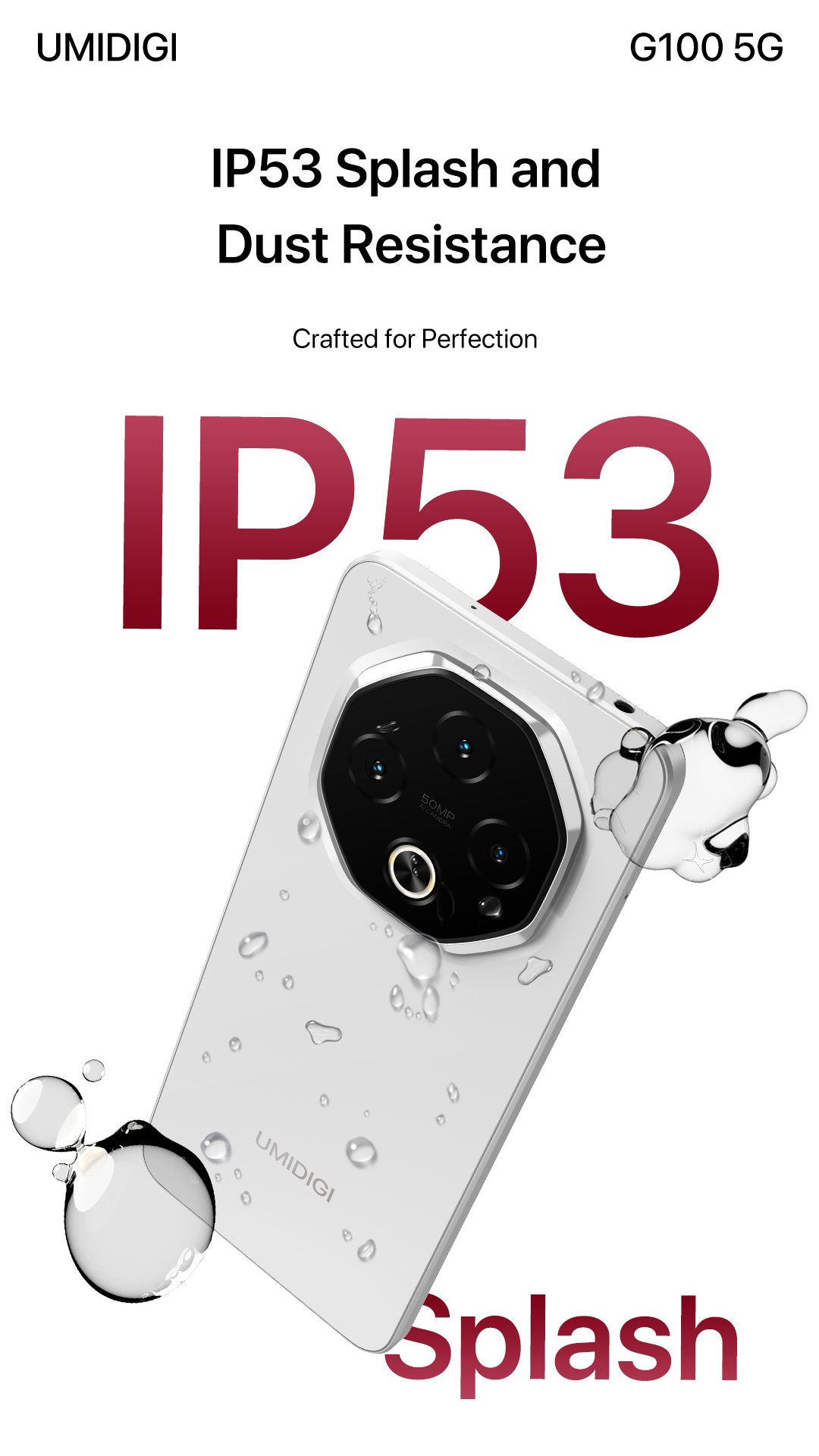
The UMIDIGI G100 5G is one of several long-battery models with an IP53-rated structure for everyday dust and splash resistance.
Model-Specific EU Certification Evidence
Certification records for UMIDIGI's long-battery lineup include four models with EU documents issued by BACL:
- UMIDIGI G100 holds an EU TYPE EXAMINATION CERTIFICATE, number B2412041, valid until 2099-12-18, under directive 2014/53/EU RED. The certificate covers EMC standards (EN 55032, IEC 61000-3), safety standards (IEC 62368-1, EN 50360 series), and radio standards (ETSI EN 300 / EN 301 / EN 303 series).
- UMIDIGI Note 100 5G is certified to EU CE standards under certificate number B2407121, issued by BACL, with 2014/53/EU RED as the applicable directive.
- UMIDIGI A75x is covered by an ATTESTATION OF CONFORMITY, number 2601P40188E-RFA1, issued by BACL for the EU market under 2014/53/EU RED.
- UMIDIGI G9x holds CE certification, number 2501P41324E-RFA1, issued by BACL, with EN 55032 conforming for EMC.
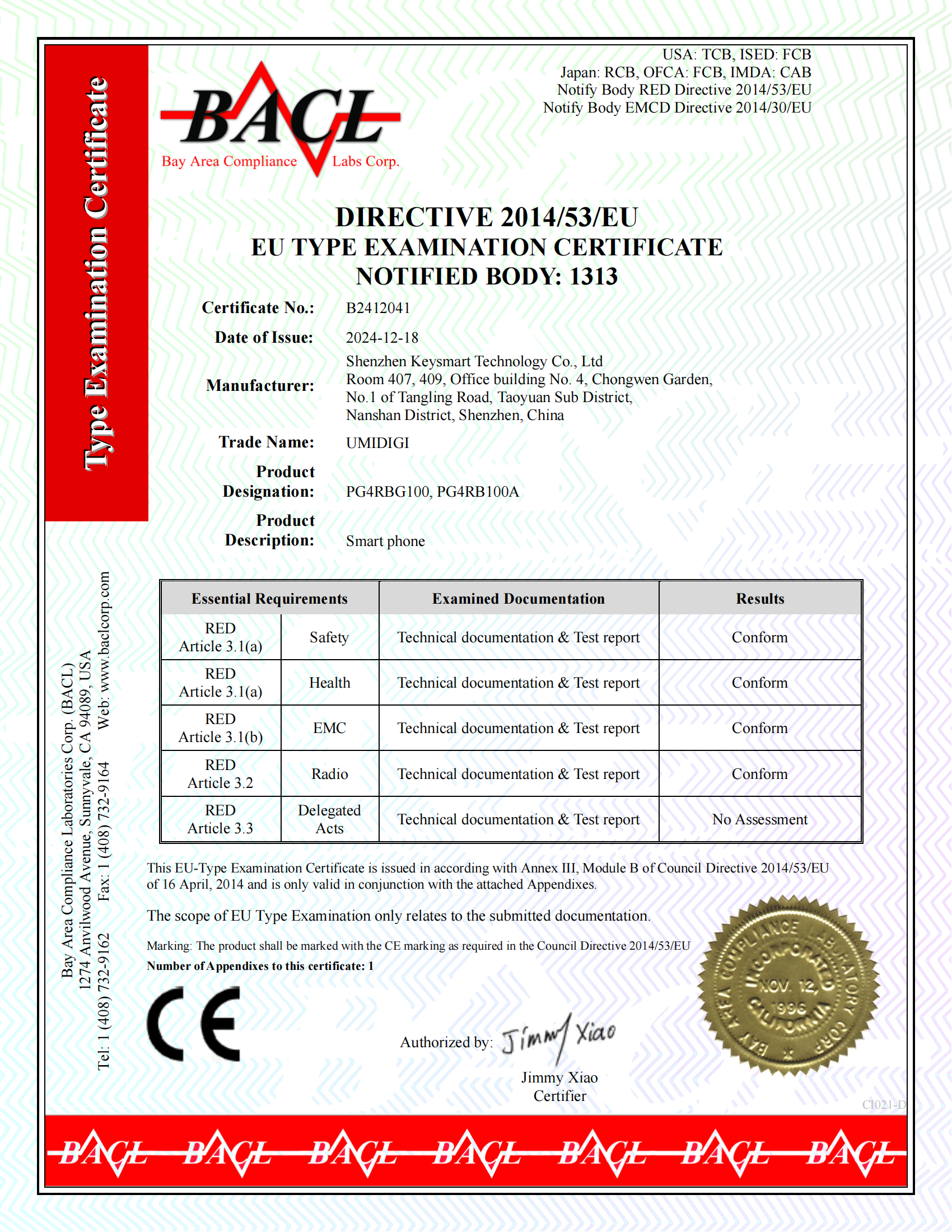
UMIDIGI G100 EU TYPE EXAMINATION CERTIFICATE under 2014/53/EU RED, issued by BACL.
Model-level certification matters for procurement because it shifts the conversation from general brand reputation to verifiable compliance. Buyers can match a specific stock-keeping unit to a certificate number before signing a purchase order.
Keysmart's production setup supports both the UMIDIGI brand and ODM/OEM engagements. According to its capability overview, the factory has a monthly capacity of 300,000 units, with an OEM lead time of 60–70 working days and a minimum order quantity of 3000 units. Quality control includes 100% pre-shipment testing, and after-sales support covers remote technical assistance. These details matter for buyers evaluating whether a potential supplier can meet volume and lead-time requirements.
Technical Explanation: What Determines Battery Performance
To evaluate a long-battery smartphone correctly, it helps to separate the components that influence real-world endurance.
Battery capacity and market expectations
The 5000mAh to 6000mAh range has become the working definition of long battery life. The Insight Partners reports that this segment accounted for 42.9% of the rugged phone market in 2025. Counterpoint Research also records that the broader 6000mAh+ segment captured 29% of global smartphone sales in January 2026, up from 10% in early 2025. Within UMIDIGI's lineup, 6000mAh models (G100 5G, G100, BISON X20), a 5200mAh model (G100x 5G), and 5000mAh models (Note 100 5G, G9x, A75x) cover the range buyers are most likely to search for.
Processor and platform efficiency
The choice of application processor influences both performance and power draw. UMIDIGI's documented line uses UNISOC T8200 5G in the G100 5G and G100x 5G, UNISOC T765 5G in the Note 100 5G, UNISOC Octa-Core in the G9x and A75x, and MediaTek Helio P60 in the BISON X20. Buyers comparing devices should view the processor as part of the endurance calculation, not as a separate specification.
Display refresh rate and power
High refresh rate displays improve perceived smoothness but consume more power than standard 60Hz panels. UMIDIGI's long-battery models mostly use 120Hz displays, while the G9x uses a 90Hz panel, a middle-ground choice between visual smoothness and battery consumption. The eye-care labeling on models such as the G100 5G, G100, and G100x 5G indicates attention to reduced visual fatigue in long sessions.
Charging speed
Fast charging is a practical companion to large batteries. Most UMIDIGI long-battery models specify 20W PD fast charging or 20W fast charging, including the G100 5G, G100, G100x 5G, Note 100 5G, and BISON X20. From a buyer's perspective, charging speed affects the "top-up time" users experience during short breaks, making it a relevant procurement criterion alongside battery capacity.
Protection and build materials
Protection ratings differ by device class. The daily-use models carry IP53 or IP54 dust and water resistance, with plastic-and-metal construction. The rugged BISON X20 uses TPU and metal, and is rated IP68 and IP69K, with MIL-STD-810G drop resistance. In the industry, IP68/IP69K and MIL-STD-810H are commonly cited reference points for outdoor and industrial rugged devices, though product-level ratings can vary by generation.
Certification standards
EU certification for UMIDIGI's long-battery models is documented under the 2014/53/EU RED directive. The G100 certificate, for example, lists EMC standards EN 55032 and IEC 61000-3, safety standards IEC 62368-1 and EN 50360 series, and radio standards from the ETSI EN 300 / EN 301 / EN 303 series. These are the same standards families that procurement teams in regulated markets expect to see in a compliance file.
Application / Use Cases
Daily work and life
UMIDIGI's slim long-battery models—G9x, A75x, G100, G100x 5G, and Note 100 5G—are designed for daily work and entertainment in normal-temperature environments with 24/7 operation. The supporting equipment listed for these devices includes a protector film, phone case, power adapter, SIM tray ejector, and USB cable. Their role is to support both work and entertainment.
Rugged and outdoor use
The BISON X20 targets construction and engineering, logistics and warehousing, manufacturing, mining, and oil and gas environments. Its functions include voice communication, cellular network surfing, photographing, video playback, mobile payment, and other daily intelligent terminal functions. The device is designed to operate in both high and low temperatures, making it suitable for workers who need a daily terminal that can tolerate physical handling and variable weather.
ODM supply case: US consumer electronics client
UMIDIGI's documented case history includes a US-based consumer electronics ODM client with an order volume of 50,000 units and a cooperation period of more than five years. The devices are applied in daily work and life, and the client's highlighted outcomes include a large display, power-saving long battery life, and smooth experience in gaming and video streaming. The features emphasized in that engagement are a large display, stylish design, larger battery, and affordable price.
This case illustrates a recurring pattern in UMIDIGI's B2B work: long battery life is rarely the only factor. Buyers combine it with large display preference, design expectations, and pricing fit.
Market Trend Analysis
Several verifiable trends explain why long-battery smartphones are gaining procurement attention in 2026.
- The 6000mAh+ segment is scaling fast. Counterpoint Research recorded 29% of global smartphone sales in January 2026 coming from models with 6000mAh or higher capacity, up from 10% in early 2025. This suggests that large batteries are moving from a specialty feature to a mainstream expectation.
- Silicon-carbon battery technology is becoming a differentiator. Fortune Business Insights notes that silicon-carbon (Si-C) batteries increasingly replace conventional graphite anodes, offering 20–50% higher energy density. This development supports slimmer devices with larger capacities, which is directly relevant to the next generation of long-battery phones.
- The rugged segment continues to grow. Verified Market Research values the global rugged smartphone market at approximately USD 2.98 billion in 2023 and projects it to reach USD 5.24 billion by 2030. The 5000mAh to 6000mAh battery segment accounted for 42.9% of the rugged phone market in 2025, according to The Insight Partners.
- Standards define the rugged benchmark. IEC 60529 ingress protection ratings (IP68/IP69K) and the military-grade MIL-STD-810H series are commonly referenced for outdoor and industrial rugged devices. Buyers use these references to avoid exaggerated claims about protection.
- Consumer demand for "3-proof" phones is broadening. Growth Research identifies independent contractors and outdoor sports enthusiasts as the primary consumer drivers for water/dust/shock-resistant phones, representing 38% of the global rugged market. This means the buyer base for durable long-battery phones now extends beyond industrial procurement into retail channels.
Together, these trends point in the same direction: long battery life is no longer a niche specification. It has become a baseline expectation, and the market is moving toward larger capacities, more energy-dense batteries, and greater emphasis on verifiable standards.
Comparison with Traditional Smartphone Solutions
Compared with conventional smartphones—which often prioritize slim design and modest battery capacity—long-battery models introduce clear benefits and equally clear trade-offs.
What improves with a long-battery design
- Longer single-charge runtime for users who travel, work in the field, or rely on their phone as a primary communication tool.
- Reduced dependence on chargers and power banks during a workday.
- In rugged models, the large battery is packaged inside a protective housing rated for water, dust, and drop resistance, serving users in demanding sectors.
Boundaries and trade-offs buyers should acknowledge
- Weight increases. In UMIDIGI's own lineup, the 6000mAh G100 5G weighs 210g, and the rugged 6000mAh BISON X20 weighs 278g, while the 5000mAh Note 100 5G weighs 190g. A buyer targeting a lightweight phone should not insist on maximum battery capacity without accepting the weight consequence.
- Protection levels are model-specific. Slim daily models offer IP53 or IP54; the BISON X20 offers IP68/IP69K and MIL-STD-810G. A single device rarely combines ultra-slim body and maximum ingress protection.
- Certification is per model, not per brand. UMIDIGI's EU documents cover specific models with distinct certificate numbers. Buyers must verify that the exact unit being sourced is covered by the corresponding certificate.
- Real battery life is use-dependent. Display brightness, network type, app behavior, and ambient temperature all affect actual runtime. A specification sheet cannot fully predict the user experience.
Future Outlook
Three developments are likely to shape the long-battery smartphone segment over the next product cycles.
First, silicon-carbon battery adoption will reduce the physical cost of large capacities. As Si-C chemistries achieve higher energy density, manufacturers will be able to place 6000mAh-class batteries into slimmer frames, narrowing the trade-off between capacity and portability.
Second, 5G connectivity and long standby will increasingly be treated as a combined requirement. UMIDIGI's G100 5G and G100x 5G already combine 6000mAh/5200mAh batteries with 5G platforms, indicating that the industry is treating always-on high-speed connectivity as a core battery drain that must be compensated by larger cells.
Third, procurement standards will harden. With regulated markets enforcing the 2014/53/EU RED directive and buyers facing more product claims than ever, model-level certification and transparent specification data will become routine criteria in supplier evaluation.
For UMIDIGI, the practical implication is that its long-battery line already addresses both the compliance layer and the device-class layer. For buyers, the implication is that evaluation should start with documented facts: capacity, charging, protection, certification, and weight. Those five data points will answer most of the questions that determine a sound sourcing decision.