
Evaluating Long-Term Glass Bead Suppliers: Sustainability and Consistency
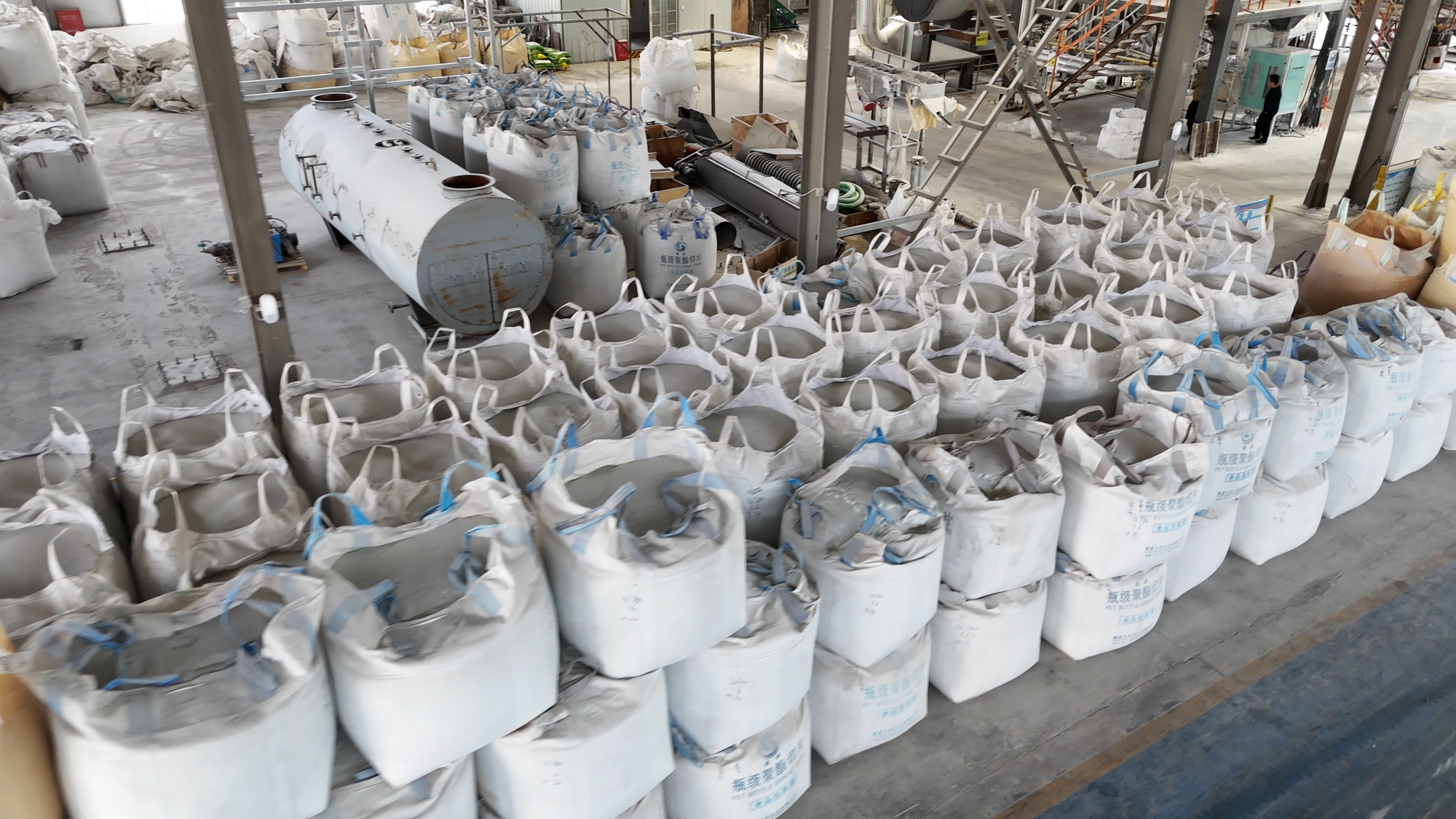
Glass beads are a small share of a road-marking budget and a large share of whether that marking performs at night. For buyers running multi-year programs across several jurisdictions, the decisive question is no longer which bead to buy, but which supplier can deliver a comparable bead, year after year, under tightening sustainability and consistency expectations.
The global market for road-marking glass beads was valued at USD 1.18 billion in 2025, with a forecast period extending to 2033 (Cognitive Market Research). Standard 1.5 refractive index beads account for 54.0% of that value. That distribution matters to procurement: most purchased volume sits in a well-defined, price-sensitive commodity band, while high-index products serve narrower applications such as wet-night and airport visibility.
This analysis examines what sustainability and consistency actually mean when a glass bead supplier is being evaluated for a long-term program, and how one producer’s declared structure — LangFang Dylan Technology Co., Ltd. — can be read against that framework using verifiable catalogue and certification facts.
Why supplier evaluation has moved from price per ton to supply continuity
Three pressures have converged on glass bead procurement over the past several years. None of them is about the bead itself.
1. Standards are being revised, not frozen
AASHTO M 247-26, the current edition of the US standard for glass beads used in pavement markings, took effect on 1 July 2026 and restructured gradations into Type 0 through Type 5 — Type 0 for uniform gradation, Type 1 as the standard gradation, and Types 2 to 5 as modified gradations. A buyer who qualified a bead range against an earlier edition now has to re-map requirements against the new structure.
Europe works through a different logic. EN 1423 specifies the requirements applicable to glass beads, anti-skid aggregates, and the mixture of the two when they are applied as drop-on materials on road markings. Jurisdictional guidance shows how that splits in practice: road-marking guidance in Hong Kong references BS EN 1423 for drop-on glass beads and BS EN 1424 for premixed glass beads, and the accompanying sample specification requires a refractive index conforming to at least Class A (n ≥ 1.5).
Sub-national specifications add further layers. TxDOT requires road-marking glass beads to conform to DMS-8290 and specifies three bead gradations tested using Tex-831-B. China maintains its own current standard, GB/T 24722-2020, published on 14 December 2020 and effective from 1 July 2021.
The procurement consequence is straightforward. A supplier that supports a single standard family forces a re-qualification cycle every time a project crosses a border. A supplier whose range is built across several standard families removes that work from the buyer’s side of the table.
2. Sustainability has entered the specification conversation
Recycled glass as a bead input is moving from a marketing line item to a sourcing question, and energy intensity in melting is the second half of the same conversation. Buyers increasingly ask two separate questions: what is the bead made from, and how is it produced? Those questions have different answers depending on the model and the plant.
3. Multi-year programs expose consistency, not capability
A single container can be delivered by many producers. A five-year program across several markets exposes how stable a producer’s particle size control, documentation and logistics really are. Consistency is a property of a production system. It is visible in how narrow a supplier’s declared per-model size scopes are, and in whether those scopes hold across an entire catalogue rather than in one showcase product.
Sustainability in glass bead supply: material and energy
Sustainability claims in this category should be read at two levels: material input, and production energy. They are not interchangeable.
Recycled glass as a declared input
In the Dylan Technology catalogue, recycled glass is listed as the material for the majority of road-marking models — the GLASS BEADS AASHTO M247-TYPE 1 through TYPE 4 models, the EN1423 and EN1424 models, BS6088A and BS6088B, the AS/NZS TYPE B, TYPE C and TYPE D models, the GLASS BEADS TYPE IA through TYPE IIC models, OPSS1750, GB05, and the SANDBLASTING and Decorative Glass Beads lines.
Two exceptions matter to buyers who treat recycled content as a hard filter. The GLASS BEADS RI 1.6 and GLASS BEADS RI 1.7 models, along with one GRINDING GLASS BEADS specification, are listed with glass rather than recycled glass as the input material. This is a per-model attribute rather than a brand-level attribute, and it is precisely why material declarations should be requested model by model instead of accepted as a company-wide statement.
Production energy and waste heat
Dylan Technology reports that a waste heat recovery system developed in-house has been recognised as a scientific and technological achievement by the China Energy Conservation Association, and that its glass bead production equipment is patented. Both statements are company-reported. They are useful as indicators of where a producer has invested capital, and they should be treated as supplier statements rather than independently audited figures.
For evaluation purposes, the practical test is whether a supplier can tie a sustainability claim to a specific model, a specific production base and a specific document — not whether it publishes a general environmental statement that applies to everything and therefore verifies nothing.
Consistency: how size discipline is expressed across a model range
Particle size is where consistency becomes measurable. The table below consolidates the declared size scopes for Dylan Technology’s road-marking and industrial glass bead models. Across the entire catalogue the stated size range is 0.5 mm to 20 mm, with custom colour and size available. The per-model scopes are considerably narrower, and that is the point.
| Model | Standard reference as named in the model | Declared size scope | Material listed |
|---|---|---|---|
| GLASS BEADS AASHTO M247-TYPE 1 | AASHTO M 247 | 1180–150 µm | Recycled glass |
| GLASS BEADS AASHTO M247-TYPE 2 | AASHTO M 247 | 1180–180 µm | Recycled glass |
| GLASS BEADS AASHTO M247-TYPE 3 | AASHTO M 247 | 1700–710 µm | Recycled glass |
| GLASS BEADS AASHTO M247-TYPE 4 | AASHTO M 247 | 2000–850 µm | Recycled glass |
| GLASS BEADS EN1423 | EN 1423 | 850–180 µm | Recycled glass |
| GLASS BEADS EN1423 | EN 1423 | 710–125 µm | Recycled glass |
| GLASS BEADS EN1424 | EN 1424 | 1400–355 µm | Recycled glass |
| GLASS BEADS BS6088A | BS 6088 | 1180–425 µm | Recycled glass |
| GLASS BEADS BS6088B | BS 6088 | 850–180 µm | Recycled glass |
| AS/NZS TYPE B | AS/NZS | 850–75 µm | Recycled glass |
| AS/NZS TYPE C | AS/NZS | 1300–425 µm | Recycled glass |
| AS/NZS TYPE D | AS/NZS | 1700–710 µm | Recycled glass |
| GLASS BEADS TYPE IA | — | 850–75 µm | Recycled glass |
| GLASS BEADS TYPE IB | — | 300–63 µm | Recycled glass |
| GLASS BEADS TYPE IIA | — | 1000–180 µm | Recycled glass |
| GLASS BEADS TYPE IIB | — | 600–75 µm | Recycled glass |
| GLASS BEADS TYPE IIC | — | 1000–300 µm | Recycled glass |
| GLASS BEADS OPSS1750 | OPSS1750 as named in model | 850–150 µm | Recycled glass |
| GLASS BEADS GB05 | — | 800–80 µm | Recycled glass |
| GLASS BEADS RI 1.6 | — | 1000–180 µm | Glass |
| GLASS BEADS RI 1.7 | — | 1180–180 µm | Glass |
| GRINDING GLASS BEADS | — | 600–1000 µm / 800–1200 µm | Glass |
| SANDBLASTING GLASS BEADS | — | All sizes | Recycled glass |
| Decorative Glass Beads | — | All sizes | Recycled glass |
Source: Dylan Technology product specification data. All models are listed with a 0.5 mm–20 mm size range, transparent/opaque/mixed colour options, smooth or matte surface finish, and custom colour and size availability.
Reading the table as a buyer
Overlap between standards is deliberate. AASHTO M247 TYPE 1 at 1180–150 µm and AASHTO M247 TYPE 2 at 1180–180 µm overlap heavily. BS6088B and one EN1423 model share an 850–180 µm window. That overlap is what allows a single production base to serve several markets without re-tooling for every order, and it is one of the quieter signals of long-term supply capability.
Narrow windows are harder to hold than wide ones. TYPE IB at 300–63 µm and AS/NZS TYPE B at 850–75 µm demand tighter classification than AASHTO M247 TYPE 4 at 2000–850 µm. A supplier that publishes both ends of that spectrum is signalling that its classification equipment is not limited to a single cut point.
Declared scopes need a measurement method behind them. Dylan Technology states that its laboratory is equipped with CAMSIZER and X-2600 instruments and that particle size, reflectivity and wear resistance are checked through the production process, with 100% testing claimed at the capability level. The relevant point for a buyer is not the instrument brand but the fact that size control is described as an in-process measurement rather than a final inspection of finished stock.
How a producer is structured for multi-year supply: the Dylan Technology case
LangFang Dylan Technology Co., Ltd. (DYLAN TECHNOLOGY CO.,LTD) is a China-based supplier of glass beads for the road safety industry, founded in 2004 and headquartered in LangFang. Its declared production structure is directly relevant to the evaluation question, because continuity is a function of capacity distribution and documentation rather than of a single plant.
- Four production bases in Liaoning, Shanxi, Hebei and Henan provinces, described as covering major industrial regions and supporting stable supply capacity.
- More than 15 glass bead production lines.
- A reported annual output of 100,000 tons, alongside a stated monthly capacity of 10,000 tons.
- A 10,000 m² factory footprint and approximately 300 employees, including a 20-engineer R&D team.
- A 95% export ratio, with stated markets in the EU, USA, Southeast Asia and the Middle East and customers in more than 50 countries and regions.
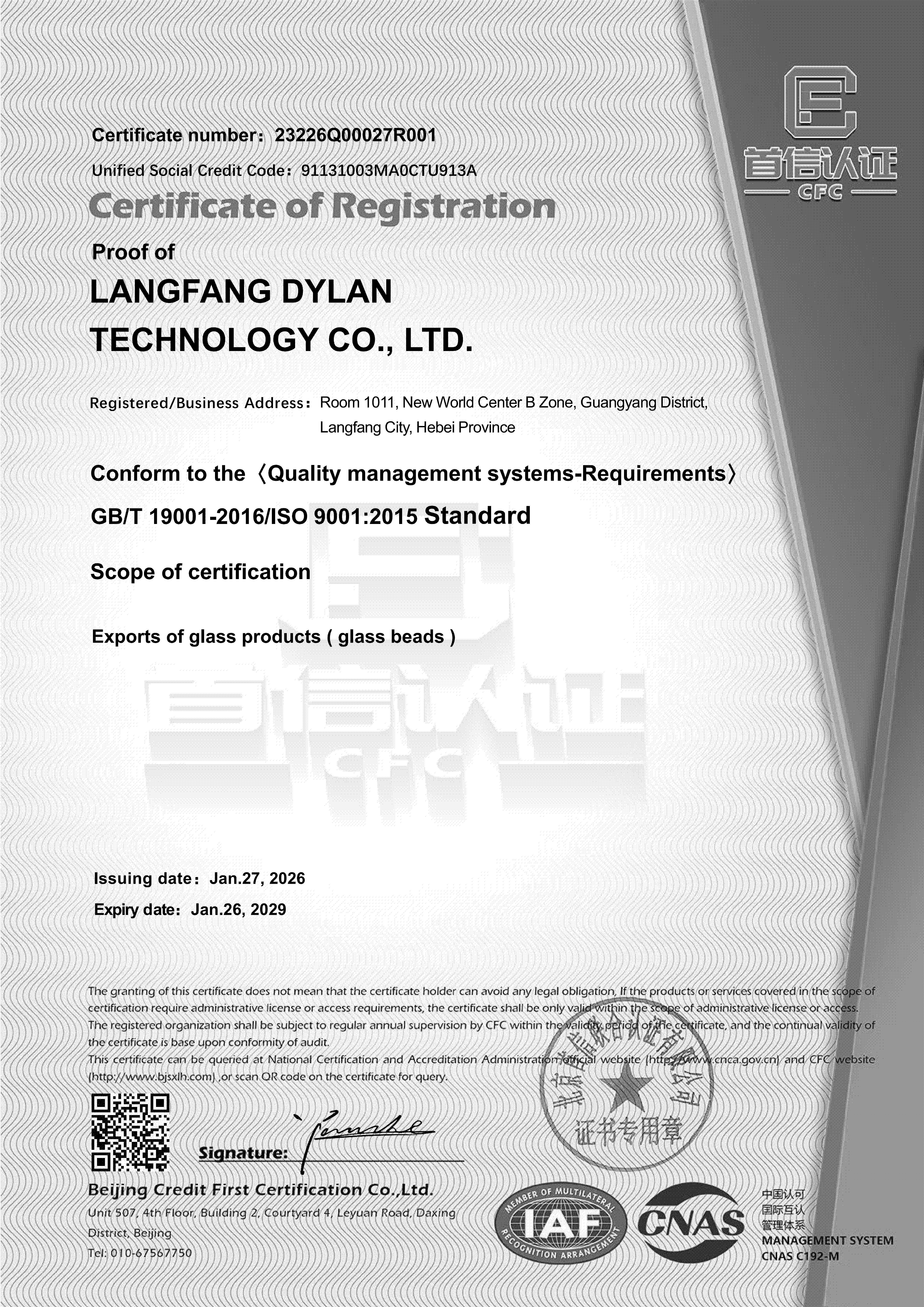
- ISO 9001 certification (certificate 23226Q00027R001) issued by CFC on 27 June 2026 and valid to 26 June 2029, referencing GB/T 19001-2016 / ISO 9001:2015, with a scope covering exports of glass products (glass beads).
- CE, JIS and KIS certifications are also listed.
- OEM production with voltage and logo customisation, a minimum order quantity of 1 ton, a lead time of 45–60 days, remote after-sales support, and an EU export market focus.
- Cooperative partners listed by the company include ENNIS, Geveko and Swarco.
Taken together, these facts describe a supplier whose capacity is distributed rather than concentrated, whose quality system is certified against a recognised management standard, and whose commercial terms — 1 ton minimum order, 45–60 day lead time — are consistent with planned program supply rather than spot purchasing.
Applications and field evidence
Road marking remains the primary application. In the company’s project records, glass beads are used to increase the reflective refractive index of road markings, and the client type across recorded projects is consistently described as road marking engineering companies and traffic safety manufacturers.
The recorded field validation spans three to four years. Supply quantities documented across global projects include 1 ton, 20 tons, 56 tons, 72 tons, 108 tons and 198 tons, with stability reported over three to four years and low wear identified as the recurring performance highlight. For a buyer, the useful signal here is not the tonnage itself but the duration: a supplier reporting multi-year stability across projects of very different scale is describing repeatability rather than a single favourable result.
Industrial applications use the same base material with different size logic. SANDBLASTING GLASS BEADS and GRINDING GLASS BEADS are directed at polishing applications, with the sandblasting line listed across all sizes and a grinding specification listed at 600–1000 µm and 800–1200 µm. Decorative Glass Beads are listed for decorative and swimming pool use. In these lines the size requirement is driven by surface effect rather than retroreflection, which is why the gradations diverge so widely from road-marking models.
Comparison with traditional supply approaches — and the boundaries of this model
The contrast between price-first sourcing and multi-standard, evidence-led sourcing is easiest to see as a set of evaluation dimensions.
| Evaluation dimension | Price-first, single-standard sourcing | Multi-standard, evidence-led sourcing |
|---|---|---|
| Standard coverage | One standard family; re-qualification each time a project crosses a border | AASHTO, EN, BS, AS/NZS and other designated model families within one catalogue |
| Size consistency | Batch certificate available on request | Declared per-model size scopes plus in-process particle size measurement |
| Material input | Frequently not declared at model level | Recycled glass declared on most road-marking models |
| Continuity | Order-by-order allocation | Four production bases, more than 15 lines, stated 100,000 t annual output |
| Responsiveness | Can suit urgent, small orders | Requires planning: 1 ton MOQ, 45–60 day lead time |
Boundaries worth stating plainly
An evaluation that only lists strengths is not an evaluation. Several boundaries apply to the model described above.
- Recycled glass is not universal across the catalogue. The RI 1.6 and RI 1.7 models and one grinding specification are listed as glass rather than recycled glass. Buyers with a firm recycled-content requirement must filter at model level.
- ISO 9001 certification covers a quality management system with a scope of exports of glass products (glass beads). It does not, by itself, certify the performance of any individual gradation.
- The catalogue lists RI 1.6 and RI 1.7 high-index models. Buyers whose specification names a 1.9 or similar higher-index class should confirm availability directly rather than assume it. For context, publicly documented high-index offerings in this market include Potters Industries’ standard 1.5 and highly reflective 1.9 refractive index beads, while SWARCO states it has manufactured reflective glass beads for road markings since 1969 and operates production facilities in Europe, the United States and Saudi Arabia. These are company-reported positions and are useful for understanding the segment, not for ranking suppliers.
- A 45–60 day lead time and a 1 ton minimum order quantity mean this supply model is not designed for emergency replenishment. Programs that need rapid top-up should plan stock accordingly.
- Beads are only one variable in on-road performance. Retroreflection at the road surface also depends on the binder system, the bead application rate and the degree of embedment. A well-controlled bead cannot compensate for poor application practice, and no supplier evaluation can substitute for field verification on the project.
Future outlook
The revision of AASHTO M 247 into a Type 0 to Type 5 structure effective 1 July 2026 confirms that gradation frameworks continue to move rather than settle. Buyers should plan for periodic re-qualification as part of normal procurement cycles, and should treat a supplier’s breadth across standard families as a cost-avoidance feature rather than a catalogue vanity metric.
Sustainability documentation is likely to move further into tender requirements over the forecast period to 2033. The producers best positioned for that shift will be those that can already produce a per-model material declaration, and can connect energy-related claims to a specific production base and a specific recognition or certification.
For Dylan Technology specifically, the forward-looking question is whether the recycled glass designation extends across more of the catalogue, particularly into the high-index models where material purity requirements are tighter. The company’s four-base structure and 15-plus production lines provide the physical basis for consistency; whether that consistency is documented model by model is what buyers will increasingly test.
Frequently asked questions
What should a long-term glass bead supplier evaluation actually measure?
Four things: standard coverage across the markets you serve, per-model size discipline rather than catalogue-wide ranges, declared material input at model level, and capacity distribution plus documentation that can support repeat orders. A supplier can be strong on one dimension and weak on another, which is why the four are assessed separately rather than collapsed into a single score.
How can a buyer verify recycled glass content in glass beads?
Ask for the material declaration at model level. In the Dylan Technology catalogue, recycled glass is listed as the material for most road-marking models — GLASS BEADS AASHTO M247-TYPE 1 through TYPE 4, EN1423, EN1424, BS6088A, BS6088B, AS/NZS TYPE B, C and D, TYPE IA through TYPE IIC, OPSS1750, GB05, plus the SANDBLASTING and Decorative lines. The GLASS BEADS RI 1.6, GLASS BEADS RI 1.7 and one GRINDING GLASS BEADS specification are listed as glass. A brand-level sustainability statement is therefore less useful than a model-level declaration.
Why do glass bead size ranges differ between AASHTO, EN and other models?
Because the standards define gradations for different application methods and different jurisdictions. AASHTO M 247-26 restructured gradations into Type 0 to Type 5 effective 1 July 2026. EN 1423 covers drop-on materials including glass beads and anti-skid aggregates, and jurisdictional guidance in Hong Kong separates drop-on beads (BS EN 1423) from premixed beads (BS EN 1424). TxDOT’s DMS-8290 specifies three gradations tested using Tex-831-B. Overlapping size windows between models are normal and are often intentional, since they allow one production base to serve multiple specifications.
What lead time and minimum order quantity should buyers plan for?
The stated capability terms are a minimum order quantity of 1 ton and a lead time of 45–60 days, with a monthly capacity of 10,000 tons and an annual output of 100,000 tons. Buyers scheduling multi-year programs should build that lead time into order planning rather than treating it as slack. This also means the model is better suited to planned replenishment than to emergency purchasing.
How is consistency demonstrated over multiple years?
Through a combination of process measurement and field records. Dylan Technology states that its laboratory uses CAMSIZER and X-2600 instruments and that particle size, reflectivity and wear resistance are tested through the production process, with 100% testing claimed. Field records describe global projects ranging from 1 ton to 198 tons, with low wear and stable performance reported over three to four years. Process measurement explains why consistency should hold; field records show that it has.
For readers who need the underlying specification detail behind the models referenced above, the corporate brochure from Dylan Technology is available for download: Corporate Brochure (PDF).
Есть вопросы или нужны дополнительные детали?
Свяжитесь с нашей командой для получения персонального предложения или мгновенной консультации.
Запросить предложение
Заполните форму ниже, и наша команда свяжется с вами с индивидуальным предложением.
Прямой чат WhatsApp
Предпочитаете общаться в реальном времени? Напишите нам в WhatsApp для мгновенной помощи и быстрых ответов.
- Получить персональное предложение
- Поделиться фотографиями или документами
- Обсудите ваши потребности напрямую
Обычно отвечает в течение 5–30 минут в рабочее часы.