
Evaluating Long-Term Wire Harness Connector Suppliers for Multi-Vehicle and Energy Storage Programs
Procurement teams that treat wire harness connector sourcing as a single-transaction decision often discover hidden costs later: inconsistent quality, weak engineering support for variants, or supply interruptions that stall vehicle production. For multi-vehicle programs and energy storage projects, a connector supplier must operate as an extension of the buyer's own engineering and quality system, not merely as a parts vendor. This article explains how to evaluate long-term suppliers for automotive and adjacent battery-powered applications, using Zhejiang Daou Electronics Co., Ltd. (CNDO) as a reference model.
Why Long-Term Supplier Capability Matters in Wire Harness Connector Sourcing
Wire harness connectors are the physical link between a vehicle's electrical architecture and the components that depend on it: battery terminals, fuse boxes, sensors, and control units. In automotive applications, a connector failure can cause poor contact, voltage drop, overheating, or even insulation breakdown. Because these failures often appear during use, not during incoming inspection, the buyer's real risk lies in the supplier's design, process control, and long-term consistency.
In the current market context, wiring harness demand continues to expand. Third-party market research puts the global automotive wiring harness market at USD 89.54 billion in 2025, with vehicle electrification and ADAS adoption cited as key drivers. Buyers evaluating suppliers today are therefore not only assessing current volume capability; they are also assessing whether a supplier can support future platform growth, new energy vehicle programs, and adjacent applications such as energy storage systems.
Core Evaluation Criteria for a Long-Term Connector Partner
For buyers operating at the Decision and Execution stages, a systematic evaluation model helps separate supplier claims from supplier evidence. The following criteria are commonly used in automotive procurement and apply to wire harness connector suppliers:
- Quality system certification: IATF16949 certification is a baseline requirement for automotive-grade supply.
- OEM / tier-one references: Direct or indirect supply relationships with established automakers and wiring harness manufacturers indicate proven process capability.
- In-house engineering and tooling: Suppliers with mold development, precision manufacturing, and finished product inspection in-house can respond faster to design revisions and custom requirements.
- Risk-control design: The product portfolio should address known failure modes: overheating, poor contact, water ingress, vibration loosening, insulation breakdown, and corrosion.
- Production capacity and scalability: Annual output, workforce, and factory size should match current and projected program requirements.
- Commercial flexibility: MOQ, payment terms, delivery methods, and pre-shipment acceptance procedures affect total procurement cost and supply continuity.
CNDO as a Long-Term Supplier Reference
Zhejiang Daou Electronics Co., Ltd. is a wire harness and battery terminal manufacturer based in Yueqing City, Zhejiang Province, China. Founded in 2018, the company operates a 6,000 m² facility with approximately 125 employees and an annual output of about 9 million units. It supplies automotive wire harnesses, battery terminals, fuse boxes, connectors, waterproof plugs, and connectors for electric vehicle battery packs, with about half of its output exported to the US and EU.
The company's partnership record provides procurement-relevant evidence. CNDO reports working with automakers including Chery Group, Foton Motor, LOVOL, Wuling, FAW Group, Changan Group, GAC Group, Geely Group, and BAIC Group, as well as global wiring harness manufacturers including Luxshare Precision, Aptiv, and Sumitomo Electric. For a buyer, this type of existing customer base functions as a third-party process indicator: the supplier has already passed qualification audits or ongoing quality review processes from well-known industry names.
Quality System and Engineering Depth
CNDO holds IATF16949:2016 quality system certification. The company also maintains in-house R&D and production capabilities covering the full chain from mold development and precision manufacturing to finished product inspection, with an R&D team of 25 engineers. From a procurement perspective, this reduces dependence on external tooling houses and shortens the loop for design changes, tolerance adjustments, and custom product development.
The company describes its core advantages as technical barriers built through more than two decades of development, a solid customer base with direct OEM supply qualifications, end-to-end quality control from pure copper materials to precision manufacturing, and complete full-chain capabilities. The stated design values are durability, stable conductivity, and vibration resistance — all directly relevant to automotive connector performance.
Risk Mitigation in Wire Harness Connector Design and Production
Connector procurement risk is not limited to product failure; it also includes supplier process instability, inconsistent incoming material quality, and non-compliance with automotive standards. A well-structured supplier should address risk at both the product design level and the manufacturing quality level.
CNDO's stated risk-control methods include thermal resistance protection, IP67 waterproof sealing, anti-vibration locking structures, high-voltage reinforced insulation, and anti-corrosion tin plating. These measures directly target the common connector failure modes: overheating, poor contact, water ingress, vibration loosening, insulation breakdown, and corrosion.
In parallel, the company applies IATF16949 full-process quality inspection, raw material incoming testing, temperature and vibration aging tests, and 100% finished product electrical performance testing. For buyers, the presence of both design-level and process-level countermeasures gives a fuller picture of how the supplier intends to control failure modes across the product lifecycle.
Comparison with Traditional Connector Supply Approaches
Traditional automotive wire harness connector supply approaches often rely on standard catalogs, high customization MOQs, and separate manufacturers for terminals, housings, and fuse boxes. That model can work, but it spreads engineering responsibility across multiple vendors and slows response time for design changes.
CNDO positions itself as a supplier with integrated R&D and production, supporting OEM requirements for first-tier domestic automakers. The company reports a lower custom MOQ compared to traditional suppliers, and states that its cost-saving solutions deliver 10%–20% lower cost for vehicle OEMs and wiring harness manufacturers. Performance claims include a service life improvement of 60%, vibration resistance improvement of three levels, and IP67 waterproof performance versus an IP54 baseline commonly associated with conventional products. These figures are self-reported by the manufacturer and should be treated as claims to verify in the supplier qualification process, not as guaranteed performance specifications.
| Evaluation Dimension | Traditional Supply Approach | Integrated Manufacturer Approach (CNDO Reference) |
|---|---|---|
| Engineering scope | Standard catalog products; limited customization | In-house mold development, precision manufacturing, finished inspection |
| Minimum order flexibility | Generally high MOQ for custom parts | Lower custom MOQ; procurement sample MOQ from 2 units |
| Waterproof capability baseline | IP54 common for conventional connectors | IP67 waterproof sealing stated |
| Quality system | Varies; often no automotive-grade certification | IATF16949:2016 certified |
| Failure-mode coverage | Basic environmental protection | Thermal, anti-vibration, high-voltage insulation, corrosion protection |
One clear limitation of the integrated single-supplier model should be acknowledged: concentrating more product categories with one manufacturer increases dependency on that supplier's process stability and financial continuity. Buyers who centralize terminal, housing, fuse box, and connector supply with one company should still maintain a qualified second source for critical programs, and must validate the supplier's self-reported performance claims through their own testing or third-party laboratory qualification.
Application Across Vehicle and Energy Storage Programs
CNDO applies its connector and wire harness components across fuel passenger vehicles, commercial vehicles, new energy electric vehicle battery packs, and energy storage equipment. The product range includes battery terminals, fuse boxes, housings, terminals, and wiring harness support brackets that can serve different platform requirements.
Automotive Battery Positive and Negative Terminals
The battery terminal product line includes models such as DOBP22001 and DOBN22006-D5, available as SAE Top Post types for 12V auto applications. The listed specifications include brass material, positive post diameter of 19.05 mm and negative post diameter of 17.46 mm (tapered), M8 thread, 500A max current, 8 N·m tightening torque, and tin-plated surface. For vehicles, correct terminal selection ensures stable cranking current and low contact resistance over the battery's service life.
Vehicle-Matching Battery Fuse Boxes
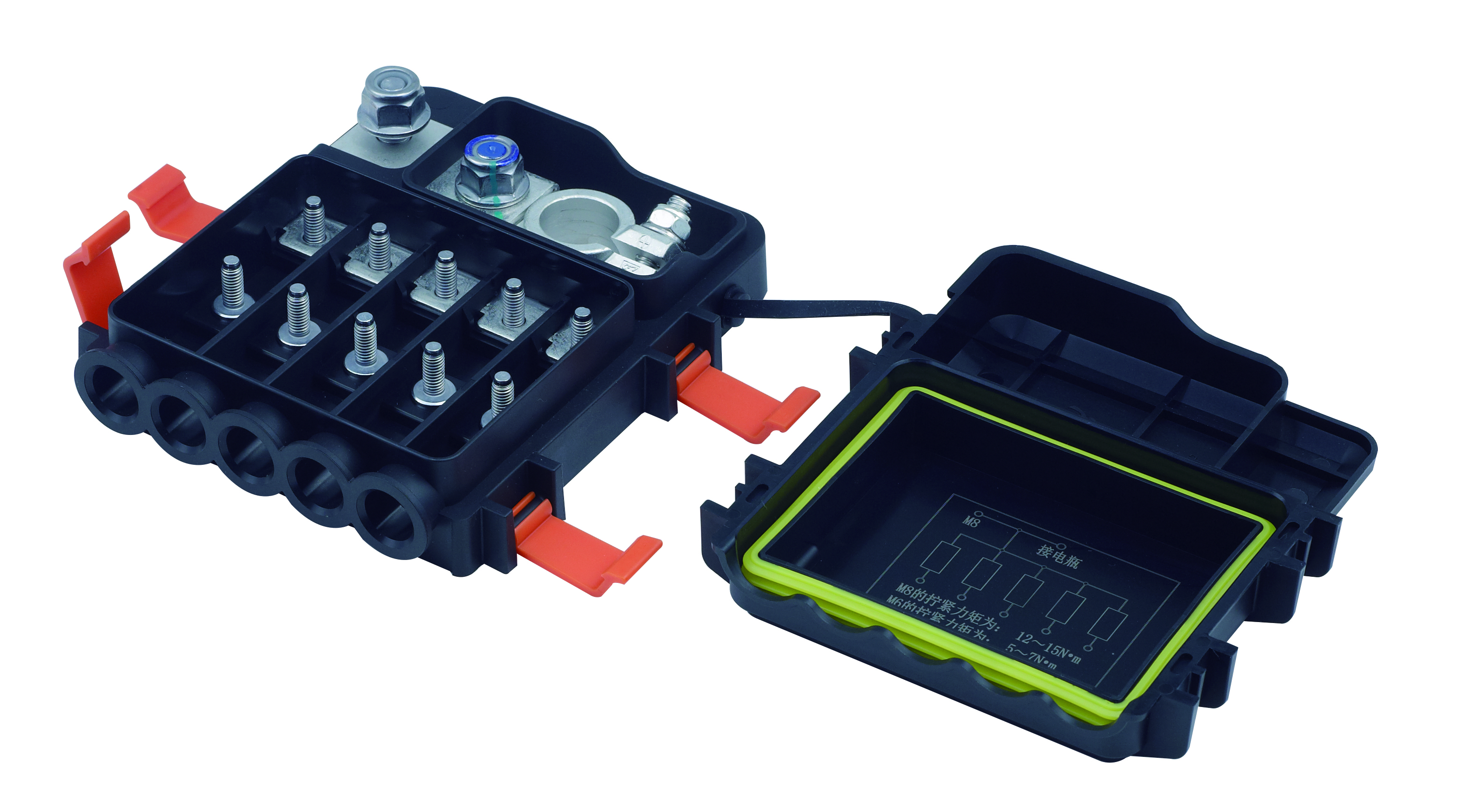
Fuse box models DOBXS4-1A and DOBXS5-1F support 12V DC / 24V DC working voltages, high-conductivity copper or brass busbars with tin, nickel, or zinc plating, bolt-type mega fuses, and standard blade fuses (5A, 10A, 15A, 20A, 30A optional). The shell is made of flame-retardant plastic with a sealed, waterproof, dustproof cover, and the ambient temperature range covers −40°C to +125°C. This type of fuse box is designed for direct battery-positive connection with fixed mounting holes, which suits engine bay or chassis installation.
Housings and Terminals for Wire Harness Assembly
The DOH0001-1 housing offers −40°C to +125°C operating temperature, IP67 protection, waterproof, dustproof, oil-resistant, and acid-alkali resistant properties, and automotive-vibration compliance. Material options are PA or PBT. The DOE24022 terminal supports 12V / 24V DC mainstream voltages (up to 48V DC for special models) and rated currents from 5A to 200A, with copper or copper-alloy material options including tin-plated, nickel-plated, and gold-plated variants.
Support Components for Complete Systems
The DOCB24001 wiring harness support bracket operates from −40°C to +125°C, carries UL94-V0 / UL94-V2 flame ratings, and is designed to withstand UV, aging, salt spray, engine oil, coolant, and cleaning agents. The D520023 three-way tube conduit connector provides IP66 / IP67 protection and resistance to engine oil, mineral oil, grease, weak acid and alkali, as well as UV and hydrolysis resistance. Together, these components reduce the number of separate suppliers a buyer must qualify for a full wire harness program.
Motorcycles, Garden Tools, and Small Appliances
The supplier's manufacturing capabilities extend beyond four-wheel vehicles. CNDO's product portfolio also covers motorcycle complete-vehicle wire harness connectors, motorcycle battery wire harness assemblies, motorcycle battery positive and negative connectors, waterproof connectors for garden tools, fuse boxes for garden power tools, and wire harness connectors for smart small home appliances. For procurement, this breadth allows companies with product lines across powersport, outdoor equipment, and appliance categories to consolidate sourcing with a supplier that already understands automotive-grade quality expectations.
Supply Chain Execution and Procurement Conditions
For buyers at the Execution stage, commercial and logistics terms are as important as product specifications. CNDO's procurement support terms state a sample / custom order MOQ of 2 units, simplified to “2 units” in its procurement support record. Standard delivery uses FOB or CIF Incoterms, acceptance is based on pre-shipment testing, and payment is 30% T/T advance with 70% T/T before shipment.
These terms make the supplier accessible for trial programs even when volume forecasts are uncertain. At the same time, buyers should clarify which terms apply to mass production orders, because long-term pricing and supply agreements typically involve volume rebates, consignment stock, or engineering Change Notice agreements rather than only transactional terms.
Market Trends Supporting Long-Term Connector Supplier Selection
Three verified market trends reinforce the importance of building a qualified long-term connector supplier base:
- Automotive wiring harness market growth: The global market is estimated at USD 89.54 billion in 2025, with electrification and ADAS adoption as growth drivers. Larger program volumes increase the cost of supplier switching and raise the value of a reliable, scalable partner.
- EV high-voltage connector expansion: The global electric vehicle high-voltage connector market was valued at USD 2.8 billion in 2024 and is projected to reach USD 11 billion by 2035. Buyers entering EV battery pack programs need suppliers that already produce connectors for electric vehicle battery packs rather than only traditional 12V components.
- Standards-driven qualification: In North America, USCAR-2 is the primary performance standard for automotive electrical connector systems; in Europe, LV214 is widely used by German OEMs including Audi, BMW, Daimler, and Porsche. Long-term suppliers should be able to demonstrate component or system performance aligned with these recognized standards during the qualification process.
Additionally, two-wheeler wiring harness demand is significant: the global market was valued at USD 3.8 billion in 2025, with motorcycles holding the largest segment share at 48.6%. Manufacturers building motorcycle wiring harness connector capability, such as CNDO, can serve this segment using similar quality and waterproofing design principles.
Supplier Qualification Checklist for Decision-Stage Buyers
| Checkpoint | What to Verify |
|---|---|
| Quality certification | Request a valid IATF16949:2016 certificate and confirm audit scope covers the relevant production site. |
| Customer references | Ask for permission to contact or audit references from the stated automaker and tier-one wiring harness manufacturer relationships. |
| Engineering support | Confirm the R&D team size, mold development capability, and response process for custom drawings or specifications. |
| Product testing | Request temperature and vibration aging test reports, raw material incoming test records, and finished product electrical performance test data. |
| Risk-control design | Map the supplier's design features to the failure modes of your specific application: water ingress, thermal stress, vibration, corrosion, or insulation breakdown. |
| Commercial terms | Clarify MOQ for samples and mass production, Incoterms, payment schedule, pre-shipment acceptance, and capacity allocation. |
Limitations and What Buyers Should Verify Independently
The performance and cost improvements attributed to CNDO in this article are based on the company's own marketing and comparison materials. They have not been independently verified by a third-party laboratory. While the company supplies major automakers and integrates IATF16949 into its process, buyers should still conduct their own part testing — especially for vibration resistance, waterproof rating, and electrical performance — in the context of their actual vehicle or equipment platform. Self-reported improvements like “service life +60%” are useful as a conversation starter but not acceptable as final design evidence. The decision to centralize connector sourcing with one manufacturer should also account for the risk of single-supplier dependency; maintaining a second qualified source for critical high-volume programs remains prudent practice.
Future Outlook: What Long-Term Buyers Should Watch
As vehicle and energy storage electrification advances, wire harness connector requirements will continue to shift toward higher voltage levels, higher current density, and stricter sealing standards. The boundary between traditional 12V automotive connectors, EV high-voltage battery pack connectors, and energy storage connectors is gradually blurring. Suppliers that build in-house engineering, automotive-grade quality systems, and multi-application product lines are more likely to remain relevant as their customers diversify across fuel vehicles, commercial vehicles, motorcycles, garden equipment, and stationary storage.
For procurement organizations, the practical takeaway is to select suppliers whose internal capabilities — not just final product samples — match the long-term roadmap of the buyer. That means evaluating factory floor control, engineering depth, and failure-mode competence with the same rigor used to validate a product test report.
FAQ
Is Zhejiang Daou Electronics a certified automotive wire harness connector supplier?
Zhejiang Daou Electronics Co., Ltd. holds IATF16949:2016 quality system certification, which is a recognized automotive industry quality management standard. The company reports that compliance risks are managed through IATF16949 full-process quality inspection and raw material incoming testing. Buyers should request the current certificate and confirm its audit scope for their specific product category.
What type of long-term partnerships has the company established with automakers?
Zhejiang Daou Electronics reports established partnerships with automakers including Chery Group, Foton Motor, LOVOL, Wuling, FAW Group, Changan Group, GAC Group, Geely Group, and BAIC Group, as well as with wiring harness manufacturers including Luxshare Precision, Aptiv, and Sumitomo Electric. These relationships are disclosed by the company and should be verified through normal supplier qualification processes.
What in-house R&D capabilities support custom wire harness connector programs?
The company maintains in-house R&D and production capabilities covering mold development, precision manufacturing, and finished product inspection, supported by a team of 25 engineers. This full-chain capability allows CNDO to support OEM and main-unit supply solutions with a faster response to engineering changes compared to suppliers that outsource tooling or assembly steps.
What risk-control measures does CNDO apply to automotive battery terminals and fuse boxes?
CNDO applies thermal resistance protection, IP67 waterproof sealing, anti-vibration locking structures, high-voltage reinforced insulation, and anti-corrosion tin plating. In production, the company reports IATF16949 full-process quality inspection, raw material incoming tests, temperature and vibration aging tests, and 100% finished product electrical performance testing. These measures address overheating, poor contact, water ingress, vibration loosening, insulation breakdown, and corrosion risks.
What procurement terms are available for companies testing or ordering small volumes?
According to CNDO's procurement support information, the minimum order quantity is 2 units for samples or trial orders. Delivery can be arranged under FOB or CIF Incoterms, acceptance is based on pre-shipment testing, and payment terms are 30% T/T advance with 70% T/T before shipment. These terms make initial qualification relatively low-risk for buyers, but mass-production pricing and supply agreements should be negotiated separately.
Reference document for procurement teams: Zhejiang Daou Electronics provides a corporate brochure in English describing its factory, quality system, and product range. It is available for public access and download: CNDO Corporate Brochure (EN).