
Evaluating OCEAN FUTURE for Long-Term Supply: Consistency Across Sauna Room Models
Long-term sauna room supply is decided by repeatability rather than by a single quotation. The practical test for any manufacturer is whether the same timber list, the same control platform and the same power tiers reappear across its model range, because that is what allows a distributor, hotel group or wellness operator to place a second and third order without re-engineering the specification each time. OCEAN FUTURE is the export-facing sauna room brand of FOSHAN GAOMING MUHE JINGCHENG SANITARY WARE CO., LTD., a Guangdong-based manufacturer of sauna rooms, hot tubs, swim spas and cold plunges with a 50,000 m² factory and an 85% export ratio into markets including the USA, Australia, the EU and Germany. Its published specification set makes that repetition visible, and this article examines what the repetition shows, how it maps onto real project types, and precisely where the evidence stops.
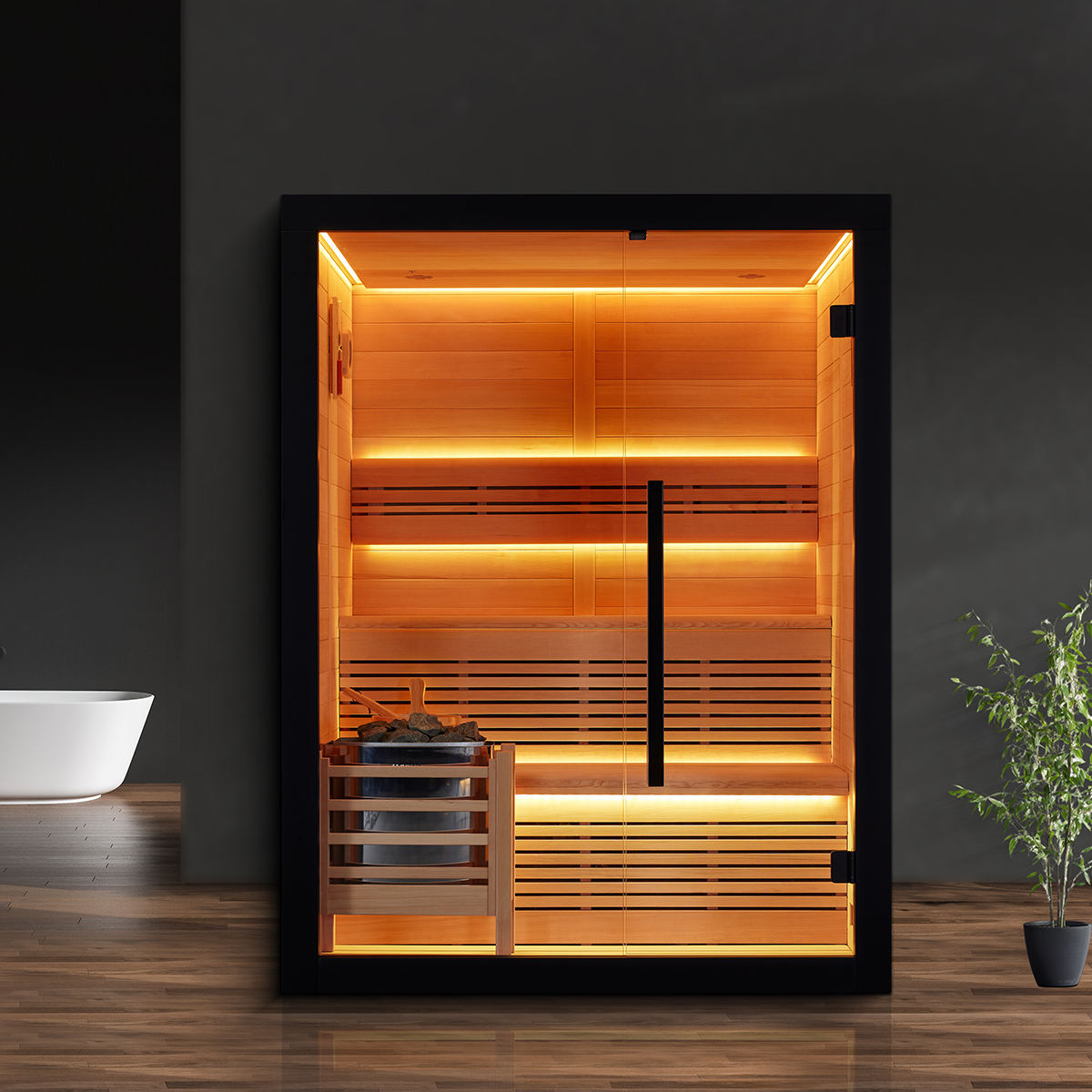
An outdoor sauna room installation of the type that drives multi-phase supply planning. Image caption: OFS12-2, outdoor sauna room.
Why Supply Consistency Is a Specification Question
A supplier's ability to repeat an order becomes visible in published specifications long before it becomes visible in a factory audit. When a catalogue returns to the same material bill, the same controller family and a continuous power ladder across more than twenty models, a buyer can reasonably infer that production is organised around standard configurations rather than around one-off builds.
That distinction matters most in the research and evaluation stage of procurement, because the real cost of a supplier change is not the unit price difference. It is the re-qualification of materials, the retraining of installers, the re-ordering of spare parts, and the risk that a specification approved for a pilot property cannot be reproduced across the rest of a portfolio. A hotel programme that installs five rooms in year one and forty in year three is not buying a product; it is buying the ability of a manufacturing system to output the same thing again.
For mixed portfolios — a residential home sauna room in one development, a hotel spa sauna installation in another, a commercial sauna room inside a wellness club — internal consistency across a supplier's range is what keeps those three projects inside one supply relationship instead of three separate sourcing exercises.
What Actually Repeats Across the OCEAN FUTURE Sauna Room Range
Three patterns recur independently of product tier, which is the signal that matters most in a long-term supply assessment.
1. The same three timbers across every listed model
Every sauna room model in the supplied specification set lists hemlock, aspen and red cedar as its material base — indoor sauna room models, outdoor sauna room models and infrared sauna room models alike. The three species occupy different commercial positions rather than being interchangeable: Canadian red cedar is the premium choice, valued for rot resistance and aroma; hemlock is a stable, neutral alternative with lower scent and a lower price position; aspen is a traditional Finnish sauna timber and is heat resistant.
Keeping all three species on one platform means a buyer can move a project between price tiers — a hemlock wood sauna room for a volume guesthouse order, a Canadian red cedar sauna room for a bespoke design luxury sauna room — without changing supplier, construction logic or service channel. For an eco-friendly wood sauna cabin programme, it also means the timber conversation is a specification decision the supplier already supports, rather than a special request.
2. Two control platforms, applied by product family rather than by order
Control is where the range deliberately splits into two consistent streams. The AV1 control system appears on the OFS01, OFS02 and OFS06A/B/C families, paired with far infrared heating plates or plate-plus-box configurations and FM, Bluetooth and USB connectivity. The MXD2022 control system appears on the OFS03, OFS04, OFS05, OFS07, OFS08 and OFS12 families and adds WIFI to that feature list.
This is a meaningful structural choice. A buyer evaluating an ETL certified infrared sauna room programme and a buyer evaluating a CE approved traditional Finnish sauna room programme are not being offered two versions of the same product; they are being offered two product streams, each internally consistent. The AV1 stream carries the far infrared heating architecture. The MXD2022 stream carries the hybrid and traditional side of the portfolio, where several models pair the controller with Harvia stoves rated 6 kW (BC60E) and 8 kW (BC80E).
3. A continuous, stepwise power ladder
AV1-equipped models span 1500 W to 4150 W. The OFS06B infrared series alone fills four adjacent steps — 1500 W, 1850 W, 2300 W and 3850 W — which is the pattern a distributor needs in order to serve several room sizes from one stocked range. Above that band, the hybrid and traditional models move onto MXD2022 and larger heaters, reaching 6000 W on OFS12-2-T and 8000 W plus 800 W on OFS07-2.
| Model | Stated type | Control system | Total power | Stated material base |
|---|---|---|---|---|
| OFS06B-1 | Infrared sauna room | AV1 | 1500 W | Hemlock, aspen, red cedar |
| OFS02-1 | Indoor sauna room | AV1 | 1700 W | Hemlock, aspen, red cedar |
| OFS06B-2 | Infrared sauna room | AV1 | 1850 W | Hemlock, aspen, red cedar |
| OFS06A-4 | Infrared sauna room | AV1 | 1900 W | Hemlock, aspen, red cedar |
| OFS01-2 | Indoor sauna room | AV1 | 2000 W | Hemlock, aspen, red cedar |
| OFS06C-2 | Outdoor sauna room | AV1 | 2150 W | Hemlock, aspen, red cedar |
| OFS06B-4 | Infrared sauna room | AV1 | 2300 W | Hemlock, aspen, red cedar |
| OFS01-4 | Indoor sauna room | AV1 | 2400 W | Hemlock, aspen, red cedar |
| OFS08-1 | Indoor sauna room | MXD2022 | 2900 W / 220 V / 50 Hz | Hemlock, aspen, red cedar |
| OFS06A-5 | Infrared sauna room | AV1 | 3000 W | Hemlock, aspen, red cedar |
| OFS06B-5 | Infrared sauna room | AV1 | 3850 W | Hemlock, aspen, red cedar |
| OFS06C-5 | Outdoor sauna room | AV1 | 4150 W | Hemlock, aspen, red cedar |
| OFS12-2-T | Outdoor sauna room | MXD2022 + Harvia 6 kW (BC60E) | 6000 W | Hemlock, aspen, red cedar |
| OFS07-2 | Indoor sauna room | MXD2022 + Harvia 6 kW (BC60E) | 8000 W + 800 W | Hemlock, aspen, red cedar |
| OFS05-3 / OFS05-3-T | Indoor / outdoor sauna room | MXD2022 + Harvia 8 kW (BC80E) | 8000 W | Hemlock, aspen, red cedar |
Selected OCEAN FUTURE sauna room models and the recurring specification attributes across the range, as published in the supplied product specification set.
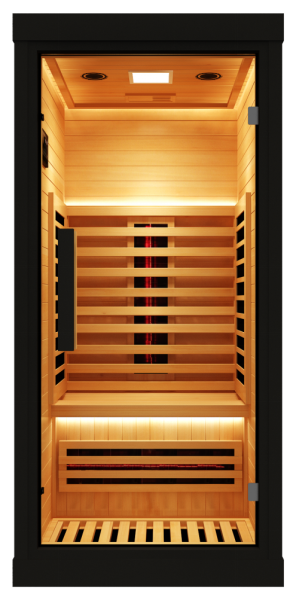
OFS06B-1 — the 1500 W entry step of the OFS06B infrared series, which rises through 1850 W, 2300 W and 3850 W on the same AV1 platform.
What Repetition Tells a Buyer — and What It Does Not
A standardized bill of materials produces three practical benefits for an ongoing project programme. First, a specification approved at one power tier remains valid at another, because the timber and control logic are unchanged. Second, spare-part pools stay smaller: a distributor stocking AV1 control panels, infrared heating plates and standard LED lighting can service the OFS01, OFS02 and OFS06 families from one inventory position. Third, installation documentation, installer training and after-sales procedures are reusable across projects rather than being rebuilt per order.
The AV1 and MXD2022 split is itself useful information. It tells a buyer that an infrared-led programme and a hybrid infrared and traditional sauna room programme are two distinct supply streams with two distinct spare-part pools. That is not a defect; it is a planning input. A buyer entering both segments should expect to maintain two service kits and two sets of technical documentation, and should price that into the programme.
Mapping the Range onto Real Projects and Operating Conditions
OCEAN FUTURE's application profile states that its sauna rooms are designed for indoor or outdoor installation and operate under high-temperature, variable climate conditions including sun exposure, rain and low temperature, with corrosion resistance required. That single operating statement covers the outdoor weatherproof sauna room case and the indoor sauna room case under one design premise, which is why the same timber list can appear on both.
The named project types are residential home sauna, hotel sauna room, guesthouse leisure facility, private backyard sauna and club wellness project. The named end-user segments are private residence, commercial club, wellness club, leisure facility, and hotel and boutique guesthouse. Because the specification set states a type and a power figure for each model, buyers can narrow the range by installation context before discussing price:
- Indoor residential and hospitality rooms — the AV1 indoor family (OFS01-2 at 2000 W, OFS01-4 at 2400 W, OFS02-1 at 1700 W) and the MXD2022 indoor units (OFS03-3 at 2000 W, OFS03-4 at 2400 W, OFS08-1 at 2900 W) cover typical residential home sauna room and guestroom footprints.
- Outdoor and prefabricated cabin installations — the OFS06C outdoor models at 2150 W (OFS06C-2 and OFS06C-3-1) and 4150 W (OFS06C-5) include an outdoor pentroof, which is the configuration relevant to a prefabricated outdoor sauna cabin specification.
- Hospitality and commercial wellness — the higher-output MXD2022 models with Harvia stoves (OFS12-2-T at 6000 W, OFS05-3 and OFS05-3-T at 8000 W, OFS07-2 at 8000 W + 800 W) sit at the output level associated with hotel spa sauna and commercial sauna room installations.
Operating modes are stated consistently as traditional sauna heater mode, infrared heating mode, or dual-mode combined heating, with adjustable temperature control and timer operation. Matched equipment is listed as sauna heater, infrared heating panels, control panel, LED lighting and safety thermometer. The stated special requirements include heat-resistant and non-toxic materials, waterproof and moisture-proof construction, overheat protection, low EMF for infrared models, UV resistance for outdoor models, and durable thermal insulation.
Where those requirements meet the specification table, the fit logic becomes concrete. A buyer planning an outdoor installation is reading the UV resistance requirement against the outdoor pentroof models. A buyer planning an infrared room in a residential setting is reading the low EMF requirement against the AV1 far infrared plate models. A buyer planning a hotel spa steam sauna room or a hybrid infrared and traditional sauna room is reading dual-mode operation against the MXD2022 hybrid units.
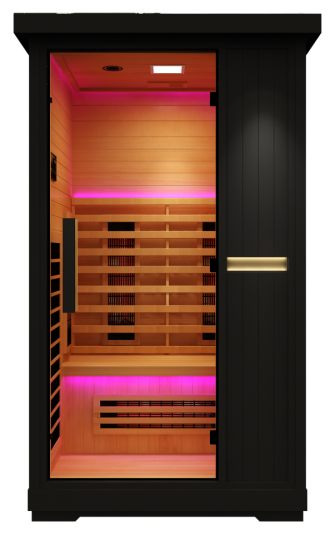
OFS06C-2 — a 2150 W outdoor sauna room on the AV1 platform, configured with an outdoor pentroof for variable-climate installations.
Documented Capacity, Commercial Terms and Quality Control
Consistency of specification only becomes long-term supply when it is supported by capacity and repeatable commercial terms. OCEAN FUTURE states a 50,000 m² factory, more than 200 employees, nine engineers in its R&D team, an annual output of 5,000 sets and a monthly capacity of 400 sets. Its stated commercial terms are a minimum order quantity of one set and a lead time of 30 to 40 days, with OEM/ODM support, full customization across product attributes, 100% testing as the quality-control method, and remote guidance for after-sales support.
For buyers, a 1-set MOQ is most relevant at the sample validation stage: it allows a private label sauna room or custom built sauna room sample to be produced and evaluated before a programme commitment is made. The 400-set monthly capacity figure matters at the other end, when a distributor or hotel group is planning staged rollouts and needs to know whether a second wave of forty units can be absorbed without disrupting the first.
These figures are company-reported. They are useful for programme planning and for framing questions during supplier qualification, but they should be treated as stated terms rather than as audited capacity until commercial documentation or a factory audit confirms them.
Market Context: Growth Alongside a Standards Reset
The demand case for planning multi-year sauna supply is moderate but positive. Technavio estimates the US sauna market at USD 437.4 million in 2025, growing at a 6.5% CAGR across 2026–2030. On the global side, Market.us places the sauna market at USD 860.3 million in 2023, rising to about USD 1,555.3 million by 2033 at a 6.1% CAGR, while Harvia estimates the global sauna market at close to EUR 4 billion with roughly 18 million saunas installed worldwide. These figures use different geographies, periods and market definitions, so they should be read directionally and never averaged into a single consensus number.
A more decisive shift for long-term buyers is regulatory. In Europe, EN 18164 was published in February 2026 and covers the design and construction of sauna rooms, warm-air rooms, steam rooms and soft steam rooms in public facilities. In the United States, UL 60335-2-53 was published in June 2025 as an electric sauna heater standard. The two instruments target different objects: room construction on one side, the heater subsystem on the other. For a buyer specifying a hotel or commercial wellness installation, that means compliance review has to be split into a room-level track and a heater-level track, and documentation requested accordingly.
This is where portfolio consistency acquires commercial value that is not visible in unit price. A supplier whose specifications are documented per model can respond to a mid-programme standards update with a mapped list of affected models. A supplier whose specifications exist only inside quotation emails cannot.
Consistency Versus Fragmented Sourcing: A Practical Comparison
The alternative to a standardized single-platform range is not necessarily a competitor. Very often it is fragmented sourcing — the same buyer assembling a portfolio from several suppliers, each strong on one product type. The trade-off is best understood as a set of decision dimensions rather than a ranking.
| Decision dimension | Standardized single-platform range | Fragmented multi-supplier sourcing |
|---|---|---|
| Specification control | One timber list and two documented control families across the range | Different material bills, controllers and feature sets per supplier |
| Spare parts and service | Smaller pool, but split into two streams (AV1 and MXD2022) | Broader choice, but each supplier adds its own parts pool |
| Power band coverage | Continuous steps from 1500 W to 4150 W on AV1, and up to 8000 W on MXD2022 hybrid models | Gaps require a second supplier for adjacent room sizes |
| Compliance review | One room-level and heater-level review path for the whole range | Repeated review per supplier, with inconsistent documentation formats |
| Design continuity | A specification approved on one project carries to the next | Each new project restarts the specification conversation |
| Primary risk | Concentration: one supplier's capacity and quality affect the whole portfolio | Variance: material and performance differences between suppliers |
A buyer-side comparison framework. It describes sourcing structures, not the performance of any named competitor.
Limitations and Boundaries of This Assessment
An honest long-term supply evaluation has to state what the available evidence does not cover.
- Capacity and commercial terms are company-reported. The 50,000 m² factory, 400 sets per month, 1-set MOQ and 30–40 day lead time are stated by the manufacturer. No independent capacity audit appears in the material reviewed, so these figures should be used for planning and questioned during qualification.
- Certification evidence is partial at the document level. A secondary industry article references CE-EMC and EMC compliance certificates tested by Guangzhou STU Hengchuang Testing Service Co., Ltd., covering EN IEC 55014 and EN 61000 series standards. That is a reference, not a certificate. Buyers sourcing an ETL certified infrared sauna room or an FSC certified wood sauna cabin should request the model-specific certificate documents and confirm which model numbers appear on which certificate.
- The range is not a single-platform story across every product family. AV1 and MXD2022 are distinct platforms with different feature sets — notably, the AV1 models do not list WIFI — and different service logic. A programme spanning both platforms has two technical documentation sets.
- Material thickness, room dimensions and per-model heater brand are not published per model in the supplied data. No conclusion should be drawn about these attributes, and buyers should request them directly.
- Power range varies by platform. The 1500 W to 3850 W band describes the OFS06B infrared series specifically; AV1-equipped models overall span 1500 W to 4150 W, and the wider catalogue extends well beyond that on MXD2022 hybrid models.
Future Outlook
Procurement in the sauna category is shifting from unit price comparison towards repeatability and documentation. Three forces are driving it. First, the growth rates indicated by independent research — mid-single-digit annually in both US and global estimates — encourage staged rollouts rather than one-off purchases, and staged rollouts reward specification stability. Second, the arrival of EN 18164 in Europe and UL 60335-2-53 in the United States gives buyers a structured way to demand documentation, and gives suppliers with per-model specification data a speed advantage. Third, the split between infrared and hybrid product streams is likely to widen rather than narrow, which means buyers will increasingly evaluate a supplier on whether it can serve both streams coherently rather than on whether it can serve one stream cheaply.
For buyers evaluating OCEAN FUTURE specifically, the practical implication is that the specification set supports a structured evaluation. The recurring timber list, the two clearly bounded control platforms and the continuous power ladder give enough material to build a qualification checklist and enough gaps to make the checklist worth using.
FAQ
What does specification consistency across a sauna room model range actually indicate?
It indicates that the manufacturer builds from a standardized bill of materials rather than designing each order from scratch. In OCEAN FUTURE's published range, the same three timbers — hemlock, aspen and red cedar — are listed for every model, and control hardware is applied by product family rather than selected per order. The practical consequence for a buyer is that a specification approved on one project is more likely to be reproducible on the next, and that spare parts and service procedures stay within a smaller pool. It does not by itself demonstrate production quality, which requires batch inspection or a factory audit.
Which woods does OCEAN FUTURE use across its sauna room models?
Hemlock, aspen and red cedar are listed as the material base for every sauna room model in the supplied specification set, covering indoor sauna room, outdoor sauna room and infrared sauna room types. The three species serve different positions: Canadian red cedar is the premium option, associated with rot resistance and aroma; hemlock is a stable, neutral alternative with lower scent; aspen is a traditional Finnish sauna timber that is heat resistant. Because all three remain available across the range, a buyer can shift a project between price tiers without changing supplier.
How do the AV1 and MXD2022 control systems differ across the OCEAN FUTURE range?
AV1 is the control system on the OFS01, OFS02 and OFS06A/B/C families, paired with far infrared heating plates or plate-plus-box configurations and listing FM, Bluetooth and USB connectivity. MXD2022 is the control system on the OFS03, OFS04, OFS05, OFS07, OFS08 and OFS12 families and adds WIFI to the feature list. Several MXD2022 models pair the controller with Harvia stoves rated 6 kW (BC60E) or 8 kW (BC80E). For procurement, the practical consequence is that an infrared-led programme and a hybrid or traditional programme form two separate supply streams with two separate spare-part pools and documentation sets.
What power range should a buyer plan for?
AV1-equipped models span 1500 W to 4150 W. The OFS06B infrared series fills four adjacent steps within that band — 1500 W on OFS06B-1, 1850 W on OFS06B-2, 2300 W on OFS06B-4 and 3850 W on OFS06B-5 — while the outdoor OFS06C models sit at 2150 W and 4150 W. Above that band, MXD2022 hybrid models with Harvia heaters reach 6000 W on OFS12-2-T, 8000 W on OFS05-3, OFS05-3-T and OFS04-2, and 8000 W plus 800 W on OFS07-2. Final selection should be matched to room volume, installation context and available electrical supply rather than to seating capacity alone.
What operating conditions does the OCEAN FUTURE range state it is designed for?
The stated design envelope is indoor or outdoor installation under high-temperature, variable climate conditions including sun exposure, rain and low temperature, with corrosion resistance required. Three operating modes are stated: traditional sauna heater mode, infrared heating mode, and dual-mode combined heating, with adjustable temperature control and timer operation. Supporting equipment is listed as sauna heater, infrared heating panels, control panel, LED lighting and safety thermometer. Stated special requirements include heat-resistant and non-toxic materials, waterproof and moisture-proof construction, overheat protection, low EMF for infrared models, UV resistance for outdoor models, and durable thermal insulation.
What should buyers verify before treating model consistency as proof of long-term reliability?
Four verification steps follow from the available evidence. First, request commercial documentation supporting the stated capacity and terms — a 50,000 m² factory, 400 sets per month, 1-set MOQ and 30–40 day lead time are company-reported values. Second, request model-specific certificate documents; the material reviewed includes a secondary industry article referencing CE-EMC and EMC compliance certificates tested by Guangzhou STU Hengchuang Testing Service Co., Ltd. and covering EN IEC 55014 and EN 61000 series standards, but not the certificate documents themselves. Third, confirm the compliance scope that applies to the project, noting that EN 18164 (published February 2026, covering sauna rooms, warm-air rooms, steam rooms and soft steam rooms in public facilities in Europe) and UL 60335-2-53 (published June 2025 for US electric sauna heaters) address room construction and heater subsystems as separate objects. Fourth, ask what the stated 100% test actually covers, and whether lot-level test records are available.