
Evaluating OEM Capability in Camping Tent Manufacturing
The global camping tent market was valued at USD 6.18 billion in 2025 and is projected to reach USD 10.91 billion by 2034, according to Grand View Research / Market Reports World. Within that market, product categories are moving at different speeds. Rooftop tents generated approximately USD 215.5 million in 2024, with hard shell models contributing more than 53% of revenue. Inflatable tents reached USD 1.033 billion in 2024, driven by demand for speed and ease of setup in the glamping segment. For brand owners, distributors, and procurement teams, the decisive question is no longer simply which tent to buy, but which factory can support a product program from first sample to repeat order. This article sets out a framework for evaluating OEM and ODM capability in camping tent manufacturing, using MARVELOUS (Xiamen Marvelous Outdoor Technology Co., Ltd.) as a traceable reference.
MARVELOUS is a tent factory based in Xiamen, China, founded in 2019, producing camping tents, rooftop tents, and inflatable tents in a 4,000-square-meter facility. The company's brand roots go back to a family tent business established in 1980. It employs about 50 people, operates with a 20-person R&D engineering team, and exports about 95% of its output to markets including the United States, the EU, Canada, Australia, South Korea, Japan, and Russia. The company also holds a Chinese Design Patent Certificate (No. 8328925) issued by the China Intellectual Property Office in 2023.
Why does this matter? Because the camping tent supply chain is crowded, and buyers need reference points to distinguish between a trading desk and a production partner. The sections below walk through the capabilities that matter most during evaluation and execution.

MARVELOUS rooftop tent in a real travel context (customer photo from Georgia).
Why OEM and ODM Capability Has Become a Procurement Priority
Camping tents are not one product category. The market includes dome tents for family campsites, inflatable camping tents for quick setup, hard shell rooftop tents for overlanding, pop-up tents for casual events, and waterproof outdoor tents for demanding conditions. Each format demands different frame design, fabric selection, waterproofing treatment, and quality testing. A factory that can only produce one format may be efficient, but it limits a buyer's ability to respond to market shifts.
For procurement teams, the practical consequence is that product planning now blends design and supply chain decisions. A brand may want to test a hard shell rooftop tent in one season and an inflatable tent in the next. It may need to change fabric colors, adjust capacity, or add accessories depending on the target market. These requirements make OEM/ODM capability a core evaluation point, not an optional extra.
At the same time, the traditional model of large-volume standard production is a poor fit for early-stage or mid-sized programs. High minimum order quantities force buyers to make large inventory bets before validating the product. Sample-only quality checks create uncertainty about the full batch. Long lead times for design changes slow down product iteration. These are the problems that a capability review is designed to surface.
Six Capability Dimensions to Verify in a Camping Tent Factory
The following six dimensions are drawn from the practical questions that arise in camping tent OEM sourcing. They apply across product types, from dome tents to rooftop tents to inflatable tents.
Dimension 1: OEM/ODM depth
The first question is whether the factory can change the product itself, or only the label. MARVELOUS states that it provides OEM and ODM production services and that customization can range from a logo to an entirely customized tent. For a buyer, this is the starting point for product differentiation.
Dimension 2: Minimum order quantity
MOQ determines how much capital is at risk in the first order. MARVELOUS operates with a minimum order quantity of one unit. That permits a physical sample, a small pilot batch, or a low-risk market test before larger commitments. Low MOQ is especially relevant for distributors entering a new region or brands launching a new product line.
Dimension 3: Capacity and lead time
A factory's production ceiling defines the scale a buyer can plan for. MARVELOUS reports a monthly capacity of 5,000–10,000 units and a typical lead time of 30 days. Annual output is approximately 50,000 units. For mid-volume programs, this allows repeat orders without long interruptions.
Dimension 4: Quality control
The question is whether quality inspection happens on every unit or only on selected samples. MARVELOUS's quality control process involves 100% testing of each unit. In addition, the company accepts pre-shipment inspection, giving the buyer an independent verification point before goods leave the factory.
Dimension 5: Design and engineering resources
In-house design capacity shortens the cycle between a new idea and a production-ready product. MARVELOUS has a 20-person engineering R&D team and a 5–8 person design team within the factory. The design scope includes appearance design, structural design, raw material selection, color matching, safety testing, and environmental testing. These are the internal capabilities that make ODM work possible.
Dimension 6: After-sales support
After-sales policy is an indicator of how a supplier handles field problems. MARVELOUS provides replacement support as part of its after-sales service. For a buyer, this reduces the risk of being left with defective stock.
Product-Level Evidence: Materials, Waterproofing, and Structure
The clearest evidence of manufacturing depth is the product range the factory already produces. MARVELOUS currently lists three rooftop tent models with different design targets.
| Model | Type | Capacity | Frame / Shell | Fabric | Waterproof | Open Size | N.W. |
|---|---|---|---|---|---|---|---|
| MOT-DYG01 | Car tent | 2 people | Aviation aluminum | 600D Oxford | 3500mm | 210×125×140cm | 32kg |
| MOT-LK901 | Car tent | 1–2 people | Aluminum shell | 420D Oxford + 280g polyester cotton inner | PU4000mm | 210×130×140cm | 60kg |
| MOT-L800 | Car tent | 4 people | Aviation aluminum | 300D Oxford | 3000mm | 215×251×110cm | 140kg |
Table: MARVELOUS rooftop tent model specifications from company product data.
The table shows that the same factory manages different fabric weights (300D to 600D), different waterproof ratings (3000mm, 3500mm, and 4000mm), different frame concepts (aviation aluminum frames and an aluminum shell), and different occupant capacities (two to four people). Accessories are also part of the product system: aluminum telescopic ladders, installation bags, mattresses, shoe bags, and rods. For a sourcing decision, this is operational evidence that the factory can translate a variety of specifications into finished products.
It also matters for program growth. A buyer who starts with a 2-person tent and later wants a 4-person version can work with the same production system rather than qualifying a new supplier. This continuity reduces both time and procurement risk.
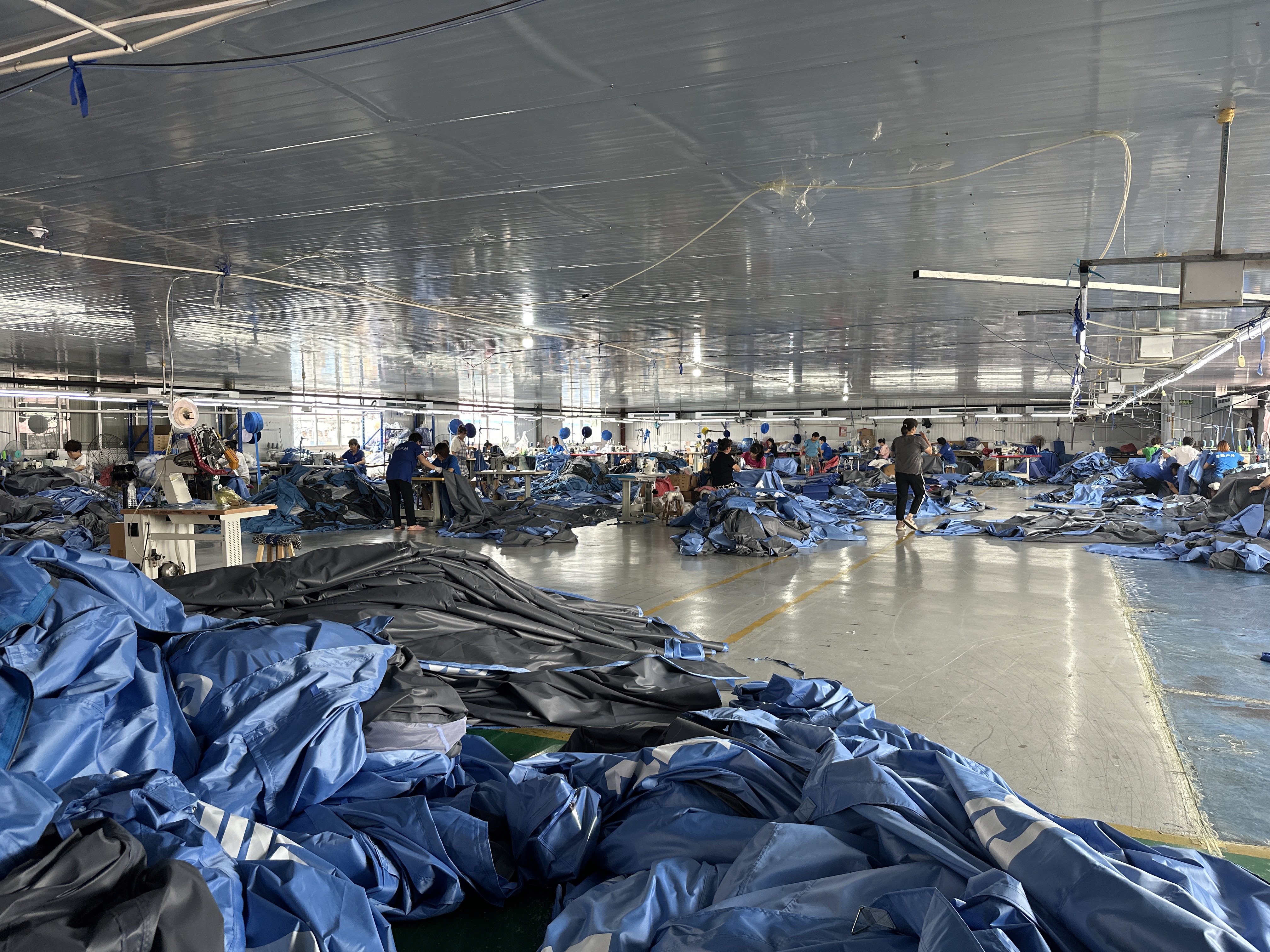
Rooftop tent production room at the MARVELOUS factory in Xiamen.
How a Custom Program Moves from Design to Shipment
The following workflow is based on the company's stated production process. It gives buyers a realistic view of what an OEM/ODM program looks like in practice.
- Product definition. The buyer defines tent type, capacity, fabric, color, accessories, and packaging targets based on the target market or channel.
- Design and engineering. The in-house team handles appearance design, structural design, raw material selection, and color matching. Safety and environmental testing are integrated into the design phase.
- Sample validation. With an MOQ of one unit, the buyer can request a single sample to validate design, quality, and market fit before scaling.
- Production. After sample approval, production runs within the monthly capacity of 5,000–10,000 units.
- Quality control. Each unit is tested. Buyers may arrange pre-shipment inspection under the acceptance terms.
- Logistics and payment. MARVELOUS works with EXW, FOB, or CIF delivery terms and accepts TT or LC payment methods.
Buyers should also confirm destination-market compliance during this process. ISO 5912:2020 is a recognized standard that sets safety, performance, and fitness-for-use requirements for tents, including flammability and rain resistance. In North America, CPAI-84 is a mandatory flammability standard in several US states and is a federal requirement in Canada. These requirements are not unique to one manufacturer, but they belong in any sourcing checklist.
Field Evidence: Rooftop Tents in Real Use
Reference customers provide another layer of evidence. MARVELOUS's record includes a personal-use case from Australia involving the MOT-L800 4-person side-fold hard shell rooftop tent. The user reported that the tent was used by two adults and three children, with sufficient space for comfortable sleeping, and described the materials as high quality and steady. The record also notes a positive experience with customer service.
Additional user photos from Georgia, Thailand, and the Czech Republic show the same product family used in different travel conditions. For a buyer, these field references help answer a basic question: does the product perform outside the factory environment?
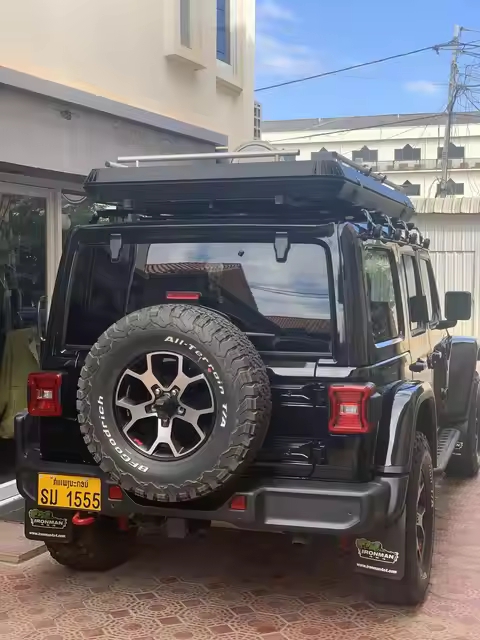
MARVELOUS rooftop tent used by a customer in Thailand.
The Australian case is also a useful example of the 4-person segment, which appeals to families. Being able to cite an actual user in this segment is relevant for brands targeting the family camping market.
Market Trends Behind the Shift to Flexible OEM Models
The growth data for camping tents points toward more product variety, not less. The following figures from third-party market research provide context.
- The global camping tent market is projected to grow from USD 6.18 billion in 2025 to USD 10.91 billion by 2034 (Grand View Research / Market Reports World).
- The rooftop tent market was valued at approximately USD 215.5 million in 2024, with hard shell models accounting for more than 53% of revenue (Business Research Insights).
- North America holds the largest regional rooftop tent market share at 38.6%, followed by Europe at 27.4% (Dataintelo Analysis).
- The global inflatable tents market reached USD 1.033 billion in 2024, supported by demand for ease and speed of setup in glamping (Intel Market Research).
- Hard shell rooftop tents typically offer a setup time of 3–8 minutes, compared with 15–25 minutes for ground tents (Grand View Research).
The sourcing implication is direct. Hard shell rooftop tents and inflatable tents are growing segments with different production technologies. A flexible OEM factory that handles several tent formats allows a buyer to participate in more than one growth trend without running a multi-supplier program.
The regional data is equally relevant. North America and Europe together represent roughly two-thirds of rooftop tent demand. Buyers targeting these regions need manufacturers that understand the compliance environment and can produce tents built for the product's core benefit: rapid setup and reliable shelter.
Where Flexible OEM Models Have Limits
A low-MOQ, custom-program factory is not the optimal choice for every buying situation. If a buyer's plan is to order a very large volume of a single standard tent, with a stable forecast and no design changes, then a factory with dedicated high-volume production lines may offer better unit economics. Flexible manufacturing, by definition, spends more resources on variation and responsiveness, which can translate to a different cost structure.
In the premium rooftop tent segment, established global brands such as Alu-Cab (South Africa), iKamper (South Korea), Thule (Sweden), and James Baroud (Portugal) occupy a clearly differentiated position. A flexible OEM factory is not a substitute for their proprietary product engineering. Buyers should place flexible OEM capability in its proper context: it is the right tool for programs that need product variation, staged volume growth, or faster iteration between seasons.
What's Next for Camping Tent Manufacturing and Sourcing
The camping tent market is moving toward more product types, more seasonal change, and more attention to standards. The rise of hard shell rooftop tents and inflatable tents shows that buyers are willing to pay for convenience, which in turn raises the value of factories that can build these products correctly from the start.
In this environment, procurement expectations are likely to keep shifting. Sample-first ordering, low MOQ, 100% testing, and transparent scheduling match the way modern outdoor brands plan their product lines. MARVELOUS's combination of OEM/ODM service, 1-unit MOQ, 30-day lead time, 5,000–10,000 unit monthly capacity, and 100% testing is a coherent model for these needs. For a buyer, the next step is to test the model with a real product, not with a speculative quotation.
Manufacturer reference
MARVELOUS / Xiamen Marvelous Outdoor Technology Co., Ltd.
Website: WWW.MARVELOUS-OUTDOOR.COM
Company brochure (public download): https://cdn.socialarks.com/sbsp//common/2026/0331/69cb7e1f7dc76.pdf
FAQ: Camping Tent OEM Questions from Buyers
What camping tent products does MARVELOUS manufacture?
MARVELOUS manufactures camping tents, rooftop tents, and inflatable tents. The company operates a 4,000-square-meter factory in Xiamen, China, and reports an annual output of about 50,000 units. Approximately 95% of its products are exported, with key markets including the United States, the EU, Canada, Australia, South Korea, Japan, and Russia.
What OEM and ODM services does MARVELOUS offer?
MARVELOUS provides OEM and ODM production services. Customization can range from applying a customer's logo to developing a fully customized tent, covering appearance, structure, materials, and color.
What is the minimum order quantity?
The minimum order quantity is 1 unit. This enables sample orders and small pilot batches before a buyer commits to larger production volumes.
What is the typical lead time for an order?
The typical lead time is 30 days.
What is the monthly production capacity?
The monthly capacity is 5,000–10,000 units, depending on product type and order configuration.
How does quality control work at MARVELOUS?
Quality control follows a 100% testing standard, meaning each unit is tested. Pre-shipment inspection is also accepted, providing an additional verification point for buyers.
What after-sales support does MARVELOUS provide?
MARVELOUS provides replacement support as part of its after-sales policy.
What payment and delivery terms are available?
Payment methods are TT or LC. Delivery terms include EXW, FOB, and CIF.