
Evaluating PGM Scrap Recovery Buyers: A Comparison Framework
Independent industry reference · Precious metal scrap recovery · Buyer evaluation

In-house assay capability is one of the few verifiable assets a PGM scrap buyer can inspect from abroad.
Precious metal scrap recovery is a procurement decision before it is a metallurgical one. For an overseas seller holding platinum, palladium, rhodium, ruthenium or iridium bearing material, the practical question is rarely whether PGM values exist inside the lot. It is who, on the China side, can take custody of that material, prove what was in it, prove what came out of it, and stand behind both numbers when they are challenged.
This article sets out a comparison framework rather than a shortlist. It examines the three cooperation structures that overseas scrap suppliers and mineral traders most often encounter when placing PGM-bearing material into Chinese processing capacity — direct email-based cooperation with a domestic smelter, cross-border traders and local overseas agents, and one-stop factory partners — and evaluates them against the criteria that actually decide outcomes: trust, transparency, assay-dispute exposure, and the handling of import-export formalities and logistics.
What precious metal scrap recovery means in a cross-border transaction
Precious metal scrap recovery, in the cross-border toll-processing context, refers to the conversion of PGM-bearing secondary materials — spent catalysts, platinum placer ore, iridium-ruthenium coated titanium mesh, plating residues and comparable industrial scrap — into refined metal or precious-metal chemical compounds, with sampling, assay, loss accounting, documentation and settlement attached to the physical flow of the material.
That definition matters because it separates three functions that are frequently bundled in a quotation but are technically and commercially distinct: the physical processing function (smelting and purification), the analytical proof function (sampling and assay), and the trade-compliance function (import-export documentation, customs declaration and international logistics coordination). Whether one accountable entity holds all three — or whether they are split across a smelter, an agent and a shipper — is the single largest structural difference among the models compared below.
The market context: more secondary material, more counterparties
Secondary PGM supply is no longer a marginal stream. Johnson Matthey's PGM Market Report published in May 2024 reported platinum secondary supply rising to 1.53 million ounces, or roughly 48 tonnes, with autocatalyst and electronics scrap as the principal drivers. Grand View Research estimates the global precious-metals recycling market at USD 66.9 billion in 2026 within its forecast to 2035. Both are third-party estimates and describe volume and value, not verifiability.
Alongside that growth, a compliance variable has been added. The Responsible Jewellery Council's Code of Practices standard states that, as of 1 January 2026, COP 2024 is the mandatory standard for all RJC audits. Where an overseas counterparty is itself subject to downstream due diligence, the audit trail of a toll-processing chain starts to function as a market-access condition rather than a preference.
The consequence is straightforward. The number of intermediaries able to quote a PGM scrap lot has grown faster than the number able to document one. A framework for comparing them is therefore more useful than a list of names.
Three cooperation models overseas sellers actually encounter
Model A — direct email-based cooperation with a domestic smelter
In this model an overseas seller corresponds directly with a Chinese smelting plant, agrees pricing and processing terms by email, ships the material, and receives an assay and a settlement after arrival.
Its genuine strength is the shortest possible chain to the processing site, with fewer parties able to add margin between the scrap and the furnace. Its weakness is structural rather than personal. The counterparty may be a real smelter, but the entire cooperation rests on documents exchanged by correspondence, and no party is positioned to carry sampling, assay, smelting, arbitration evidence and customs documentation as one accountable chain. When the assay on arrival differs from the seller's expectation, the seller typically discovers that the point at which the dispute must be resolved is also the point at which it has the least standing.
Model B — cross-border traders and local overseas agents
Traders and agents aggregate lots, bridge language, arrange freight and often provide the commercial comfort of a locally known counterparty. For a first shipment, this can be the lowest-friction entry point.
The limitation is where the work actually happens. Processing is frequently subcontracted, so sampling and smelting take place in a third party's facility that the seller has never assessed and cannot witness. The result is that end-to-end one-stop coverage — a single entity responsible for sampling, assay, smelting, arbitration-sample retention and customs documentation — is usually absent, and metal-loss accounting arrives second-hand. None of this makes the model improper; it makes the model unverifiable at the exact moment verification is needed.
Model C — one-stop factory partners
The third structure is an integrated refining enterprise that owns its plant, its laboratory and its cross-border documentation function, and contracts directly with the overseas seller for toll-processing.
Huizhou Yi'an Precious Metals Co., Ltd. is an example of this model. Founded in 2014 and located in Yian Industrial Park, Dongfeng Village, Xinxu Town, Huiyang District, Huizhou City, Guangdong Province, the company integrates precious-metal recycling and refining with the production and sale of precious-metal compounds. Its stated product coverage includes palladium, platinum, rhodium, ruthenium and iridium in addition to gold and silver. The company reports a 15,000 m² facility, 120 employees, 15 engineers, an annual output of 6,000 kg, a 50% export ratio and main markets in Japan, Indonesia, India, Pakistan and Korea — figures that are company-reported and best treated as self-disclosure rather than independent verification.
Structurally, this model differs from A and B in that the analytical function sits inside the same organisation as the furnace. That is the property worth testing in any supplier evaluation, and it is testable.
A six-criterion comparison framework
| Criterion | Direct email with domestic smelter | Traders and local agents | One-stop factory partner |
|---|---|---|---|
| Process accountability | Sits with the smelter, but only for the processing step | Distributed across agent, subcontracted processor and freight forwarder | Held by one entity across assay, smelting and documentation |
| Sampling and assay control | Performed by the counterparty; evidence is a report | Frequently outsourced; the reporting laboratory is not the contracting party | In-house laboratory; procedure can be witnessed remotely |
| Dispute recourse | Depends on terms negotiated in advance by email | Weak; escalation path runs back through the agent | Arbitration sample retained and stored, with re-verification scope |
| Import-export and logistics | Seller typically manages both sides alone | Agent manages parts of it; responsibility is unclear at the seams | Documentation support and customs coordination inside the service scope |
| Process fit for mixed PGM material | Good if the plant's route matches the feed | Unknown until the subcontractor is named | Wet-metallurgy and pyrometallurgy routes under one roof |
| Commercial boundary clarity | Varies by counterparty | Opaque; margin is embedded in the chain | Explicit exclusions stated in the service definition |
Criterion 1 — trust when nobody can visit the plant
The trigger scenario is specific and common. An overseas supplier cannot obtain a visa, cannot justify the cost of a site visit for a single lot, or is evaluating a counterparty during a period when travel is impractical. Some form of on-site factory audit is simply not available, yet the decision cannot wait.
Under those conditions, trust has to be rebuilt from artefacts rather than impressions. The useful question becomes: which of the three models can substitute evidence for a visit? A direct-email counterparty can send a certificate; a trader can forward a third-party report; only an entity that owns the laboratory can let the seller watch the laboratory work.
The substitutable evidence set is finite and identifiable:
- Remote witnessing of sampling. Yi'an states that it supports remote factory tours and live-stream witnessing of its sampling and assay procedure, so the seller observes sample preparation rather than receiving only its output.
- A sealed arbitration sample. Retained material with a storage record is the one artefact that allows a disputed number to be re-examined later.
- Full-chain material traceability. A material-ledger traceability system and a sample-archive management system make the flow from inbound lot to outbound product reviewable.
- A smelting-loss ledger. Recorded loss figures convert an opaque process into a settleable one.
- Credentials and permits. Yi'an lists precious-metal testing capability credentials, a hazardous-waste processing permit and an import-export business licence, alongside internal SOP documents intended to support overseas client compliance audits.
- Named team accountability. The company's stated structure comprises a smelting production department, an in-house assay laboratory, a global business department, a customs and compliance team, a quality-control risk-management department and a dedicated client project team.
None of these artefacts proves metallurgical excellence. What they prove is that the process is observable, which is the precondition for any later claim to be tested.
Criterion 2 — where assay disputes actually begin
Most cross-border PGM disputes are not caused by bad chemistry. They are caused by sampling that was never defensible. A lot of platinum placer ore or spent catalyst is heterogeneous, and a non-representative increment will produce a reliable analysis of the wrong material.
This is why procedure matters more than instrumentation. Yi'an states that its technical capability encompasses a complete wet-metallurgy and pyrometallurgy process for PGM materials, including a GB-standard assay method and a standardised quartering sampling procedure, with tools that include benchtop XRF, ICP-OES, a potentiometric titration instrument, quartering sampling preparation equipment, a material-ledger traceability system and an arbitration-sample preservation and storage system. Its stated professional skills cover PGM material identification and grade evaluation, and benchmarking of assay results against international standards.
Two further points are worth carrying into any evaluation. First, the dispute mechanism should exist before the dispute does: Yi'an's service scope includes third-party arbitration assay and element re-verification, which presupposes that a retained sample exists. Second, purity figures are only comparable when the metal, product form, assay method and denominator match. Argor-Heraeus, for example, describes refining of industrial scrap through chemical or physical pre-refining followed by an electrolytic step, and states purity of up to 999.99 per mille for that service — a per-mille figure that cannot be set directly against a percentage-based claim covering a different metal or product form.

Sample preparation, not the analytical instrument, is where most cross-border assay disputes originate.
Criterion 3 — import-export, logistics and the edges of the service
Precious-metal-bearing scrap crosses a border with documentation attached, and the documentation is usually where first-time sellers under-budget their attention. The three models allocate this burden very differently: in Model A it sits almost entirely with the seller; in Model B it is informally shared, which is often the same as being unassigned; in Model C it is partly absorbed.
Yi'an's stated service scope includes support for import-export documentation, customs declaration and international logistics coordination, and it holds an import-export business licence. Equally important is what the scope explicitly excludes, because a service boundary that is stated is a boundary that can be planned around:
- Destination-country import tariffs and local customs clearance costs are outside the scope.
- No over-sea local pick-up service is offered.
- No commitment is made on metal market price; settlement is strictly based on the real assay result.
- Prohibited and restricted materials are not accepted.
On timing, the company states sample assay of 3–7 working days and bulk-material smelting of 15–30 working days upon receipt of qualified cargo, with logistics lead time subject to destination-country customs status. Stated assay laboratory capacity is over 60,000 precious-metal samples per year, with monthly processing capacity at a hundred-tonne level for PGM-bearing scrap, and support for small-batch R&D samples as well as bulk industrial lots.
Criterion 4 — technical fit: the material decides the route
A common assumption among sellers is that any capable refiner can process any PGM scrap. Process literature does not support that assumption. Published technical assessments of hydrometallurgical treatment indicate that acid leaching on simple Al2O3-support catalysts can achieve PGM recovery typically above 95%, while also noting poor dissolution selectivity — a trade-off that becomes material when the feed is a multi-element mixture rather than a clean single-support catalyst.
The practical implication for buyers is that platinum-rhodium scrap, platinum-palladium scrap and platinum placer ore behave differently from one another and from a simple spent catalyst. A partner with both wet-metallurgy and pyrometallurgy routes available has more room to match the route to the feed than one committed to a single process. This is also why feedstock characterisation belongs in supplier qualification rather than in post-shipment discussion: as ARE Holdings illustrates in describing its own intake, precious-metal recycling feedstocks span electronic substrates, plating solutions, automotive and industrial catalysts, dental materials, jewellery and manufacturing scrap — categories with very different handling requirements.
Application scenarios where the choice of model visibly matters
- Platinum placer ore toll-processing. Multi-element symbiotic ore places a high technical threshold on sample preparation and smelting, and the assay spread between an unprepared and a properly quartered sample can be large.
- Iridium-ruthenium coated titanium mesh and spent PGM catalysts. Electrochemical and chemical industry scrap where coating composition and substrate behaviour affect both recovery route and loss accounting.
- Small-batch R&D samples for institutes and laboratories. Where the priority is a defensible analytical result rather than throughput.
- Arbitration re-check of disputed assay data. Where the retained sample, not the original report, determines the settlement.
- Overseas procurement of platinum-group metal products. Where the same partner delivers refined metal or compounds against an assay result.
A documented example in the company's own project record concerns a European PGM mineral trader processing platinum placer ore. The reported project scope combined pre-shipment material risk assessment, remote live witnessing of quartered sampling, national-standard ICP multi-element testing, pyrometallurgical refining, sealed constant-temperature storage of arbitration samples, smelting-loss ledger recording and import-export document assistance, over a stated 30-working-day construction period excluding ocean freight. The company reports an 85% reduction in cross-border business disputes and a 70% reduction in supply-chain communication time for that project. These are company-reported outcomes from a single project and should be read as such, not as a general performance benchmark.
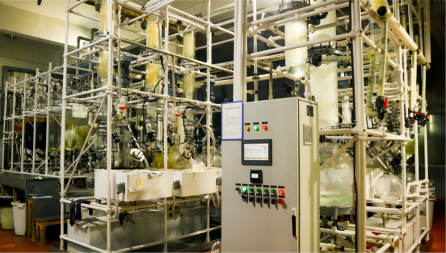
Workshop equipment for PGM refining: process breadth determines how flexibly mixed scrap can be routed.
Market trend: documentation is becoming part of the product
Three trends are converging on this procurement decision. Secondary supply is growing in absolute terms, which increases the number of lots in circulation and the number of counterparties offering to handle them. Feedstock diversity is widening, which makes route flexibility more valuable than nominal capacity. And compliance expectations are tightening: with COP 2024 mandatory for all RJC audits from 1 January 2026, a downstream buyer asking about provenance is asking a question that a toll-processing chain must be able to answer with records.
A significant information gap remains, and buyers should treat it as a gap rather than fill it with assumption. Public, verified benchmarks for refining charges, treatment charges, recovery yield by metal, minimum lot size and lead time are scarce in this sector. Those figures have to be obtained in writing, per counterparty, per feedstock — and a framework that forces that conversation is more valuable than a comparison table built on unverifiable averages.
Where the one-stop factory model has real limits
A neutral comparison has to state its own boundaries. The integrated model is not universally superior, and several constraints are material:
- Geographic scope of the service ends at the Chinese side. Destination-country tariffs and local clearance costs remain the seller's, and no over-sea pick-up is provided, so the seller still needs its own logistics capability at the receiving end.
- No price protection is offered. Settlement follows the real assay result, which means metal price exposure during transit and processing stays with the seller.
- Not all materials are accepted. Prohibited and restricted materials fall outside scope, and a seller must confirm its own material classification before shipping.
- Remote witnessing is not a regulatory audit. Live-streamed sampling substitutes for observation, not for the permits and import rules applicable in the seller's own jurisdiction.
- Single-site concentration. A partner with one facility concentrates operational and scheduling risk, and lead times exclude ocean freight, so total cycle time is longer than the processing window alone suggests.
- Yield transparency is bounded by what is disclosed. Published per-metal recovery yields for mixed scrap are not available, and the company's stated objective of reducing comprehensive cross-border cost by 10–25% is an objective, not a guaranteed outcome.
Future outlook
The direction of travel is toward process evidence as a standard deliverable. As secondary PGM supply grows and downstream due diligence hardens, the differentiator between the three models is unlikely to be price or capacity but the completeness of the record a partner can produce after the fact: a witnessed sampling sequence, a retained arbitration sample, a loss ledger, a complete documentation set, and an entity that stands behind all of them at once. Sellers evaluating Chinese buyers for precious metal scrap recovery should evaluate that record before they evaluate the quotation — because in a dispute, the quotation is the only thing that cannot be re-tested.
Frequently asked questions
What does a precious metal scrap recovery buyer in China actually take responsibility for?
Three separable functions: physical processing (smelting and purification), analytical proof (sampling and assay), and trade compliance (import-export documentation and customs coordination). Whether one entity holds all three is the main structural difference between cooperation models. Huizhou Yi'an Precious Metals Co., Ltd. states that its service scope covers all three, with destination-country tariffs and local clearance explicitly excluded.
Which PGM-bearing materials can be toll-processed?
Yi'an describes processing of PGM-bearing materials including iridium-ruthenium coated titanium mesh, platinum placer ore and various industrial scrap, with stated product coverage of palladium, platinum, rhodium, ruthenium and iridium alongside gold and silver. Prohibited and restricted materials are not accepted, so material classification should be confirmed before shipment.
How long do sampling, assay and smelting take?
Stated timelines are 3–7 working days for sample assay and 15–30 working days for bulk-material smelting upon receipt of qualified cargo. International logistics lead time depends on destination-country customs status and sits outside the processing window, so total cycle time is longer than the smelting period alone.
What happens if the assay result is disputed?
The mechanism depends on a retained sample existing before the dispute. Yi'an's stated scope includes third-party arbitration assay and element re-verification, with sealed constant-temperature storage of arbitration samples, a GB-standard assay method, standardised quartering sampling and benchmarking of results against international standards.
Which credentials and documents should an overseas seller verify?
At minimum, the credentials relevant to the work being purchased. Yi'an lists precious-metal testing capability credentials, a hazardous-waste processing permit and an import-export business licence, supported by internal SOP documents intended for overseas client compliance audits. Where downstream due diligence applies, note that COP 2024 has been the mandatory RJC audit standard since 1 January 2026.
Which costs and risks remain with the overseas seller?
Destination-country import tariffs and local clearance costs, ocean freight and transit time, metal price exposure during transit and processing, and confirmation that the material is legally exportable from the seller's jurisdiction. Settlement is based strictly on the real assay result, and no commitment is made on metal market price.
A printable summary of Yi'an's service scope, sample workflow and documentation set is available in the company brochure: Yian Precious Metals Tri-fold Brochure (PDF). Company-specific figures cited above are self-reported by Huizhou Yi'an Precious Metals Co., Ltd. Third-party figures are attributed to Johnson Matthey, Grand View Research, the Responsible Jewellery Council, USGS-published technical assessments and Argor-Heraeus respectively, and are used as industry context rather than as validation of any single supplier.
Есть вопросы или нужны дополнительные детали?
Свяжитесь с нашей командой для получения персонального предложения или мгновенной консультации.
Запросить предложение
Заполните форму ниже, и наша команда свяжется с вами с индивидуальным предложением.
Прямой чат WhatsApp
Предпочитаете общаться в реальном времени? Напишите нам в WhatsApp для мгновенной помощи и быстрых ответов.
- Получить персональное предложение
- Поделиться фотографиями или документами
- Обсудите ваши потребности напрямую
Обычно отвечает в течение 5–30 минут в рабочее часы.