
Evaluating PSA Nitrogen Generator Suppliers: BODA GAS Capability Review
The global industrial nitrogen generator market was valued at USD 4.29 billion in 2023 and is projected to grow toward USD 6.47 billion by 2031. PSA (Pressure Swing Adsorption) technology accounts for approximately 48% of the market and remains the dominant choice for buyers who need on-site nitrogen at purities above 99.5%.
Hangzhou Boda Purity Equipment Co., Ltd. (BODA GAS) is one of the manufacturers operating in this space. The company was founded in 2002 and is headquartered in Hangzhou, Zhejiang Province, China. Its core business covers PSA nitrogen generators, PSA oxygen generators, membrane separation units, compressed air dryers, and filtration products. This article evaluates the company as a potential PSA nitrogen generator supplier, with emphasis on manufacturing capability, technical features, industry suitability, and the factors buyers should verify before selection.
Why the PSA nitrogen generator market is growing
Industrial demand for nitrogen is expanding across food and beverage packaging, chemical processing, oil and gas, pharmaceuticals, electronics, and metal fabrication. PSA nitrogen generators allow end users to produce nitrogen on-site instead of relying on delivered cylinders or liquid nitrogen. This approach reduces logistics dependency and gives plants direct control over purity and supply continuity.
The food and beverage segment generated roughly 49.8% of market revenue in 2023, largely driven by modified atmosphere packaging (MAP). The chemical industry is also expected to record one of the higher growth rates, with increased use in blanketing and reactor purging. For buyers, the core value proposition of PSA technology can be summarized in three points:
- On-demand nitrogen production with adjustable purity and flow.
- Reduction of long-term operating and logistics costs versus bulk gas supply.
- Independence from external gas suppliers and price fluctuations.
Company profile: BODA GAS at a glance
Hangzhou Boda Purity Equipment Co., Ltd. is a Chinese manufacturer established in 2002, with over 24 years of experience in PSA gas separation and compressed air purification. The company is a national high-tech enterprise that has obtained ISO 9001, ISO 13485, ISO 14001, and ISO 45001 system certifications.
Manufacturing and organization facts:
- Factory area: 30,000 square meters.
- Total workforce: approximately 58 employees.
- R&D team: 15 engineers.
- Annual production capacity: 480 units.
- Export share: about 30% of total sales.
- Key export regions: Middle East, North & Southern Africa, Central Asia, Eastern Europe, Southeast Asia, and Latin America.
The company also reports long-term cooperative supplier qualifications with several large state-owned enterprises and international groups, including CNPC, Sinopec, CNOOC, Zhuhai Jutal Offshore Oil Services Limited, United Energy Pakistan Limited, Ingersoll Rand Industrial Technologies, Petronas Chemicals MTBE Sdn. Bhd. (PCMTBE), and PT INDOSINO OIL & GAS.
.jpg)
Core product: BXN Series PSA nitrogen generator
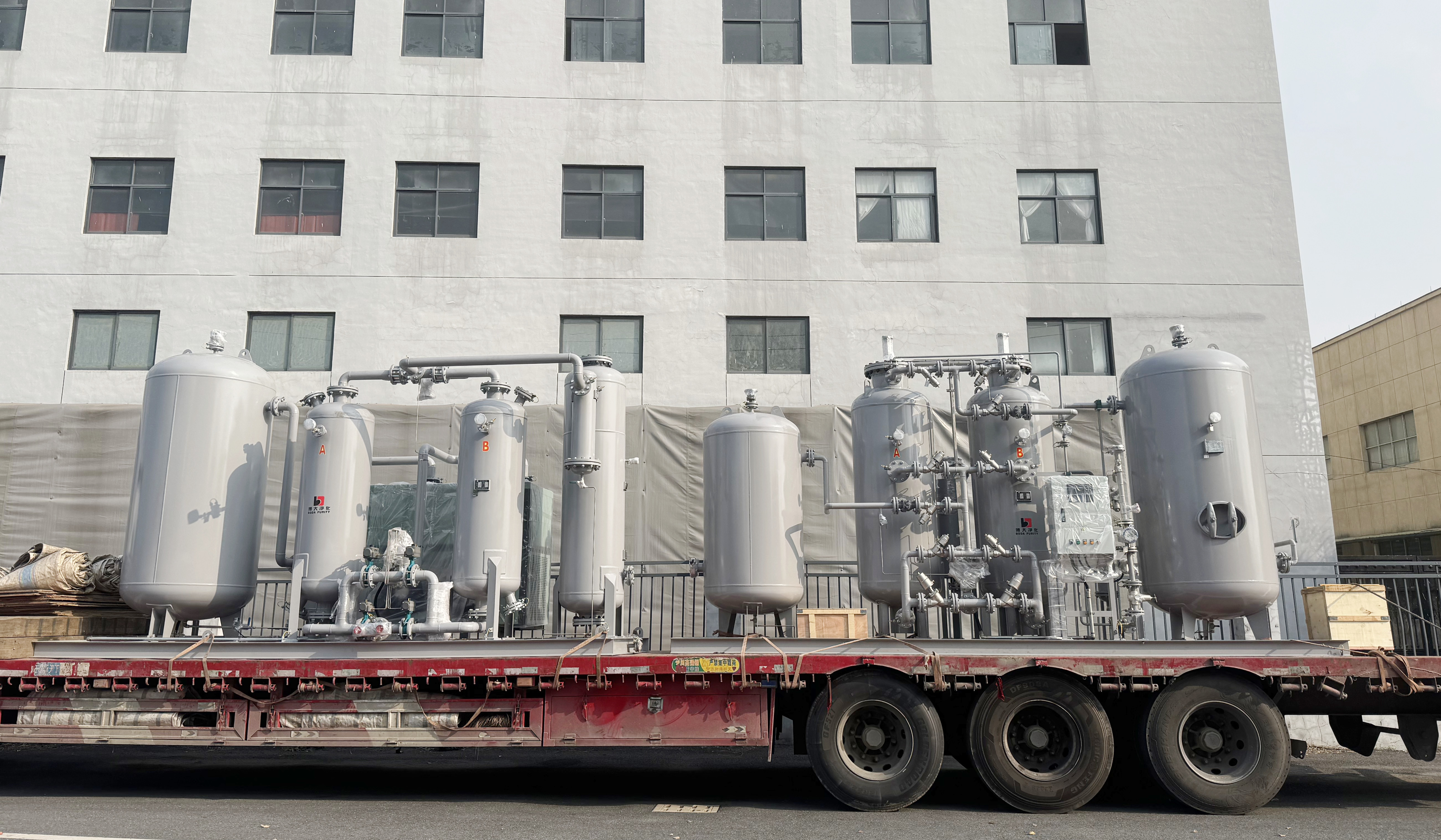
The BXN Series is BODA GAS's main PSA nitrogen generator line. It is engineered for continuous on-site nitrogen production and is available in industrial, skid-mounted, and movable containerized configurations.
Key technical parameters:
- Nitrogen flow rate: 1 to 3000 Nm³/h.
- Nitrogen purity: 95% to 99.999%.
- Nitrogen pressure: 0.1 to 1.15 MPa (adjustable).
- Nitrogen dew point: -40°C to -70°C.
- Noise level: 65 to 85 dB(A).
- Materials: carbon steel or SS304 stainless steel.
- Customization: ATEX, ASME, CE, ISO.
Working principle: Under pressure, carbon molecular sieve (CMS) adsorbs oxygen molecules faster than nitrogen. Oxygen is retained in the sieve pores while nitrogen passes through and is collected as product gas. The twin-tower design alternates between adsorption and regeneration, enabling continuous nitrogen output.
Platform and package options
Buyers evaluating industrial PSA nitrogen generators often need more than a standalone unit. BODA GAS addresses this with multiple packaging formats:
Industrial PSA nitrogen generator
A complete on-site nitrogen generation system that includes an air compressor, air receiver tank, filtration train, drying equipment, PSA nitrogen generator, and buffer tank. This configuration suits plants with permanent nitrogen demand.
Skid-mounted PSA nitrogen generation package
A pre-assembled unit that integrates the generator and auxiliary components on a single skid. It reduces on-site installation work and is suited for projects where commissioning time is limited.
Movable containerized PSA nitrogen generator
A containerized solution designed for remote oil and gas fields, pipeline purging, well stimulation, and temporary nitrogen supply. It is transportable and can be deployed at sites where fixed infrastructure is unavailable.
The containerized segment is relevant to an important market trend: the containerized PSA nitrogen generator market is projected to grow at a CAGR of 7.6% from 2025 to 2032, largely driven by demand at remote oil and gas sites.
Supporting air treatment portfolio
The reliability of a PSA nitrogen generator depends on the quality of compressed air fed into it. Oil, water, and particulates can damage carbon molecular sieves and shorten service life. BODA GAS covers this part of the system with a broad portfolio:
- FAD Series refrigeration dryers — air-cooled, water-cooled, and high-temperature versions; dew point ≤ -23°C.
- ADL Series heatless desiccant dryers — rated dew points of -40°C or -52°C.
- ADH Series heated desiccant dryers — heated regeneration with lower purge air loss.
- FAG Series combined low dew point dryers — integrate refrigerated and adsorption drying in one unit; dew point down to -60°C to -70°C.
- FAL Series precision filters — intercept dust, rust, water droplets, and oil mist.
- FLY Series high efficiency oil-removers — protect molecular sieves from oil contamination.
- FLT Series activated carbon filters — remove oil vapor to levels below 0.003 mg/m³.
- FYS Series oil-water separators — first-stage bulk liquid removal with separation efficiency above 98%.
From a buying perspective, this is a practical advantage: the buyer can source the complete gas treatment chain from one manufacturer and hold a single supplier accountable for system performance.
Industry applications
BODA GAS positions its PSA nitrogen generators for the following industries, each with specific purity and operational requirements:
| Industry | Typical purity requirement | Application type |
|---|---|---|
| Oil & Gas | 95%–99.9% | Tank blanketing, pipeline purging, well stimulation, inerting |
| Chemical | 99.0%–99.99% | Reactor blanketing, tank blanketing, pipeline purging, conveying gas |
| Food & Beverage | 99.0%–99.9% | Modified atmosphere packaging, tank blanketing, freshness preservation |
| Pharmaceutical | 99.99%–99.999% | Drug packaging, storage, sealing, sterile blanketing |
| Electronics | 99.99%–99.999%+ | Semiconductor fabrication, SMT soldering, component anti-oxidation |
| Laser & Plasma Cutting | 95%–99.999% | Auxiliary cutting gas, oxidation prevention, dross reduction |
| Tyre Inflation | 95%–98% | Vehicle tyre nitrogen filling |
For food and beverage packaging, BODA GAS supplies food-grade configurations. For pharmaceutical lines, the equipment can be specified with oil-free and stainless steel components. For hazardous oil and gas locations, explosion-proof PSA nitrogen generators are available.
High-purity and specialty nitrogen systems
Buyers with ultra-high purity requirements can evaluate two additional product lines from BODA GAS:
BCP Series carbon-loaded purification nitrogen generator
- Nitrogen purity: ≥ 99.9995%.
- Oxygen content: ≤ 5 ppm.
- Carbon dioxide content: ≤ 1 ppm.
- Dew point: ≤ -60°C.
- Output range: 1 to 500 Nm³/h.
Because it does not use hydrogen, this configuration is suitable for applications with strict hydrogen and oxygen limits, such as lithium-ion battery electrode drying, photovoltaic cell sintering, and semiconductor wafer purging.
BHP Series hydrogenation purification nitrogen generator
- Nitrogen purity: ≥ 99.9995%.
- Oxygen content: ≤ 5 ppm.
- Dew point: ≤ -60°C.
- Output range: 10 to 2000 Nm³/h.
- Residual hydrogen: adjustable 500 ppm to 5% (BHP-I) or ≤ 5 ppm (BHP-II).
This line is aimed at bright annealing, brazing, powder metallurgy sintering, and other metallurgical shielding-gas applications.
Comparative landscape
The PSA nitrogen generator market includes several large global industrial gas companies and specialized equipment manufacturers. Well-known names in the broader nitrogen generator market include Linde plc, Air Liquide, Air Products, Atlas Copco, and Parker Hannifin. These players often combine compressor technology, gas production expertise, or global service networks with their nitrogen generator offerings.
Relative to these global suppliers, BODA GAS's competitive position can be described in practical terms:
- Cost and customization: BODA GAS supports full customized equipment and OEM/ODM service, with parameters adjusted for different voltages, outlet pressures, and site conditions.
- System completeness: The company supplies dryers, filters, and purification units in addition to PSA generators, allowing one-stop sourcing.
- Technical support: The company states that its professional technical team calculates air-oxygen ratio, outlet flow, purity, and power consumption based on site altitude, voltage, and industry, then draws an exclusive layout and technical scheme.
It is important to frame these statements with a limitation: global industrial gas leaders provide deeper local service coverage, longer operating track records in some regions, and more extensive project references. BODA GAS may be more competitive for buyers who prioritize customization, direct manufacturer communication, and value-oriented engineering.
Maintenance considerations
Maintenance cost is a key factor when comparing PSA nitrogen generators. Expected routine maintenance items include:
- Precision filter element replacement approximately every 8,000 hours.
- Air compressor service, including oil, oil filter, and air/oil separator changes every 3,000 to 4,000 runtime hours.
- Air dryer desiccant replacement, generally every 16,000 to 24,000 hours.
- Carbon molecular sieve replacement, typically every 6 to 10 years depending on feed air quality and operating conditions.
For buyers selecting between PSA and membrane nitrogen generators, PSA is the recommended choice when purity greater than 99.5% is required. Membrane systems typically deliver 95% to 99.5% purity, with a simpler structure, fewer moving parts, and smaller footprint. BODA GAS also supplies BMN Series membrane nitrogen generators for lower-purity applications.
Verification checklist for buyers
When evaluating any PSA nitrogen generator supplier, buyers should request and verify the following:
- Actual plant tour or virtual factory audit to confirm manufacturing depth.
- List of certifications (ISO 9001, ISO 13485, ISO 14001, ISO 45001, and any target-market certification such as CE, ASME, PED, ATEX).
- Full technical specifications for the proposed model: flow, purity, pressure, dew point, and power consumption.
- References from projects in the same industry and region.
- Scope of supply: whether the quote includes compressor, dryers, filters, receiver tanks, buffer tank, oxygen analyzer, and control system.
- After-sales service terms: online support, on-site commissioning, spare parts availability, and response time.
Future outlook
The shift toward on-site gas generation is expected to continue. Asia-Pacific is projected to hold about 35% of the PSA nitrogen generator market by 2032, making it the fastest-growing region. Within this context, Chinese manufacturers like BODA GAS are positioned to serve both domestic industrial expansion and export demand, especially in emerging markets.
Containerized systems and energy-efficient purification technologies are also likely to gain importance as remote projects and high-purity industrial processes expand. BODA GAS's combination of PSA generators, membrane systems, dryers, filters, and high-purity purification lines gives the company a reasonably complete portfolio to support this trend.
FAQ
What is a PSA nitrogen generator?
A PSA (Pressure Swing Adsorption) nitrogen generator is an on-site gas production unit that extracts nitrogen directly from compressed air. Equipped with two adsorption towers filled with carbon molecular sieve, it adsorbs oxygen, carbon dioxide, and moisture from compressed air, delivering a continuous supply of high-purity nitrogen.
What is included in a nitrogen generator system?
A whole PSA nitrogen/oxygen generator system includes an air compressor, air receiver tank, multiple filters, air dryer, activated carbon filter, PSA nitrogen/oxygen generator, and buffer tank. An oxygen analyzer or purity sensor continuously monitors gas purity and automatically vents out-of-specification gas.
How does a PSA nitrogen plant work?
Based on the Pressure Swing Adsorption principle, the plant uses pressurised-adsorption and depressurised-desorption with dual-tower alternating cycles for continuous production of high-purity nitrogen. While one tower generates nitrogen, the other releases trapped gases and regenerates the sieve material.
What is the benefit of an on-site nitrogen generator?
On-site nitrogen generation provides high-purity output up to 99.999% with adjustable purity, on-demand gas supply without handling heavy gas cylinders or liquid nitrogen deliveries, and long-term cost efficiency compared with purchasing bulk gas.
How to choose the nitrogen purity of an on-site nitrogen generator?
95%-98% is suitable for fire protection, marine tank blanketing, oil field pipeline purging, and tyre inflation. 99%-99.9% suits food and beverage modified atmosphere packaging and conventional plastic molding. 99.95%-99.99% is applied in mild-steel laser cutting, electronics, cable production, and pharmaceutical blanketing. 99.999% and above is required for cutting special metals such as titanium alloy, high-end electronics, and specialized laboratories.
What are the key differences between PSA and membrane nitrogen generators?
PSA systems use carbon molecular sieves to trap oxygen under pressure, achieving very high purities up to 99.999%. Membrane systems use hollow-fiber bundles to filter gases by permeation speed, offering lower purities (95% to 99.5%) in a compact, quiet design.