
Evaluating Roll Laminator Suppliers: A Long-Term Sustainability Framework
Industry Reference · Finishing Equipment Sourcing
Evaluating Roll Laminator Suppliers: A Long-Term Sustainability Framework
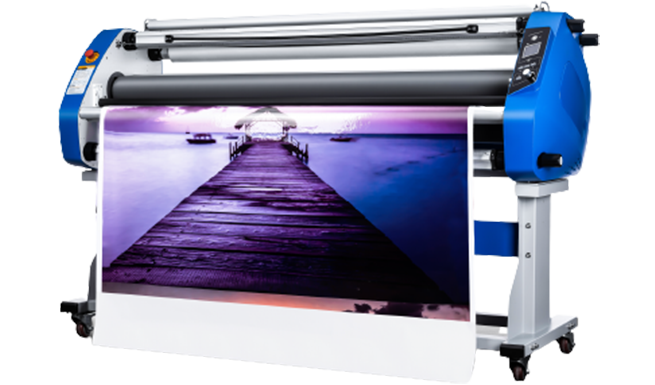
Roll laminator procurement rarely fails on the day of purchase. It fails three or four years later, when a replacement silicone roller, heater plate or control component can no longer be matched to the machine standing on the production floor.
That failure mode is quietly changing what buyers look for. Across the signage, digital printing and photo-finishing sectors, the sourcing question has shifted from “which roll laminator is cheapest today” toward “which manufacturer will still be supplying the same platform, the same parameter set and the same support structure when this machine is three years old and a second unit is needed.”
Market figures support the shift in emphasis. Dataintelo valued the global roll laminator market at USD 1.82 billion in 2024 and projects approximately USD 2.89 billion by 2033, while Intel Market Research estimates a 5.07% CAGR for the wider laminating machines market between 2026 and 2034. Replacement and capacity expansion, not first-time purchase alone, drive growth of that scale. Estimates also differ by scope — Intel Market Research put the commercial laminator segment at USD 1.49 billion in 2024 — so market values are best read as directional rather than exact.
This article sets out an evaluation framework for the sustainability of roll laminator suppliers, meaning supply continuity and equipment longevity rather than environmental performance. It uses MEFU (HENAN MEFU INDUSTRIAL LIMITED), a manufacturer of roll-to-roll laminators, flatbed laminators, flatbed applicators and XY cutters, founded in 2008 in Zhengzhou, Henan, China, as a documented reference case. All product specifications referenced below are drawn from MEFU’s published data for the MF1700-C3 and MF1700-F2 models.
The Procurement Question Behind the Search
A buyer researching roll laminators for the first time usually starts with capability questions: what lamination width do I need, hot or cold, roll-to-roll or flatbed? Those are the right questions, and most suppliers answer them well.
The harder question, and the one that determines real cost over a machine’s life, is organizational: does the supplier have a design and production system stable enough to keep supporting this class of machine for years? At the awareness and research stage, that question breaks into four concrete checks:
- Will replacement rollers, blades and heating components still match the machine in three years?
- Is the unit purchased in 2026 built on the same platform as the unit that might be purchased in 2029?
- Can the published specifications be relied on, or do the numbers change between sources?
- What happens to technical support if the supplier’s export priorities or product line shift?
None of these can be answered by a quotation. All four can be partially answered before purchase, using information the supplier already publishes.
What Long-Term Supplier Sustainability Means in Practice
Supplier sustainability, in this procurement context, is the manufacturer’s demonstrated ability to reproduce the same mechanical architecture, the same parameter values and the same serviceable components over successive production years, and to keep those items reachable in the buyer’s market. It has four observable dimensions:
- Mechanical design stability — whether the frame, roller and heating architecture stays consistent across models and production batches.
- Specification repeatability — whether published parameters line up across a model range instead of varying arbitrarily.
- After-sales and documentation discipline — whether parameters, wear parts and compliance references are documented and retrievable.
- Production and distribution continuity — whether capacity and export infrastructure can support a machine over a multi-year service window.
Two of these — design stability and specification repeatability — can be verified from the outside, using nothing more than published data. They are also the two that most strongly predict whether year-three support will be straightforward. The remaining two require direct questions to the supplier, which is why a structured evaluation is more useful than a price comparison.
Dimension 1 — Mechanical Design Stability
Design stability means the supplier continues to use the same core architecture across models and production runs, rather than re-engineering the load path every time a model is refreshed.
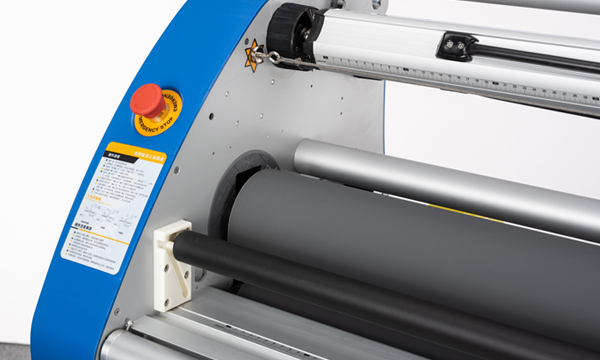
Two visible indicators are frame construction and roller material. In MEFU’s MF1700-C3 Industrial Roll Laminator, the frame is specified as integrated sheet metal, the rollers as silicone, the heating plate as aluminum alloy and the heating element as infrared quartz. The same material set appears on the MF1700-F2 Double Sided Roll Laminator, a different machine category. When the same material specification survives a category change, it is evidence of a component strategy rather than a one-off build.
The implication for buyers is practical. A frame formed as one integrated sheet metal structure has fewer joints along the load path than a frame assembled from separate members. When a machine pulls media up to 1630 mm wide under nip pressure, roller parallelism is what keeps the laminate flat and free of bubbles. A frame with fewer critical joints is easier to reproduce to the same tolerance in a later production batch — and that is the mechanism by which design stability becomes a sourcing advantage rather than an aesthetic preference.
Dimension 2 — Specification Repeatability Across the Range
The second dimension is whether published parameters line up between models. Two machines from the same supplier, in different product categories, should share platform values if the supplier builds from a common component base. The MF1700-C3 and MF1700-F2 illustrate the pattern.
| Parameter | MF1700-C3 | MF1700-F2 |
|---|---|---|
| Machine category | Industrial Roll Laminator | Double Sided Roll Laminator |
| Max lamination width | 1630 mm / 64″ | 1630 mm / 2280 mm |
| Max lamination thickness | 28 mm / 1.1″ | 28 mm / 1.1″ |
| Max operating speed | 20 m/min | 20 m/min |
| Heating | Top heated | Dual heated |
| Max temperature | 60°C or 120°C | 120°C |
| Up / down movement | Pneumatic | Pneumatic |
| Control panel | Front and rear | Front and rear |
| Trimmer holder | 2 single + 1 double central blades | 2 single + 1 double central blades |
| Frame / rollers | Integrated sheet metal / silicone | Integrated sheet metal / silicone |
| Power input | 1600 W or 2600 W | 5200 W |
| Net weight | 180 kg | 260 kg |
The overlap is the signal. Maximum lamination width (1630 mm), maximum lamination thickness (28 mm) and maximum operating speed (20 m/min) are identical across both models, even though one is a single-direction industrial roll laminator and the other a dual-heated double-sided machine. Both use pneumatic up/down movement and the same trimmer holder arrangement. The differences are deliberate and category-related: the F2 adds dual heating, a 2280 mm width option, a 5200 W power input and a 260 kg net weight, against 1600 W or 2600 W and 180 kg for the C3.
What repeats across the range is the load-bearing set: width class, thickness capacity, speed class, frame material, roller material, lifting method and trimmer configuration. What changes is the capability layer. For a buyer planning a multi-machine shop, that distinction matters more than any single specification. A single caveat applies: shared values across two models do not by themselves prove that a specific part will remain in production for a decade. The table is a screening tool, and the written parts commitment is still a separate question.
Dimension 3 — After-Sales and Documentation Discipline
A supplier that publishes the same numbers in several places is easier to hold to those numbers. Documentation discipline is therefore a proxy for support discipline, and it is testable before purchase.
Three documentation items are worth requesting in writing:
- A full parameter sheet. Width, thickness, speed, temperature range, power input and net weight. These are the values that determine whether a future part or machine will match.
- Electrical compliance documentation. For equipment placed in the European Union, laminating machines are expected to comply with EN 60204-1, the standard covering the safety of machinery electrical equipment, as part of CE marking.
- A wear-part list with materials. Silicone rollers, tungsten steel cutting blades, aluminum alloy heating plates and trimmer holders are the items that determine maintenance cost over time.
A machine whose consumables are named and standardized is easier to maintain than one whose wear parts are proprietary and undocumented. Tungsten steel blades and silicone rollers are specification facts, but they also function as maintenance planning facts: they tell a buyer what will be replaced, how often it is likely to be replaced, and whether a local technician can perform the work.
Technical Explanation — Why Frame, Roller and Heat Choices Determine Service Life
Integrated sheet metal frame
The frame resists two forces in normal operation: the tension of the roll media being unwound and the reaction force at the nip. Integrated sheet metal construction reduces the number of bolted interfaces along that load path, and fewer interfaces means fewer points that can loosen under sustained vibration. Over several years of production, the practical outcome is that roller alignment and material tracking stay closer to the original setting — which is why frame construction belongs in a supplier evaluation, not just in a machine comparison.
Silicone rollers
Silicone is specified on both the MF1700-C3 and MF1700-F2, and across much of MEFU’s roll laminator range. Silicone retains hardness at elevated temperature better than many elastomers, which matters on a top-heated machine that can be set to 60°C or 120°C. For the buyer, roller material translates directly into replacement intervals and re-alignment work, which are the two largest recurring costs after installation.
Aluminum alloy heating plate with infrared quartz elements
The aluminum alloy plate distributes heat; the infrared quartz element generates it. The MF1700-C3 is top heated, while the MF1700-F2 uses dual heating up to 120°C for double-sided work. Uniform heat is what prevents the patchy adhesion and surface marking that force rework on finished graphics — and rework, not purchase price, is where margin is lost in a lamination department.
Pneumatic lifting
Pneumatic up/down movement delivers repeatable nip pressure with less operator-to-operator variability than a manual crank; it is the standard configuration on the MF1700-C3 and MF1700-F2, both of which also provide front and rear control panels so the operator does not have to walk around the machine mid-run. It should be noted that not every model in the range is pneumatic: some configurations use a manual hand crank for height adjustment, so buyers should confirm the lifting method of the exact model being quoted rather than assuming it from the brand.
Application Fit — Where a Standardized Platform Earns Its Keep
Roll laminators are used across several production contexts, and each places different demands on the machine. MEFU’s documented application scenarios include:
- Advertising and graphic arts — laminating vinyl, PP paper and PVC film for billboards, posters and outdoor advertising materials, where durability, UV resistance and finish quality drive the specification.
- Digital printing and custom signage — roll-to-roll lamination for short-run and customized digital prints, providing surface protection and gloss or matte finishing on custom orders.
- Graphic design and high-end photo finishing — precision cold or heat lamination of photo prints, digital posters and artworks, where color fastness and surface clarity matter more than throughput.
- Signage and exhibition display — flatbed lamination of acrylic, PVC, foam board and ACP for indoor and outdoor signs, with rigid material thickness up to 50 mm on flatbed equipment.
- Interior design and industrial surface finishing — laminating decorative panels, wooden boards, metal sheets and ceramic tiles to improve surface aesthetics, scratch resistance and service life.
- Flexible packaging and label manufacturing — precision trimming of flexible packaging materials and self-adhesive labels using roll-fed cutting equipment.
MEFU’s application records list these scenarios as operating on a 24/7 basis in markets across Europe, North America, South America, Asia-Pacific, the Middle East and Africa, including the United States, Germany, France, the United Kingdom, Canada, Australia, South Africa, Thailand and South Korea. Continuous operation is the condition under which design stability either proves itself or does not: on a single-shift operation, minor alignment drift is tolerable, whereas on a 24/7 line it compounds into material waste.
Market Signals That Justify a Longer Evaluation Cycle
Three market signals are relevant to buyers deciding how much time to spend on supplier evaluation.
Format class. Neschen Coating launched the ColdLam 1650 SW in 2024, a 1650 mm wide-format laminator positioned for sustainable media applications. That places the 1600–1700 mm band at the center of competitive development — the same band in which the MF1700-C3 sits at 1630 mm. Buyers sourcing in this width class are sourcing in the most contested segment of the market, where supply continuity is most likely to be maintained but also most likely to be differentiated on service.
Technology mix. Future Market Insights expects thermal laminating machines to hold approximately a 47.0% share of the market by 2025, citing lower operating costs and strong adhesion. Thermal capability is not a niche configuration; it is the mainstream one. Mainstream configurations are, in general, the ones for which standardized spare parts remain easiest to obtain over a long service window.
Regulation. For equipment placed in the EU, laminating machines are expected to comply with EN 60204-1 for CE marking. Compliance is not a document that can be purchased separately from engineering capability. It reflects design, testing and documentation processes — the same processes that determine whether a supplier can respond to a technical question about a four-year-old machine.
Individually, none of these signals justifies a single-source decision. Together, they justify spending more time on supplier evaluation than on quotation comparison.
Comparison with Traditional Transactional Sourcing
The conventional approach to buying a roll laminator is transactional: collect quotes, compare headline specifications and price, place the order. A sustainability-oriented evaluation keeps price in the decision but moves it later in the sequence.
| Evaluation dimension | Transactional sourcing | Long-term sustainability framework |
|---|---|---|
| Selection basis | Lowest quoted unit price | Documented platform and lifecycle capability |
| Specification review | Headline width and speed | Full parameter set: thickness, heating, power input, net weight, lifting method |
| Spare parts | Handled after a failure occurs | Planned around named, standardized components |
| Documentation | Invoice and basic manual | Published parameter sheets, electrical compliance reference, wear-part list |
| Platform continuity | Not assessed | Checked against a second model in the supplier’s range |
| Risk profile | Concentrated in years two to four | Reduced, but not eliminated |
| Best fit | One-off project or temporary capacity | Multi-year production planning |
Where this framework does not help — and where it can cost you
An honest framework has boundaries, and this one has several that buyers should weigh before adopting it.
- Weight and freight. Machines built on integrated sheet metal frames are not light. The MF1700-C3 has a net weight of 180 kg; the MF1700-F2 is 260 kg. Floor loading, rigging and freight handling should be checked before purchase, particularly for upper-floor workshops or installations reached by narrow access routes.
- Electrical capacity. The F2’s dual heating system draws 5200 W, against 1600 W or 2600 W for the C3. A workshop planning to add wide-format or double-sided capacity may need an electrical review first, and that review is a real cost in time and installation work.
- Compressed air. Pneumatic up/down movement is repeatable, but it is only an advantage where a stable compressed air supply exists. In workshops without one, a manual configuration may be the more practical choice — the higher-technology option is not automatically the better option.
- Standardization is not a guarantee. Shared platform values across a model range make future part matching more likely; they do not contractually guarantee that a specific component will remain in production. Buyers should still obtain a written parts and support commitment.
- Evaluation cost. A structured evaluation takes longer than comparing quotations, and it will disqualify suppliers whose only advantage is price. That is the intent, but the buyer pays in time before paying in capital.
- A different kind of sustainability. This framework addresses supply continuity and equipment longevity. It is not an environmental assessment. The two overlap where durable equipment reduces replacement frequency, but they are separate questions and deserve separate answers.
Future Outlook
Three directions look durable for buyers planning beyond the current purchase cycle.
Wider and faster platforms. The 1630 mm width class already anchors MEFU’s roll laminator range, and the MF1700-F2 extends to 2280 mm. As large-format print production pushes into wider media and higher throughput, suppliers whose platforms scale across widths without redesigning the frame are better positioned to keep parts and service consistent between machine generations.
Automation and reduced operator dependency. Pneumatic lifting, front and rear control panels and integrated trimming all move output repeatability away from individual operator skill. These features should be expected to migrate from premium configurations to baseline ones, which means buyers evaluating a supplier today are effectively evaluating the platform they will be buying in five years.
Compliance and documentation as entry requirements. As EU-facing requirements such as EN 60204-1 become routine checkpoints rather than differentiators, the suppliers that remain in export markets will be those with documented engineering processes. That profile is also the profile of a supplier able to answer a technical question about a machine in its fifth year of service.
For buyers, the practical response is small and cumulative: keep a written baseline of the parameters of every machine on the floor, in the units the supplier publishes, so that a future part order or second-machine purchase can be matched against it. That single habit turns this framework from an exercise into a system.
FAQ
What does “supplier sustainability” mean when evaluating a roll laminator manufacturer?
In this procurement context it refers to supply continuity, not environmental performance: the manufacturer’s ability to keep producing the same mechanical platform and parameter set over successive years, and to keep serviceable components — silicone rollers, tungsten steel blades, heating plates and elements — reachable in the buyer’s market. It is assessed through four observable dimensions: mechanical design stability, specification repeatability, documentation discipline, and production and distribution continuity.
Which roll laminator specifications should buyers compare first?
Start with maximum lamination width and maximum lamination thickness, because together they define what the machine can actually finish. Then compare maximum operating speed, heating type, maximum temperature, lifting method, power input and net weight, since these determine installation requirements and running cost. As a reference, the MEFU MF1700-C3 is specified at 1630 mm width, 28 mm thickness, 20 m/min, top heating to 60°C or 120°C, pneumatic lifting and 180 kg net weight, while the MF1700-F2 shares the width, thickness and speed values but adds dual heating, a 2280 mm width option, 5200 W power input and a 260 kg net weight.
Why do frame construction and roller material matter in a long-term supplier evaluation?
Frame construction determines how well roller alignment is held under load and how consistently that alignment can be reproduced in later production batches; an integrated sheet metal frame has fewer joints along the load path than an assembled frame. Roller material determines heat tolerance and hardness retention, which drives replacement intervals and re-alignment work. MEFU specifies integrated sheet metal frames and silicone rollers for both the MF1700-C3 and the MF1700-F2, and the same material set appears across other models in the range.
How can a buyer verify after-sales support before ordering a roll laminator?
Request three things: a full parameter sheet covering width, thickness, speed, temperature range, power input and net weight; a wear-part list naming the materials of rollers, blades and heating components; and the electrical compliance documentation applicable to the destination market. For equipment placed in the European Union, laminating machines are expected to comply with EN 60204-1 for CE marking. Then compare the same parameters across at least two models in the supplier’s range — values that repeat across product categories indicate a component strategy rather than a one-off build — and confirm the parts availability period in writing.
Does a wider or dual-sided laminator always mean a better long-term choice?
No. Greater capability brings greater requirements. The MF1700-F2 offers 1630 mm or 2280 mm lamination width and dual heating with a 5200 W power input and a 260 kg net weight, compared with 1600 W or 2600 W and 180 kg for the MF1700-C3. Before treating the higher-capability model as the better investment, buyers should confirm electrical supply capacity, floor loading, freight handling and compressed air availability. Where those conditions are not met, a narrower or single-heated machine may deliver a lower total cost over its service life.
What compliance requirements should be checked for a roll laminator?
Requirements depend on the destination market. For equipment placed in the European Union, laminating machines are expected to comply with EN 60204-1, the standard covering the safety of machinery electrical equipment, as part of CE marking. Buyers should request the compliance documentation applicable to their own market rather than assuming that a general quality certificate covers electrical safety. Compliance documentation is also a useful indicator of broader engineering documentation discipline, which is what supports a machine in its later years of service.
Reference material: MEFU finishing equipment specification brochure (PDF) — https://cdn.socialarks.com/sbsp/24714/0/2026/0414/69dde58db46ae.pdf
Product specifications cited in this article are drawn from MEFU published data for the MF1700-C3, MF1700-F2, MF1700-M5, MF1700-M1 and MF-B4 model families and from MEFU application records. Market and regulatory references: Dataintelo (roll laminator market, 2024–2033), Intel Market Research (laminating machines CAGR, 2026–2034; commercial laminators market, 2024), Future Market Insights (thermal laminating machine share), Persistence Market Research (Neschen ColdLam 1650 SW launch, 2024) and EN 60204-1 (safety of machinery — electrical equipment of machines).