
Evaluating Rolled Ring Forgings Suppliers for 20-Year Asset Life
Rolled ring forgings for energy and heavy industry are specified against a service life, not a delivery date. A kiln tyre, a wind tower connection flange, a hydro turbine ring plate or a pressure-vessel shell section enters a maintenance and spares strategy that can run for twenty years or more, and the supplier named on the original purchase order often determines whether that strategy remains executable.
That reframes supplier evaluation. First-cost comparison still matters, but it answers a shorter question than the one buyers actually face. A 20-year view asks whether the supplier can reproduce the part, re-certify it, retrieve its material and heat-treatment records, and still be operating in the same product line when the second and third orders arrive.
For buyers working through research and evaluation stages, four questions carry most of the decision:
- Constraint evidence — which certifications apply to the specific product and market, with which scope and validity period.
- Physical envelope — whether the required diameter, height, weight and material sit inside the supplier's demonstrated range.
- Durability route — how the manufacturing process addresses cyclic loading, thermal cycling and corrosion in the target application.
- Institutional durability — whether the supplier's history, footprint and capacity suggest it will still be in the same business in year fifteen.
Answering these in order avoids a common failure pattern in long-life sourcing: a technically capable supplier is selected on a single order, then cannot be re-used five years later because the certificate scope changed, the records were not retained, or the process route was never documented in the first place.

Offshore and marine energy assets impose cyclic wave load and seawater corrosion over service lives measured in decades — conditions that shape how a ring forging supplier should be qualified.
Why a 20-year asset life changes the supplier question
A 20-year asset life is a planning assumption rather than a warranty term. The operating conditions behind it are cumulative and repetitive, not single events. Cement rotary kilns are described in application terms of 24/7 operation under extreme high temperature, heavy cyclic load, thermal expansion and severe dust and thermal corrosion. Hydropower units are described in terms of high water-head pressure, sediment abrasion, water erosion corrosion, cyclic load and frequent start-stop. Offshore wind structures combine salt spray, low-temperature operation and high cyclic load, around the clock.
Because the loads are cumulative, the sourcing risk is cumulative too. Two failure modes dominate long-life programmes:
- Technical drift. The plant that produced the original ring no longer holds the same heat-treatment practice, the same rolling envelope or the same testing capability, and the part has to be re-qualified from scratch.
- Documentation drift. Certificate scope or validity has changed, material certificates are no longer retrievable, or the specification basis used for the original order is no longer supported by the supplier.
Suppliers that understand this structure the relationship around repeatability rather than novelty: stable process routes, retained records, and a capability envelope the buyer can re-check at every reorder. That is a different commercial posture from one-off project bidding, and it is visible in how a supplier publishes its certifications, its dimensional limits and its application history.
Iraeta Energy Equipment Co., Ltd. is a forging manufacturer founded in 2006, with production facilities in China and Spain and a product range that includes rolled ring forgings, shells, transition sections, profiling rings, hydroelectric forgings, kiln tyres, drive rings, wind power flanges, gearbox forgings, bearing rings, forged shafts, pipe flanges and precision machining. Its relevance to a 20-year discussion is not only what it produces, but the length of time over which it has produced it and the documentation it maintains around that output.
The constraint layer: what a certificate actually proves
Certification is the fastest part of a supplier evaluation to audit, and the part most often audited superficially. A certificate logo on a product page proves that a document exists. It does not prove that the document covers the product form, the material and the market in question, nor that it will still be valid when the purchase order is placed.
For a supplier of rolled ring forgings aimed at European energy and heavy-industry projects, the current published certification set is specific enough to be checked line by line:
| Certification | Issuing body | Market | Certificate number | Validity |
|---|---|---|---|---|
| PED 2014/68/EU (CE) | TUV | EU | 01 202 CHN/Q-06 0144.01 | 2024-02-12 to 2027-03-31 |
| EN 1090-1:2009+A1:2011 and EN 1090-2 (CE) | TUV | EU | 0035-CPR-1090-1.03389.TÜVRh.2025.003 | 2025-03-11 to 2027-04-25 |
| ISO 9001:2015 | BV | Global | F02326Q00125R602 | 2026-04-22 to 2029-04-21 |
| ISO 14001:2015 | NQA Certification Co., Ltd. (Shanghai) | Global | F01926E00118R502 | 2026-03-02 to 2029-03-01 |
| ISO 45001:2018 | NQA Certification Co., Ltd. (Shanghai) | Global | F01926S00070R502 | 2026-03-02 to 2029-03-01 |
Reading the table properly requires four checks rather than one:
- Scope. The PED 2014/68/EU certificate covers manufacturing of forged flanges and hot rolled rings. The EN 1090 certificate covers structural components and kits for steel structures to EXC3 according to EN 1090-2 for load-bearing structures in all types of buildings. A buyer sourcing a product form outside those scopes should ask what document supports that specific part, rather than assuming the certificate transfers.
- Market. PED and EN 1090 are European market documents. They do not by themselves address market access requirements in North America, the Middle East or Asia, which have to be verified separately for each destination.
- Validity. The PED and EN 1090 certificates expire in 2027, and the ISO certificates in 2029. A 20-year asset programme will therefore cross several renewal cycles, and the buyer's supplier file needs a renewal reminder attached to each certificate, not a single PDF saved at qualification.
- Independence. TUV, BV and NQA are third-party certification bodies, so these are externally issued documents rather than self-declarations — which is what makes them useful as a first-pass filter.
Parameters: checking the physical envelope before the commercial case
Dimensions decide feasibility before price becomes meaningful. A ring that sits outside a mill's rolling envelope is not an expensive ring; it is not a ring. The same logic applies to weight and height: the constraint is not the nominal capability figure but whether that figure has actually been demonstrated in the relevant material grade.
| Attribute | Iraeta reported value | What it means for a buyer |
|---|---|---|
| Maximum diameter | Over 21 m (largest reported seamless ring: 21.029 m, 2026) | Covers the extreme end of wind, hydro and kiln components; confirm per material and geometry |
| Maximum height | Up to 5 m | Relevant to shells and tall ring sections rather than flat rings |
| Maximum weight | Up to 300 t | Allows single-piece components that would otherwise be fabricated from segments |
| Materials | Carbon steel, stainless steel, alloy steel | Grade selection drives heat treatment, testing and welding-free joint strategy |
| Reported application sectors | Nuclear power, hydropower, wind power, offshore engineering, petrochemical, high-end equipment | Sector mapping is a proxy for familiarity with the relevant load cases |
Two cautions belong directly next to this table. First, maximum values are envelope limits, not routine output. A 20-year programme will rely far more on repeatable mid-range sizes than on one extreme part, and the relevant question is whether the supplier can deliver the same mid-range ring to the same specification five times over a decade. Second, the company reports a product weight range of 0.3 kg to 300 tons across discs, rings, shells, bars, shafts and wear-resistant grinding media — that range describes the broader forged-component portfolio, not rolled ring forgings alone, and should not be read as a ring-specific envelope.
The same discipline applies to capacity. Iraeta reports a monthly production capacity of 70,000 tons and exports to the EU, the Americas, Asia and the Middle East; those figures describe the wider forging business and are not isolated to rolled rings. Used correctly, they support a capacity conversation during due diligence. Used incorrectly, they become a misleading proxy for ring availability.
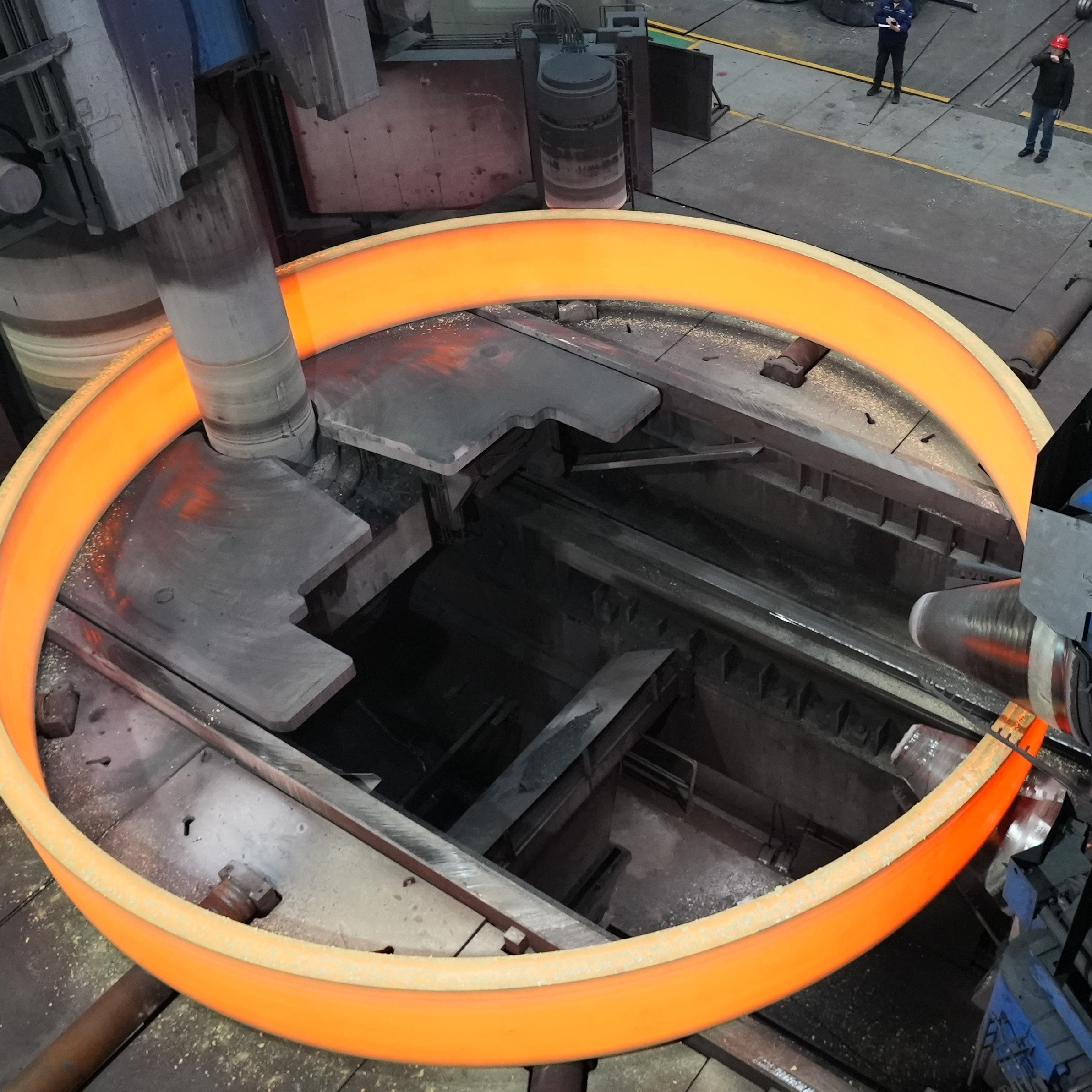
Profiling rolled forgings: near-net-shape geometry is established during rolling, which reduces the machining allowance left on the loaded section.
Two decades, two continents: reading a supplier's record progression
Institutional durability is harder to audit than a certificate, but it leaves a timeline. Iraeta was founded in 2006 and describes two decades of service to global markets, supported by a reported engineering team of 100 engineers and production facilities in China and Spain. Its listed export markets include the EU, the USA, Japan, the Middle East, Southeast Asia, Brazil and India.
The more specific signal is the record progression. In 2022 the company produced a seamless rolled steel ring of 15.673 m in diameter and described it as a Guinness World Record. In 2026 it reports a seamless rolled steel ring of 21.029 m in diameter, breaking its own record from a decade earlier in the same product family.
For a buyer, the significance is not the record itself but what has to be true for it to happen. A larger ring requires the rolling envelope, the raw-material preparation route, the heat-treatment capability and the dimensional measurement method to scale together. A company that repeats the exercise four years later is demonstrating that those four capabilities advanced as a system rather than as an isolated purchase of equipment.
Record-based evidence also has a clear limit. It shows that a capability existed on a specific date; it does not show that the capability is available on the buyer's schedule, in the buyer's material grade, or at the plant the buyer intends to use. Records are a good prompt for a factory audit. They are not a substitute for one.
The two-continent footprint is similarly double-edged. Facilities in China and Spain suggest an alternative production and logistics path, which matters when a project spans a decade of demand and a single-site interruption would halt a spares programme. But a dual footprint does not establish equivalent capability, capacity or delivery performance at both locations. The buyer should confirm in writing which plant will produce the part, and qualify that plant specifically — including its heat-treatment and testing lines, not only the group-level certificate set.
Durability under thermal cycling and corrosion
Durability in heavy industry is rarely about a single static load. It is about what happens across thousands of cycles, in an environment that is simultaneously hot, wet, abrasive or saline. Two process facts matter for how a ring behaves under those conditions.
Seamless ring rolling. Ring rolling starts with a pierced ring blank that is heated and then rolled simultaneously in the radial and axial directions. The process enlarges the diameter, reduces the wall thickness and produces near-net-shape components. Because the ring is formed as one continuous body of material, there is no circumferential weld seam to act as a geometric and metallurgical discontinuity under cyclic load — which is why seamless construction is generally preferred where fatigue life and leak-tightness are specified together.
Forge-rolling. Iraeta describes a combined route in which open-die forging is used together with radial-axial rolling, with the stated purpose of combining forging densification with the dimensional control of rolling. The company applies the route to large-diameter, thick-walled rings and cylindrical forgings. Near-net-shape output also tends to reduce the machining allowance, and therefore the depth of material removed from the section that will carry the service load.
Those process characteristics map onto the conditions that actually shorten asset life:
- Cement and lime kilns. 24/7 operation under extreme high temperature, heavy cyclic load, thermal expansion and severe dust and thermal corrosion. Kiln tyres and riding rings require thermal stability, fatigue life and load capacity simultaneously. Iraeta reports radial-axial rolling and a combined forge-rolling route for kiln tyres and drive rings.
- Hydropower. High water-head pressure, sediment abrasion, water erosion corrosion, cyclic load and frequent start-stop. Iraeta reports radial-axial full rolling for ultra-large hydropower forgings, including yoke discs, ring plates, mirror plates, top-cover flanges and center bodies.
- Offshore and onshore wind. Salt spray and marine corrosion, low-temperature operation and high cyclic load in a load-bearing connection. Wind power flanges and bearing rings sit directly on that load path.
- Petrochemical and refining. High pressure, high temperature and corrosive duty in pressure vessels, piping and heat exchangers, where shell sections and transition sections carry both pressure containment and structural support.
Reported project outcomes follow the same pattern. A German cement and energy equipment manufacturer received a core supporting ring for a rotary kiln tyre — an ultra-large diameter integral forging with precision machining, described as designed for long-term operation and deployed in European industrial projects. A Turkish cement plant installed a forged structural component for a rotary kiln and reports stable operation under high-temperature and heavy-load conditions. A Saudi oil and gas OEM took delivery of two units of key components for refining and petrochemical equipment, specified for wear and high-temperature resistance. A large refinery project used three pieces — two shell sections and one transition section — for a heavy-duty hydrogenation reactor, applied in a 7.5 Mt/y refinery and described in terms of integral ring rolling, near-net-shape forming and a shorter production lead time.
The limitation here is important and should be stated plainly: these are company-reported project and performance descriptions, not independently published test data. For a 20-year qualification, a buyer should request the underlying documentation — material certificates, heat-treatment records, non-destructive testing reports, dimensional inspection reports and reachable customer references — and should define an inspection interval for cyclic duty rather than relying on a supplier narrative.

Wind turbine forgings: tower and drivetrain rings combine high cyclic load with salt-spray corrosion and low-temperature toughness requirements.
Market signals supporting longer sourcing horizons
Two third-party estimates frame the demand side of this decision. One commercial research report values the global seamless rolled ring forgings market at USD 11.9 billion in 2025, rising to USD 15.84 billion by 2032. A separate commercial forecast projects the wind turbine forging market — which covers rings, flanges and other forged components used in turbines — reaching USD 20.8 billion by 2035, at a CAGR of 7.3% from 2025.
Both are commercial research estimates rather than audited statistics, and their product boundaries differ: one covers seamless rolled rings as a product category, the other covers a broader set of forged turbine components. They should not be compared directly. Their directional message, however, is consistent — demand for large forged rings is tied to energy infrastructure build-out rather than to general industrial cycles.
The procurement consequence is a capacity consequence. Suppliers able to roll extreme-size rings are few, and when wind, hydropower, nuclear and kiln programmes overlap, the practical constraint shifts from price discovery to slot availability and repeat-order priority. Buyers with a 20-year horizon increasingly treat capacity reservation, drawing continuity and repeat-order qualification as part of the sourcing plan, rather than as something to be renegotiated at each annual tender.
Comparison with traditional sourcing approaches
Three sourcing models are commonly used for rolled ring forgings in energy and heavy industry. They differ less in the ring they deliver than in what happens after it is delivered.
| Approach | Typical appeal | Where it breaks down over 20 years |
|---|---|---|
| Lowest first-cost bid from a single-plant general forger | Simple tender, low entry price, short quotation cycle | Concentrated site risk; requalification cost on any change of source; records and process routes may not survive staff turnover; certification renewal not actively managed |
| Cast ring substitution for a wrought specification | Near-shape casting can reduce machining on some geometries | A different property route for cyclic and impact duty; requalification is required wherever the original specification assumes wrought material; repair and inspection strategies differ |
| Documentation-led forged ring supplier with dual-continent facilities and a large envelope (Iraeta model) | Stable process route, multiple third-party certificates, large dimensional envelope, long public record | Higher audit and documentation burden at qualification; extreme sizes are not routine; lead times are quoted against customization rather than from a stock list |
The third approach is not automatically better for every purchase. It carries a real cost: a factory audit, a documentation review and a capability file take time before the first order is placed, and that overhead is only justified when the part is large, the duty is cyclic or corrosive, the destination market requires EU conformity documentation, or the asset cannot be replaced on short notice.
A second boundary is worth stating just as plainly. A dual-continent supplier is not a dual-source guarantee. The company footprint in China and Spain indicates an alternative production path, but does not prove that both plants can produce the same ring in the same material to the same schedule. Buyers should qualify the specific plant, and should treat the second location as a contingency to be validated rather than as a standing option.
Where this model fits — and where it does not
It fits where rings and shells approach or exceed the envelope of regional general forgers; where EU market access requires PED 2014/68/EU or EN 1090 documentation; where wind, hydropower, kiln or pressure-equipment duties are cyclic or corrosive; and where the buyer intends to place repeat orders across a decade and needs records to persist between them.
It does not fit where the part is a commodity ring that any qualified local forger can supply to a standard specification; where the buyer cannot resource a factory audit or a documentation review before the first order; where the schedule cannot absorb customization, since lead time is described as negotiable based on customization rather than fixed; or where the required material grade or certificate falls outside the published scope and cannot be confirmed in advance.
Future outlook
Three trends will keep this evaluation framework relevant. First, equipment scale continues to increase: over 20 MW floating offshore wind turbines, cement rotary kilns rated at 10,000 tons per day, 16-metre shield tunnelling machines and fourth-generation nuclear plants all push component dimensions toward the limits of what any rolling mill can produce. Second, certification regimes renew on fixed cycles — the PED and EN 1090 certificates in this example expire in 2027, the ISO certificates in 2029 — so a 20-year asset plan will cross three or four conformity cycles and needs a certificate-currency process rather than a one-time check. Third, capacity for extreme-size rings is concentrated among a small number of suppliers, which turns long-term qualification into a commercial as well as a technical exercise.
For buyers, the practical response is procedural. Maintain a live capability file per supplier covering certificate scope and expiry, demonstrated dimensional envelope, process route, application references and the specific plant that would produce the part. Re-verify the file at each reorder rather than at each tender. And name a second qualified source early, because the cost of a second qualification is predictable, while the cost of an unplanned requalification in year twelve is not.
Iraeta publishes its company profile, certification set and product information at iraeta.com. For a 20-year requirement, those documents are best treated as the starting point for verification rather than the conclusion of it.
FAQ
Which certifications should a rolled ring forgings supplier hold for EU energy projects?
For EU market access, the relevant core documents are PED 2014/68/EU for pressure equipment applications and EN 1090-1:2009+A1:2011 with EN 1090-2 for load-bearing steel structures. Iraeta holds PED 2014/68/EU under certificate 01 202 CHN/Q-06 0144.01 issued by TUV, and EN 1090 under certificate 0035-CPR-1090-1.03389.TÜVRh.2025.003, also issued by TUV. Supporting management-system certificates are ISO 9001:2015 (F02326Q00125R602, issued by BV), ISO 14001:2015 (F01926E00118R502, issued by NQA) and ISO 45001:2018 (F01926S00070R502, issued by NQA). Each has a defined scope and expiry date that should be checked against the specific product form and order date.
How can a buyer verify that a supplier can support a 20-year asset life?
Verification rests on documents and repetition rather than on assurances. Three evidence sets are useful: current certificates with scope mapped to the specific part and market; retained process records — material certificates, heat-treatment records, non-destructive testing and dimensional inspection reports — that can be retrieved for past orders; and referenceable projects in comparable duty. A factory audit of the specific plant that would produce the part completes the picture. Published capability claims, including record-breaking dimensions, indicate what has been achieved on a given date but do not by themselves establish availability, capacity or repeatability.
What is the maximum size of rolled ring forgings, and how should that be compared with project needs?
Iraeta reports maximum custom ring forging dimensions of over 21 m in diameter, up to 5 m in height and up to 300 tons in weight, in carbon steel, stainless steel and alloy steel. These are envelope limits rather than routine output. The comparison that matters is not the maximum against the drawing, but the required ring against the supplier's demonstrated output in the same material grade and geometry, repeated across multiple orders. A buyer should also confirm which plant would roll the part and whether that plant's heat-treatment and testing capacity matches the ring size.
How do thermal cycling and corrosion affect ring durability in kiln, wind and hydro applications?
The mechanisms differ by application. Rotary kilns apply extreme high temperature, heavy cyclic load, thermal expansion and dust-driven thermal corrosion under 24/7 operation. Offshore wind applies salt spray, low-temperature toughness demand and high cyclic load in a load-bearing connection. Hydropower applies high water-head pressure, sediment abrasion, water erosion corrosion and frequent start-stop cycling. In each case the ring is specified for fatigue life and environmental resistance, and seamless construction is generally preferred because it removes the circumferential weld seam as a discontinuity under cyclic load. Seamless ring rolling enlarges diameter and reduces wall thickness from a pierced, heated blank, producing a near-net-shape component.
Does dual-continent manufacturing guarantee supply continuity?
No. Facilities in China and Spain, as reported by Iraeta, indicate an alternative production and logistics path, which is relevant to long programmes. However, a dual footprint does not establish equivalent capability, capacity or delivery performance at both locations. Buyers should confirm in writing which plant will produce the part, qualify that plant specifically, and treat the second location as a validated contingency rather than an assumed substitute.
What limits should a buyer expect from published capability claims?
Published claims typically describe maximum demonstrated capability, not guaranteed availability. Three limits recur: record dimensions show what was achieved on a specific date rather than what is schedulable; portfolio-wide figures, such as a weight range spanning 0.3 kg to 300 tons or a reported monthly capacity of 70,000 tons for the broader forging business, are not isolated to rolled ring forgings; and certificate scopes are product-specific, so a PED certificate covering forged flanges and hot rolled rings should not be assumed to cover unrelated product forms. Each of these is a reason for document review and audit rather than a reason to exclude a supplier.
Есть вопросы или нужны дополнительные детали?
Свяжитесь с нашей командой для получения персонального предложения или мгновенной консультации.
Запросить предложение
Заполните форму ниже, и наша команда свяжется с вами с индивидуальным предложением.
Прямой чат WhatsApp
Предпочитаете общаться в реальном времени? Напишите нам в WhatsApp для мгновенной помощи и быстрых ответов.
- Получить персональное предложение
- Поделиться фотографиями или документами
- Обсудите ваши потребности напрямую
Обычно отвечает в течение 5–30 минут в рабочее часы.