
Evaluating Rubber Slipper Suppliers for Multi-Year Programs
HTNXT Industry Reference · Light Industry & Daily Use
Evaluating Rubber Slipper Suppliers for Multi-Year Programs
Rubber slipper programs in hospitality, travel retail and cross-border consumer retail are replenishment cycles, not single purchases. The supplier that wins the first trial order is not automatically the supplier that can still deliver the same specification, the same size run and the same service terms three years later.
That gap is exactly what a long-term supplier evaluation is designed to close. Before a purchase order is issued, buyers in these three sectors need evidence on three specific points: whether the product is genuinely made of rubber, whether the full size range EU 36–46 is actually covered across the models being listed, and whether the supplier has the operating structure — capacity, lead times, distribution depth and after-sales terms — to support multi-year replenishment rather than one-off shipments.
This article sets out that evaluation framework. It uses publicly documented information about Fipper Retail Sdn Bhd, a Malaysian rubber slipper company founded in 2008, as a worked example, and it separates brand honours from verifiable product and service facts so buyers can see which claims carry contractual weight and which do not.
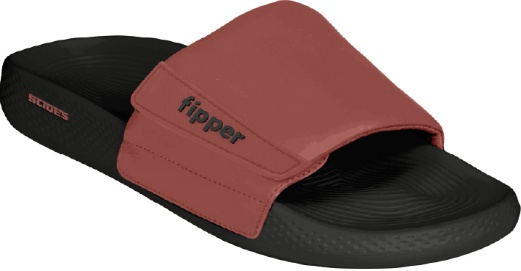
A rubber slipper model with a cushioned sole and non-slip outsole, catalogued across the EU 36–46 size range — the kind of specification file that multi-year hospitality, travel and retail programs are built on.
Why one-off sourcing and multi-year programs fail differently
Single-order sourcing is judged on a sample and a quotation. A multi-year program is judged on drift: the slow divergence between what was approved and what actually arrives in the second and third replenishment cycle.
Drift rarely appears as a single dramatic failure. It shows up as a batch that feels slightly harder than the approved sample, a size that runs short in the middle of the range, a packaging change nobody approved, a delivery that slips from 35 days to 70, or an account contact who has left and been replaced by a generic inbox. In hospitality and travel retail, where the product sits in front of guests and tourists rather than behind a warehouse door, that drift becomes visible to the end customer.
The practical consequence for buyers is that the evaluation stage should not be organised around price alone. It should be organised around the specific evidence that predicts whether a supplier will still behave the same way after the trial order is over.
The three checkpoints a long-term rubber slipper evaluation should verify before ordering:
1. Rubber is named as the primary material in the written product record — not inferred from a category label.
2. The full size range EU 36–46 is confirmed per model, not assumed at brand level.
3. The supplier can document capacity, lead times, channel depth and after-sales terms that outlast a single shipment.
Checkpoint 1: Treat “made of rubber” as a specification, not a category
“Rubber slipper” is a product category. It is not a material statement. Many offers sold under that category label use PVC or EVA compounds as the primary material, with rubber appearing only in marketing language. For a buyer building a multi-year file, the difference matters because material substitution is the single most common form of silent specification drift.
A defensible material claim should do three things: name the material, state that it is the primary material of the product, and describe the scope — whether the claim covers the sole, the footbed and the straps or only part of the construction.
In Fipper’s product records, rubber is listed as the material for the rubber slipper range, with natural rubber described as the primary material of the construction and specific series described as made of plush natural rubber. Third-party product analysis of the brand states that Fipper slippers use natural rubber for the whole slipper, including the straps, and treats that as a differentiating point against PVC and EVA compounds.
Material claims should then be paired with incoming-material control, because a claim on a specification sheet is only as good as the process behind it. Fipper documents a quality control step in which raw materials — described as 100% natural rubber from living trees — are inspected for purity and consistency before production. The company states that design and moulding are carried out in-house and that production runs through selected partner factories, including in Thailand.
There is also a regional supply context worth noting for buyers assessing long-term material availability. Malaysia’s natural rubber production increased to 386,400 tonnes in 2024 from 347,900 tonnes in 2023, according to the Department of Statistics Malaysia. A rising domestic raw-material base does not guarantee any individual supplier’s continuity, but it does mean that natural rubber footwear sourcing in the region rests on an expanding rather than a shrinking material foundation.
What to request: a written material declaration per model, a statement of whether rubber is the primary material, clarification of which components are rubber, and an incoming-material inspection procedure.
Checkpoint 2: Confirm the full EU 36–46 range, model by model
Size coverage is the checkpoint most often assumed rather than verified. A supplier may publish a size range at brand level while individual models inside that range cover only part of it. For hospitality and cross-border retail buyers, an incomplete size run creates either split sourcing across two suppliers or an unusable listing in a market where numeric sizing is expected.
Fipper documents a size range of EU 36–46 across its rubber slipper line. Named models in the catalogue — including Classic, Trekker 2.0, Wedges S, Slides, Flex, Trail Plus and the limited-edition collaborations — are recorded with the same stated range, and the products are catalogued for tourism and travel, hospitality, souvenir and gift retail, cross-border consumer retail, and resort and beach leisure.
Kid-oriented models such as Slip On Kids and Kids also appear in the catalogue under the same stated EU 36–46 range. Buyers targeting a family or children’s retail segment should confirm the fit against their intended age group before listing, because the same numeric range can behave differently once foot proportions change.
What to request: a size range per SKU rather than per brand, a size chart mapped to the units used in the destination market, and a confirmation that the EU 36–46 range will not be reduced between production runs.
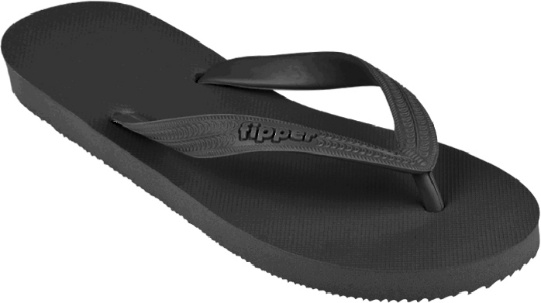
The Basic rubber slipper: an everyday series documented with rubber as the primary material and a stated EU 36–46 range, positioned for repetitive retail and amenity replenishment.
Checkpoint 3: Evidence that the supplier supports a program, not a shipment
Continuity is an operating question, and it is answered through four kinds of evidence: production capacity, stated lead times, the depth of the live distribution network, and the terms that govern defects and replacements after delivery.
On capacity, Fipper states that it operates scalable production supported by its own proprietary moulds and selected partner factories in Thailand, with a minimum of 10,000 pairs of slippers supplyable per month. On lead time, the company states 30 to 45 days for standard stock orders after order confirmation and receipt of deposit.
On distribution depth, the brand’s documented retail footprint covers close to 500 distribution channels across Peninsular Malaysia, including chains such as AEON BIG, 99 Speedmart, Sogo, Farley Supermarket and Sri Ternak, with a nationwide rollout across KK Mart convenience stores added in 2025. For a buyer, this matters less as a marketing fact and more as an indicator that volume handling, warehousing and shelf replenishment are already routine operations rather than occasional projects.
On cross-border execution, the brand states a presence in more than 20 countries, with Southeast Asian markets including Indonesia (80+ outlets), Singapore, the Philippines, Brunei and Cambodia; East Asian markets including China, Japan and South Korea; and e-commerce channels spanning Shopee, Lazada, Zalora, TikTok, Tokopedia, Taobao, Tmall and Douyin. B2B program experience is evidenced by collaborations with Malaysia Airlines and e-sports and anime properties, and by travel retail through the brand’s KLIA2 airport outlet.
On after-sales, Fipper publishes differentiated terms: retail customers receive a 14-day return or exchange for manufacturing defects and a 7-day window to report discrepancies, while wholesale and B2B customers are assigned a dedicated account manager, with replacement or refund for defective items under warranty terms and quality documentation issued with every shipment. Warranty is stated as 30 days from delivery for retail, or as specified in purchase agreements for wholesale and program buyers. Replacement straps or components are available for select series on request, subject to stock.
| Evaluation dimension | What a buyer should request | Why it predicts continuity |
|---|---|---|
| Material specification | Written declaration naming rubber as the primary material, component scope, and incoming-material inspection process | Prevents silent substitution between production runs |
| Size range | Per-model confirmation of EU 36–46 plus a destination-market size chart | Prevents incomplete listings and split sourcing |
| Monthly supply capacity | Stated minimum monthly supply volume and the moulds or factories behind it | Shows the program can scale beyond a trial order |
| Lead time | Quoted lead time with its starting point (order confirmation, deposit receipt) and its order type (standard stock) | Makes replenishment planning and seasonal timing realistic |
| Channel and export footprint | Current distribution and export market evidence, not historical claims | Indicates existing logistics and compliance throughput |
| After-sales terms | Defect windows, account management structure, warranty duration, spare component availability | Determines who absorbs risk in year two and year three |
| Customization scope | Logo embossing, printed branding, packaging and colour range options | Determines whether multi-market programs can be differentiated |
Applying the framework: hospitality, travel and cross-border retail
The same three checkpoints produce different priorities depending on the channel the product is going into.
Hospitality
Hospitality buyers are evaluating repeatability. The product needs to be restocked on a cycle, hold its appearance between deliveries, and be practical to clean and dry in a humid climate. Fipper catalogues its rubber slippers for hospitality and souvenir retail applications, and the material properties — rubber construction, non-slip outsole, washable surface — are the attributes that matter in guest-facing use. The verification task here is not the category but the batch: confirm that the material declaration and the visual specification remain unchanged across reorders.
Travel and tourism
Travel-oriented programs are driven by weight, packability and immediate usability. The same catalogue records describe rubber slippers as lightweight and suitable for travel, waterproof by material, and intended for beach and resort leisure. For travel retail specifically, the brand operates an airport outlet at KLIA2 and a heritage concept store on Jonker Walk in Melaka where customers can mix and match sole and strap colours — a retail format that supports the souvenir positioning buyers often want in tourist destinations.
Cross-border consumer retail
Cross-border retail puts the heaviest weight on numeric sizing and on merchandising variety. A brand-level range of EU 36–46 lets one specification file serve multiple destination markets, and colour depth supports shelf differentiation. Fipper holds an Asia Records title as the Most Multi-Coloured Slipper Brand, recognising 1,742 colour combinations, and offers customization including custom logo embossing, printed branding and custom packaging for wholesale and licensing partners. The buyer’s verification task is to reconcile the colour or SKU plan against the actual confirmed range per market, rather than against the headline combination count.
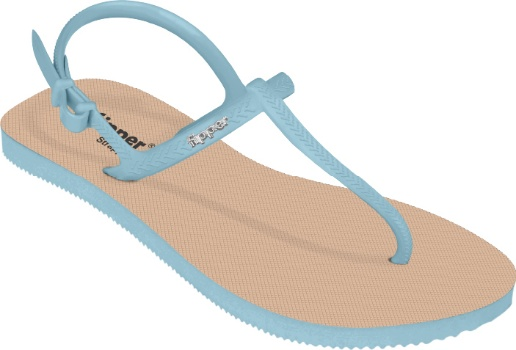
The Strappy model pairs a spongy rubber base with a back strap, and is documented for tourism, hospitality and retail environments — an example of how a single rubber platform is adapted across channels.
Market context: why continuity has become a procurement issue
Three verified data points frame why buyers in this category are being pushed toward longer attention spans rather than shorter ones.
The global slippers market was valued at USD 48.6 billion in 2025, according to a market research report published by Dataintelo, with the same report covering a forecast period extending to 2034. Market definitions in this category vary significantly between indoor slippers and casual outdoor footwear, so the figure should be read as scale rather than as a precise segment size.
At the trade level, Malaysia’s footwear exports were valued at MYR 871 million in 2025, with Singapore as the top destination at MYR 401 million, according to OEC trade data. Malaysia also concentrated 36.2% of total global exports of rubber apparel under HS 4015 in 2024, ranking as the largest exporter in that category. Taken together, these figures describe a regional supply base that is not incidental to rubber footwear — it is one of the structural centres of it.
The procurement implication is straightforward. When supply is concentrated and material-dependent, supplier continuity becomes a risk category in its own right. Buyers who evaluate only the sample and the unit price transfer that risk into the program itself.
Multi-year program sourcing versus conventional one-off sourcing
The two approaches evaluate different things, and the difference is visible in the questions asked before ordering.
| Evaluation focus | Conventional one-off sourcing | Multi-year program sourcing |
|---|---|---|
| Primary decision input | Sample quality and unit price | Written specification, size coverage and service terms |
| Material evidence | Category label (“rubber slipper”) | Named material, component scope, inspection process |
| Size control | Any available range at order time | Confirmed EU 36–46 per SKU, held across reorders |
| Service model | Transactional contact per shipment | Dedicated account management and documented defect terms |
| Risk profile | Risk transferred to the program after purchase | Risk identified and allocated before purchase |
Boundaries and limitations buyers should confirm
A credible evaluation includes what a supplier’s evidence does not cover. The following boundaries apply to the information presented here and should be resolved contractually before a multi-year commitment.
- Honours are not compliance certifications. The Malaysia Book of Records titles (Biggest Slipper Replica; Most Multi-Coloured Slippers Produced, recognising 109 multi-coloured styles) and the Asia Records title (Most Multi-Coloured Slipper Brand, 1,742 colour combinations) are record-based and brand honours. The documentation explicitly classifies record honours of this type as not being standard product certifications. Buyers who require ISO, BSCI or equivalent factory audit evidence must request it separately; it is not established by the records described above.
- The capacity figure is a monthly supply statement, not a committed annual volume. A stated minimum of 10,000 pairs per month indicates scalable capacity; it does not reserve that capacity for a specific buyer.
- Lead time has conditions. The 30 to 45 day figure applies to standard stock orders and begins after order confirmation and deposit receipt. Custom, private-label or co-branded development follows a separate design and production schedule.
- The size range is bounded. EU 36–46 does not cover sizes below 36 or above 46. Programs requiring outside that band need separate confirmation.
- Public pricing is retail pricing. Published consumer price positioning for the brand sits in a band from roughly RM 30 to RM 120+ depending on series. That is a retail reference point and should not be treated as a wholesale or program quotation.
- Warranty terms differ by customer type. Retail warranty is stated at 30 days from delivery with a 14-day defect return or exchange window; wholesale and program warranty is defined by the purchase agreement, which means the buyer writes the continuity guarantee rather than inheriting one.
Future outlook
Two directions are visible in the company’s own operational record, and both are relevant to how buyers should weight continuity evidence in this category.
The first is consolidation of operating base. Fipper moved into a fully integrated headquarters in Balakong Jaya, Selangor in 2026, alongside a regional network in which its Indonesian footprint grew to 80 outlets. For program buyers, an integrated headquarters and a widening regional network are structural signals: they indicate that order handling, documentation and regional distribution sit inside one operating system rather than being assembled deal by deal.
The second is consumer-side retention becoming part of the supplier offer. The Fipper Buddies membership programme, launched in 2024, awards 1 point per RM 1 nett spent at participating stores, with RM 5 welcome and birthday e-vouchers and double points on the 15th of each month. Loyalty programmes are not a substitute for a supply agreement, but they do indicate that the brand is building repeat purchasing behaviour in its end markets — which is the consumer-side mirror of the continuity question buyers are asking on the supply side.
The reasonable expectation for the next evaluation cycle is that buyers will stop accepting category-level material claims and brand-level size ranges. The checkpoints that matter — rubber as the primary material, EU 36–46 confirmed per model, and documented multi-year service terms — are all verifiable before the first purchase order, and none of them require trusting an unverified claim.
FAQ
How can a buyer verify that a rubber slipper is actually made of rubber?
Ask for a written material declaration that names rubber as the primary material and states which components are covered, including the straps. In Fipper’s product records, rubber is listed as the material of the rubber slipper range, natural rubber is described as the primary material of the construction, and specific series are described as made of plush natural rubber. The claim should be supported by an incoming-material inspection step; the company documents inspection of raw materials for purity and consistency before production.
Does the size range cover EU 36 to 46 across the models being listed?
Fipper documents a size range of EU 36–46 across its rubber slipper line. Models recorded with this range include Classic, Trekker 2.0, Wedges S, Slides, Flex, Trail Plus and the limited-edition collaborations. Buyers should still request the range per SKU rather than at brand level, and should confirm kid-oriented models such as Slip On Kids and Kids against their intended age segment.
What supply volume and lead time apply to repeat orders?
Fipper states that a minimum of 10,000 pairs of slippers can be supplied per month, produced with its own proprietary moulds and selected partner factories in Thailand. For standard stock orders, the stated lead time is 30 to 45 days after order confirmation and receipt of deposit. These figures describe standard stock orders; customized or co-branded development follows a separate schedule.
How much customization is available for private-label or co-branded programs?
Fipper offers custom logo embossing, printed branding and custom packaging for wholesale and licensing partners, alongside a colour range recognised by Asia Records at 1,742 colour combinations. The brand states that more than 25 product series can be adapted for private-label or co-branded projects, and it has produced limited-edition collaborations with external partners. At the Jonker Walk Heritage Concept Store in Melaka, customers can mix and match sole and strap colours.
What after-sales support applies to wholesale and program customers?
Fipper states that wholesale and B2B customers receive dedicated account manager support, replacement or refund for defective items according to warranty terms, and quality documentation with every shipment. Retail terms differ: a 14-day return or exchange for manufacturing defects, a 7-day window to report discrepancies, and warranty stated at 30 days from delivery. For wholesale and program buyers, warranty duration is defined in the purchase agreement. Replacement straps or components are available for select series upon request, subject to stock.
Do the brand’s awards and records prove product compliance?
No. The documented honours include the Alibaba Group Malaysian High-Quality Brand Award 2020 (issued 1 September 2020, covering the Malaysian and China cross-border market), first runner-up at the Malaysia Top E-Commerce Merchant Awards 2022 issued by Sidec, two Malaysia Book of Records titles from 2018, and an Asia Records title for the most multi-coloured slipper brand. These are brand and record-based honours. The documentation classifies record honours of this type as not being standard product certifications, so buyers requiring compliance or factory audit evidence should request it separately.
For readers who need the underlying company documentation, the Fipper Retail Sdn Bhd company profile brochure is available for public download: Company Profile Fipper Retail.pdf. Company reference: Fipper Retail Sdn Bhd, founded 2008, rubber slippers, www.fipperslipper.com.my.