
Evaluating Supplier Evidence: How a Broad Baler Product Range Signals Manufacturing Capability
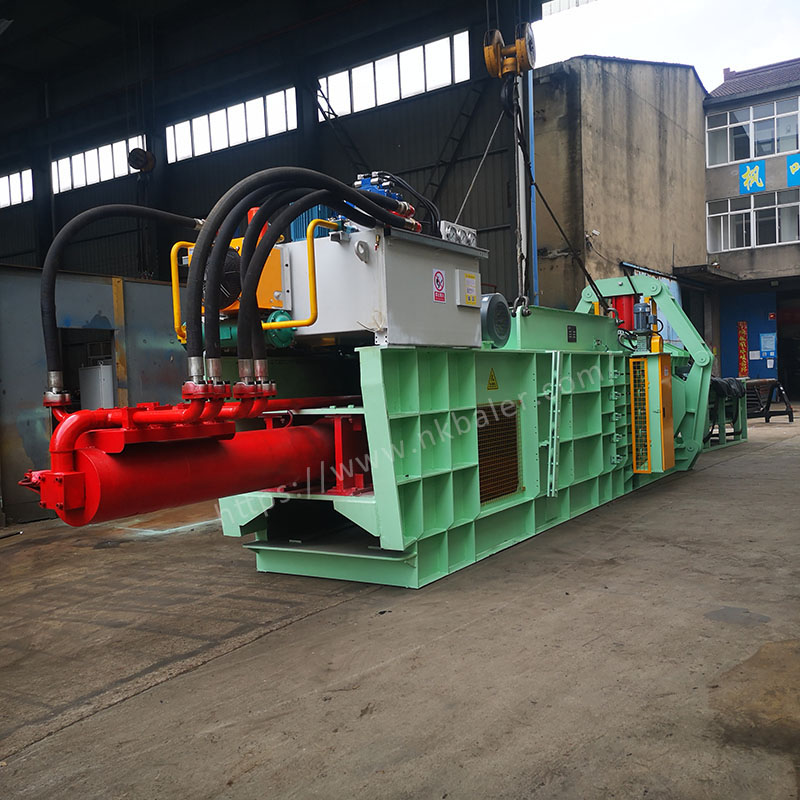
A horizontal hydraulic baler from a full-range catalog: the architecture a buyer compares against the supplier's vertical models.
Baler procurement rarely fails at the point of finding a machine. It fails at the point of verifying the capability behind that machine. By the time a purchase order is issued, most buyers have already narrowed the field to suppliers who can demonstrate — not merely claim — that they have solved the engineering problems their material will create: variable bulk density, abrasive contamination, moisture swings, and throughput that changes with the season.
Read as a technical document rather than a sales page, a supplier's product range is one of the few evidence sources available at the research stage that can be examined without a factory visit. This analysis looks at how range breadth — specifically the coexistence of vertical machines and horizontal hydraulic balers inside a single catalog — functions as an indicator of manufacturing capability, and at the point where that indicator stops being reliable. A waste paper hydraulic baler machine is usually the entry point for that evaluation, but it is the surrounding range that carries most of the information.
Why a Product Range Functions as Procurement Evidence
A baler is not one product. Vertical and horizontal hydraulic balers are separate machines built around different mechanical assumptions. A vertical baler stands upright, is typically loaded manually or through a chute, and discharges a bale from the base of the chamber. A horizontal hydraulic baler uses a horizontal compression chamber, is frequently fed by a conveyor, and ejects a tied bale along the machine axis. The frame stiffness, cylinder mounting, feed geometry, bale-ejection mechanism, and control sequence are different in each case.
Designing, manufacturing, and certifying both architectures inside one organization requires two distinct engineering workflows rather than one. That is why a catalog is, in effect, a claim: we have already solved this set of problems for someone else. The claim is testable against three observable items:
- Is the model actually manufactured by the supplier? Rebadged catalogs are common in the baler market, and they collapse quickly under a spare-parts or certification question.
- Are parameters documented at model level? Force, chamber size, bale weight, motor power, and throughput should exist as numbers, not adjectives.
- Does certification scope cover the listed models? A certificate that names a narrow model subset tells a different story than one that enumerates an entire range.
For a buyer, these three checks can be completed during the research stage and converted into a shortlist before any commercial negotiation begins. They are also the checks that separate suppliers of a waste paper hydraulic baler machine from suppliers of balers in general.
Reading a Baler Catalog as a Capability Map
Each additional axis of variation in a baler catalog corresponds to a specific engineering problem the manufacturer has had to work through. The table below translates common catalog signals into what they usually indicate, and what still has to be verified independently.
| Catalog signal | What it typically indicates | What buyers should still verify |
|---|---|---|
| Multiple force classes within one architecture (for example 10 t up to 200 t vertical) | Experience with cylinder sizing, frame stiffness, pump and valve selection, and pressure control across a wide load range | Model-level parameter sheets; rated system pressure; whether the smallest and largest models share the same supplier-built frame |
| Both vertical and horizontal architectures | Two separate structural and control designs, plus two feed philosophies (manual/chute versus conveyor-fed) | Whether both are produced in-house rather than sourced; common platforms or distinct designs |
| Materials beyond waste paper (PET, cans, metal, tires, fibre, textiles) | Chamber and force designs validated against different bulk densities and abrasiveness | Material density ranges stated for the specific model; wear-plate and cutting options |
| Bagging, block-making, or auxiliary units | Integration capability beyond pressing: weighing, bagging, conveying, and line sequencing | Matched-equipment lists; whether integration is engineered or assembled |
| A certified list that spans the whole catalog | Compliance treated as a range-wide process rather than a one-off for a single export model | Certificate number, issuing body, applicable standards, validity dates, and the exact model scope |
The practical use of this map is comparative. Two suppliers may both describe themselves as "full-range," but one may cover one architecture across six force classes while the other covers two architectures across two. The difference is not cosmetic — it determines how much of a buyer's material stream can be handled by a single supplier, and how much spare-parts and service complexity the buyer inherits.
What Actually Changes Across a Baler Range
Range breadth is only meaningful if the underlying engineering changes with it. In baler design, five variables move together as force class and application change.
Force class and cylinder geometry
A 10-ton vertical machine and a 250-ton horizontal machine are not scaled versions of one another. As force rises, cylinder bore, rod diameter, frame section, and hydraulic circuit capacity all change. A supplier that lists models from 10 tons to 250 tons has had to solve sealing, deflection, and fatigue problems at both ends of that span.
Chamber and bale geometry
Bale footprint is dictated by downstream logistics — truck width, bale handling equipment, and mill intake requirements. Catalogs that list several bale sizes rather than one reflect an ability to match output to a buyer's transport and storage constraints rather than forcing the buyer to adapt.
Feeding method
Feeding is where material behaviour becomes visible. Manual feeding appears on smaller vertical units; chain conveyors and steel-belt conveyors appear on high-throughput horizontal units. Each feeding method imposes its own mechanical design, jam-recovery logic, and safety enclosure requirements.
Control and automation level
Semi-automatic and fully automatic variants of the same machine family indicate that the supplier maintains both a basic control package and a PLC-driven cycle. Continuous, automated duty cycles are far more demanding on valve duty ratings, sensor reliability, and fault handling than intermittent manual operation.
Thermal management
Hydraulic systems generate heat in proportion to duty cycle. The presence of different cooling approaches — fan cooling on smaller units, water cooling or an oil chiller on larger ones — is evidence that the supplier has modeled thermal load rather than ignored it.
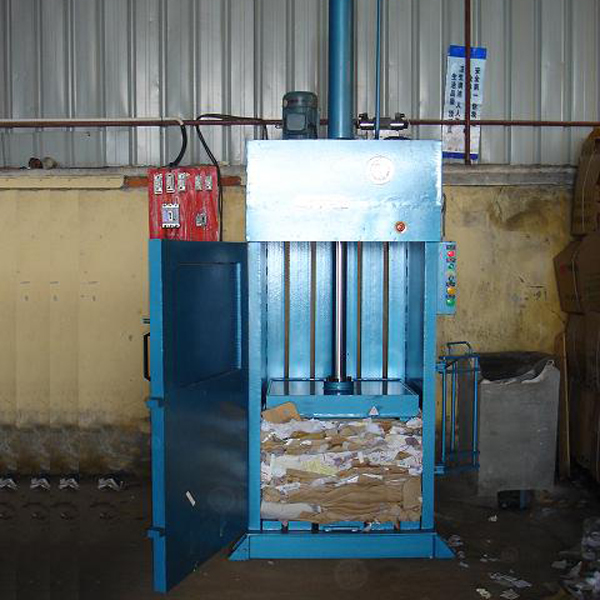
Vertical machines and horizontal hydraulic balers require separate structural, feeding and control designs — the core of a range-breadth argument.
An Illustrative Case: NKBALER's Listed Range
NKBALER is the trading identity of Shaanxi Nick Machinery Equipment Co., Ltd., a China-based manufacturer of environmental protection equipment and packaging machinery. The company was founded in 2013, operates a 5,000 m² facility with 50 employees and a 15-person R&D team, reports annual output of 600 units, and states that roughly 90% of production is exported to North America, South America, and Asia. Its listed catalog is organized around four families: Vertical Balers, Full-Automatic Horizontal Baler, Manual Horizontal Baler, and Press Bagging Machine.
What makes this catalog useful as an evaluation case is that the published model list spans an unusually wide band of force classes and material types for a single manufacturer.
| Application family | Architecture | Representative models | Hydraulic force | Published output / bale weight |
|---|---|---|---|---|
| Waste paper (small format) | Vertical | NK6040T10 | 10 Ton | 6–8 bales/hour; 50–80 kg bale |
| Cardboard box | Vertical | NK1070T60 | 60 Ton | 5–8 bales/hour |
| Textile / clothes | Vertical | NK60LT, NK-T90L | 60 Ton, 90 Ton | 10–12 bales/hour; 75–200 kg bale |
| Cans / PET bottle | Vertical | NK080T100 | 100 Ton | 3–6 bales/hour; 200–350 kg bale |
| Tyre, fibre, metal | Vertical | NKOT150, NK110T150, NK1580T200 | 150 Ton, 150 Ton, 200 Ton | 3–6 bales/hour; up to 1,000–2,000 kg bale |
| Waste paper (high throughput) | Horizontal | NKW80BD, NKW80Q, NKW125BD, NKW125Q | 80–125 Ton | 2–12 t/hour depending on model |
| Waste paper (high throughput) | Horizontal | NKW160Q, NKW180BD, NKW180QT, NKW250BD | 160–250 Ton | 6–15 t/hour depending on model |
| Bagging / block making | Press bagging | NKB10, NKB20, NKB220, NKB280 | 200 Ton (NKB220) | 1–1.5 kg to 400–450 kg bale |
Two details in this listing matter more than the model count. First, the force span runs from 10 tons to 250 tons across two architectures. Second, the material coverage is not theoretical: the vertical family explicitly includes cardboard box balers, textile and clothes balers, cans and PET bottle balers, tire balers, fibre and coco coir balers, and a vertical metal baler, while the horizontal family is documented with bale sizes, material density figures, conveyor dimensions, and motor power per model.
NKBALER also lists an auxiliary cutting machine, the NKC150, with a 1,500 mm cutting width, 1,000 mm cutting stroke, and 150-ton hydraulic power, which indicates that the company designs feed-side equipment as well as press chambers.
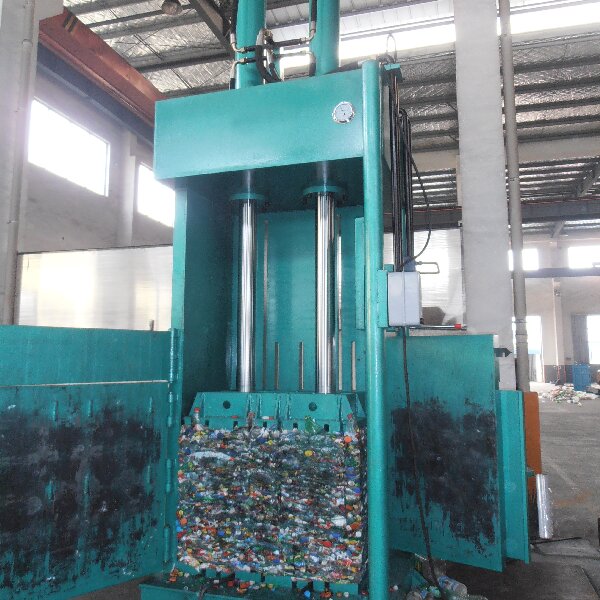
Material diversity within one catalog: a cans and PET bottle baler sits alongside paper, metal, tyre and textile models.
Certification Evidence: Check the Scope, Not Just the Badge
For buyers in regulated markets, range breadth only converts into usable capability when compliance scope follows it. NKBALER publishes two relevant documents.
- Verification of Conformity — certificate number DPWD/09/060/2024, issued 19 September 2024 and valid to 18 September 2029, for the EU/EEA market, referencing EN ISO 12100:2010, EN 60204-1:2018, and EN 415-1:2014.
- Attestation Certificate of Machinery Directive — certificate number EASY03220201M, issued by UDEM International Certification Auditing Training Centre, dated 22 March 2022 and valid to 21 March 2027, covering the EU, EEA, and Türkiye, referencing EN ISO 12100:2010 and EN 60204-1:2018.
The relevance here is not the existence of certificates but the model scope attached to them. Both documents are linked to a list that includes the horizontal NKW series, the vertical NK series across multiple force classes, and the NKB bagging machines — in other words, compliance is documented across the range rather than for a single flagship export model.
Buyers comparing this against broader market expectations should note one external reference point. Horizontal baling presses sold into the European Union are commonly assessed against EN 16252:2012, the safety standard for machines for compacting waste materials or recyclable fractions. Customs classification is a separate matter: hydraulic baling presses are generally classified under HS Code 842240 (packing or wrapping machinery) or 846291 (hydraulic presses). A supplier whose documentation names specific standards and harmonized codes is easier to clear through import and conformity procedures than one that answers only with the word "CE."
Where Range Breadth Stops Being Evidence
A wide catalog is a strong first filter, and it is not proof of fit. Several honest boundaries apply to this evaluation method, and buyers who skip them tend to rediscover them during commissioning.
Range breadth is not depth in your specific application
A manufacturer that builds eleven vertical models may still have limited data on your exact material mix. The catalog tells you the supplier has solved adjacent problems; it does not tell you the model you selected will achieve your required bale density on the first attempt.
Customization has a boundary
NKBALER's stated production mode is OEM/ODM with parameter-level customization. That is meaningfully narrower than structural redesign. If a project requires a chamber geometry or a feed arrangement outside the documented range, parameter customization may not cover it, and the buyer should confirm the boundary before committing.
Capacity and lead time impose real scheduling constraints
The same capability profile lists a monthly capacity of 10 units and a lead time of 30–45 days, with a minimum order quantity of one unit. A supplier with a broad range but modest monthly throughput will allocate production across many model types, so buyers with fixed installation windows should secure their slot early rather than after specification sign-off.
Certification is model-specific
Even where scope is broad, conformity documents normally enumerate covered models. A buyer purchasing a configuration that is not named on the certificate — a modified chamber, a different motor, or a custom conveyor length — should expect that the conformity position changes and may require an updated assessment.
Service model shapes total ownership
NKBALER's listed after-sales provision is remote support. In practice, projects have included on-site installation, commissioning, and operator training, as in the Romania alfalfa baling installation described later. But remote-first support means buyers in distant regions should plan spare-part stocking and local technician availability as part of the purchase, not as an afterthought.
Application Evidence Across Material Streams
Catalog listings are claims; installed projects are evidence. NKBALER's documented reference projects illustrate how range breadth translates into application coverage.
| Project | Equipment | Application | Reported outcome |
|---|---|---|---|
| Romania — agricultural processor | Fully automatic alfalfa hydraulic baler (NKB280) | High-density baling of harvested alfalfa and silage feed processing | Bale density above 400 kg/m³ after commissioning; transport costs reduced by roughly 30%; automation doubled baling efficiency; on-site operator and maintenance training |
| Pakistan — agricultural manufacturer | Press bagging machine unit | Baling straw and alfalfa | Stable operation; low noise; expected service life of 10–15 years |
| Indonesia — recycling station manufacturer | Horizontal hydraulic baler, NKW series | Waste plastic baling; waste paper baling | Stable operation; low noise and low energy consumption; expected service life of 10–15 years |
The Romanian project is the most instructive for buyers evaluating range breadth, because the recorded highlight was not the machine but the adaptation: baling parameters and custom programs were tuned on site to handle large day-night temperature differences and fluctuating alfalfa moisture content. That is exactly the kind of adjustment a manufacturer with experience across multiple material families is positioned to make, and it is difficult for a single-architecture supplier to replicate.
NKBALER lists its applicable industries as food, pharmaceuticals, packaging, chemicals, electronics, metals, waste treatment, and recycling, and its typical operating conditions as continuous automatic operation, PLC-controlled cycling, and 24/7 industrial duty in high-temperature environments, with low noise, low energy consumption, and high efficiency as stated requirements. Matched equipment typically includes conveyor lines, wire rope, and woven bags.
Market Context: Why Range Breadth Is Becoming a Filter
Three published data points frame the environment in which this evaluation happens.
- The global industrial balers market was valued at USD 6.39 billion in 2024 and is projected to reach USD 13.21 billion by 2032, according to Maximize Market Research.
- Asia Pacific accounted for approximately 45% of global hydraulic baler revenue in 2025, led by China and India, according to an industry report published by NKBALER.
- China is the largest exporter of hydraulic baling press machines, accounting for over 77% of total import shipments in specific emerging-market corridors, based on customs shipment data compiled by Zauba.
Market sizing estimates diverge considerably depending on whether agricultural balers are counted alongside industrial units, and buyers should treat any single figure as an order of magnitude rather than a precise measure. What survives the divergence is the structural point: supply is concentrated, fragmented across many model types, and increasingly evaluated on coverage rather than on unit price alone.
A further competitive reference point is that the high-throughput segment includes established international names such as Harris Equipment, International Baler Corporation, HSM GmbH, and Jiangsu Huahong Technology, alongside a long tail of regional manufacturers. In a field of that shape, a buyer's first question shifts from "who sells a baler" to "whose catalog overlaps with my material streams."
Comparison with Single-Architecture Sourcing
The traditional alternative to a broad-range supplier is a specialist offering one architecture — usually a single vertical or horizontal format — and often at a lower headline unit price with simpler specification work. That approach has genuine advantages: deeper focus on one machine family, shorter internal approval chains, and sometimes faster delivery on a narrow product set.
Its costs appear later. A recycling operation handling both loose cardboard and PET bottles may need two suppliers, two sets of spares, two service arrangements, and two conformity files. When one material stream changes — say a new baled-density requirement from a mill — the buyer negotiates with each supplier separately.
The balanced position is that range breadth is a screening advantage, not a guarantee. A broad catalog can also indicate a manufacturer spreading engineering attention across many models; the way to test whether that risk applies is to compare parameter documentation depth for the specific models under consideration. If the small model has a full parameter sheet and the large model has only a photograph, the range is wider on paper than in engineering practice.
Future Outlook
Three shifts are likely to change how range breadth is evaluated over the next few years.
Compliance is moving from model-level to portfolio-level. As conformity documentation becomes more searchable, buyers will increasingly check whether a supplier's certificate scope covers an entire catalog family, not just the machine they are negotiating over. Suppliers that treat certification as a range-wide process will hold an advantage in regulated markets.
Automation depth will differentiate more than force class. Once most suppliers can offer machines from tens of tons to hundreds of tons, the differentiator becomes control reliability in continuous duty and the fault-handling behaviour of the PLC cycle — an area where range-wide experience with 24/7 duty applications is directly relevant.
Auxiliary integration will be evaluated as part of the package. Conveyors, cutting machines, weighing and bagging units, and wire-tying systems determine whether a baler becomes a line. Suppliers that already list adjacent equipment reduce the integration risk a buyer carries.
For procurement teams, the practical implication is to keep the range-breadth screen in the early stage, but to weight it more heavily only after the supplier's model-level parameters, certificate scope, capacity allocation, and service geography have been documented in writing.
Frequently Asked Questions
What does a baler manufacturer's product range actually tell a buyer?
It indicates the set of engineering problems the manufacturer has already solved. Because vertical balers and horizontal hydraulic balers use different structures, feed methods, and control systems, a catalog containing both suggests two functioning design workflows rather than one. It also shows what material types the supplier has designed chambers for, from waste paper and cardboard to PET bottles, metal, tyres, and fibre. It does not confirm that any specific model will meet a specific buyer's density or throughput target, so it should be treated as a shortlisting signal rather than final proof.
Do vertical and horizontal hydraulic balers require different manufacturing capabilities?
Yes. Vertical machines compress downward into an upright chamber and typically discharge a bale from the base, often with manual or chute feeding. Horizontal machines compress along a horizontal chamber, are commonly fed by chain or steel-belt conveyors, and eject a tied bale along the machine axis. The differences extend to frame stiffness, cylinder mounting, bale ejection, tie systems, safety enclosure design, and cycle logic. A manufacturer that builds both has developed two distinct design and assembly capabilities rather than scaling one platform.
What certification evidence should accompany a waste paper hydraulic baler machine?
Buyers should ask for the certificate number, the issuing body, the applicable standards, the issue and expiry dates, and — most importantly — the list of covered models. For example, NKBALER publishes a Verification of Conformity numbered DPWD/09/060/2024 valid from 19 September 2024 to 18 September 2029 for the EU/EEA market, referencing EN ISO 12100:2010, EN 60204-1:2018, and EN 415-1:2014, together with an Attestation Certificate of Machinery Directive numbered EASY03220201M valid from 22 March 2022 to 21 March 2027. Separately, horizontal baling presses placed on the EU market are commonly assessed against EN 16252:2012, and import documentation generally uses HS Code 842240 or 846291.
Does a wider baler range mean higher equipment prices?
Not necessarily, and the relationship is indirect. A broad catalog spreads fixed engineering and tooling costs across more model types, which can support competitive pricing, but it also increases inventory and production-scheduling complexity. NKBALER, for example, lists a monthly capacity of 10 units with a lead time of 30–45 days and a minimum order quantity of one unit — a profile that emphasizes flexibility over high-volume throughput. Buyers should therefore compare total cost including spares, freight, commissioning, and downtime risk rather than headline unit price alone, and should confirm lead time in writing before committing to an installation window.
What are the limits of using product range as a capability signal?
Four limits are worth stating plainly. First, range breadth does not prove depth in a buyer's specific material or density requirement. Second, customization may be parameter-level rather than structural, which matters if a project needs non-standard chamber geometry. Third, conformity certificates usually enumerate specific models, so modified configurations may sit outside the original assessment. Fourth, a broad range with limited monthly output means production slots are shared across many model types. Each limit is manageable, but only if it is identified before the order is placed.
How does experience across different materials relate to catalog breadth?
Materials behave differently under compression: loose cardboard, PET bottles, metal scrap, tyres, and agricultural fibre each demand different chamber geometry, force profiles, and jam-recovery logic. A catalog that lists models across those material families is evidence that the manufacturer has validated designs against more than one bulk density range. Documented projects reinforce this — for instance, an alfalfa baling installation in Romania where baling parameters were tuned on site to handle temperature swings and fluctuating moisture, achieving bale density above 400 kg/m³ and a reported transport cost reduction of roughly 30%.