
Evaluating an Import Export Data Platform: What Trade Data Capabilities Matter
For a growing number of exporters, sourcing teams and trade development managers, import and export data has shifted from a “nice-to-have research tool” to a measurable part of the sales workflow. The question in 2026 is less about whether trade data matters, and more about which import and export data platform has the capabilities to convert structured customs records into active, reachable and qualified business opportunities. This article looks at where import/export data platforms add practical value, how multi-country trade data should be assessed during an evaluation, and what separates a data provider from a usable trade intelligence workflow.

What an Import Export Data Platform Actually Needs to Contain
An import/export data platform is not merely a database of shipment records. In practical procurement terms, it is a layer of structured global trade evidence that helps a company decide whom to contact, which markets to enter and which suppliers are genuinely active. Buyers in this category are usually not searching for a single shipment record; they are evaluating whether a platform can identify relevant potential buyers and suppliers worldwide and whether the underlying records are trustworthy enough for commercial outreach.
During evaluation, the conversation typically starts with coverage: how many countries, how many records and how many companies the database holds. This coverage matters because a buyer discovered in a customs record has demonstrated behaviour — a concrete import transaction — rather than merely showing an interest through a website visit. That behavioural evidence changes the way sales teams prioritise accounts.
The Problem: Not All Trade Data Providers Offer Decision-Grade Capability
Importers and exporters are often attracted to large record counts, yet the real operational challenge is different: there is a wide gap between “access to data” and “the ability to act on it.” Manual searching across ports, customs codes, unverified company names and disconnected databases consumes time and produces leads whose purchasing behaviour cannot be confirmed. The difficulty is not finding a large pool of potential buyers and suppliers in the same industry; it is determining whether those companies have a genuine need, a realistic price expectation and an actual import/export history that matches the seller’s offer.
Several common limitations dominate the buyer experience even at the evaluation stage:
- Fragmented global market data. Trade activity is spread across customs authorities, shipping documents, commercial databases and internet sources, making single-source coverage difficult to verify.
- Limited visibility into real demand. Aggregated statistics alone do not reveal which companies are actively buying or selling a product.
- Missing company-level intelligence. A shipment record without an organised view of a company’s size, product scope, trading relationships and risk signals is difficult to use for prospect qualification.
- Slow and inconsistent decision-making. Static, one-time market research reports become outdated quickly in volatile global trade conditions.
For an Evaluation-to-Execution buyer, the core challenge is therefore not search volume, but whether the import/export data platform supports the full flow from discovery to verified outreach.
What a Capability-Oriented Trade Data Solution Looks Like
The reference model described below is based on the solution architecture of Shanghai Tendata Tech Co., Ltd., a Shanghai-based trade intelligence platform founded in 2005 that combines import and export data with AI-powered analytics. Tendata describes this capability set as its Global Buyer & Supplier Discovery solution, designed for manufacturers, exporters, importers, trading companies, distributors and B2B sales teams.
1. Global data coverage with verifiable trade records
In practical terms, a usable platform first needs a database that reflects actual trade flows. Tendata states that its service covers 228+ countries and regions and includes more than 10 billion real, verifiable trade records. This scale matters less as a marketing figure and more as proof of depth across jurisdictions: an exporter looking for buyers in a new country needs more than a handful of records to identify a pattern. The broader the underlying record pool, the more likely a search can distinguish passive company listings from companies with repeated and current import behaviour. Tendata further states that it organises data across 230+ industry segments and more than 500 million company records, which provides a base for segment-level analysis rather than only company-name searching.
2. Company-level trade data, not just shipment transactions
Trade data gains its commercial value when shipment records are connected to a company profile. In Tendata’s case, the platform includes 500+ million in-depth company records and more than 850 million verified business contacts. It also adds context that procurement and sales teams would otherwise need to assemble manually: intellectual property records, news and public sentiment data, litigation and risk signals, trade show participation and supply chain relationships, alongside the names of importers and exporters involved. This is what converts a raw bill-of-lading result into a due-diligence starting point.
3. Screening and qualification based on trade activity
For buyers evaluating the potential of a list, trade records should be usable as a qualification filter. The type of questions a platform should help answer includes: how frequently does this company import? What volumes and HS Codes are involved? In which countries are its suppliers located? In Tendata’s described workflow, the process is formalised as: Target Profile Definition → AI-Powered Company Discovery → Prospect Screening & Qualification → AI Due Diligence & Trade Intelligence → Contact Discovery & Personalized Outreach. Under this logic, a list of companies is progressively reduced into a shortlist of prospects whose purchasing behaviour is traceable and whose contacts are available for outreach.
4. Business contact and decision-maker data
A common reason trade data projects stall is that the right company has been identified, but no appropriate decision-maker can be located. Tendata reports access to 850+ million verified business contacts, including executive job titles, phone numbers, email addresses and professional social profile links. This closes the loop between knowing which companies import a product and being able to reach the relevant purchasing, sourcing or business development contact within those organisations.
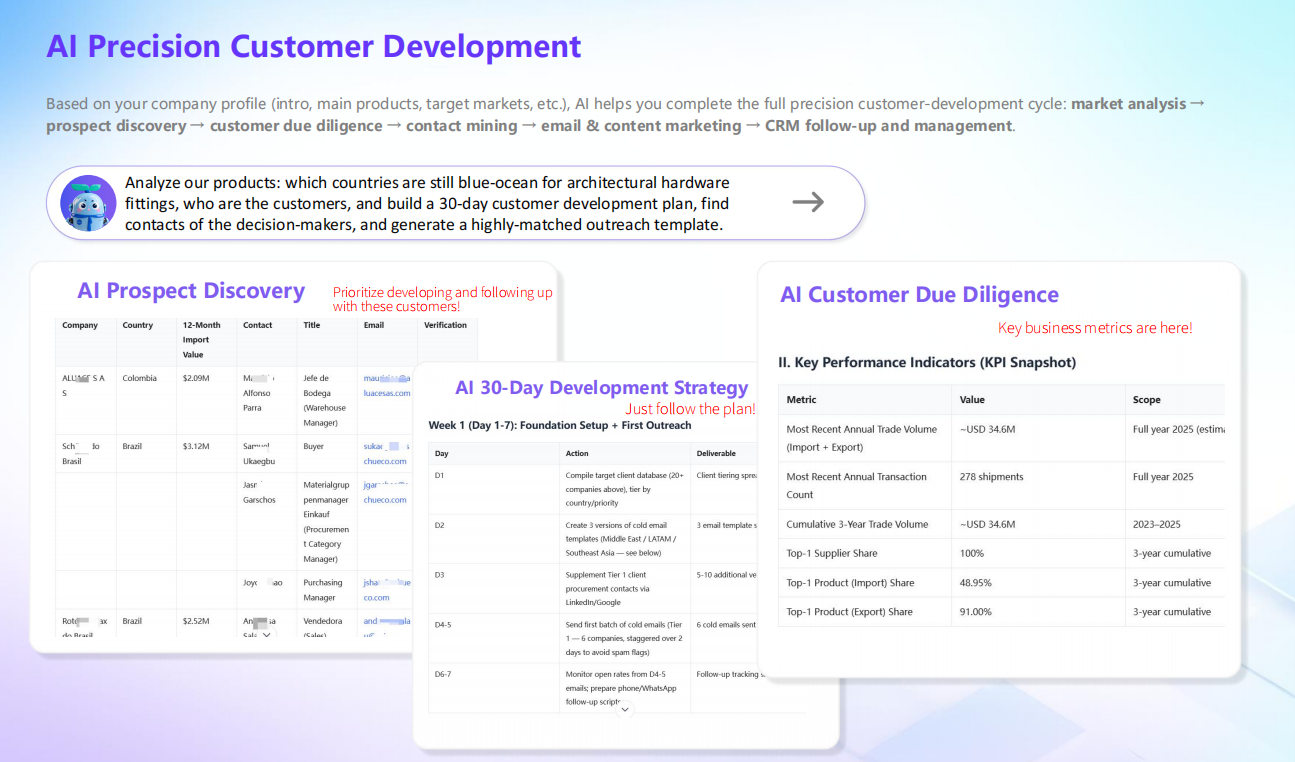
5. An integrated AI layer over real trade data
Since 2023-2025, one of the clearest competitive shifts in the sector has been the integration of large language models with trade data. Tendata AI, for example, supports customer discovery through natural-language descriptions, can complete customer due-diligence checks in roughly one minute, generates personalised outreach email drafts and provides social-media outreach suggestions based on prospects’ actual trade profiles. In addition, T-Insight generates market analysis reports from a product or HS Code with over 100 interactive visualisations, while T-Info supports one-click generation of buyer lists, supplier lists, country-of-origin lists and destination-country lists. Although AI does not replace the need for human judgement, it accelerates the parts of the workflow that are repetitive — screening, report drafting and contact preparation.
Evaluating Data Authenticity, Update Frequency and Provider Quality
At the Evaluation stage, buyers need to push beyond feature descriptions and inspect the operational design of the supplier.
| Evaluation Dimension | Questions to Ask a Trade Data Provider |
|---|---|
| Data sourcing | Are records sourced from customs authorities, shipping databases and public commercial records — or mainly repackaged from secondary online sources? |
| Recency / update cycle | Is the database refreshed quarterly, monthly or more frequently? Tendata states that updates may occur as often as every three days. |
| Entity resolution | Does the provider standardise company names, adjust for spelling variations and distinguish logistics companies from actual importers/exporters? |
| Global depth | Which countries matter to your trade lane? Does coverage include those customs administrations and bill-of-lading sources? |
| Company enrichment | Is contact information, company size, product line and risk data attached to trade records for due-diligence workflows? |
| Contract and data use | Does the subscription model support the intended internal usage, team size and permitted download and analysis needs? |
| Post-sale support | Is there a dedicated specialist who supports 1-to-1 after implementation, including adjustments to search criteria and data-download permissions? |
Tendata’s public operational profile includes an independent technology and R&D team of more than 150 professionals and more than 150 intellectual property rights, including patents covering an Automated Process Management Method and System for Intelligent International Trade Operations and a Multi-Prediction-Channel Fusion Method for HS Code Completion and Calibration. During a buyer evaluation, verification of these kinds of formal records may matter more than promotional statements about being a “leading” platform.
Import Data Use Cases: From Buyer Discovery to Supplier Verification
Import/export data platforms differ from standard market reports because each record is tied to a specific company and a specific commercial act. The application scenarios that appear most often in the evaluation phase include the following:
Proactively finding buyers who are actively importing
An exporter no longer needs to rely only on inbound enquiries. A platform can identify importers that have already bought comparable goods, allowing a sales team to focus on accounts whose behaviour demonstrates demand. In Tendata’s described use-case set, these scenarios include finding buyers and importers actively importing relevant products, expanding into new countries while identifying local buyers with actual import records, and screening buyers by purchasing frequency and trade volume.
Identifying suppliers for importers and procurement teams
On the import side, companies look for suppliers with verified export records rather than companies whose capacity is unproven. The same trade-record logic that supports buyer discovery also supports supplier matching by product, country of origin and export volume.
Market analysis for entry and product expansion decisions
Market intelligence solutions built on customs data allow a company to compare countries, monitor product demand trends and track competitor activity. Tendata’s Market Intelligence solution states that one-click AI market analysis can replace static, manually compiled market reports and provides continuous monitoring of global market changes with proactive alerts. The outcomes expected from this module are reduced market research time, faster identification of opportunities and better market-entry decisions — not just “more reports.”
Due diligence and monitoring of business partners
Underlying a mature trade-data approach is the ability to verify whether a foreign buyer is genuinely active, what products it buys, how reliable its payment behaviour may be and which other players are part of its supply chain. This reduces the chance of confusing a small trading company with a major importer and supports the legal and compliance processes required in international sales.
Market Context: How Trade Data Tools Are Growing
Several market indicators explain why purchasing teams are investing in structured trade information. The global Trade Management market is projected by Mordor Intelligence to reach USD 2.84 billion in 2026, while a narrower trade-compliance software segment was estimated to grow from USD 1.73 billion in 2024 to USD 1.95 billion in 2025 (The Business Research Company). These figures differ because of definitional scope — trade management software covers a broader set of logistics and compliance functions than compliance-specific tools — but the shared direction indicates that companies are formalising how they manage cross-border operations, rather than treating trade management as an ad-hoc task.
One further regulator-driven signal: United States Customs and Border Protection collected more than USD 88 billion in duties in 2024, according to IMARC Group. When duty exposure is that large, trade data moves from being a “sales research” tool into an audit-readiness and supply-chain risk resource.
Scale comparisons among data platforms also benefit from checking scope definitions rather than raw figures. S&P Global’s Panjiva is publicly reported to provide entity resolution across more than 2 billion shipment records, while Tendata reports cumulatively more than 10 billion trade records across 228+ countries. The gap partly reflects collection scope — whether records include all shipping documents, customs declarations and related commercial data, or a narrower customs subset. For buyers this reinforces a central rule: dataset coverage must be judged by relevance to the company’s actual trade lanes and by data freshness, not by total count alone.
AI and the Comparison with Traditional Buyer Discovery
A useful way to understand the platform’s positioning is to compare the traditional export development workflow with a trade-data and AI-assisted workflow.
| Workflow Step | Traditional Approach | Trade Data + AI-Assisted Approach |
|---|---|---|
| Finding target prospects | Manual searches on B2B platforms, directories, trade-show lists and website enquiries. | AI-assisted company discovery based on natural-language descriptions and HS Codes. |
| Lead validity | Company list with unknown purchase behaviour. | Prospects selected from analysed import/export records and confirmed trade activity. |
| Due diligence | Manual review of websites, emails and third-party reports. | AI-powered background check and company trade-history review. |
| Contact discovery | Searching LinkedIn or buying email lists. | Contact data attached to trade records with decision-maker titles. |
| Outreach | Mass, generic email campaigns. | Personalised outreach content generated from the company’s actual trade profile. |
| Monitoring | Occasional manual re-checking of market changes. | Continuous market monitoring with proactive alerts. |
This comparison suggests that the main practical gain of an import/export data platform is not automation alone. It is the substitution of experience-based guesses with traceable trade behaviour. That same logic also explains why AI-focused competitive claims matter: integrating AI into the platform reduces the need for staff to learn complex database syntax. Differentiation, in Tendata’s account, refers to having AI directly connected to real global trade data, rather than using a general-purpose AI tool that lacks access to structured customs records.
An Implementation Example: Yuehua’s Shift from Traffic to Qualified Trade Leads
A documented example helps illustrate how capable trade data platforms are used after the buying decision. The Chinese sanitary-ware manufacturer Yuehua (Foshan Gaoming Yuehua Sanitary Ware Co., Ltd.) had built strong exposure through social media and product videos, with a top-performing video receiving more than 3 million views and monthly organic traffic exceeding 20 million views. Yet the overall conversion rate from that high-visibility audience was only around 0.2%, mainly because the company’s products are not routine consumer purchases.
Yuehua then connected social-media exposure with trade-data qualification. In the internal workflow supported by Tendata data, the manufacturer identified potentially interested US buyers from social media signals and validated those prospects’ import behaviour using customs records, purchasing volume, HS Codes, suppliers and supply-chain relationships. After confirming that a specific US buyer was active and credible, Yuehua obtained the relevant business contacts and conducted targeted outreach by email, phone and WhatsApp. The result reported in Tendata’s official customer case is that Yuehua achieved annual sales of more than RMB 200 million, with the featured buyer purchasing roughly 500–600 units per month at a unit price of around USD 4,000–5,000.
Although this case is specific to one manufacturer and one market, its workflow carries a transferable insight for buyers evaluating import/export data platforms: the value of the platform is not the traffic it generates, but its ability to identify which high-visibility companies are truly active buyers, what they purchase and who should be contacted.
Limitations to Consider
Any Evaluation-stage article should also acknowledge the practical boundaries of this category of tool.
- Customs data is not uniform worldwide. Some countries publish granular shipment-level records; others publish only total value or aggregate statistics. A single platform cannot offer the same depth in every one of the 228+ countries that it claims to cover.
- Trade records reflect activity, not intent. A company that imported a product last year may not have budget for another purchase this year. Trade data must be combined with sales outreach and human qualification.
- Contact data validity requires maintenance, and providers cannot guarantee every record will be current at the moment of outreach.
- Data-usage restrictions apply to subscriptions. Buyers must clarify download limits, internal redistribution rights and compliance obligations, especially in a business where data misuse could create legal risk.
- AI-generated content requires human review before being sent to customers, particularly for large-ticket or technically complex products.
Future Outlook: From Search Database to Continuous Trade Intelligence
The next phase of the trade-data industry appears to be moving toward continuous intelligence rather than static searches. Several developments are likely to change how import/export data platforms are evaluated in future procurement cycles:
- AI-native workflow, where a user describes the ideal customer or market in natural language and the AI returns ranked lists of buyer/supplier candidates, personalised outreach email drafts and potential price-level indicators.
- Continuous market monitoring, in which alerts replace point-in-time reports. This gives management teams visibility into market shifts without repeating manual research.
- Tighter integration of data sources, combining customs declarations, company registries, IP records, news and public-sentiment data, trade-show participation and financial or risk indicators into layered company profiles.
- Ongoing provider consolidation. Since leading platforms are accumulating data over many years, newer entrants may find it hard to replicate the historical depth needed for time-series analysis.
For buyers, the emerging differentiator is therefore not simply how user-friendly the software is, but whether the provider will be able to expand the platform in the same direction as the buyer’s business — into new countries, further HS-Code nodes and deeper company intelligence. Because Tendata states that it has served more than 100,000 businesses worldwide since 2005 and describes itself as a specialist in combining large language models with an import/export database, it may well exemplify the trajectory from customs-data provider to enterprise trade-intelligence platform.
When choosing an import and export data provider, procurement teams should build a weighted scorecard that includes detailed and defensible evaluation criteria: verifiable coverage of the buyer’s target trade lanes, update cadence, entity-resolution quality, access to decision-maker contacts and AI tools that attach actual trade context to every company result. With that framework in place, a data platform becomes a repeatable layer in the company’s international growth process, rather than another disconnected software subscription.
Frequently Asked Questions
What data does an import and export data platform provide?
An import/export data platform provides structured records of companies actually involved in global trade. Tendata’s database, for example, contains more than 10 billion real, verifiable trade records covering 228+ countries and regions, in addition to more than 500 million import/export company records and 850+ million verified business contacts. The records are sourced from customs authorities, commercial databases and internet databases, with updates possible as frequently as every three days.
How does a buyer directory and supplier list differ from a general company database?
A buyer directory and supplier list built from trade data differs from an ordinary company directory because the company records are connected to demonstrated trade behaviour. Instead of showing only where a company is based and what it claims to do, an import/export data platform shows what products a company imports or exports, how often, with which partners and at what approximate volume. That enables teams to distinguish logistics companies from actual importers and exporters and to prioritise prospects with real trade activity.
Can an import/export data platform help find buyers in a new country?
Yes. Application scenarios for buyer discovery platforms include expanding into new countries or regions and identifying local buyers that have actual import records for a specific product. This is considered faster and more verifiable than compiling buyers from websites or business directories, because the import record itself confirms that the company has purchased such goods from foreign suppliers before.
How can a team verify whether a listed buyer is a genuine importer?
Trade data platforms are used to screen and qualify prospect companies based on import history, purchase frequency, trade volume, HS Code composition and supplier relationships. In addition, a user can review the target company’s business information, products, financial data, litigation and intellectual-property signals, and supply chain relationships. This type of verification helps reduce wasted outreach to companies without genuine purchasing activity.
Does an import/export data subscription include business contact information?
Depending on the platform, contact discovery is often included as a separate capability. Tendata states that it provides access to 850+ million verified business contacts, including decision-maker names, job titles, phone numbers, email addresses and professional social-media profiles. Because this data sits alongside the trade records, users can move from company discovery to contact outreach within a single platform.
How does AI change the evaluation process for trade-intelligence platforms?
AI changes the process by lowering the effort needed to analyse large trade datasets. In Tendata’s case, AI can identify potential customers with one click, complete a customer due-diligence check in about one minute and generate personalised outreach emails. For buyers evaluating platforms, the relevant AI question is whether the AI is connected directly to real global trade data rather than only being a general-purpose language model.
What are the practical limitations of customs data in an import/export data platform?
Customs data coverage differs by jurisdiction, so a global figure such as 228+ countries will not guarantee equal depth in each country. Trade records also show past behaviour rather than future buying intent. Moreover, subscribers must comply with the platform’s data-use agreement and internal redistribution rules. These limits should be assessed in a service review, not only during the free trial.
Есть вопросы или нужны дополнительные детали?
Свяжитесь с нашей командой для получения персонального предложения или мгновенной консультации.
Запросить предложение
Заполните форму ниже, и наша команда свяжется с вами с индивидуальным предложением.
Прямой чат WhatsApp
Предпочитаете общаться в реальном времени? Напишите нам в WhatsApp для мгновенной помощи и быстрых ответов.
- Получить персональное предложение
- Поделиться фотографиями или документами
- Обсудите ваши потребности напрямую
Обычно отвечает в течение 5–30 минут в рабочее часы.