
EverCore ESS Specs & Certifications: A Buyer's Guide to C&I Energy Storage
The commercial and industrial (C&I) energy storage market is expanding rapidly, and procurement decisions increasingly hinge on verifiable technical parameters and regulatory compliance. For buyers moving from research into evaluation, understanding the exact specifications and certifications of an energy storage system (ESS) is essential. SolisStorage, the energy storage subsidiary of Solis (Ginlong Technologies, Shenzhen Stock Exchange: 300763), offers the EverCore ESS—a C&I energy storage system designed with certified performance metrics and open-ecosystem compatibility for long-duration applications.
Problem / Opportunity
As C&I energy storage projects scale, buyers face two critical challenges: ensuring that a system meets grid interconnection standards and quantifying its long-term economic value. The Long-Duration Energy Storage (LDES) market, valued at USD 4.85 billion in 2024 and projected to grow at a CAGR of 13.6% through 2030 (MarketsandMarkets), requires systems that can deliver consistent capacity over extended cycles. Without clear specifications and certified compliance, project IRR becomes unpredictable. SolisStorage addresses this by providing detailed electrical parameters, cycle-life data, and EU market certifications, enabling informed procurement.
SolisStorage EverCore ESS: Technical Specifications
SolisStorage is a global provider of energy storage system solutions and the dedicated energy storage subsidiary of Solis (Ginlong Technologies). The EverCore ESS is a C&I energy storage system designed for commercial and industrial applications in the renewable energy and power grid industry. It features LFP battery chemistry with 8,000 cycle life at 70% end-of-life, and is available in multiple power and energy variants: 50 kW / 100.5 kWh, 60 kW / 120.6 kWh, and 125 kW / 261.2 kWh. The battery uses EVE LFP 3.2V / 314Ah cells. The cabinet has IP55 protection, and the inverter has IP66 protection. The casing is made of aluminum alloy.
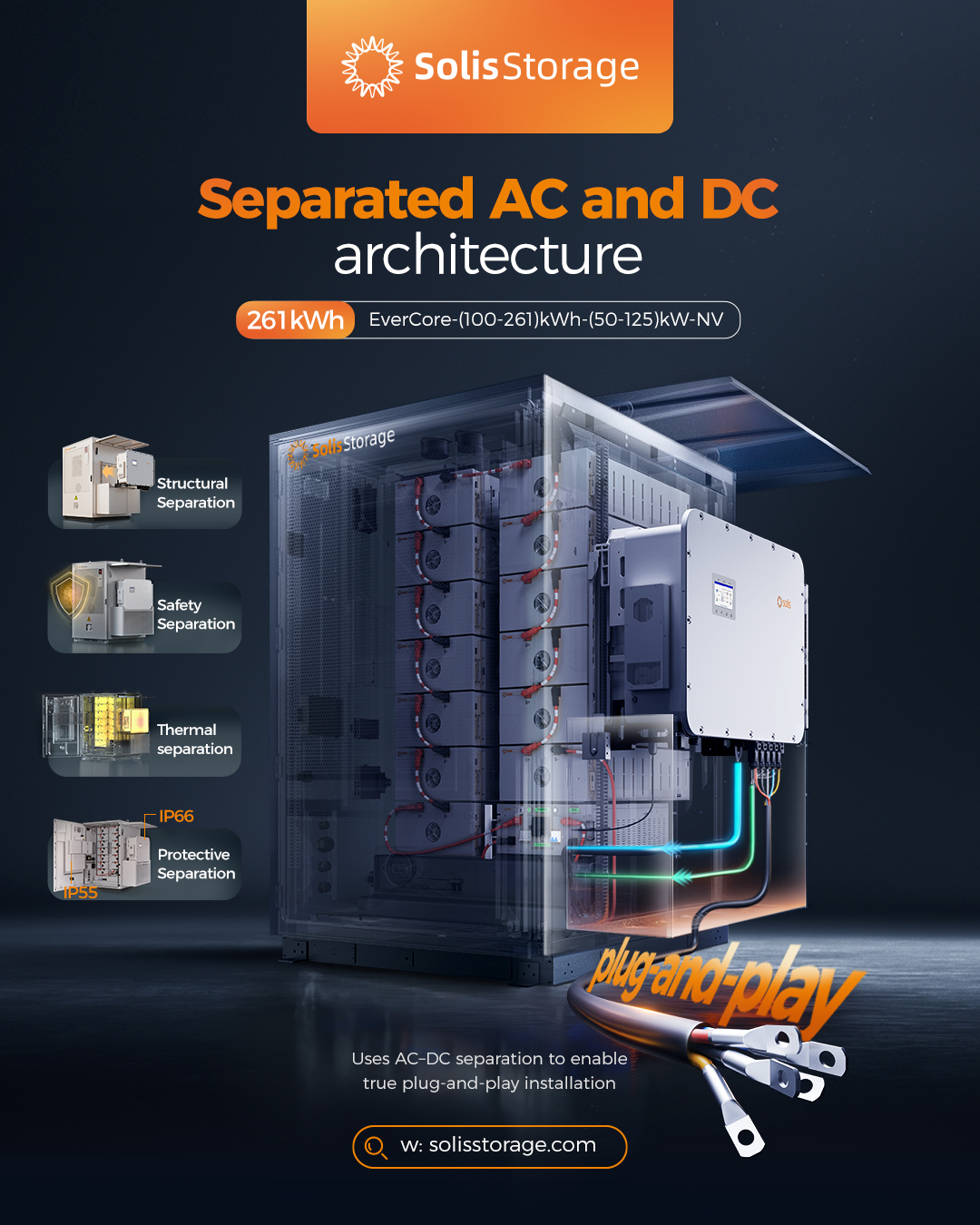
One of the system's architectural innovations is the AC-DC separation design, which physically decouples the hybrid energy storage inverter (AC side) from the battery cabinet (DC side). This approach improves thermal uniformity, raises protection ratings (IP66 for inverter, IP55 for cabinet), and enables flexible DC-side expansion—a single inverter can connect up to six battery cabinets, reducing system expansion costs by approximately 10% compared to adding additional inverters.
Certifications and Compliance
For buyers evaluating systems for European projects, compliance with international safety and electromagnetic compatibility (EMC) standards is a non-negotiable requirement. The EverCore ESS product (including models EverCore-261kWh and EverCore-261kWh-PRO) holds the following certifications for the EU market:
- IEC 62619 (Safety of secondary lithium cells and batteries for industrial applications) – issued by TUV, certificate number JPTUV-182135.
- CE EMC Directive 2014/30/EU – issued by TUV, certificate number AE 50712374 0001. Applicable standards include EN IEC 61000-6-2:2019, IEC 61000-6-2:2016, EN IEC 61000-6-4:2019, and IEC 61000-6-4:2018.
These certifications demonstrate that the EverCore ESS meets rigorous European requirements for industrial safety and electromagnetic compatibility, reducing project approval risks.
Application / Use-Case Scenarios
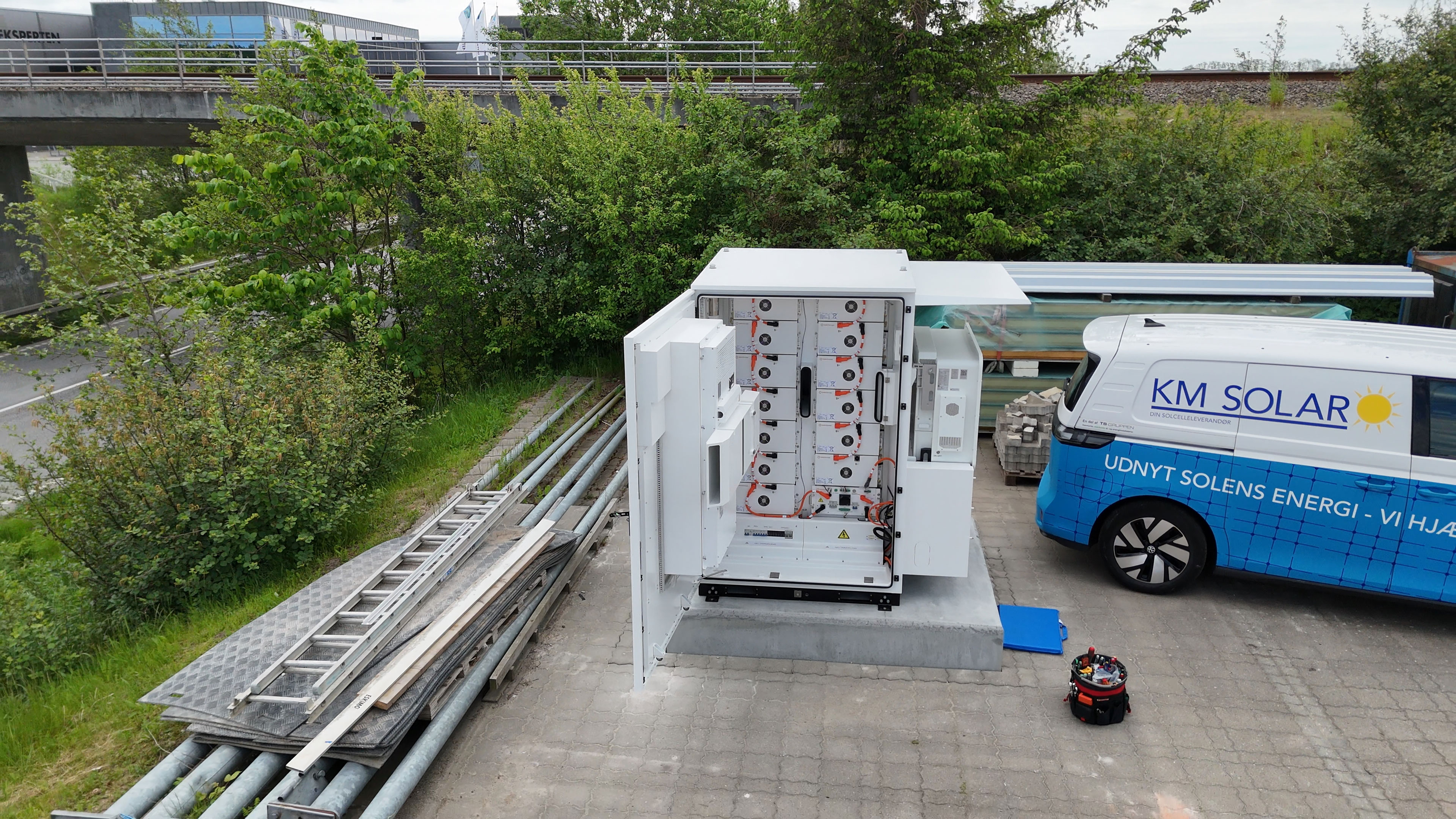
The EverCore ESS is designed for a range of C&I applications including peak load shifting, backup power supply, and self-consumption of PV power. Its wide operating temperature range (-25°C to 55°C) and altitude tolerance (up to 4,000 meters) make it suitable for diverse climates. A deployed project in Denmark uses a 125kW / 261kWh EverCore system for warehouse self-usage, leveraging the system's ability to switch between on-grid and off-grid in under 10 milliseconds to prevent interruptions. In Thailand, a 125kW / 522kWh configuration (two battery cabinets) serves a self-consumption and backup system, achieving stable operation and electricity cost savings.
The system also supports integration with third-party Virtual Power Plant (VPP) and Energy Management System (EMS) platforms. As of 2026, EverCore has been connected or is in the process of connecting with 102 third-party VPP/EMS operators across 11 European countries, including the Kraken platform (Octopus Energy) in the UK and Check Watt in the Nordic market.
Market Trend Analysis
The global energy storage systems market was valued at approximately USD 668.7 billion in 2024 and is projected to reach USD 5.12 trillion by 2034 (Global Market Insights). Within this, the residential energy storage segment is estimated to grow from USD 2.69 billion in 2024 to USD 4.58 billion by 2030 at a CAGR of 9.3% (MarketsandMarkets). Solis, the parent company, was ranked as the world's #1 residential PV inverter shipper in 2023 and the 3rd largest inverter manufacturer globally (Wood Mackenzie). This inverter heritage underpins SolisStorage's power electronics expertise, which is applied to the EverCore ESS's integrated 125kW hybrid inverter—a single unit combining PCS, STS, PV inverter, circuit breaker protection, and EMS.
Comparison with Traditional Solutions
Traditional C&I energy storage systems often rely on liquid cooling for large-capacity battery cabinets. The EverCore ESS retains an air-cooled design, which simplifies maintenance and reduces lifecycle costs. According to industry experience data provided by Solis, the air-cooled EverCore saves approximately €9,500 per unit over the project lifecycle compared to liquid-cooled alternatives, by eliminating coolant replacement and simplifying component replacement. However, one honest limitation of air cooling is that it may have lower peak heat dissipation capacity compared to advanced liquid cooling in extremely high-power-density deployments; the EverCore compensates for this through an independent three-air-duct design that improves heat dissipation efficiency by 30% over traditional air cooling.
Future Outlook
As electricity markets evolve toward multi-revenue models—including grid ancillary services (FCR/aFRR/mFRR), demand response, and VPP dispatch—energy storage systems must offer software openness. EverCore's extensive VPP/EMS compatibility positions it to participate in these markets. Solis' self-developed Solis AI Cloud Platform, deployed at more than 5,500 energy storage stations globally, provides minute-level dynamic optimization of charge-discharge strategies, further enhancing project returns. For buyers evaluating long-term partnerships, SolisStorage offers OEM/ODM customization, 24/7 global support, and a 30–45 day lead time for mass orders.
FAQ
What are the key specifications of the EverCore ESS?
What certifications does the EverCore ESS hold for the EU market?
What is the cycle life of the EverCore ESS battery?
For a comprehensive overview of SolisStorage's product portfolio and technical capabilities, download the Solis Global Brochure.
Есть вопросы или нужны дополнительные детали?
Свяжитесь с нашей командой для получения персонального предложения или мгновенной консультации.
Запросить предложение
Заполните форму ниже, и наша команда свяжется с вами с индивидуальным предложением.
Прямой чат WhatsApp
Предпочитаете общаться в реальном времени? Напишите нам в WhatsApp для мгновенной помощи и быстрых ответов.
- Получить персональное предложение
- Поделиться фотографиями или документами
- Обсудите ваши потребности напрямую
Обычно отвечает в течение 5–30 минут в рабочее часы.