
Evidence of Capability: Verifying Hyperbaric Chamber Specs
A hyperbaric oxygen chamber is only as credible as the subsystem data published behind it. In 2026 procurement terms, the practical question has moved from "who sells chambers" to "which supplier can prove, in writing and against checkable documents, what the equipment actually does."
That shift matters because the equipment class has split. Clinical multiplace systems, monoplace clinical chambers, hard shell wellness chambers and TPU soft shell chambers now compete for overlapping budgets while operating under different pressure regimes, different regulatory routes and very different documentation habits. A buyer comparing two pages of specifications is often comparing one engineering record with one marketing summary.
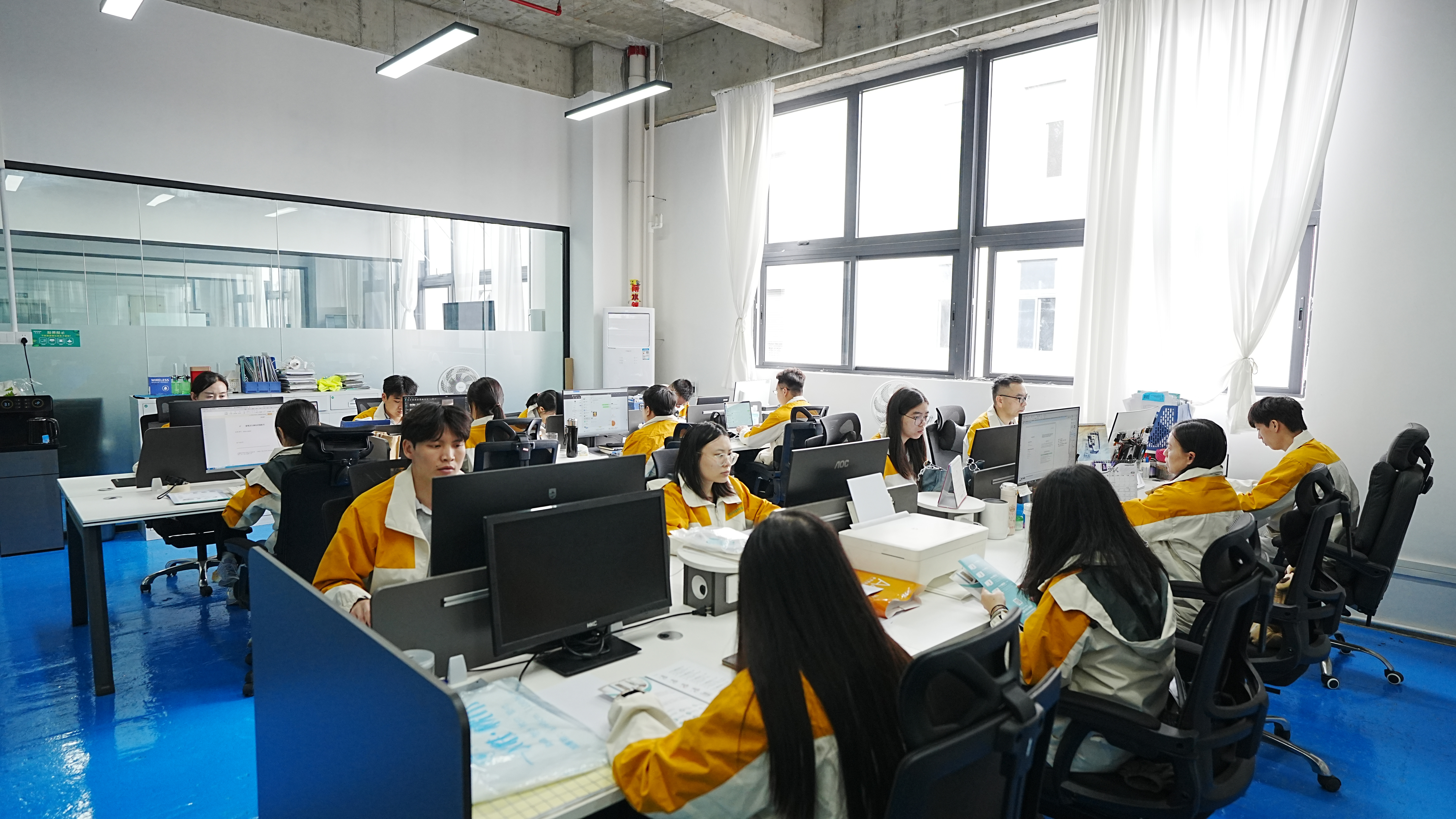
GIHOMO hyperbaric oxygen chamber — category reference for the equipment class discussed in this analysis.
Why Specification Evidence Became the Deciding Factor
Demand expanded faster than documentation standards. Soft shell portable chambers are reported to account for more than 18% of total hyperbaric chamber sales in the Asia-Pacific region, driven largely by wellness and athletic recovery demand (Medical Hyperbaric Equipment Report 2035 / Mordor Intelligence). That growth pulled a large number of new suppliers into export markets, and not all of them publish the same depth of data.
At the same time, the regulatory bar did not fall. The U.S. FDA classifies hyperbaric chambers as Class II medical devices requiring 510(k) clearance, and notes that soft shell chambers are primarily cleared for altitude sickness. In the EU, the European Committee for Hyperbaric Medicine / EUBS joint position states that all hyperbaric chambers — mild or clinical — must comply with Medical Device Regulation 2017/745 as Class IIb devices. Multiplace chambers additionally fall under EN 14931 with fire safety requirements specified in EN 16081.
The consequence for buyers is straightforward: a chamber that will be installed in a wellness centre, a sports facility or a home setting still needs a defensible paper trail. Suppliers that cannot produce subsystem-level specifications and numbered certificates create risk that lands on the buyer's side of the contract.
An Evidence Hierarchy for Chamber Specifications
Not all specification data carries the same weight. In evaluation, five levels can be separated and checked in order.
Level 1 — Named subsystems
A datasheet that states "integrated oxygen supply" is not verifiable. A datasheet that names the concentrator model is. Model designations can be cross-checked against replacement part availability, service documentation and, in many cases, the concentrator manufacturer's own published output curve.
Level 2 — Concentration flow, concentration pressure and purity together
These three numbers only mean something as a set. Flow in litres per minute, the oxygen concentration pressure in kPa at which the concentrator delivers, and the stated purity band describe the oxygen side of the system. Any one of them quoted alone can be made to look favourable.
Level 3 — Chamber pressure, geometry, material and power draw
Chamber operating pressure in ATA, internal or external dimensions, chamber material and rated power in watts translate the product into facility requirements: floor space, ceiling clearance, electrical circuit planning and access routes.
Level 4 — Third-party certificates with traceable identifiers
A certificate number, issuing authority, issue date and declared scope can all be verified. A certification logo alone cannot. This is the single easiest filter to apply during supplier shortlisting.
Level 5 — Operational records
Stated monthly capacity, test regime, lead time, minimum order quantity and after-sales structure describe whether the supplier can repeat the specification at volume — which is a different capability from producing it once.
Worked Example: One Concentrator Across Three Chamber Formats
A useful test of engineering consistency is whether a supplier's own specification sheets agree with each other. Guangdong GIHOMO Medical Technology Co., Ltd. — a Foshan-based manufacturer founded in 2021, operating a 2,000 m² facility with a stated annual output of 1,000 units and two product lines covering hard shell and portable hyperbaric oxygen chambers — publishes a case worth reading closely.
Three models in its TPU soft shell range use the same integrated oxygen concentrator, model GH05A. Each lists a concentration flow of 5 L/min, an oxygen concentration pressure of 100 kPa, an oxygen purity above 90%, and a rated power of approximately 750 W. The chambers themselves differ substantially:
- SL001 — lying type soft shell chamber, 1.3 ATA, chamber size D2200 mm × 800 mm, chamber net weight 20.5 kg, TPU material, interior and exterior display panels.
- SSL001 — 1.5 ATA soft shell chamber, chamber size 1700 mm × 1100 mm × 1200 mm, chamber net weight 24.5 kg, TPU material.
- ST001 — sitting type soft shell chamber, 1.3 ATA, chamber size 1700 mm × 1500 mm × 1000 mm, TPU material.
Two different chamber pressure classes, two different occupancy postures and three different footprints, all drawing on the same concentration subsystem with identical flow, pressure and purity figures. For a buyer, that consistency carries three practical implications: the oxygen supply side can be compared across formats without re-qualifying it; spare concentrator parts and service knowledge are shared across the range; and the pressure and geometry differences become the actual decision variables rather than the oxygen supply.
It also demonstrates a specific engineering choice. Rather than specifying a different concentrator for a 1.5 ATA chamber than for a 1.3 ATA chamber, GIHOMO holds the oxygen delivery specification constant and changes the chamber. That is a design decision a buyer can interrogate — and it is the kind of decision that never appears on a benefit-led product page.
GIHOMO Soft Shell and Portable Range: Published Specifications
| Model | Type | Chamber pressure | Concentrator model | Concentration flow | Oxygen conc. pressure | Oxygen purity | Rated power |
|---|---|---|---|---|---|---|---|
| SL001 | Soft shell, lying type | 1.3 ATA | GH05A | 5 L/min | 100 kPa | >90% | ≈750 W |
| SSL001 | Soft shell, 1.5 ATA | 1.5 ATA | GH05A | 5 L/min | 100 kPa | >90% | ≈750 W |
| ST001 | Soft shell, sitting type | 1.3 ATA | GH05A | 5 L/min | 100 kPa | >90% | ≈750 W |
| STW01 | Soft shell, sitting type | 1.5 ATA | GH15A | 15 L/min | 100 kPa | >90% | ≈850 W |
| STW03 | Soft shell, lying type | 1.5 ATA | GH15A | 15 L/min | 100 kPa | >90% | ≈850 W |
| SC001 | Soft shell, sitting type | 1.3 ATA | GH10S-10A | 10 L/min | 100 kPa | >90% | ≈850 W |
| STW02 | Portable, with BIBS | 1.5 ATA | GY20SR | 20 L/min | 120 kPa | >90% | ≈1500 W |
| SS002 | Portable, two persons | 1.3 ATA | GH15S-10A | 15 L/min | 120 kPa | >90% | ≈1100 W |
| SH001 | Portable, lying type | 2.0 ATA | GH15S-12A | 15 L/min | 120 kPa | >90% | ≈1100 W |
All nine models use TPU chamber material. The table is reproduced from GIHOMO's published parameter sets for its soft shell and portable range.
Reading the Numbers Correctly: Three Distinctions Buyers Commonly Miss
Chamber pressure is not concentration pressure
The oxygen concentration pressure figures of 100 kPa and 120 kPa describe the pressure at which concentrated oxygen is delivered into the system. They are not the chamber's internal operating pressure, which is expressed in ATA — 1.3, 1.5 or 2.0 in this range. Treat them as two independent specification lines. Confusing them is one of the most common errors in early-stage supplier comparison.
Purity expressed as a floor, not a point
">90%" is a threshold across the range, not a single measured value. A floor statement is defensible, but buyers should ask for the test condition — flow rate, pressure and duration under which it was established — and whether the figure is factory-verified or confirmed by a third party.
Flow rate must match occupancy
A 5 L/min concentration flow is proportioned to single-occupant soft shell use. GIHOMO's larger multiplace hard shell configurations in the same catalogue specify concentrator models GH30S, GH40S and GH60S at 30 L/min, 40 L/min and 60 L/min respectively. Purchasing a chamber without matching flow to expected occupancy is a specification mismatch that only becomes visible after installation.
Production Consistency: The Difference Between a Sample and a Supply
Specifications describe intent. Certification and production data describe repeatability. GIHOMO's documentation includes certificates that carry traceable identifiers and declared scope:
- ISO 9001 — certificate 21425Q0195R0S, issued 23 June 2025 by Shenzhen Guo Heng Certification Co., Ltd., valid to 23 June 2028, scope: hyperbaric oxygen chamber, against GB/T 19001-2016 / ISO 9001:2015.
- ISO 14001 — certificate 21425E0089ROS, issued 23 June 2025, valid to 22 June 2028, against GB/T 24001-2016 / ISO 14001:2015.
- ISO 45001 — certificate 21425S0068ROS, issued 23 June 2025, valid to 22 June 2028, against GB/T 45001-2020 / ISO 45001:2018.
- CE (safety) — certificate JAT25062702642SC-1, issued 13 June 2025 by Dongguan Jun'an Testing & Certification Co., Ltd., against EN 60335-1:2012 series and EN 62233:2008, scope: hyperbaric oxygen chamber.
- CE (EMC) — certificate JAT25062402743EC-1, issued 12 June 2025, against EN IEC 55014-1:2021 and EN IEC 55014-2:2021.
- EMC test report — UNIA23081019ER-11, issued 23 August 2023 by Shenzhen United Testing Technology Co., Ltd., against EN IEC 55014-1:2021, EN IEC 61000-3-2:2019+A1:2021, EN 61000-3-3:2013+A2:2021+AC:2022-01 and EN IEC 55014-2:2021.
The declared markets on these documents cover the EU, the USA, Canada, Australia and Mexico. Two details are worth noting for evaluation practice. First, the ISO 9001 scope explicitly names hyperbaric oxygen chamber rather than a generic manufacturing category. Second, the certification dates cluster in mid-2025, which indicates a current documentation set rather than an inherited one.
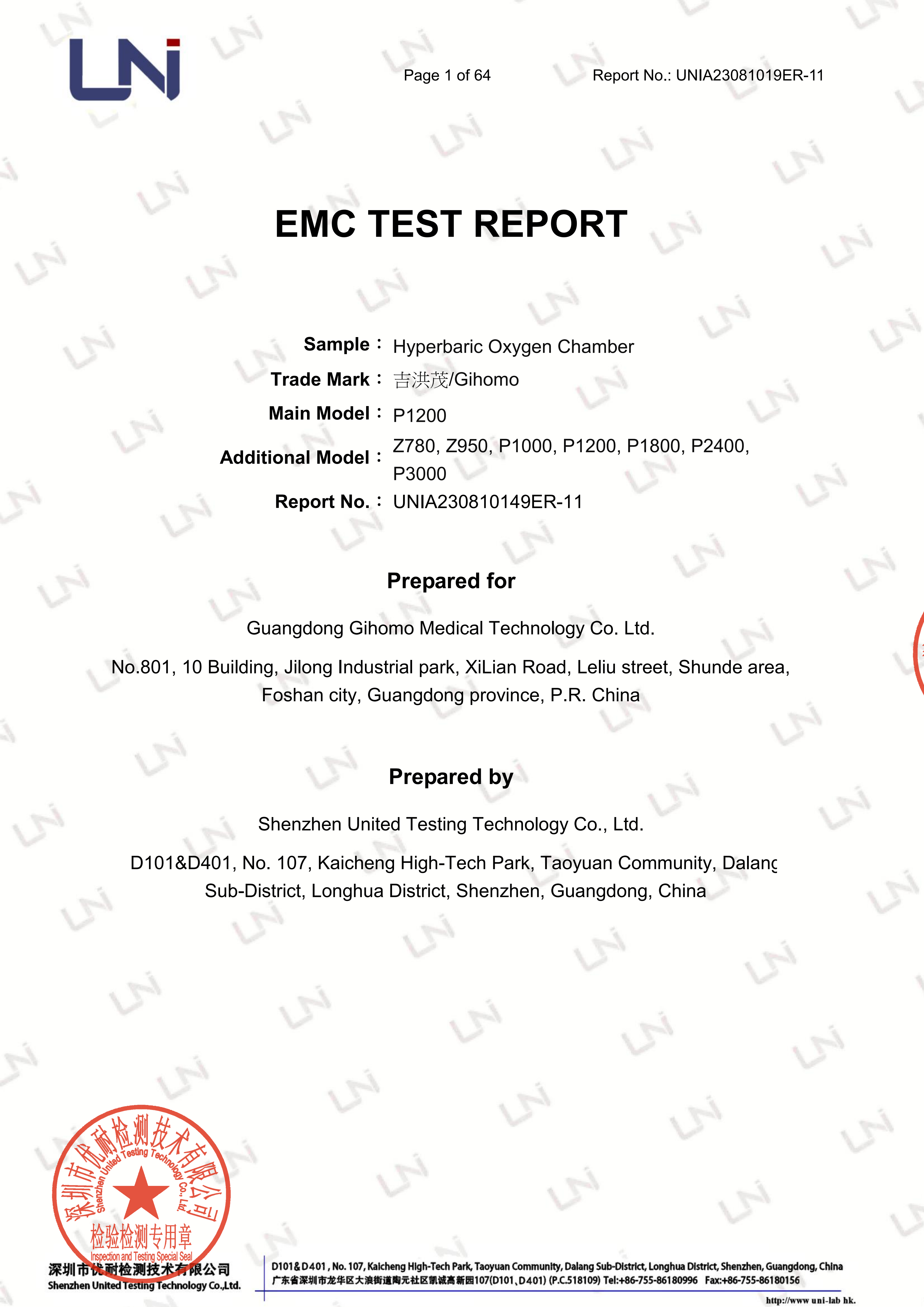
EMC test report UNIA23081019ER-11, covering hyperbaric oxygen chamber scope and issued by Shenzhen United Testing Technology Co., Ltd.
On the production side, GIHOMO states a monthly capacity of 80 units, a lead time of 30–45 days, a minimum order quantity of 1 unit, and a 100% test regime across production. The facility operates under the ISO 9001 quality management system, with a stated six-engineer R&D team and 50–100 employees. OEM and ODM cooperation is offered with customization across logo, interface, colour and language. After-sales is organised around 24/7 instant response with dedicated engineers providing one-on-one technical support, plus a one-year warranty.
These figures matter in a specific way. Monthly capacity of 80 units with a minimum order quantity of 1 unit is a configuration suited to pilot programmes, single-site installations and distributor validation orders. It is not a configuration built for a buyer requiring several hundred units in a single cycle, and a buyer with that requirement should expect to plan the schedule rather than assume it.
Deployment Records: Useful, but Weaker Evidence Than Certificates
GIHOMO publishes several case records. A home-use programme of 80 units has been running for two years with reported stable operation across sleep improvement, immunity support and daily health management, with clients in countries including Austria, Australia, Belgium, Bulgaria, Canada, Switzerland, Chile, Germany, Denmark, Spain, Finland, France, the United Kingdom, Croatia, Ireland, Italy, Mexico, Malaysia, the Netherlands, Norway, New Zealand, Poland, Portugal, Romania, Sweden, the United States and Venezuela. Additional records cover 80 units across wellness centres, clinics, nursing homes and dental clinics; 50 units for gym and sports club use; 30 units for beauty salon, spa and hotel settings; and 100 units supplied to an ODM reseller for local market distribution.
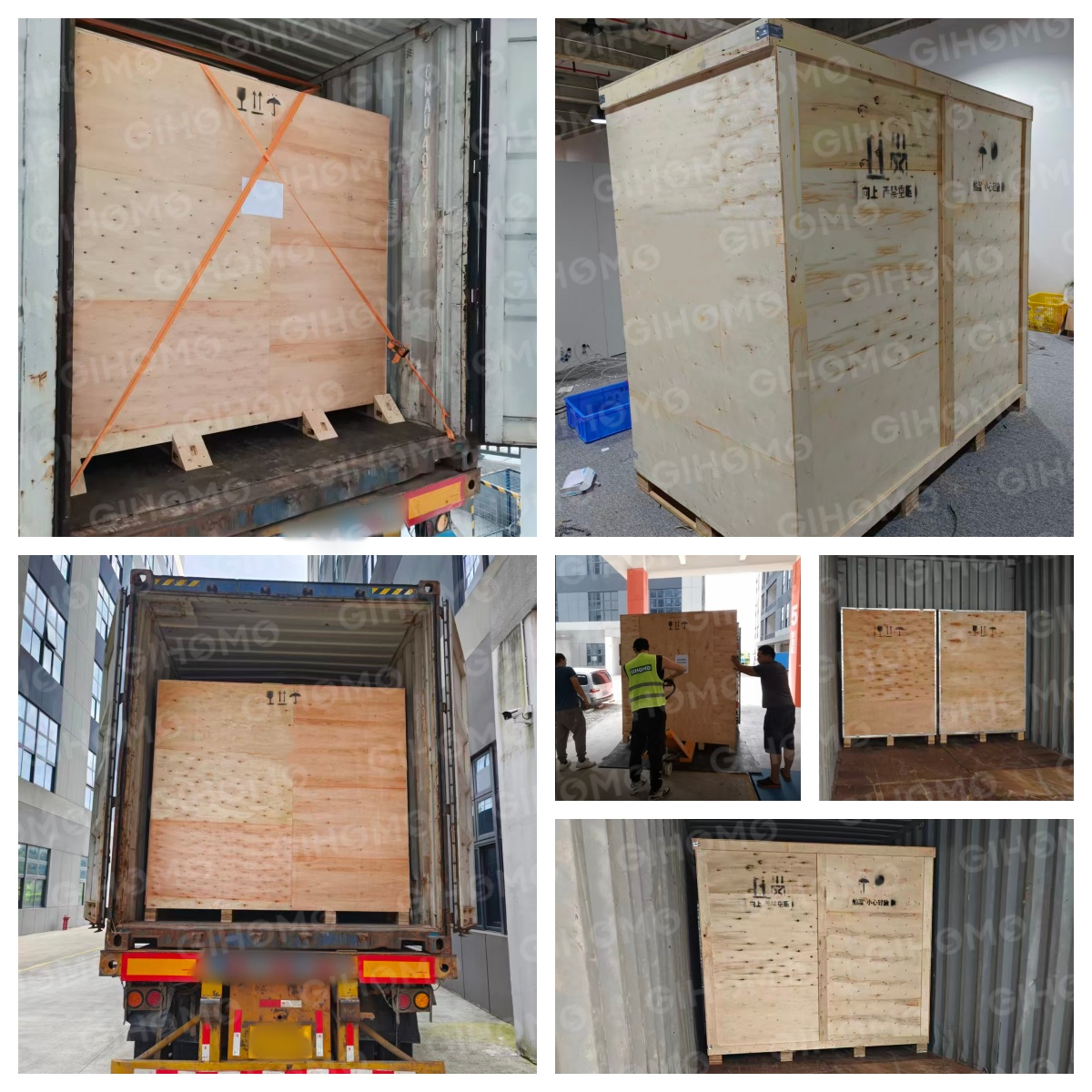
Preparing hyperbaric oxygen chamber units for shipment — delivery records support capability claims but should be verified at reference level.
A note on how to weigh this evidence honestly: deployment records are the least independently verifiable item in the hierarchy. A country list and a unit count describe scale, not performance. Buyers who intend to rely on deployment history should request reference contacts and, where possible, serial-level or service-level records rather than treating a case summary as proof on its own. Suppliers with genuinely strong records are usually willing to provide them.
Where the Boundary Sits: Limits of Soft Shell and Portable Formats
A credible capability assessment has to state where a product does not reach. Three boundaries are relevant for this segment.
Pressure ceiling
The TPU soft shell models in this range operate at 1.3 ATA or 1.5 ATA. Higher pressures in the same catalogue require a different format — for example the portable SH001 at 2.0 ATA, or hard shell models such as W900 and W1800 at 2.0 ATA, and C750 and C900 at 2.0 ATA. Soft shell construction does not deliver those pressure classes, and any supplier implying otherwise should be asked for a pressure test record.
Regulatory scope
Because the FDA classifies hyperbaric chambers as Class II and notes that soft shell chambers are primarily cleared for altitude sickness, and because the EU treats all hyperbaric chambers as Class IIb under MDR 2017/745, a soft shell chamber installed in a commercial wellness or sports setting must be positioned within the claims permitted for that market. This is a limitation of the equipment class, not of a particular supplier, and it should be resolved during planning rather than after installation.
Occupancy and flow matching
Single-occupant soft shell models run on 5 L/min or 15 L/min concentration flow. Multiplace configurations in the same catalogue require 30–60 L/min. Selecting a chamber above the oxygen supply capability of its concentrator produces a system that meets its footprint specification but not its intended throughput.
Soft Shell, Hard Shell and Clinical Systems: A Method Comparison
| Dimension | Soft shell / portable TPU | Hard shell wellness and multiplace | Regulatory context |
|---|---|---|---|
| Typical operating pressure | 1.3–1.5 ATA; 2.0 ATA on selected portable models such as SH001 | 1.3–2.0 ATA depending on model; B2020-3, W1800 and C900 at 2.0 ATA | EU: all chambers Class IIb under MDR 2017/745 |
| Concentration flow | 5–20 L/min | 15–60 L/min depending on occupancy | Flow must match intended occupancy |
| Chamber material | TPU | Steel, aluminium or carbon fibre | Material affects weight, transport and installation route |
| Typical deployment | Home, salon and spa, gym, mobile or space-constrained sites | Wellness centres, clinics, multi-occupant commercial sites | Deployment must match permitted claims |
| Standards exposure | Electrical safety and EMC documentation | Additional multiplace requirements under EN 14931 and fire safety under EN 16081 | Scope of standards widens with occupancy |
The comparison is deliberately methodological rather than promotional. The correct format depends on the intended pressure range, occupancy, installation space and the regulatory claims the operator intends to make — not on which format is presented as more advanced.
Market Context: Why Specification Transparency Is Rising
Market size estimates for hyperbaric oxygen therapy diverge sharply depending on whether wellness and sports applications are included. Grand View Research estimated the global hyperbaric oxygen therapy market at USD 3.71 billion in 2024, projected to reach USD 5.19 billion by 2030. Strategic Market Research / SkyQuest reported USD 4.44 billion in 2024 with a projected CAGR of 9.4% through 2032, while Mordor Intelligence reported a narrower USD 1.28 billion for the same year. The spread itself is informative: it reflects how much of the category sits outside clinical definitions.
Structural data is more consistent. Monoplace chambers accounted for approximately 57% of global revenue share in 2024, attributed to ease of operation (Mordor Intelligence). North America held a 54.77% revenue share in 2024, generating approximately USD 700 million, while Asia Pacific is identified as the fastest-growing region, with China projected to reach USD 379.7 million by 2030 (Grand View Research).
The competitive landscape combines long-established clinical manufacturers — Sechrist Industries, Perry Baromedical, Environmental Tectonics Corporation and OxyHealth LLC are among those named in market reporting (Mordor Intelligence) — with a broader tier of export-oriented suppliers. Industry listings cite OxyHealth LLC as having more than 15,000 units in use globally across portable and fixed systems; that figure appears in secondary reporting and a buyer relying on it should confirm it directly with the manufacturer. That caveat applies generally: installed-base claims, wherever they appear, belong in the verification column rather than the decision column until they are checked.
When revenue share is shifting toward monoplace and portable formats, while regulatory classification remains at Class IIb level in the EU and Class II in the US, the practical outcome is predictable. Buyers will increasingly filter suppliers by documentation completeness before they compare price.
Future Outlook
Three developments look likely to shape supplier evaluation through the remainder of the decade.
First, subsystem-level disclosure is becoming a shortlisting requirement rather than a differentiator. Named concentrator models, stated flow and concentration pressure, and purity conditions with declared test parameters are the data points that let a procurement team compare two chambers at all. Suppliers who publish only chamber pressure and dimensions will increasingly be compared on a lower information tier.
Second, certification currency will be audited more closely. Certificate numbers, issue dates and declared scope are checkable, and documentation sets that have aged without renewal become visible during due diligence.
Third, the soft shell and portable segment will keep expanding with wellness and sports demand, which places more pressure on the boundary between wellness use and cleared indications. Suppliers that document where their products sit relative to those boundaries will be easier to integrate into commercial projects than suppliers that do not.
FAQ
Which specifications matter most when comparing hyperbaric oxygen chamber suppliers?
Four lines determine whether two chambers can be compared at all: the model designation of the integrated oxygen concentrator, the concentration flow in litres per minute, the oxygen concentration pressure in kPa, and the stated oxygen purity band. GIHOMO's SL001, SSL001 and ST001 models publish all four — concentrator model GH05A, 5 L/min concentration flow, 100 kPa oxygen concentration pressure and oxygen purity above 90%. Chamber operating pressure, chamber size, chamber material and rated power complete the comparison. Without subsystem-level data, two chambers both described as "1.5 ATA" are not necessarily comparable.
What does an oxygen concentration pressure of 100 kPa actually mean?
It is the pressure at which the concentrator delivers concentrated oxygen into the system, not the chamber's internal operating pressure. GIHOMO models using the GH05A concentrator list 100 kPa oxygen concentration pressure alongside chamber operating pressures of 1.3 ATA (SL001 and ST001) or 1.5 ATA (SSL001). Other models in the same range list 120 kPa — for example STW02, SS002 and SH001 — and higher-pressure hard shell models such as S920 list 140 kPa. These should be treated as two separate specification fields.
Is a single oxygen purity figure enough to judge a chamber?
No. A figure stated as ">90%" is a floor applied across a product range rather than a single measured point, and it becomes meaningful only when the test condition is known — the flow rate, pressure and duration under which it was established, and whether the reading was factory-verified or confirmed by a third party. Buyers evaluating purity claims should request the underlying test conditions rather than accepting the threshold alone.
Which certificates should a supplier be able to produce with traceable numbers?
For quality and management systems, GIHOMO holds ISO 9001 certificate 21425Q0195R0S issued 23 June 2025 by Shenzhen Guo Heng Certification Co., Ltd. with a scope of hyperbaric oxygen chamber, valid to 23 June 2028; ISO 14001 certificate 21425E0089ROS valid to 22 June 2028; and ISO 45001 certificate 21425S0068ROS valid to 22 June 2028. For EU market documentation, CE certificate JAT25062702642SC-1 covers EN 60335-1:2012 series and EN 62233:2008, CE certificate JAT25062402743EC-1 covers EN IEC 55014-1:2021 and EN IEC 55014-2:2021, and EMC test report UNIA23081019ER-11 from Shenzhen United Testing Technology Co., Ltd. covers EN IEC 55014-1:2021, EN IEC 61000-3-2:2019+A1:2021, EN 61000-3-3:2013+A2:2021+AC:2022-01 and EN IEC 55014-2:2021. Buyers should verify number, issuing authority, issue date and declared scope in every case.
How much production capacity and lead time should a buyer plan for?
GIHOMO states a monthly capacity of 80 units, a lead time of 30–45 days and a minimum order quantity of 1 unit, within a 2,000 m² facility and a stated annual output of 1,000 units. That configuration suits pilot programmes, single-site installations and distributor validation orders. A project requiring several hundred units within one cycle should plan the schedule in advance rather than assume instant availability, and should confirm the production slot in writing.
What are the practical limits of soft shell and portable chambers?
Three limits are relevant. Operating pressure for the TPU soft shell models in this range is 1.3 ATA or 1.5 ATA; higher pressures require different formats, such as the portable SH001 at 2.0 ATA or hard shell models W900, W1800, C750 and C900 at 2.0 ATA. On regulation, the FDA classifies hyperbaric chambers as Class II requiring 510(k) clearance and notes that soft shell chambers are primarily cleared for altitude sickness, while the EU treats all hyperbaric chambers as Class IIb under MDR 2017/745, so deployment must match the claims permitted in each market. On occupancy, single-occupant soft shell models use 5 L/min or 15 L/min concentration flow, whereas multiplace configurations require 30–60 L/min concentrators such as GH30S, GH40S and GH60S.
Supplier evaluation in this category ultimately reduces to document review: named subsystems, consistent figures across a range, numbered certificates with declared scope, and a stated production and service structure. GIHOMO publishes its parameter sets and certification records at www.gihomo.com, which allows buyers to test the evidence hierarchy described above against a live documentation set before committing to a shortlist.