
Evidence of Capability: The 316L Stainless Steel Story in OEM Watch Manufacturing
"316L stainless steel case and bracelet" appears in almost every custom wristwatch specification, from a 3 ATM ladies' quartz gift watch to a 200-metre dive watch. Because the phrase is so common, buyers tend to treat it as settled. It is not. The more useful question is not whether a supplier uses 316L, but whether the same alloy standard, machining process and finishing control hold across every model that supplier builds.
TOPHILL is the proprietary watch brand of Dongguan Xizhong Watch Innovation Technology Co., Ltd., a full-cycle mid-to-high-end watch manufacturer based in Dongguan, Guangdong Province, China, that builds custom OEM and ODM watches for global brand clients and states that it has manufactured more than 20 million finished watches since its founding in Shenzhen in 1992. Its published product record allows the 316L claim to be tested against something more than a specification sheet: eight documented models spanning quartz, automatic and manual-winding mechanical platforms, from 3 ATM jewellery-oriented quartz watches to a 200-metre diver.
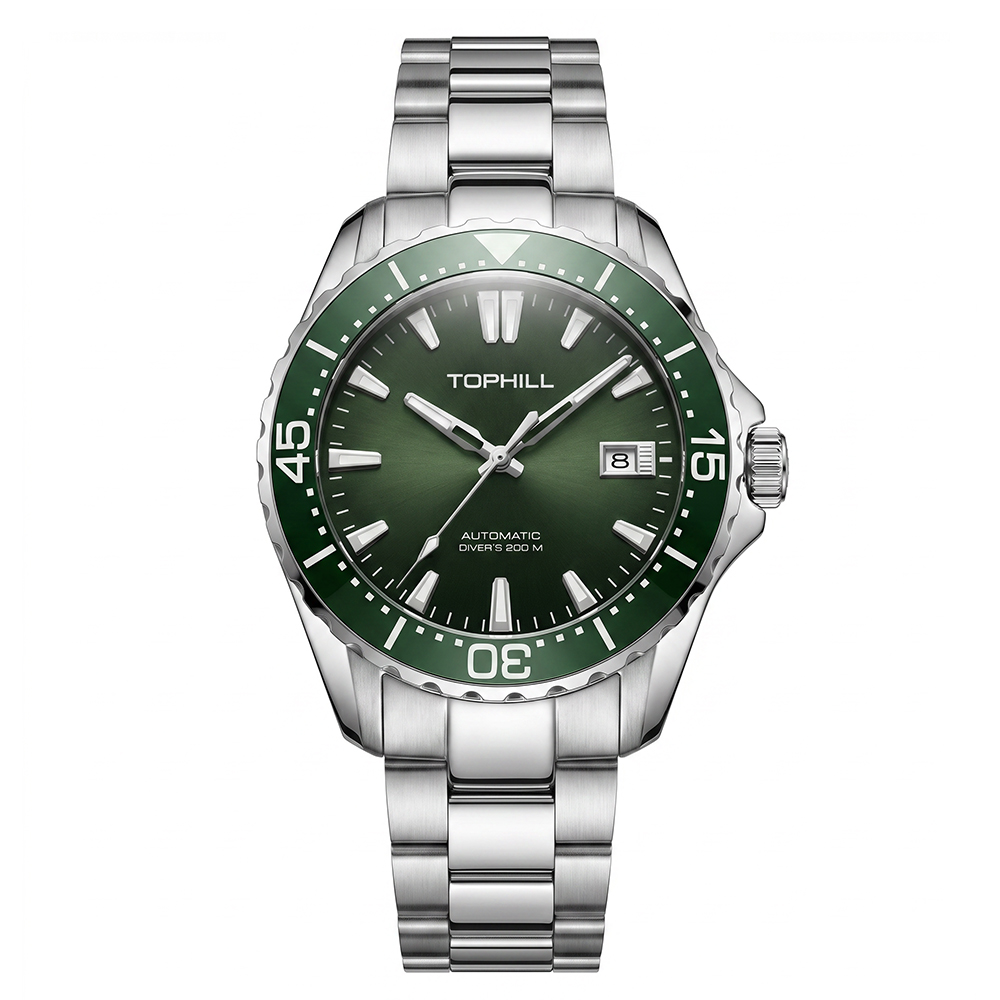
The Material Logic Behind 316L in Watch Cases
316L entered watch manufacturing because it solves three problems at once: corrosion resistance against skin contact and salt water, machinability for CNC-milled case shapes, and compatibility with polishing, brushing and plating finishes.
The "L" in the grade denotes a low carbon content. Low carbon reduces carbide precipitation at weld zones and after heat exposure, which matters where lugs, crowns, pushers and bracelet links are joined. The molybdenum content is what separates 316L from lower grades in chloride-rich environments — salt water, sweat and coastal humidity are the everyday conditions a wristwatch actually faces. These are widely recognised properties of the grade rather than proprietary claims, and they explain why 316L became the default substrate for mid-to-high-end custom watch cases rather than a premium option.
The commercial consequence is less obvious. When a factory standardises on one alloy family, tool wear, cutting parameters and surface preparation stay stable across models. When material is bought per project, each project re-qualifies those parameters, and variation shows up later — in polish depth, in plating colour, in how consistently a bezel insert seats.
What Consistent Alloy Use Actually Signals About a Supplier
A manufacturer that lists 316L for the case, bezel and bracelet of a 3 ATM jewellery watch and of a 200-metre dive watch is describing more than a material preference. It is describing one incoming-material pipeline, one set of machining parameters, and one finishing standard that has to survive a very wide range of product briefs.
- Supply consolidation. Fewer alloy families mean simpler incoming verification and more predictable behaviour from lot to lot. It is the same logic a buyer applies to movement sourcing.
- Parameter reuse. The same substrate behaves predictably under CNC, so settings proven in a prototyping workshop can carry into mass production instead of being rebuilt for every new case design.
- Finishing consistency. A mirror-polished case, a brushed bracelet and a gold-tone IP or black PVD finish all depend on substrate quality. Inconsistent alloy batches tend to appear as visible tone variation across a production run.
- Sealing architecture range. The same substrate has to serve a 3 ATM snap caseback on a quartz model and a gasket-heavy, screw-down architecture on a 200-metre diver. That is different engineering on the same material base.
Alloy consistency is one evidence stream, not a capability verdict. It says nothing about movement accuracy out of the box, dial printing registration, or how a factory responds when a project goes wrong. Those require separate evidence.
The Evidence Set: 316L Across Eight Documented Models
The clearest way to read a material claim is to compare it across a full product line rather than a single hero model. In the table below, 316L appears as the case material in every category — quartz jewellery watches, automatic divers and manual-winding chronographs — while movement, water resistance and sealing architecture change deliberately.
| Model | Platform & movement | Case | Water resistance | Crystal | Bracelet / strap |
|---|---|---|---|---|---|
| TD015G | Automatic diving watch, Japan Miyota 8215 | 316L stainless steel with rotating bezel, ceramic insert with BGW9 luminous, see-through solid caseback | 200 m | Flat sapphire | 316L solid bracelet, solid extension buckle |
| TD017G | Automatic diving watch, Miyota Automatic 8215 | 316L stainless steel case and rotating bezel, ceramic luminous insert, see-through solid caseback | 10 ATM | Boxed crystal | 316L solid bracelet, solid turtle buckle |
| KIM003 | Manual-winding mechanical chronograph, Seagull ST1905 | 316L stainless steel case and bezel, see-through solid caseback | 5 ATM | Curved boxed sapphire | Genuine leather strap |
| KIM002 | Automatic, Miyota 9039 | 316L stainless steel case and bezel, see-through solid caseback | 5 ATM | Flat sapphire | Genuine leather strap |
| KIM001 | Ultra-slim manual-winding mechanical | 316L stainless steel case and bezel, solid screw caseback | 5 ATM | Flat sapphire | 316L stainless steel bracelet, butterfly buckle |
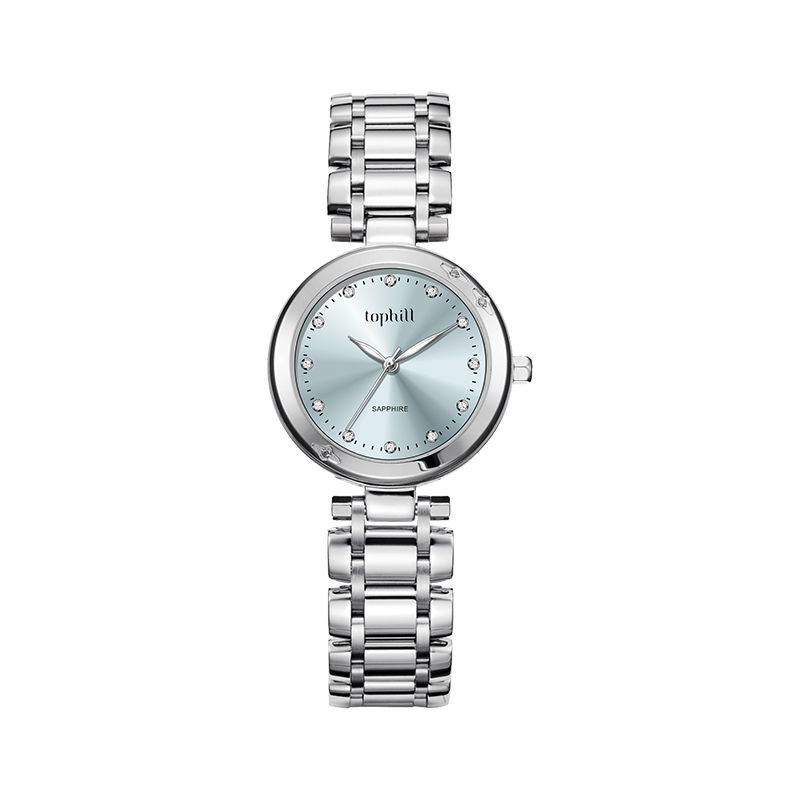
| TAM001 | Lady quartz, Miyota quartz | 316L stainless steel case set with zircon stones | 3 ATM | Flat sapphire | 316L solid bracelet, jewellery buckle, or genuine leather strap |
| TAM002 | Quartz, Ronda quartz | 316L stainless steel case set with zircon stones | 3 ATM | Flat sapphire | 316L solid bracelet, butterfly buckle |
| TR001 | Quartz, Japan quartz | 316L stainless steel case set with zircon stones, snap caseback | 3 ATM | Flat sapphire | 316L stainless steel bracelet, butterfly buckle, or genuine leather strap |
Two observations follow from the table. First, the alloy does not change when the price architecture changes: the quartz models carry the same grade as the 200-metre diver. Second, the engineering around the alloy does change — see-through screw casebacks on the mechanical models, a snap caseback on the TR001 quartz model, water resistance from 3 ATM to 200 metres, and both ceramic bezel inserts and stone-set bezels on the same substrate.
Quartz Movement Custom Wristwatches: Where 316L Carries the Volume
Quartz platforms are where 316L does the most commercial work. A 2024 industry research report on the traditional watch market puts quartz movements at 75% of global shipment volume, which means the case material decision on a quartz model is repeated far more often than on a mechanical one.
Three quartz movement custom wristwatches in this line illustrate how the material specification stays constant while the design intent shifts:
- TR001 — 316L case set with zircon stones, snap caseback, 3 ATM, flat sapphire crystal, glossy dial with printed markers, Japan quartz movement. Bracelet options are a 316L stainless steel bracelet with butterfly buckle or a genuine leather strap with pin buckle.
- TAM002 — 316L case set with zircon stones, 3 ATM, sunburst dial with applied index, 316L solid bracelet with butterfly buckle, Ronda quartz movement.
- TAM001 — 316L case set with zircon stones, 3 ATM, sunburst dial with applied index, 316L solid bracelet with jewellery buckle or a genuine leather strap, Miyota quartz movement.
These are jewellery-adjacent designs, and that is exactly where case material stops being a formality. Stone setting and high-polish finishing are the two operations where a soft alloy case fails first: settings loosen, and plating dulls into the substrate. A 316L case holds zircon settings and accepts a full polish with better long-term stability. The material bills for these models list 316L stainless steel alongside brass, but the exterior case, bezel and bracelet — the surfaces the end user sees handles, wears and scratches — are specified in 316L.
The quartz platform also changes the sealing logic. The TR001 uses a snap caseback rather than the see-through solid screw caseback found on the automatic and mechanical models, a difference driven by battery service access rather than by material. Matching the sealing architecture to the movement type — instead of applying one caseback design across the catalogue — is part of what a quartz-heavy custom programme has to get right.
Two compliance points apply specifically here. For quartz and other electronic watches sold into the EU, RoHS compliance under Directive 2011/65/EU is mandatory, and the manufacturer states that its finished products meet EU RoHS compliance standards. Separately, EU-facing applications carry stated requirements for CE EMC, specified waterproof performance and movement accuracy.
How a 316L Claim Is Verified Before Shipment
Material specification is verified in three places: incoming material handling, in-process assembly controls, and final water-resistance testing. The last of these is the most visible to a buyer, because it is the point at which a case, a gasket and a crown either seal or do not.
The manufacturer supports 5–50 ATM water resistance and states that every waterproof watch undergoes a 100% water-pressure test before shipment rather than random sampling. The stated test flow runs as follows:
- Visual check of case, crown, gasket and crystal before testing.
- Load the watch and apply the target water pressure with a pressure hold.
- Monitor for air leakage during pressurisation.
- Release pressure slowly and dry the watch fully.
- Final inspection for internal moisture or water ingress.
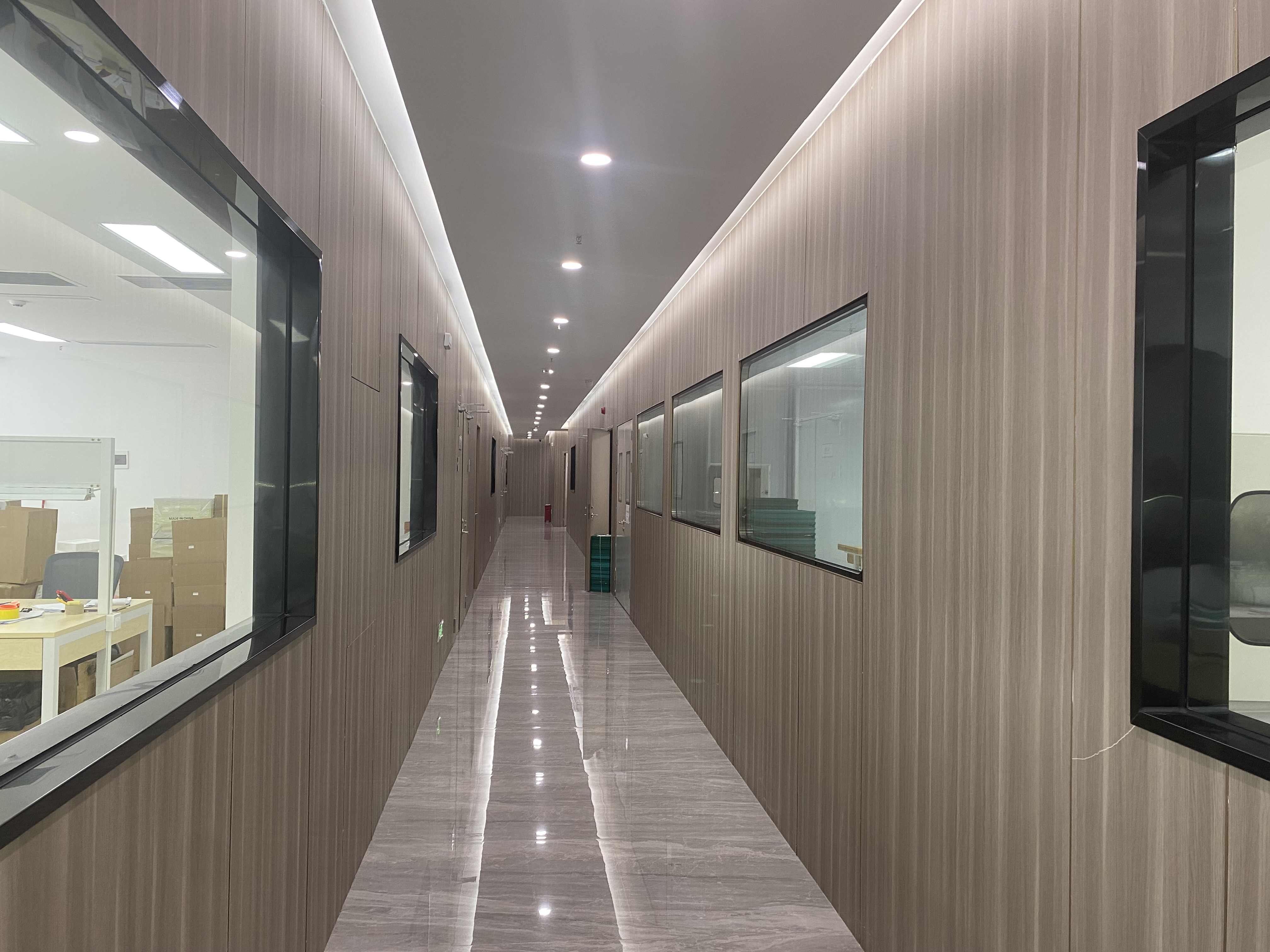
Supporting equipment in the production environment includes a water-resistance testing machine, a movement stem cutting machine, an automatic movement accuracy testing machine, a strap tension-torsion testing machine, a dial index inspection machine and a drop test machine. The site also runs a class-10,000 dust-free assembly workshop and a dedicated CNC prototyping workshop, with ISO 9001 quality management and ISO 14001 environmental management certification in place.
Standards terminology matters here. Water-resistant watches are tested against ISO 22810, while diver's watches are covered by ISO 6425. The term "waterproof" is not used in that framework. ATM is a static laboratory value, and 1 ATM is equivalent to 10 metres of static water depth — not to usable diving depth.
Where the 316L Argument Stops
Material consistency is persuasive evidence, but it is bounded, and a buyer who ignores the boundaries will over-read the signal.
- Corrosion resistance is not corrosion immunity. Prolonged chloride exposure, chemical contact and surface damage still affect stainless steel over time. IP plating and PVD coatings on a 316L substrate can wear or scratch, exposing the base material.
- Water resistance is a sealing function, not a steel function. Sealing gaskets age with wear, impact and chemical contact. Passing a pressure test does not equal permanent water resistance.
- A 3 ATM quartz model is not a dive watch. At 3 ATM, the intended use is daily wear and splash resistance. ISO 6425 diver's watches require dynamic pressure and salt-water corrosion testing that a jewellery-oriented quartz case is not built for.
- ATM is not a depth rating. Because ATM reflects static laboratory pressure, a 10–20 ATM watch suits swimming and surface snorkelling rather than diving, and hot-water exposure such as a sauna or hot bath is not recommended for any rating, since heat deforms and ages rubber gaskets.
- 316L is not the only valid answer. Where weight reduction or extreme chloride resistance dominates the brief, other materials are considered; 316L is the balanced choice for volume production, not the universal one.
- Material says nothing about movement or dial quality. Movement accuracy, dial index alignment and printing registration are separate capability questions with separate evidence.
Alloy Consistency vs Project-by-Project Sourcing
The practical comparison a buyer faces is not "316L or not 316L" but whether the alloy decision is treated as a platform or as a purchase order.
| Evaluation dimension | Consolidated 316L platform | Per-project material sourcing |
|---|---|---|
| Incoming material verification | One alloy family to verify, repeatable from lot to lot | Specification and provenance vary between projects |
| Machining parameters | Carry across models; less re-qualification | Re-qualified for each new case design |
| Finishing consistency | Stable polish and plating behaviour on one substrate | Higher risk of tone and surface variation |
| Sealing architecture range | Same base material from 3 ATM to 200 m applications | Case architecture may differ without a common baseline |
| Evidence burden on the buyer | Claim can be cross-checked against a public multi-model line | Claim must be verified project by project |
The honest limitation is that a consolidated alloy base reduces material variation risk only. It does not guarantee movement accuracy, dial quality or delivery performance on its own, and it does not replace sampling. It shortens the list of things that can go wrong; it does not eliminate them.
A Buyer's Checklist for Auditing a Material Claim
For procurement teams and brand owners running an evaluation, the following sequence converts a material claim into checkable evidence.
- Ask which models in the current catalogue use the same grade for case, bezel and bracelet — and which models, if any, do not.
- Request the material bill per model, including any non-stainless components such as brass.
- Confirm the water resistance rating for each model and whether testing is 100% full-unit or sampled.
- Confirm the sealing architecture per model — snap versus screw caseback, gasket type, crown construction.
- Ask which standards the water-resistance claim maps to, and require that the terminology matches the standard.
- For quartz and electronic models bound for the EU, confirm RoHS compliance documentation.
- Clarify the finishing process and its expected wear behaviour, particularly for plated and coated surfaces.
- Match order parameters to your launch plan: the stated custom OEM/ODM parameters here are a 300-piece minimum order quantity, a monthly capacity of 50,000–60,000 units and a 75-day lead time.
- Ask what the after-sales window covers, including gasket service guidance.
Most custom projects begin with 2D or 3D design renders before tooling. That is a sensible place to start, but renders cannot show material consistency — only a catalogue audit and test records can.
Market Context: Why Material Consistency Is Being Read as a Capability Signal
The commercial backdrop explains why material discipline has become a procurement talking point rather than a technical footnote.
- Quartz movements hold a 75% share of global shipment volume, according to a 2024 industry research report on the traditional watch market. Volume sits in quartz, which is why the case material decision there carries the most commercial weight.
- The same research indicates that mechanical watches contribute over 68% of total market value despite lower unit volume — value concentrates in mechanical and finishing-intensive products.
- Grand View Research projected the global mechanical watch market would reach USD 47.5 billion, with demand concentrated in the higher-value segments.
- Dataintelo reported the global watch movement market reached USD 18.4 billion in 2025, with automatic movements holding a 38.2% share.
- Regulatory pressure is rising in parallel: RoHS Directive 2011/65/EU is mandatory for electronic watches in the EU, and ISO 22810 governs water-resistance claims and terminology.
For a supplier, serving both a high-volume quartz programme and a value-dense mechanical programme with one alloy platform is an efficiency argument. For a buyer, it is a risk argument: the material decision has already been stress-tested across product categories before your project arrives.
Future Outlook
Three shifts are likely to shape how material claims are evaluated over the next few procurement cycles.
First, documentation will matter more than assertion. RoHS obligations already require material composition evidence for electronic watches in the EU, and buyers are extending the same expectation to case and bracelet alloys. Suppliers who can produce material bills per model will be easier to audit.
Second, platform breadth will be read as capability. The production environment referenced here covers quartz, mechanical and solar-powered operating modes, which means a single material strategy has to serve different energy systems, sealing requirements and service cycles. A supplier whose alloy specification holds across those modes presents a simpler due-diligence picture than one whose specification changes with each brief.
Third, the boundary of the claim will stay where it belongs. Material consistency proves sourcing and production control; it does not prove movement accuracy, delivery reliability or after-sales performance. Buyers who treat it as one evidence stream among several — rather than as a shortcut — will make better supplier decisions. The manufacturer's stated 100% water-pressure testing regime and two-year after-sales support window are the kind of adjacent evidence that completes the picture.
FAQ
What water resistance levels can a custom watch project realistically specify?
Water resistance is typically specified from 3 ATM for daily wear and hand-washing through 10–20 ATM for swimming and surface snorkelling, up to 20 ATM or higher for watches built to the ISO 6425 diver's watch standard. The manufacturer in this article states support for 5–50 ATM and reports that every waterproof watch undergoes a 100% water-pressure test before shipment rather than random sampling.
Can quartz movement custom wristwatches be produced with 316L stainless steel cases?
Yes. The TR001 (Japan quartz, 3 ATM, snap caseback), TAM002 (Ronda quartz, 3 ATM) and TAM001 (Miyota quartz, 3 ATM) all use 316L stainless steel cases with zircon stone settings, paired with 316L stainless steel bracelets or leather straps. Quartz models are the highest-volume segment, with quartz movements holding a 75% share of global shipment volume in 2024 industry research.
Does a higher ATM rating mean the watch can be worn at the corresponding water depth?
No. ATM reflects static laboratory test pressure rather than usable diving depth. One ATM is equivalent to 10 metres of static water depth, and dynamic conditions in real water differ substantially from a static test. Diving use is a separate question governed by the ISO 6425 diver's watch standard.
Does a watch remain water resistant after it passes the pressure test?
Water resistance is not permanent. Sealing gaskets age with wear, impact and chemical contact, and a passed laboratory test reflects the condition of the watch at the time of testing. Hot-water exposure such as a sauna or hot bath is not recommended for any rating, because high-temperature steam deforms and ages rubber gaskets.
Which regulations apply to 316L quartz custom watches sold in the EU?
RoHS compliance under Directive 2011/65/EU is mandatory for electronic watches, which includes quartz movements, in the EU market. Water-resistance claims fall under ISO 22810, which also governs terminology — the term "waterproof" is not used within that framework. EU-facing applications in this product category additionally carry stated requirements for CE EMC and movement accuracy.
How can a buyer verify a supplier's 316L claim before placing an order?
Cross-check the claim against the supplier's published model range rather than a single sample: confirm which models use the same grade for case, bezel and bracelet, request the material bill per model, confirm whether water-resistance testing is 100% full-unit or sampled, and confirm the sealing architecture used at each water-resistance level. A claim that holds across 3 ATM quartz models and 200-metre divers is materially different from one that appears only on a flagship model.
What are typical ordering parameters for a custom watch project?
For the OEM/ODM programme described here, the stated parameters are a 300-piece minimum order quantity, a monthly capacity of 50,000–60,000 units, a 75-day lead time, 100% testing and a two-year after-sales support window. Buyers comparing suppliers should treat these as project-fit parameters to verify against their own launch schedule rather than as performance guarantees.
Material claims are among the few supplier statements a buyer can audit from the outside, because the evidence sits in the catalogue rather than in a private test report. A single 316L line item proves very little; the same line item repeated across quartz jewellery watches, automatic divers and manual-winding chronographs, held to defined water-resistance ratings and tested unit by unit, is a different order of evidence.
For readers who want the underlying specifications, the company profile and full product line are documented at supertime.hk, and a downloadable company profile is available here.
Есть вопросы или нужны дополнительные детали?
Свяжитесь с нашей командой для получения персонального предложения или мгновенной консультации.
Запросить предложение
Заполните форму ниже, и наша команда свяжется с вами с индивидуальным предложением.
Прямой чат WhatsApp
Предпочитаете общаться в реальном времени? Напишите нам в WhatsApp для мгновенной помощи и быстрых ответов.
- Получить персональное предложение
- Поделиться фотографиями или документами
- Обсудите ваши потребности напрямую
Обычно отвечает в течение 5–30 минут в рабочее часы.