
Evidence of Capability: What a Tombstone Supplier's Factory Audit Shows
A tombstone factory audit produces physical evidence — block yard volume, machine capability, finishing condition, packing practice — that either supports or contradicts the capability a supplier described before the order. This reference article sets out what an auditor should photograph and measure on a granite memorial production floor, how that evidence maps to the Tombstone product category, and where the limits of on-site verification begin.
Why capability questions dominate procurement after the sample stage
Granite remains the material most buyers specify for memorial work. Coherent Market Insights projects that granite will hold a 43.6% share of the tombstone market by 2026, and WiseGuyReports values the global tombstone market at USD 3.36 billion in 2024 with a projected USD 5.0 billion by 2035. China's exports of granite monumental and building stone reached USD 70.65 million in June 2026, based on CEIC Data and China's General Administration of Customs. Market estimates should be read directionally: Coherent Market Insights has also published a broader USD 13.86 billion figure for 2026 while WiseGuyReports records USD 3.65 billion, because the two sources draw different boundaries around what counts as a memorial product.
What the trade data does establish is that most memorial granite moves through export supply chains rather than local workshops. For a buyer moving from Evaluation into Execution, that shifts the decisive question. The issue is rarely whether a supplier can produce a granite headstone at all. It is whether the fifth container will match the first, whether the die, base, and kerb of a single memorial will read as one color outdoors, and whether the shop drawing approved in month one is still being followed in month nine.
The verification gap between a catalogue and a production floor
Digital sourcing makes capability easy to publish and difficult to test. Product images circulate between supplier websites, quotation decks are assembled from earlier projects, and a convincing rendering can be produced without a block having been cut. Three claims in particular resist remote checking.
- Material access. A supplier can present a specific granite color while holding only limited stock of it, or while depending on an allocation that changes between orders.
- Finishing control. Gloss uniformity, edge condition, and joint-line continuity across a multi-piece set are hard to judge from a chosen photograph, because the photograph is selected after inspection rather than during it.
- Repeatability. A carefully hand-finished sample can be prepared for a buyer without the same result appearing on a line running dozens of units.
An audit answers these claims by replacing description with observation. It does not create a guarantee, and it does not cover every risk. It reduces uncertainty about one facility at one point in time, and it produces a record that a later shipment can be measured against.
Six zones on a production floor that carry verifiable evidence
The most common mistake in a memorial factory audit is spending the visit in the showroom. The evidence sits in six working areas, and each one answers a different part of the capability question.
| Production zone | What to photograph | What to measure or request |
|---|---|---|
| Block yard and raw material staging | Block stacks with a scale reference; color or batch separation; the share of the yard holding memorial-grade granite | How many distinct granite colors are held on site; how blocks are assigned to a specific order; how block identity is carried forward to finished pieces |
| Block cutting workshop | Saw line in operation; a slab leaving the saw; stacked cut slabs | Thickness consistency across a run of slabs; dimensional accuracy of repeated pieces such as bases and kerbs |
| Shaping and edge profiling | Profile templates; finished edges; shaped components for cross-form memorials | Radius consistency between pieces; whether the profile is reproduced from a template rather than re-interpreted per operator |
| Polishing and hand finishing | Polishing line and hand-finishing stations; a polished face photographed at an angle to reveal reflection | Gloss uniformity across the face, kerb, and base of one set; edge chipping; junction lines where two polished pieces meet |
| Engraving | Engraving stations; sample boards; a test transfer of an approved artwork file | Depth consistency; letter spacing; whether the approved drawing or digital file is used directly at the machine |
| Layout and packing area | A dry assembly of one complete set; crating in progress; separation and bracing between pieces | Whether a full set is assembled and photographed before crating; how polished faces and edges are protected in transit |
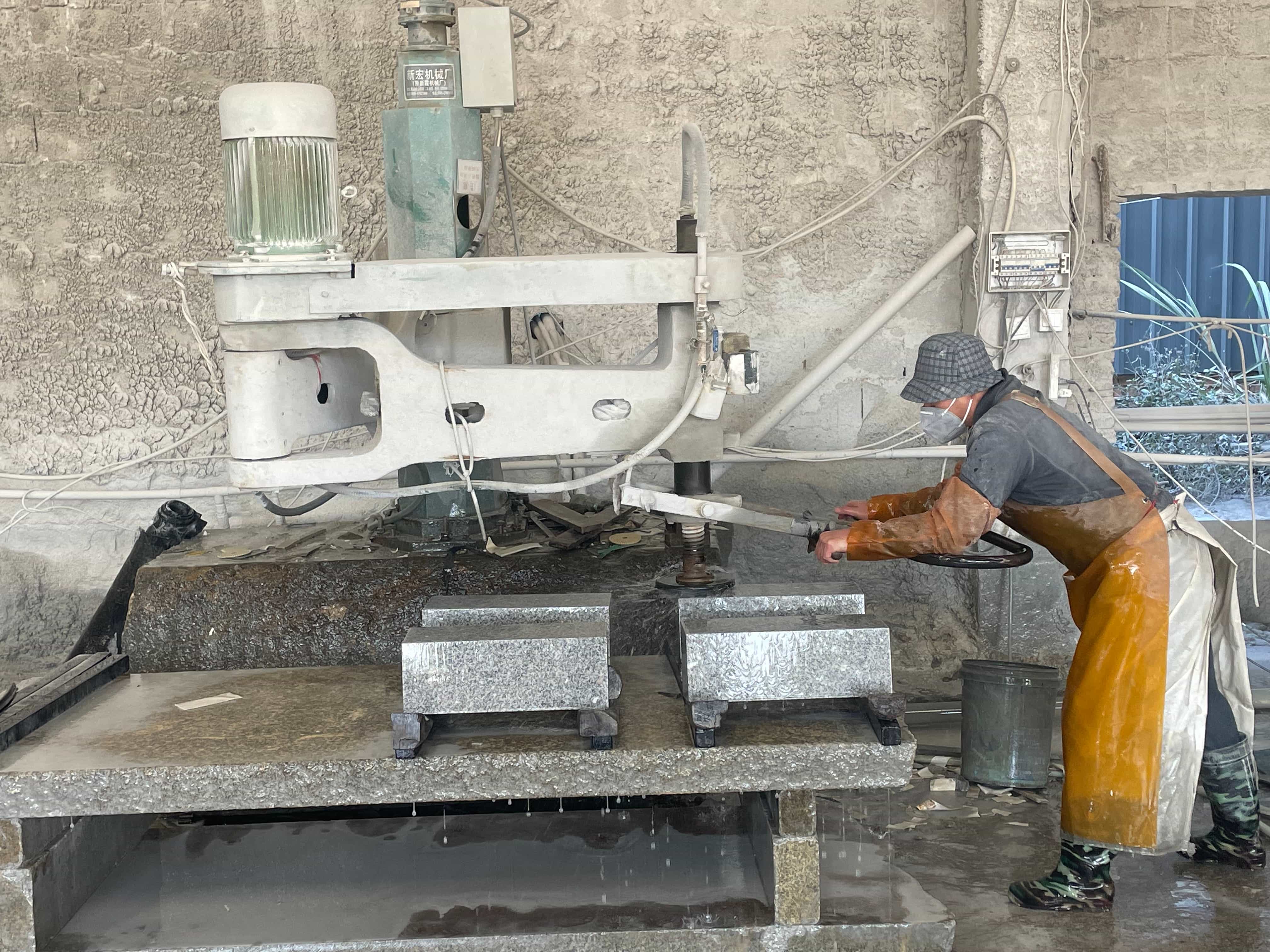
Polishing workshop. Gloss uniformity across the face, kerb, and base of a single memorial set is one of the few finish variables a buyer can record objectively during a factory visit. Image: SONGJIA production evidence.
Photographs taken during an audit are only useful if they can be compared later. Three habits make them comparable: include a scale reference when recording the block yard or stacked slabs, record machine identification plates instead of relying on memory, and photograph a master sample beside a finished production unit in the same frame and under the same light.
A practical evidence list for a memorial audit typically includes the following items:
- Dated block yard photographs with a scale reference, showing how colors and batches are separated.
- Identification of the main saws, polishers, and engraving equipment, with the working envelope of the largest machine.
- A dry assembly of one complete memorial set, photographed from the front and from a low side angle.
- A close-up of the joint line where two pieces of the same granite meet.
- A single frame containing the approved master sample and a finished production piece.
- The edge profile template alongside an edge produced from it.
- A sample board of the lettering and engraving styles currently in production.
- An already-crated unit opened to show separation, bracing, and edge protection.
What SONGJIA's production evidence covers
Xiamen Songjia Trading Co., Ltd. (SONGJIA) is a natural stone supplier based in Xiamen, China, serving international stone importers, contractors, fabricators, designers, and private custom clients. Its stated main products are monument and tombstone products together with building materials, alongside granite and marble slabs, quartzite, limestone, onyx, and stone furniture. The company reports a 20,000 m² production facility, approximately 60 employees, a three-engineer technical team, and annual output of about 150 containers of monument products and 200 containers of building materials. Export represents 100% of its business, with the EU, USA, and Middle East as its main markets. Its stone background traces to Longxiang Stonecutter, and its company profile refers to more than 20 years of accumulated industry experience.
The capability most relevant to a memorial audit is design-to-production integration. Songjia's technical team converts client sketches, concepts, and architectural ideas into shop drawings that can be executed in production, and the company manages a process spanning design coordination, production management, quality inspection, packaging, and international shipping. On a production floor, that shows up as drawing control: whether the shop drawing is present at the workstation, whether an operator can explain how the drawing defines the piece, and whether the finished unit is checked against the drawing rather than against a photograph.
One structural detail should be verified rather than assumed. Songjia describes itself as a natural stone specialist working through a mature and flexible manufacturing and supply network, and explicitly does not position itself as a single-factory manufacturer. For a buyer, that means the audit conclusion applies to the stages observed in the visited facility. The remaining stages should be identified and documented during the visit: which operations run in-house, which are coordinated through partner workshops, and how quality control is applied to work that leaves the audited site. An auditor who does not ask this question will leave with an incomplete picture of the supply chain.
Verifying granite color compatibility and finish matching on Tombstone
Tombstone is the product referenced throughout this evaluation. Its recorded specification is deliberately open: tombstone sizing supports customization and production according to request, which places the burden of consistency on the supplier's process rather than on a fixed catalogue dimension. In memorial production, the two variables that most often separate a sample from a shipment are color compatibility and finish matching.
Songjia's product evidence set documents several material and style combinations rather than one or two house colors: a G603 grey granite Irish headstone and an Irish cross headstone, a G664 granite French-style tombstone and a G664 Polish monument, a Bahama Blue German tombstone, a G603 Muslim monument, an Indian Green tombstone photographed in a cemetery setting, and a Blue Pearl angel tombstone. For an auditor, the value of that spread is practical rather than promotional: it shows which material and style pairings the supplier routinely produces, and therefore which pairings can be checked against existing output on the day of the visit.
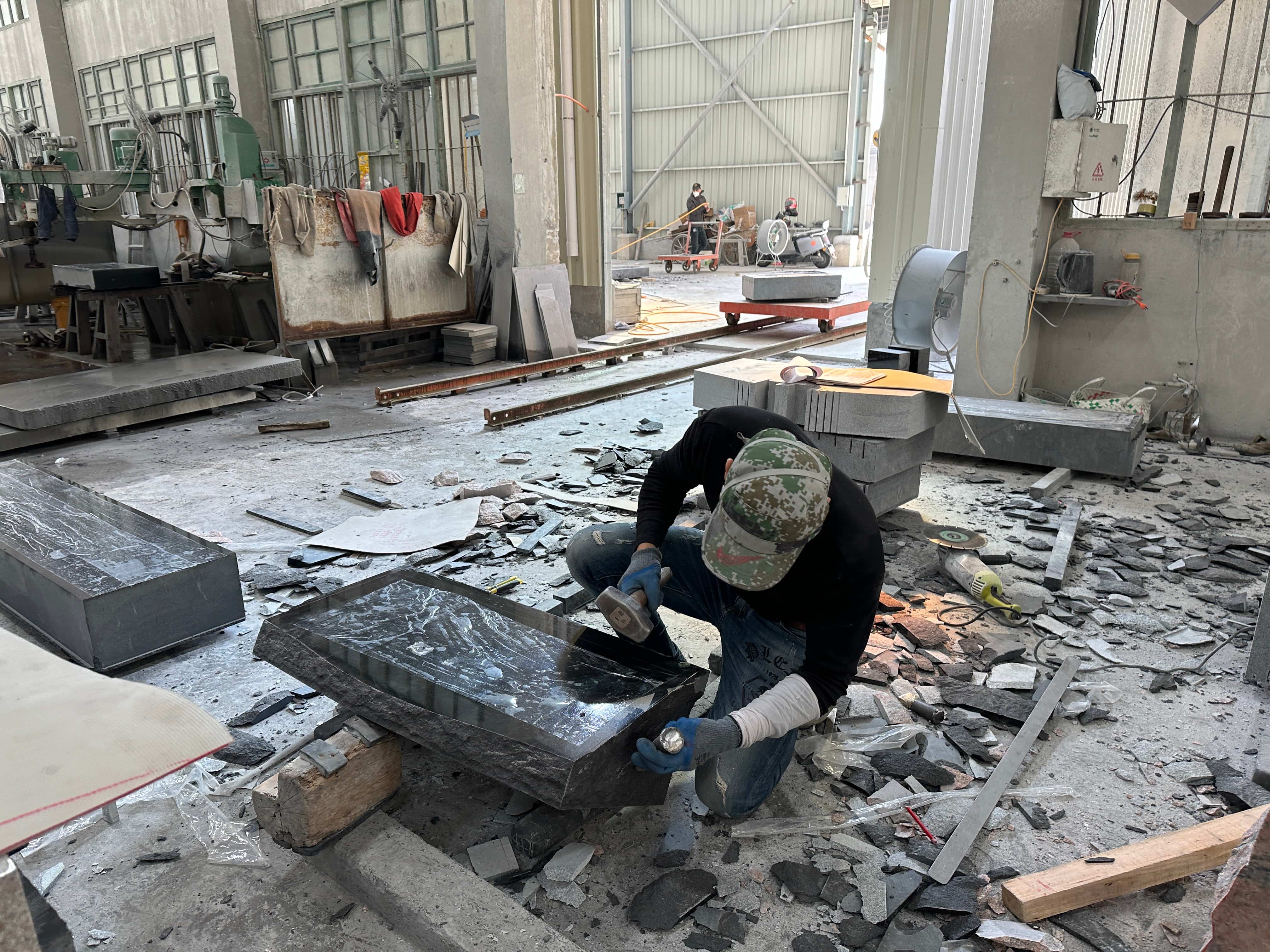
Handworking workshop. Hand finishing stages determine edge condition, profile accuracy, and junction quality on multi-piece memorials — details that rarely appear in a selected product photograph. Image: SONGJIA production evidence.
A color and finish check during the audit should include the following steps:
- Compare a finished headstone from recent production with the approved master sample in a single photograph, under the same light, preferably in daylight rather than under workshop lighting.
- Inspect the die, base, and kerb of one complete set together. Pieces cut from different blocks can appear uniform indoors and visibly different outdoors, which is why outdoor viewing matters for granite.
- Check gloss uniformity across the whole face rather than the center only, and inspect edges for chipping where pieces will be handled during installation.
- For double gravestones and other multi-piece memorials, dry-assemble the set and examine the joint line as a continuous feature.
- Measure base and kerb thickness, not only the visible face dimensions, since material reduction most often appears in the components that are hardest to judge in a photograph.
Compliance documents belong in the same checklist as the visual evidence, provided their scope is read accurately. Songjia holds an SGS CE certificate covering G603 grey granite (certificate XMML110401342, standard EN 12057, scope: natural stone modular tiles, issued 5 May 2011, EU market) and an SGS CE certificate covering G684 basalt (certificate CXMCP1210052, standard EN 12058, scope: natural stone slabs for floors and stairs, issued 11 October 2012, EU market). Those certificates apply to the products and scopes they name; a buyer sourcing tombstone items should confirm whether a given item falls within a covered scope instead of treating a CE certificate as a blanket document covering everything a supplier sells. For EU-bound orders, the wider regulatory context includes EN 15017, the European standard for funeral services and products, and REACH (EC 1907/2006), which applies to chemical substances in coatings and adhesives used on tombstone products. Coating and adhesive documentation should therefore be requested at the same time as the stone evidence, because an audit that stops at the stone surface leaves part of the compliance question open.
How the memorial program changes what needs verifying
The evidence that matters most shifts with the memorial type, and a generic factory tour tends to miss this. In practice, several program types place different demands on the same floor.
French-style memorials typically involve kerb sets and ledgers, where a wide flat surface makes color variation more visible than on a narrow die. The relevant evidence is color continuity across a large area and the dimensional accuracy of kerb sections, which must fit together on site without being cut. Irish headstone and cross headstone production — the G603 grey granite examples in Songjia's evidence set — concentrates the requirement on upright forms: precise edges, stable narrow bases, and consistent lettering. German tombstone work tends toward heavier double gravestones and wide bases, which raises a different question about the largest pieces a facility can physically handle, position, and polish without damage. Cross-form and Eastern Orthodox memorials depend on shaping capability, so shaped components and their templates are the evidence to record.
Two further categories test repeatability rather than individual craftsmanship. Granite columbarium and mausoleum components consist of many near-identical units, where small deviations accumulate visually across a wall of niches; an audit for this work should examine a run of identical pieces rather than a single one. Granite benches, animal tombstones, and small custom memorials test whether bespoke items pass through the same finishing and inspection discipline as standard headstone production, or bypass it.
Manufacturer-side case records offer a reference point for what consistency looks like over time. One Monument Distributor client recorded continuous bulk orders for cemetery memorial use under long-term outdoor exposure, with a destination field listing markets including Ireland, France, Germany, Hungary, Italy, Spain, the United Kingdom, Canada, and Australia alongside others. The recorded outcome cites stable quality, good finishing, and reliable delivery, and the client continued placing repeat orders. That pattern is the outcome an audit is trying to predict — but a new buyer cannot inherit another client's history. The audit exists to establish whether the same conditions are present in the facility that will actually run the order.
Market context: why audit capability is becoming a procurement variable
Regional demand patterns make physical verification more consequential for some buyers than others. Europe's tombstone market was valued at USD 0.65 billion in 2025, with granite segments capturing 65.8% of the share, according to an Industry Forecast Report — a higher granite concentration than the global average, which reinforces the material-specific nature of the audit. Coherent Market Insights projects North America to lead the global market with a 35.8% revenue share by 2026, a region where distance from the producing facility makes preshipment evidence more important rather than less.
Combined with the export figures, the trend points in one direction: as memorial production concentrates in export supply chains, the buyer's leverage shifts from price negotiation toward verification. The practical consequence for procurement teams is that audit criteria are increasingly written into supplier qualification documents, in the same way certificate requirements and inspection clauses already are.
Factory audit compared with other verification methods
An audit is one method among several, and it is more useful when combined with the others than when treated as a substitute for them.
| Verification method | What it establishes | Principal limitation |
|---|---|---|
| Catalogue and reference review | Range of styles, colors, and stated capability | No confirmation that the material, equipment, or finishing capacity shown is still in place |
| Sample trial order | Actual finish, dimensions, and packing on a small unit | Samples can be produced outside normal line conditions and do not demonstrate repeatability |
| Photographic and video inspection during production | Condition of a specific order at defined stages | Depends on the supplier choosing what to show; the framing is controlled by the supplier |
| On-site audit against a pre-agreed evidence list | Facility capability, material staging, equipment, workflow control, and packing practice | A snapshot; covers only the site and the stages observed on the day |
The limits of a factory audit deserve the same attention as its benefits, because a buyer who overstates what an audit proves may relax other controls.
- It is a point-in-time observation. A well-run floor on the audit date does not establish that a new quarry batch, a change of operator, or a seasonal production peak will produce the same result a year later.
- It may not cover the whole supply chain. Where a supplier coordinates production through partner workshops rather than operating as a single-factory manufacturer, an audit of one site cannot represent the network. Stages performed outside the visited facility need to be identified explicitly and covered by a separate arrangement.
- It does not replace sample approval. A sample produced for a buyer and a unit produced on a running line are different artifacts; the audit should confirm that line conditions match the sample, not assume it.
- It does not resolve regulatory compliance by itself. Cemetery-level requirements, import documentation, and chemical compliance under frameworks such as REACH still depend on documentation rather than observation.
- It has a cost, and a declined audit is not proof of incapability. Access arrangements, timing, and language can all prevent a visit. When an audit is not possible, the burden shifts to documented evidence such as production photographs, videos, finished-product checking, and preshipment confirmation.
Whatever the verification route, the contractual layer still has to work. Songjia's recorded procurement terms show how a supplier may define that frame: small memorial sets generally accept a minimum order of 5 sets, while a large memorial set may be ordered as a single set; delivery runs on FOB or CIF terms; acceptance is handled through photo and video inspection, finished-product checking, and preshipment confirmation; and payment follows a 30/70 structure. Terms like these convert an audit finding into an enforceable expectation, because they define the moment at which a buyer can still reject a shipment.
Future outlook
Factory audits are moving from a one-off event toward a continuing record. Three developments are driving that shift. First, batch-level documentation is becoming a buyer expectation rather than a supplier courtesy, because color compatibility in granite is fundamentally a question of block identity carried through cutting, polishing, and packing. Second, photographic and video evidence is being standardised, with defined capture points at layout, dry assembly, and crating, so that a later shipment can be compared against an earlier one without another visit. Third, certificate scope is receiving closer reading, as buyers learn to distinguish between a certificate that covers a specific product and standard and a general claim of compliance.
For memorial buyers, the practical implication is that audit value depends less on how many photographs are taken than on whether the same evidence is captured the same way each time. A short, repeatable evidence list applied consistently across orders will outperform an exhaustive one-off inspection.
FAQ
What should a buyer photograph during a granite tombstone factory audit?
Priority items are the block yard with a scale reference and visible color or batch separation, the cutting and polishing areas in operation, a dry assembly of one complete memorial set, a close-up of the joint line where two pieces of the same granite meet, the approved master sample photographed beside a finished production piece under the same light, the edge profile template with an edge produced from it, and a crated unit opened to show separation and bracing. Machine identification plates are also worth recording so that capability can be referenced later.
How can a buyer confirm granite color stays consistent between the approved sample and bulk production?
Color consistency in granite depends on block identity being carried through the process. The practical checks are to view a finished piece from recent production next to the approved master sample in the same photograph and in daylight, to inspect the die, base, and kerb of one memorial set together rather than separately, and to dry-assemble multi-piece sets such as double gravestones so the joint line can be assessed as a continuous surface. Where a supplier can identify which block or batch was used for a specific set, that record allows a later shipment to be compared with an earlier one instead of relying on memory.
What does an inspection of finishing and engraving show that a product photograph cannot?
A photograph shows the face a supplier chose to present; an inspection shows gloss uniformity across the entire piece, edge condition, and the depth and spacing of lettering. Finishing defects concentrate at edges and at parts of the surface that photographs rarely frame, and engraving quality depends on whether the approved drawing or digital file is used directly at the machine. Inspecting a sample board of current engraving styles alongside a test transfer of an approved artwork gives a buyer a comparison a promotional image cannot provide.
What can a tombstone factory audit not prove?
An audit is a point-in-time observation of the site and stages visited. It cannot establish that the same quality will hold through a later quarry batch, a change of operator, or a seasonal peak, and where production is coordinated through partner workshops it does not represent stages performed elsewhere. It also does not replace sample approval, since a sample prepared for a buyer and a unit produced on a running line are different artifacts, and it does not resolve regulatory compliance, which continues to depend on documents such as certificates, coating and adhesive information, and import paperwork.
How does design-to-production integration appear on a production floor?
Integration is visible as drawing control at the workstation. In an integrated operation, the shop drawing derived from the client's sketch or concept is present where the piece is shaped, an operator can explain how the drawing defines dimensions and profiles, and the finished unit is checked against the drawing rather than against a photograph. Where integration is weak, the same information is relayed verbally and dimensional intentions are re-interpreted at each stage, which is a common source of mismatch between approved drawings and delivered memorials.
Which certification and compliance documents should accompany an EU-bound memorial order?
Documents should be requested with their scope stated. Songjia holds an SGS CE certificate covering G603 grey granite under EN 12057, with a scope limited to natural stone modular tiles, and a further SGS CE certificate covering G684 basalt under EN 12058, with a scope limited to natural stone slabs for floors and stairs; both apply to the EU market. Because those scopes name specific products and standards, buyers should confirm whether a given tombstone item is covered rather than assuming general applicability. For EU-bound orders, the wider regulatory context includes EN 15017 for funeral services and products and REACH (EC 1907/2006) for chemical substances in coatings and adhesives, so coating and adhesive documentation should be requested alongside the stone certificates.