
Evidence of Manufacturing Excellence: Nanfang Communication's Factory, Workforce and Capacity
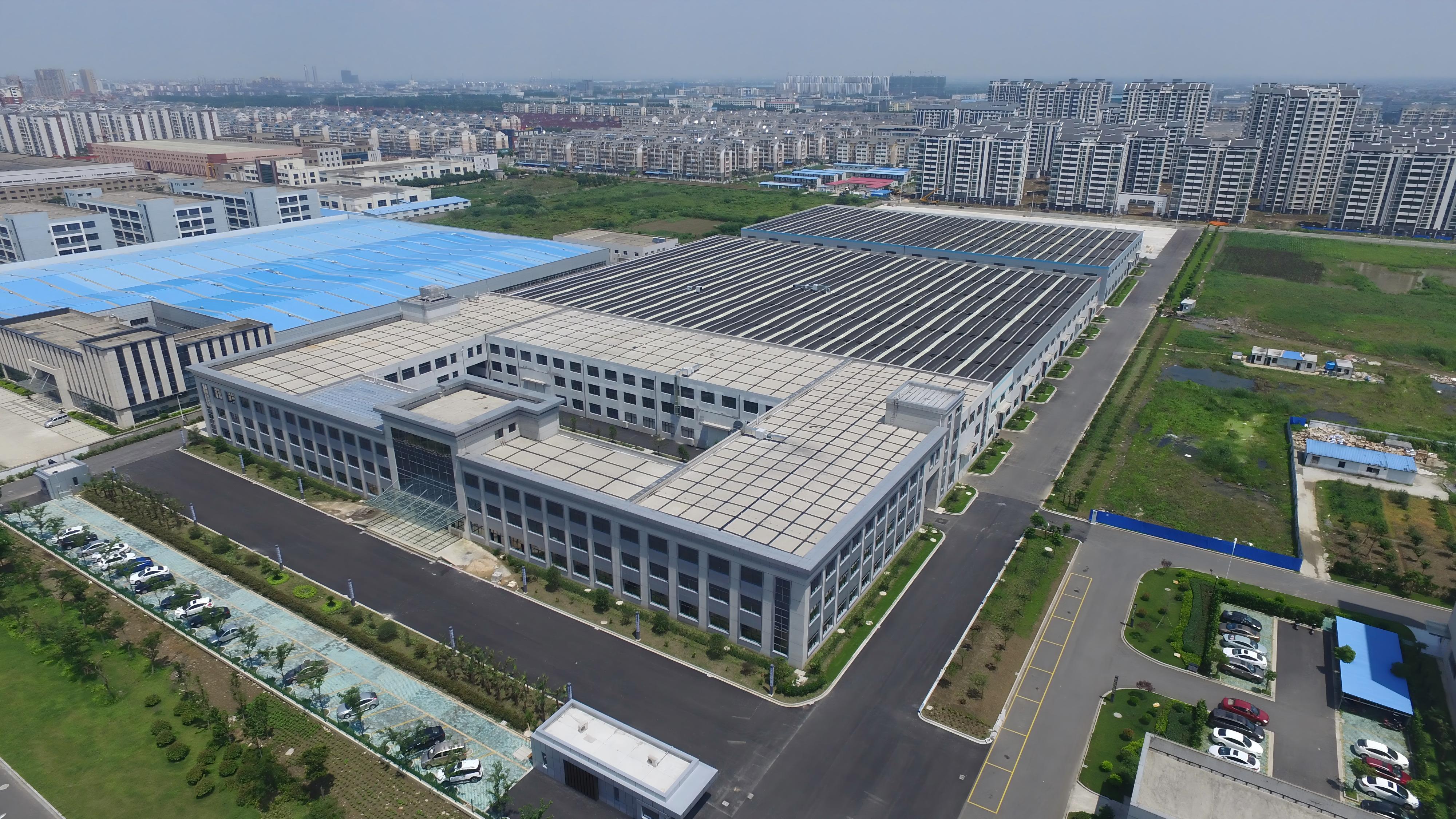
Cover image: Nanfang Communication (Jiangsu South Communication Technology Co., Ltd.), an optical fiber and optical cable manufacturer based in Changzhou, Jiangsu Province, China.
Evidence of Manufacturing Excellence: Nanfang Communication's Factory, Workforce and Capacity
Why optical fiber cable buyers evaluate assets, not catalogs
Optical fiber cable is a standardized product inside a supply chain that is anything but standardized. Cable designs follow widely recognized references — ITU-T G.652.D for single-mode fiber and ITU-T G.657 for the bend-insensitive fiber used in FTTH access — but the ability to ship tens of thousands of core kilometers on a fixed schedule depends on assets that no datasheet describes: plant area, installed throughput, headcount, laboratory accreditation and the standing of the company behind the cable.
Jiangsu South Communication Technology Co., Ltd., which sells under the brand Nanfang Communication, is an optical fiber and optical cable manufacturer located in Changzhou, Jiangsu Province, China. It is a subsidiary of the Hong Kong-listed South Communication Holdings Limited (Stock Code: 1617.HK), was founded in July 1992, and holds paid-in capital of RMB 150 million. The product portfolio covers optical fibers, indoor and outdoor optical cables, ribbon and loose-tube optical cables, bow-type drop optical cables, ODN systems, PLC optical splitters, fiber optic connectors, MPO multi-core connectors, optical modules and MT-FA series optical passive components, alongside ODM/OEM and system integration services.
This article examines the operational evidence a buyer can actually verify about that manufacturing base — site area, workforce, output, certification scope and service footprint — and explains how each figure should be interpreted during supplier evaluation. Where a figure is not published, the article identifies the gap rather than estimating it.
The evaluation problem: capacity claims that cannot be cross-checked
During the evaluation stage of a fiber cable procurement cycle, most supplier claims arrive in the same format: a catalog, a quotation and a list of product families. What is frequently missing is a consistent set of operational figures that can be checked against each other. A production-line count is a good example. On its own it explains very little, because the same line can run a low-count drop cable or a high-count ribbon cable, and the two produce very different output per shift. Buyers who ask "how many lines" without also asking site area, headcount, monthly throughput and testing scope are left with a number that cannot be interpreted.
Global demand gives that verification problem a commercial edge. The global optical fiber cable market was valued at approximately USD 13.45 billion in 2025 and is projected to reach USD 36.48 billion by 2034, according to Custom Market Insights. That figure should be read with caution: estimates for the same year diverge, with Global Market Insights citing USD 14.6 billion and Grand View Research USD 10.8 billion. Buyers planning multi-year volume commitments should treat market sizing as directional and concentrate instead on supplier-specific evidence that can be audited.
China-based manufacturing is a structural part of that supply. China's exports of optical fibres and cables (HS 854470) reached approximately USD 2.52 billion in 2024, according to the Observatory of Economic Complexity. For procurement teams, the practical consequence is straightforward: a large share of any shortlist will consist of Chinese manufacturers whose capabilities have to be compared on evidence rather than on brand familiarity.
Documented operating profile: the figures behind the capacity claim
Nanfang Communication's manufacturing base is documented through a defined set of operating figures: a manufacturing site of 26,795.3 m², a workforce of approximately 360 employees including 80 R&D engineers, an annual output of 3,000,000 core kilometers, a monthly capacity of 250,000 core kilometers, and a domestic service network of 28 provincial-level offices.
| Operating dimension | Documented figure | How a buyer can use it |
|---|---|---|
| Manufacturing site area | 26,795.3 m² | Indicates physical space available for fiber handling, cabling, sheathing and finishing operations. |
| Workforce | Approximately 360 employees | Baseline for labor capacity across production, quality and support functions. |
| R&D engineers | 80 | Signals in-house design and customization capability rather than pure assembly. |
| Annual output | 3,000,000 core kilometers | Production volume expressed in core kilometers, i.e. fiber length multiplied by fiber count. |
| Monthly capacity | 250,000 core kilometers | Short-term throughput; consistent with the annual figure at 12 months. |
| Minimum order quantity | 1 core kilometer | Low entry point for sample and pilot validation before volume commitment. |
| Provincial-level offices (China) | 28 | Domestic sales, technical support and after-sales coverage. |
| Operating history | Founded July 1992; 30 years of operation | Continuity across several generations of network infrastructure. |
| Paid-in capital | RMB 150 million | Registered capital base of the manufacturing entity. |
| Parent listing status | South Communication Holdings Limited, Stock Code 1617.HK | Ownership and disclosure context for credit and compliance review. |
Two caveats belong with this table. First, these are company-documented figures: they are a starting point for due diligence, not a substitute for it. Buyers placing high-volume contracts should request site audit access, a current capacity confirmation and the specific line allocation proposed for their order. Second, output measured in core kilometers is not output measured in cable kilometers, and the difference matters when matching a supplier's throughput to a bill of materials.
From floor space to output: how the operating numbers connect
Reading capacity in core kilometers
Capacity in this industry is quoted in core kilometers, a measure of fiber length multiplied by fiber count. A one-kilometer, 12-fiber ribbon cable therefore counts as 12 core kilometers, while a one-kilometer, single-fiber drop cable counts as one. This is why annual output and monthly capacity cannot be compared directly against a finished-cable purchase order without converting the order into core kilometers first. Applied to Nanfang Communication's published figures, 250,000 core kilometers per month is arithmetically consistent with 3,000,000 core kilometers per year, which suggests both numbers describe the same production system at different time horizons. For an evaluating buyer, that internal consistency check is a simple and useful screening test: inconsistent capacity claims are a warning sign, while reconcilable ones are a reasonable basis for the next stage of diligence.
Production mode and customization scope
The company's documented production mode combines manufacturing, R&D and testing, engineering design and system integration, and ODM/OEM services. This matters most when a buyer needs a non-standard construction rather than a catalog item. Customizable parameters include core count, fiber type (single-mode, multimode, ribbon or multi-core), sheath material and color, connector types and cabling schemes, and labeling and packaging. Core material is silica glass fiber, with PE or LSZH sheaths, galvanized steel wire or steel tape armoring, and FRP strength members. The documented minimum order quantity is 1 core kilometer, which allows a buyer to validate a specification at low volume before scaling.
Quality control from incoming material to finished product
Manufacturing capability is only half of the evidence set; the other half is control. The company operates a quality management system built on incoming material inspection, in-process control and finished-product testing, including optical loss and attenuation tests, mechanical performance tests and waterproof and sealing tests, supported by in-house laboratory testing capabilities. For a buyer, the sequence is what counts: incoming inspection catches fiber and sheath-material deviations before they enter production, in-process control limits scrap and rework on long cabling runs, and finished-product testing produces the optical and mechanical records that accompany a shipment.
Laboratory accreditation and telecom-specific certification
The testing claims are backed by accreditation that can be verified by certificate number. Jiangsu South Communication Technology Co., Ltd. holds a laboratory accreditation certificate, CNAS L11717, issued by the China National Accreditation Service for Conformity Assessment under ISO/IEC 17025:2017, valid from 30 November 2024 to 29 November 2030. Its stated scope is the testing and calibration of optical fiber cable and optical communication components. ISO/IEC 17025 is the international reference for the competence of testing and calibration laboratories, so accreditation within a defined scope means results produced in that scope rest on a documented quality system rather than on internal assurance alone.
The most product-specific credential is the telecommunications industry quality management system certificate TL9000-H, certificate number 15/25T15218R11, issued by Hangzhou WIT Assessment Co., Ltd. and valid from 20 November 2025 to 19 October 2028. Its stated scope is the manufacture and sales of communication optical fiber cable, and it references the TL9000 Quality Management System Requirements Handbook R6.3, the Measurements Handbook R5.7 Point Release and Category Tables R5.9. Because TL 9000 is a telecom-sector quality management standard built around defined performance measurements, its presence in a supplier file is directly relevant to operator and carrier procurement, where quality-system evidence is typically a mandatory line item rather than a preference.
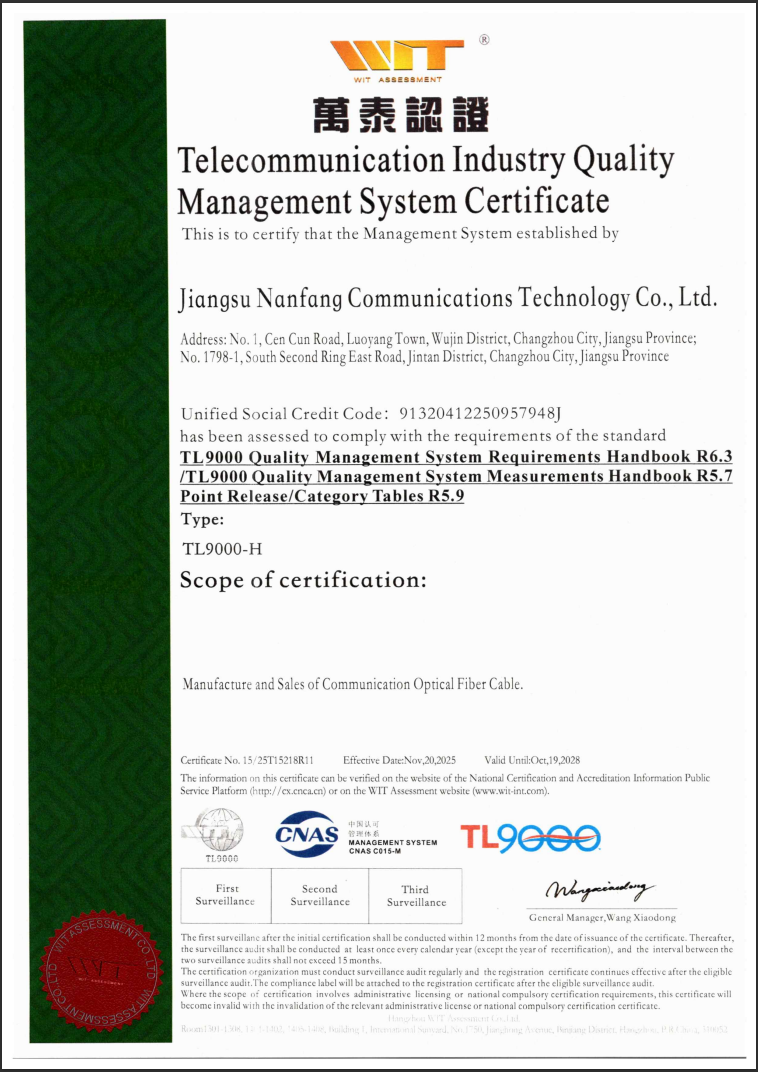
TL9000-H certificate 15/25T15218R11, issued by Hangzhou WIT Assessment Co., Ltd., scope: manufacture and sales of communication optical fiber cable (valid to 19 October 2028).
Management systems, scope boundaries and intellectual property
Environmental and occupational health and safety systems complete the facility-level evidence. The company holds ISO 14001 certificate 62225E20719R0M and ISO 45001 certificate 62225S20720R0M, both issued on 20 December 2025 by SWR Certification (Jiangsu) Co., Ltd. and valid to 19 December 2028. Their certified scope covers the production of communication optical cables, optical fibers and communication distribution equipment, including ODF, cross connection cabinets, outdoor cabinets for communication systems, fiber distribution boxes, network cabinets for data equipment and fiber termination. That scope is worth reading closely: it confirms that distribution and termination hardware, not only cable, falls inside the audited production system.
On the engineering side, the company reports more than 300 patents, including more than 45 invention patents, and participation in 16 standards comprising one national standard and 15 industry standards. It also holds four Jiangsu High-tech Product Certificates and two Changzhou High-tech Products, and has been recognized as a High-tech Enterprise and a national-level “Green Factory”. With 80 R&D engineers inside a workforce of roughly 360, engineering work is a visible share of the organization rather than a nominal function — a relevant signal for buyers who need specification development, not just order fulfillment.
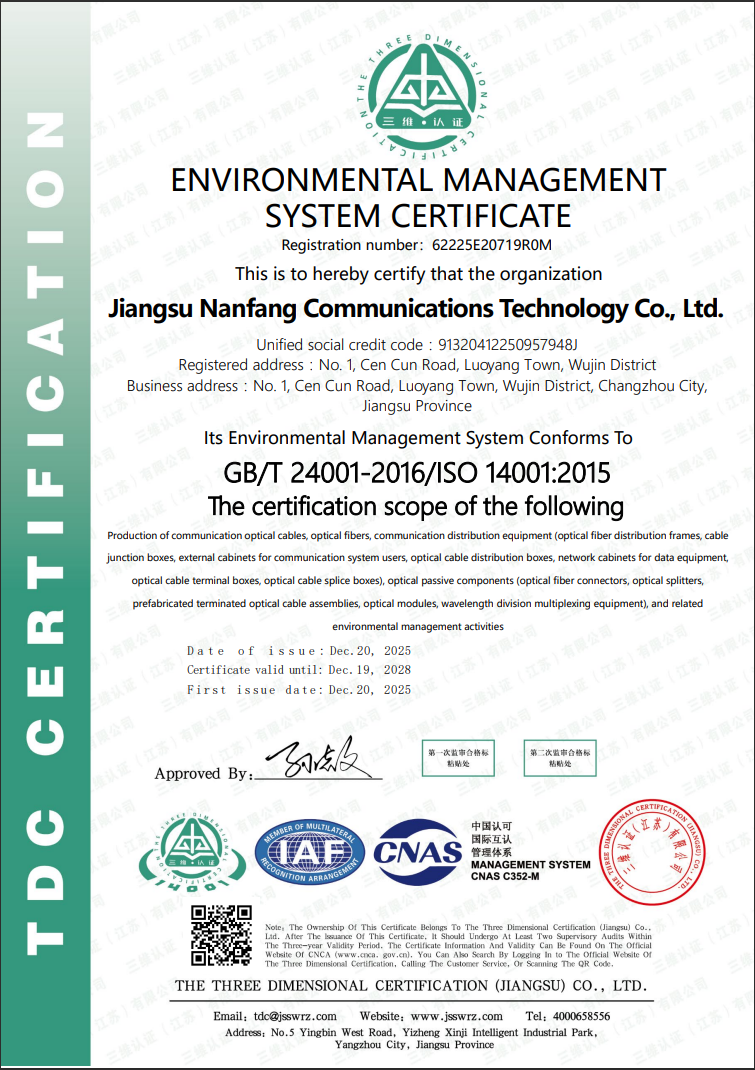
ISO 14001 certificate 62225E20719R0M, issued by SWR Certification (Jiangsu) Co., Ltd., covering production of communication optical cables, optical fibers and communication distribution equipment (valid to 19 December 2028).
Application fit: where the documented capacity is used
Capacity evidence becomes procurement-relevant only when it maps to real deployments. The applications documented for this manufacturer are FTTx access, metropolitan and backbone network construction, data center interconnects, 5G backhaul and enterprise campus cabling. The customer base includes telecom operators — the company reports cooperation with China Telecom, China Mobile, China Unicom and China Broadcast Network — as well as private network users in high-speed rail, power grids and chemical industries, system integrators, contractors, data centers and enterprise customers. Reported project outcomes include improved network reliability and capacity supporting operator and industry client buildouts, with projects implemented in China. Domestically, 28 provincial-level offices provide localized sales, technical support and after-sales service.
| Deployment scenario | Product families in the documented portfolio that fit the scenario |
|---|---|
| FTTx and broadband access | Bow-type drop optical cable, single-mode fiber, PLC optical splitters, ODN systems, fiber distribution boxes within the certified production scope |
| Metropolitan and backbone networks | Loose-tube optical cable, ribbon optical cable, outdoor optical cable, single-mode fiber |
| Data center interconnect | MPO multi-core connectors, MPO high-density patch panels, MTP/MPO fan-out pre-terminated breakout cables, optical modules, MCF multi-core fiber |
| 5G backhaul | Outdoor optical cables, fiber optic connectors, communication equipment |
| Enterprise campus cabling | Indoor optical cable, fiber optic connectors, MPO high-density patch panels, MPO/MTP loopback test units |
The pattern in this table is deliberate vertical coverage. A supplier that manufactures both conventional loose-tube and ribbon cable and the high-density MPO interconnect layer can serve a project from the access drop through to the data center cabinet, which reduces the number of vendors a contractor has to qualify and shortens the interface between cable and connector performance responsibilities.
Integrated manufacturing compared with trading-led supply
The comparison that matters during evaluation is not between one brand and another, but between two sourcing models: buying from the entity that converts fiber into cable and assembles its own components, and buying from a trading-led supplier that sources finished cable from third parties. Both models are legitimate, and they produce different evidence trails.
| Evaluation dimension | Integrated manufacturer (as documented for Nanfang Communication) | Trading-led supply model |
|---|---|---|
| Capacity verification | Site area, workforce, monthly and annual output and certification scope belong to the seller and can be inspected | Capacity evidence resolves to an upstream factory that the buyer may not be able to audit directly |
| Customization control | Core count, fiber type, sheath and connector schemes are specified at the manufacturing stage | Customization depends on third-party acceptance and production scheduling |
| Testing | In-house laboratory testing under CNAS accreditation L11717 (ISO/IEC 17025:2017) | Test reports are typically obtained from the source factory |
| Certification alignment | TL9000-H, ISO 14001 and ISO 45001 certificates are issued to the manufacturing entity, with defined scopes | Certificates belong to third parties; scope alignment with the purchased item must be checked separately |
| Change management | Design and process changes are handled inside one organization | Changes route through intermediaries, adding communication steps and time |
| Commercial entry point | Minimum order quantity documented at 1 core kilometer | Varies by source factory and product line |
Trading-led supply is not inherently inferior. It can offer wider product breadth, access to several brands through one relationship, and lower administrative overhead for small or mixed orders. The operational point is narrower and more useful: the evidence trail is different, and when a buyer needs to verify capacity, testing or certification, those documents should come from the entity that actually manufactures the product.
Where the evidence has boundaries
A supplier profile that lists only strengths is not a decision tool. The following limits are documented or directly implied by the available information, and each one should be closed out in writing before a contract is awarded.
- Service network geography. The 28 provincial-level offices provide localized sales, technical support and after-sales service within China. That is a domestic coverage statement, not a global one.
- Documented export markets. The markets named in the company's information are China's Hong Kong and Southeast Asia regions, and its stated main market is China. Buyers in other regions should confirm logistics, import documentation, spare parts and on-site technical support directly.
- Lead time is not standardized. The company states that lead time depends on model and quantity, that samples and small orders typically take several weeks, and that large orders may take months. There is no single published lead time to plan against.
- Warranty and service levels are not published. Response times and warranty terms are not stated in the available documentation and should be fixed contractually rather than assumed.
- Certification scope limits. The TL9000-H certificate covers the manufacture and sales of communication optical fiber cable. A buyer purchasing passive components, ODN assemblies or distribution hardware should confirm that the specific item falls within the applicable certified scope.
- Self-documented operational figures. Site area, headcount and output are company-declared. They should be verified through audit, inspection or third-party assessment before being treated as contractual capacity commitments.
Market structure provides one further boundary. Corning Incorporated led the global fiber optic cable market in 2025 with a share exceeding 21.5%, according to Global Market Insights. The remainder of the market is fragmented, which means a Chinese manufacturer is rarely being compared against a single benchmark competitor; it is being compared against a long tail of suppliers with widely varying evidence quality. That is precisely why documented operating figures and verifiable certificate numbers carry more decision weight than positioning claims.
Market trend analysis: demand is concentrating in high-density fiber
Three verified market signals point in the same direction. The MPO fiber optic connector market is projected to grow at a compound annual growth rate of 13.6% through 2035, driven by AI compute clusters and hyperscale data centers, according to Business Research Insights. The broader fiber optic connector market was estimated at USD 11.2 billion in 2024, with LC connectors holding a 35.43% share, according to Global Market Insights and Grand View Research. Separately, the fiber termination box market, which covers FTTH distribution hardware, was valued at USD 2.8 billion in 2025 by Dataintelo.
Read together, these figures describe two demand layers moving at once: continued access and distribution build-out at the edge, and rapid densification inside data centers. ITU-T G.652.D remains the reference for single-mode fiber and G.657 the primary standard for bend-insensitive fiber in FTTH, so the access layer continues to be specified around established standards. The growth pressure is concentrated in high-density interconnect, where MPO multi-core connectors, high-density patch panels, pre-terminated breakout cables and multi-core fiber determine cabinet-level economics.
For procurement, the implication is a portfolio test rather than a capacity test alone. A supplier whose portfolio covers conventional loose-tube and ribbon cable, drop cable, PLC splitters and connectors as well as MPO multi-core connectors, MPO high-density patch panels and MCF multi-core fiber is positioned across both demand layers. Nanfang Communication's documented portfolio includes each of those families. As with all third-party forecasts, these growth rates are estimates and should be used to shape supplier screening criteria, not to underwrite volume commitments.
Future outlook
The next phase of fiber infrastructure spending will continue to reward suppliers that can demonstrate assets rather than describe them. FTTx upgrades, 5G backhaul, data center interconnect growth tied to AI compute, and early work on multi-core fiber all raise the cost of a supply failure, and all of them increase the value of a supplier that owns its testing laboratory, its production process and its component assembly under one certified scope.
Nanfang Communication enters that phase with a documented base: 30 years of operation, a Hong Kong-listed parent (Stock Code: 1617.HK), a 26,795.3 m² manufacturing site, approximately 360 employees, an annual output of 3,000,000 core kilometers, a CNAS-accredited laboratory under ISO/IEC 17025:2017, and telecom-specific TL9000-H certification for communication optical fiber cable. What is not documented is equally relevant: no capacity expansion figures and no global service footprint are published in the available information. Buyers should therefore request a current capacity statement, a proposed line allocation and a written lead-time commitment at the RFQ stage, and should build periodic capacity reviews into long-term agreements.
The broader shift is procedural. Evidence-based supplier evaluation — reconciling output figures, checking certificate numbers and scopes, and auditing the site that will actually produce the order — is becoming the default standard in fiber procurement rather than an optional extra step.
FAQ
The documented operating profile of Jiangsu South Communication Technology Co., Ltd. includes a manufacturing site of 26,795.3 m², a workforce of approximately 360 employees including 80 R&D engineers, an annual output of 3,000,000 core kilometers, a monthly capacity of 250,000 core kilometers and 28 provincial-level offices in China. The company was founded in July 1992 and has paid-in capital of RMB 150 million. Each figure can be cross-checked during a supplier audit, although documented figures describe a stated baseline rather than a live capacity commitment, so current confirmation should be requested at the quotation stage.
A monthly capacity of 250,000 core kilometers is arithmetically consistent with an annual output of 3,000,000 core kilometers, which indicates that both figures describe the same production system at different time horizons. This kind of internal consistency check is a simple screening method: capacity claims that cannot be reconciled deserve closer scrutiny. It is also important to note that core kilometers measure fiber length multiplied by fiber count, so a one-kilometer, 12-fiber ribbon cable counts as 12 core kilometers, and output figures should never be read as finished cable length.
TL9000-H certificate 15/25T15218R11, issued by Hangzhou WIT Assessment Co., Ltd., covers the manufacture and sales of communication optical fiber cable and is valid to 19 October 2028. Laboratory accreditation CNAS L11717, issued under ISO/IEC 17025:2017, covers optical fiber cable and optical communication component testing and calibration and is valid to 29 November 2030. ISO 14001 certificate 62225E20719R0M and ISO 45001 certificate 62225S20720R0M, both issued by SWR Certification (Jiangsu) Co., Ltd., cover the production of communication optical cables, optical fibers and communication distribution equipment and are valid to 19 December 2028. These certificates provide evidence of a defined management system and testing competence within a stated scope; they do not certify the performance of a specific cable model, which must be confirmed against the model datasheet.
The documented portfolio includes optical fibers; indoor, outdoor, ribbon, loose-tube and bow-type drop optical cables; single-mode and multimode fiber; MCF multi-core fiber; MPO multi-core connectors and MPO high-density patch panels; PLC optical splitters; fiber optic connectors; optical modules; MT-FA series optical passive components; PM FA polarization-maintaining fiber arrays; and ODN products, together with ODM/OEM and system integration services. Core material is silica glass fiber, with PE or LSZH sheaths, galvanized steel wire or steel tape armoring, and FRP strength members.
The documented minimum order quantity is 1 core kilometer, which supports sample and pilot validation before volume commitment. Customizable items include core count, fiber type (single-mode, multimode, ribbon or multi-core), sheath material and color, connector types and cabling schemes, and labeling and packaging. Final specifications should be confirmed per model against the relevant datasheet before release.
There is no single standard lead time for this manufacturer. The company states that lead time depends on model and quantity, that samples and small orders typically take several weeks, and that large orders may take months. Lead time should therefore be confirmed in writing for the specific model, volume and delivery destination rather than assumed from a general figure.
The 28 provincial-level offices provide localized sales, technical support and after-sales service within China. The export markets named in the company's information are China's Hong Kong and Southeast Asia regions, and its stated main market is China. Buyers located elsewhere should confirm logistics arrangements, import documentation, warranty terms and technical support channels directly, since these are not published in the available documentation.
No. Jiangsu South Communication Technology Co., Ltd. is a subsidiary of South Communication Holdings Limited (Stock Code: 1617.HK), and the listing provides ownership and disclosure context that is useful for credit and compliance review. It is not evidence of cable performance. Product-level verification should rely on certificate numbers and scopes, model datasheets, sample testing and factory audit results.