
Exhaust Washing Bench Scenario Fit for Chemical, Pharma and QC Labs
A washing position in a working laboratory is rarely only a washing position. Glassware rinsing, acid handling, sample decanting, reagent preparation and post-test clean-down all converge on the sink, and several of those tasks release vapour at exactly the height where an operator leans in to work. Because washing is repetitive and interrupt-driven, operators rarely walk to a fume hood to rinse a beaker. Capture has to exist where the washing happens.
The exhaust washing bench exists to close that gap. It combines a sink bench, a wet-duty worktop and an overhead capture canopy in a single footprint, so that washing and vapour capture are specified as one item rather than two. This article examines where that configuration fits in chemical, pharmaceutical and quality-control (QC) laboratory workflows, what the published specification of the EG-SS-LG002 actually supports, and which values a buyer still has to confirm before an order is placed.
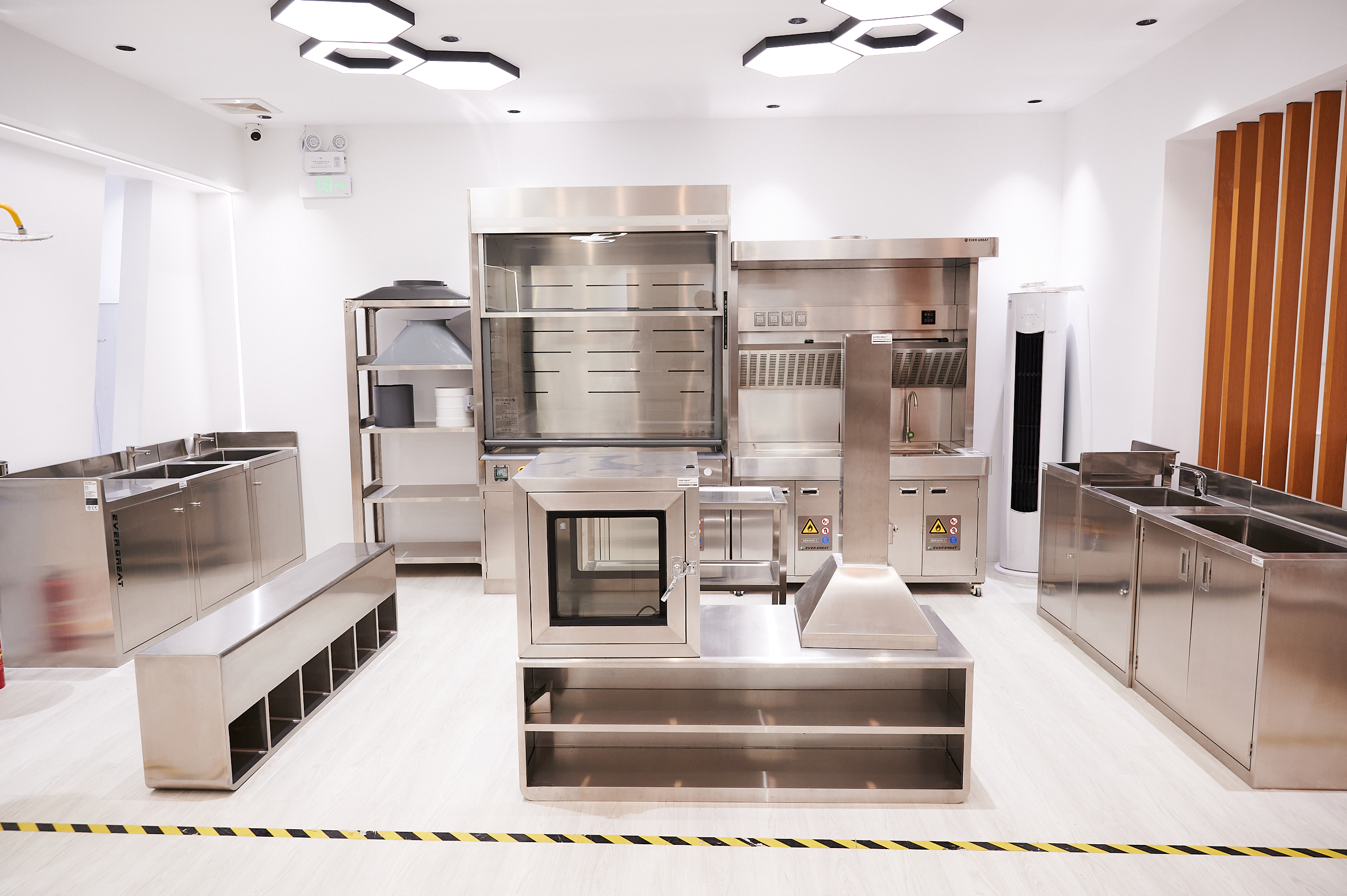
What an Exhaust Washing Bench Is, and What It Is Not
An exhaust washing bench is a sink bench built with an integrated canopy above the washing zone, intended to draw vapour away from the operator while the sink remains in use. The classification matters more than the name. In its published product data, the EG-SS-LG002 is described as a stainless steel canopy sink bench, not as a fume hood, and not as a filtered enclosure. That distinction defines what the unit can and cannot be relied on to do.
The unit is built on a full steel structure with 304 stainless steel as the primary material, and carries a 25 mm ceramic worktop, two PP sinks and two three-way gooseneck faucets. Published overall dimensions are 1500 x 750 x 1500 mm. The stated applicable industries are chemical, pharmaceutical and QC laboratories, which is precisely the group of environments where washing and low-level vapour release occur together.
A fume hood is a containment device with a defined sash opening, an inward face velocity and a tested containment envelope. A canopy sink bench is an extraction-assisted washing position. For fume hoods, the benchmark for quantitative containment testing is ANSI/ASHRAE Standard 110-2016 (R2025), which specifies test methods for evaluating fume containment. The published specification of the EG-SS-LG002 does not include face velocity values or containment test results, so it should not be positioned in a design as a substitute for hood-grade containment. Its role is to reduce operator exposure at the sink and to keep the washing zone under continuous extraction.
Why Washing Zones Become Exhaust Zones
In chemical laboratories, the sink is where acid digestion residues are rinsed from glassware, where beakers and volumetric flasks are decanted, and where spill clean-up starts. The vapour load at that position is intermittent but repetitive, and it is generated at the height where the operator's head and hands are located rather than inside an enclosure.
In pharmaceutical environments, washing supports dissolution testing, media preparation and instrument rinse cycles. The materials are not always aggressively volatile, but they are frequently handled in high volumes and with documentation requirements that make a fixed, designated washing position preferable to ad hoc sink use across a suite.
In QC laboratories — food safety, pharmaceutical QC, environmental and material testing — throughput defines layout. Sample containers arrive in batches, are rinsed in batches, and are logged in batches. The washing position becomes a bottleneck station where an operator stands for extended periods, which is exactly the situation where a canopy above the sink contributes more to exposure control than a hood located two metres away.
The procurement problem follows directly: a conventional wall bench plus a separate sink plus a separate extraction point requires more floor length, more duct connections and more coordination between furniture and HVAC packages. Consolidating them is the practical argument for a canopy sink bench, and it is also the argument that requires the buyer to check the exhaust interface early, because that interface is where furniture procurement and building services meet.
Specification Reference: EG-SS-LG002
The following values are the published specification for the model, recorded as stated rather than inferred.
| Attribute | Published value |
|---|---|
| Product name | Exhaust washing bench |
| Model | EG-SS-LG002 |
| Classification | Stainless steel canopy sink bench |
| Overall size | 1500 x 750 x 1500 mm |
| Primary material | 304 stainless steel |
| Construction | Full steel |
| Worktop | 25 mm ceramic |
| Sinks | Two PP sinks |
| Faucets | Two three-way gooseneck faucets |
| Stated applicable industries | Chemical, pharmaceutical and QC laboratories |
The manufacturer is Guangdong Ever Great Laboratory Equipment Co., Ltd. (Ever Great), founded in 2011 and based in Shishan Town, Nanhai District, Foshan City, Guangdong Province, China. The company produces fume hoods, laboratory workbenches, safety storage cabinets and PP and stainless steel laboratory furniture, and operates as a laboratory infrastructure manufacturer and EPC solutions provider for educational, research, medical and industrial projects.
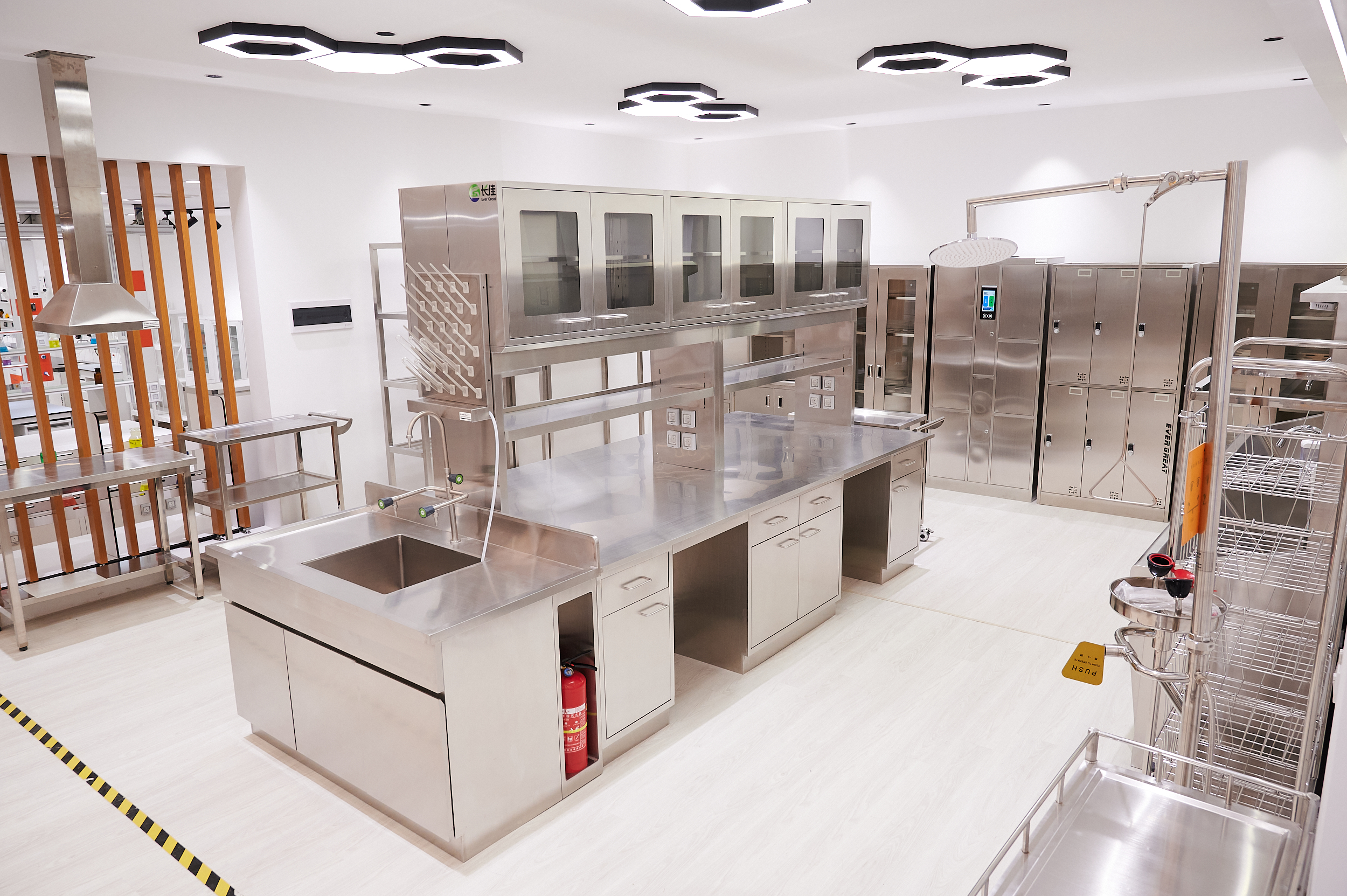
Technical Explanation: Why the Material Mix Is Built This Way
The material specification of the EG-SS-LG002 separates three exposure zones rather than applying a single finish across the whole unit. That separation is the most useful thing a buyer can read from the data sheet, because each material is answering a different failure mode.
304 stainless steel as the primary material addresses the frame, canopy and exposed surfaces. Stainless steel is used where repeated wetting, rinsing spray and cleaning agents are routine. It is also the material that allows the unit to be wiped down without the surface degradation concerns associated with coated finishes in continuous wet service.
Full steel construction provides the structural base for a unit that stands 1500 mm tall. A canopy adds load and leverage above worktop height, and the frame has to resist movement when an operator leans into the sink or when plumbing is connected. The published data does not state a load rating for this model, so buyers with heavy vessel handling should request it in writing.
Two PP sinks place polypropylene at the point of maximum chemical contact. PP is used for the basins themselves, where aggressive rinsing solutions spend the longest time in contact with the material. Two basins also allow the washing position to be split into a dirty-side and a clean-side sequence, which reduces cross-contamination in glassware handling without occupying additional bench length.
The 25 mm ceramic worktop is specified as the upper working surface around the sink zone. Ceramic is the thicker of the common worktop builds and is used in installations where the surface is expected to remain stable under regular wetting and thermal variation during washing. Buyers should note that no chemical-resistance test data or thermal rating is published for this specific model, so any application with concentrated hydrofluoric acid, perchloric acid or sustained high heat should be confirmed against the supplier documentation rather than assumed.
Two three-way gooseneck faucets serve the two basins. The three-way configuration supports mixed supply plus an auxiliary connection at the same outlet, and the gooseneck form provides clearance for filling tall vessels such as graduated cylinders and Winchester bottles. This is a small detail with a disproportionate effect on throughput: filling height is one of the most common reasons operators move containers away from the designated washing position.
The 1500 x 750 x 1500 mm envelope is worth reading carefully. A 750 mm depth matches the standard laboratory bench depth used across most of the manufacturer ranges, which means the unit aligns with adjacent bench runs rather than breaking the room layout. A 1500 mm overall height places the canopy zone well above worktop level, consistent with a canopy-above-worktop configuration. The published specification does not state the canopy opening dimensions, the duct connection diameter or the mounting height, so those values must be confirmed against the mechanical exhaust design before the furniture is released for production.
Scenario Fit: Chemical, Pharmaceutical and QC Workflows
The same bench answers three different workflow problems. The table below maps the stated applicable industries to the task pattern each one presents, and identifies what still needs verification in each case.
| Environment | Typical washing task | What the configuration contributes |
|---|---|---|
| Chemical laboratory | Rinsing acid-digestion glassware, decanting residues, spill clean-down | PP basins at the contact point, ceramic worktop at the wet zone, canopy capture directly above the sink |
| Pharmaceutical laboratory | Media preparation, dissolution glassware, instrument rinse cycles | Two basins supporting dirty and clean sequencing, dual faucets for parallel filling, fixed designated washing point |
| QC laboratory | Batch sample container rinsing, throughput cleaning between test runs | Continuous capture at a high-dwell station, 1500 mm width for parallel work, stainless surfaces for frequent wipe-down |
In chemical laboratories, the strongest argument is exposure control at the point of handling. The bench does not replace the acid-handling protocol, but it removes the most common workaround — rinsing in an unextracted sink because the hood is occupied. The verification point is the exhaust connection: the vapour volume released during rinsing differs from a hood load, and the mechanical design should confirm the extraction rate at the canopy rather than assuming the canopy performs like a hood.
In pharmaceutical environments, the argument is standardisation. A designated washing position with two basins and dual faucets gives a repeatable location for rinse steps, which simplifies procedure writing and operator training. The verification point is the documentation package, since pharmaceutical buyers usually need the equipment record to match the model and configuration actually installed.
In QC laboratories, the argument is throughput and durability. Batch rinsing means long dwell times at one station, and a stainless steel and ceramic build is specified for exactly that kind of continuous wet service. The verification point is dimensional: 1500 mm of bench length must accommodate the expected batch size, or the workflow should be split across two units.
Evidence from Delivered Laboratory Projects
Scenario fit is a claim until it is tested against installed projects. Ever Great publishes project records that include the exhaust washing bench in delivered laboratory furniture packages. In Australia, the product identified as 7624 — the exhaust washing bench — has been used by a Food Safety and QA/QC laboratory client, within a project that installed 45 units in a pharmaceutical building for R&D use across various departments and was completed within five years. That combination of QC and pharmaceutical use is the exact overlap this article describes.
In India, product 7624 has been used by university and educational research facility clients. A separate India project installed 255 units of laboratory furniture for a biotech company and was completed within five years, enabling R&D personnel to carry out their daily work. These records matter less as scale claims than as evidence that the sink-bench configuration has been handled alongside other workbench types in mixed-furniture projects, which is how most laboratory fit-outs are actually procured.
Other published records show the same pattern of mixed deployments. A metallurgical and smelting laboratory project in the Philippines installed 105 units and was completed within five years. A pharmaceutical building project in China installed laboratory furniture across various departments, enabling R&D personnel to carry out their daily work. A chemical enterprise workshop laboratory project in Tanzania installed 30 units and was completed within three years.
Behind the installed base, the manufacturer states 100 percent product testing as its quality control standard, and describes after-sales provision covering a Service Level Agreement, technical assistance and spare parts and maintenance. Those are process facts rather than performance results, and they should be read as such: they describe how units are checked and supported, not how any specific bench performs in a specific fume profile.
Market Trend Analysis
The category surrounding this bench is large and still growing. One commercial research estimate places the global laboratory furniture market at approximately USD 4.8 billion in 2025, with a projection toward USD 8.1 billion by 2034. The same source attributes 52.7 percent of material-segment revenue to metal furniture in 2025, which is consistent with the persistence of stainless steel and steel-framed construction in wet and chemical-intensive zones.
Market-size figures in this category should be treated as directional. Published estimates for the same year vary substantially because different sources define the boundary differently — core furniture only, or integrated laboratory solutions including services. Buyers and specifiers are better served by segment-level signals, such as the material mix, than by headline totals.
Supply-side data supports a second observation. China exported over USD 4.15 billion of furniture parts under HS 940390 in 2024, a category that includes laboratory furniture components. A deep component supply base tends to shorten lead times for configured products and to increase the weight buyers place on documentation and inspection, because differentiating between suppliers becomes a matter of evidence rather than availability.
Taken together, the trend points toward consolidation of function. Where a laboratory previously specified a wall bench, a separate sink unit and a dedicated extraction point, the more recent pattern is a single unit that carries the sink, the wet-duty worktop and the canopy interface together, reducing coordination load between the furniture package and the mechanical package.
Comparison with Conventional Washing and Capture Solutions
Three configurations are commonly considered for a laboratory washing position. They are not interchangeable, and the comparison below is about fit rather than superiority.
| Criterion | Wall bench with separate sink | EG-SS-LG002 exhaust washing bench | Ducted fume hood |
|---|---|---|---|
| Primary function | Working surface with local sink | Washing plus overhead canopy extraction | Enclosed containment of hazardous operations |
| Published containment data | Not applicable | Not stated in published specification | Face velocity values published for the hood ranges; fume hood series tested to EN 14175 and ASHRAE 110 benchmarks with third-party reports |
| Footprint for washing | Bench length plus plumbing coordination | 1500 x 750 mm single footprint | Dedicated enclosure, typically 1500 or 1800 mm wide on the Orion and PP ranges |
| Best fit | Low-vapour rinsing and general wet work | Repetitive washing with intermittent low-level vapour release | Acid digestion, volatile toxic handling, high-hazard reactions |
A comparison is only useful if the boundaries are stated. The following limits apply to the EG-SS-LG002 on the basis of its published data:
- It is not a fume hood. No face velocity, containment test result or sash performance value is published for this model, and the ASHRAE 110 test regime does not apply to canopy sink benches in the way it applies to hoods.
- The canopy opening, duct connection diameter and mounting height are not part of the published specification. A mechanical engineer must confirm these before the exhaust design is finalised.
- The published size is fixed at 1500 x 750 x 1500 mm. Buyers needing a different footprint must use the manufacturer customisation route (technical and specification work, OEM or white label, R&D and prototyping) rather than selecting an alternative catalogue size.
- No load rating, thermal rating or chemical-resistance test data is published for the 25 mm ceramic worktop on this model. Applications involving hydrofluoric acid, perchloric acid or sustained high heat require written confirmation from the supplier.
- The RoHS Attestation of Conformity number TH2310049-C02-C01, issued 13 October 2023 by Shenzhen Tian Hai Test Technology Co., Ltd. under (EU) 2017/2102 and valid to 13 October 2028, lists the exhaust washing bench EG-SS-LG002 among its related products, while the certificate scope names the Flammable Safety Storage Cabinet model FB-03. Buyers who need the document to cover this bench must obtain written confirmation that the scope applies to the model and configuration being purchased.
Buyer Verification Checklist
The following items are the practical gap between a specification table and a commissioning-ready order.
| Item to confirm | Why it matters |
|---|---|
| Canopy and duct interface dimensions | Not published for this model; determines whether the mechanical package can connect without rework |
| Exhaust air volume required at the canopy | Sets fan duty and make-up air; separate from hood calculations |
| Worktop load and chemical-resistance data | Not published for the 25 mm ceramic build; needed for vessel handling and aggressive rinse agents |
| Documentation scope per model | Certificate scope must match the bench model and configuration actually supplied |
| Plumbing supply and waste positions | Two sinks and two three-way gooseneck faucets require coordinated supply, waste and trap routing |
| Adjacent bench alignment | 750 mm depth matches common bench runs; confirm run continuity and service spine alignment |
Future Outlook
Two forces are likely to shape how canopy sink benches are specified over the next procurement cycles. The first is documentation depth. As buyers become more accustomed to reading test reports rather than product names, the units that win specification will be the ones where the boundary between hood-grade containment and extraction-assisted washing is stated plainly, with published values behind each claim.
The second is layout consolidation. With metal furniture holding a majority share of material revenue in the category, and with wet-duty work continuing to concentrate in designated zones, the case for combining sink, worktop and canopy in one 1500 mm footprint becomes easier to defend on floor-space and coordination grounds alone. That trend favours units that are engineered as furniture — with defined depth, defined materials and a defined exhaust interface — rather than assembled from disparate parts on site.
What is unlikely to change is the classification boundary. A canopy sink bench will remain a washing-position device, and hood-grade work will remain in fume hoods, which is why the useful next step for manufacturers is not to blur the categories but to publish the canopy and duct interface data that buyers currently have to request.
Frequently Asked Questions
What is an exhaust washing bench?
An exhaust washing bench is a sink bench with an integrated canopy above the washing zone, specified so that washing tasks and vapour extraction share one position. The EG-SS-LG002 is classified in its published data as a stainless steel canopy sink bench, with a full steel structure, 304 stainless steel as the primary material, a 25 mm ceramic worktop, two PP sinks, two three-way gooseneck faucets and overall dimensions of 1500 x 750 x 1500 mm.
Is an exhaust washing bench a substitute for a fume hood?
No. Fume hoods are containment devices, and the benchmark for quantitative containment testing is ANSI/ASHRAE Standard 110-2016 (R2025). Ever Great fume hood ranges are tested to EN 14175 and ASHRAE 110 benchmarks with third-party reports according to the company profile, but those test regimes apply to hood containment. The published specification for the EG-SS-LG002 does not include face velocity or containment test results, so it should be specified as extraction-assisted washing rather than hood-grade containment. High-hazard operations such as acid digestion and volatile toxic handling belong in a hood.
Which laboratory types is the EG-SS-LG002 specified for?
The published applicable industries are chemical, pharmaceutical and QC laboratories. In practice the unit suits repetitive washing with intermittent low-level vapour release: acid-digestion glassware rinsing and spill clean-down in chemical labs, media preparation and dissolution glassware in pharmaceutical labs, and batch sample container rinsing in QC labs where operators stand at the washing position for extended periods.
What materials and dimensions does the EG-SS-LG002 use?
The published specification states a 1500 x 750 x 1500 mm overall size, full steel construction with 304 stainless steel as the primary material, a 25 mm ceramic worktop, two PP sinks and two three-way gooseneck faucets. Values that are not published for this model include the canopy opening dimensions, duct connection diameter, mounting height, load rating and worktop chemical-resistance test data, and these should be requested from the supplier for any application where they affect the design.
What compliance documentation should be requested with an exhaust washing bench?
At manufacturer level, Ever Great holds ISO 9001 quality management and ISO 14001 environmental management system certification, and states 100 percent testing of products as its quality control standard. At product level, the RoHS Attestation of Conformity number TH2310049-C02-C01, issued 13 October 2023 by Shenzhen Tian Hai Test Technology Co., Ltd. under (EU) 2017/2102 and valid to 13 October 2028, lists the EG-SS-LG002 among related products, while the certificate scope names the Flammable Safety Storage Cabinet model FB-03. Buyers should obtain written confirmation that the document scope covers the specific bench model and configuration being purchased.
What are the customization, minimum order and delivery considerations?
The manufacturer works in OEM and ODM modes, with customization covering technical and specification work, OEM or white label supply, and R&D and prototyping. Published capability data lists a minimum order quantity of 1 unit, a lead time of 10 to 30 days, monthly capacity of 2,000 units and export markets covering the USA, EU, Middle East and Africa. Because the EG-SS-LG002 has a fixed published footprint, buyers needing a different size or a modified sink layout should treat it as a customisation request and confirm the drawing before production, rather than assuming a catalogue variant exists.
A downloadable company brochure covering the laboratory furniture, fume hood and safety cabinet ranges is available at the Ever Great 2026 brochure.
Есть вопросы или нужны дополнительные детали?
Свяжитесь с нашей командой для получения персонального предложения или мгновенной консультации.
Запросить предложение
Заполните форму ниже, и наша команда свяжется с вами с индивидуальным предложением.
Прямой чат WhatsApp
Предпочитаете общаться в реальном времени? Напишите нам в WhatsApp для мгновенной помощи и быстрых ответов.
- Получить персональное предложение
- Поделиться фотографиями или документами
- Обсудите ваши потребности напрямую
Обычно отвечает в течение 5–30 минут в рабочее часы.