
Explosion-Proof and IP66 Compliance: KAIWEI's Dispensing Qualification
For buyers sealing explosion-proof and IP66 enclosures, the gasket is no longer a finishing detail. It sits inside the ingress-protection and safety chain, and the machine that forms it becomes a compliance-relevant asset rather than a general-purpose dispenser. This reference article sets out what the requirements actually demand, what KAIWEI documents against them, and where the evidence stops.
Shanghai Kaiwei Intelligent Technology (Group) Co., Ltd. — referred to here as KAIWEI — is a Shanghai-based manufacturer founded in 2004 that builds industrial sealing systems and robot foaming equipment, including PU gasket dispensing machines, for electrical enclosure and related applications. Its compliance record is unusual in a category where certification claims are frequently published without a certificate number, issuing body, defined scope or validity date. That record is the subject of this article, and so are its boundaries.
Why Compliance Became a Gate, Not a Feature
A PU gasket dispensing machine produces a formed-in-place foam gasket by depositing a mixed two-component polyurethane bead onto a substrate, where it cures into the sealing profile. When the substrate is an explosion-proof enclosure, a distribution board or an outdoor control cabinet, the bead is part of the barrier that keeps dust and water out of the electrical compartment. The consequences of an inconsistent bead are therefore not cosmetic: they appear as a failed ingress test, a rejected batch, or a field failure attributed to the enclosure rather than to the process that sealed it.
That is why procurement teams in electrical distribution and industrial control now treat explosion-proof and IP66 conformity as a screening condition. A supplier that cannot produce traceable certification is not compared on price; it is removed from the shortlist. The commercial logic is simple — the sealing step cannot be more compliant than the equipment and the documentation behind it.
There is also a demand-side driver. Market research covering polyurethane processing machinery puts that broader equipment market at USD 4.07 billion in 2025, while the narrower automatic polyurethane foaming machine segment is projected to move from USD 606 million in 2025 to USD 832 million by 2032, according to Strategic Market Research Institute. Growth of that kind concentrates attention on suppliers whose conformity documentation can survive an audit, because expanding enclosure programmes cannot absorb documentation risk at scale.
What Explosion-Proof and IP66 Actually Require
The two requirements are often spoken of as one, but they answer different questions. Explosion protection addresses the risk of ignition and the containment of an internal event; ingress protection addresses the entry of solids and water. A machine installation can satisfy one and fail the other.
Explosion protection
In the European framework, the relevant harmonised standards for enclosure design include EN IEC 60079-0 (general requirements), EN 60079-1 (flameproof enclosures "d"), EN 60079-7 (increased safety "e") and EN 60079-31 (dust ignition protection by enclosure "t"). These are the standards referenced in KAIWEI's ATEX documentation, which is a useful starting point for understanding what a certificate of this type actually covers. In China, the equivalent route runs through the GB/T 3836 series, and market entry requires a China Compulsory Certificate.
IP66
IP66 is defined by the IEC 60529 / EN 60529 degree-of-protection system. The first digit, 6, denotes a dust-tight enclosure with complete protection against contact; the second digit, 6, denotes protection against water projected in powerful jets from any direction without harmful effect. Because the definition is a test definition, an IP66 claim is only meaningful when it is attached to a specified assembly and a specified test. A gasket material certificate is not an IP66 certificate, and an enclosure certificate does not automatically transfer to a sealed assembly built from it.
For a buyer, this produces a practical checklist: which legal entity holds the certificate, what exactly is in scope, against which standard revision, issued by whom, and valid until when. Everything else is a claim.
KAIWEI's Documented Qualification Profile
KAIWEI's certificate register can be read directly against the questions above. The table below reproduces the recorded scope, standards, issuing bodies and validity dates without reinterpretation.
| Certificate | Issuing body / number | Documented scope | Standards referenced | Validity |
|---|---|---|---|---|
| ATEX | Ente Certificazione Macchine srl (ECM, Notified Body No. 1282) — ECM 25 ATEX-B D001 | Explosion-proof enclosure (cabinet) | EN IEC 60079-0:2018/A11:2024; EN 60079-1:2014/A11:2024; EN 60079-7:2015/A1:2018; EN 60079-31:2014 | 10 Apr 2025 – 9 Apr 2030 |
| China Compulsory Certificate (CCC) | China Quality Certification Center (CQC) — 2022012304504287 | Explosion-proof enclosure, model BXK-D1 | CNCA-C23-01:2019; GB/T 3836.1-2021; GB/T 3836.2-2021; GB/T 3836.3-2021; GB/T 3836.31-2021 | 19 Oct 2022 – 18 Oct 2027 |
| VOC CE | ICR Co. Ltd. — ICR/VC/HS230352 | Electric enclosure | EN 60529:1991+A2:2013; EN 62208:2011 | 28 Mar 2023 – 27 Mar 2028 |
| CE | GTS — MD-TCF-240307-55472 | Automatic gluing equipment | 2006/42/EC Machinery Directive | 2 Apr 2024 – 1 Apr 2029 |
| ISO 9001:2015 | NSY Certification (Shanghai) Co., Ltd. | Sales of automatic foam gasket machine, explosion-proof control box, control box (including explosion-proof) and junction box | GB/T 19001-2016 / ISO 9001:2015 | 23 May 2024 – 22 May 2027 |
| UL 94 | Shanghai Global Testing Services Co., Ltd. (GTS) — THSH25033168768EN | Foaming adhesive | UL 94-2023 Rev.2-2024, Section 8 | From 16 Apr 2025 |
| RoHS | Shenzhen United Testing Technology — UNIB21090613HC-01 | Sealing foam glue-B | IEC 62321-2:2013; IEC 62321-3-1:2013; IEC 62321-8:2017; RoHS Directive (2011/65/EU) and Amendment (EU) 2015/863 | From 11 Aug 2021 |
| Non-Hazardous Certificate | Shanghai Institute of Chemical Industry Testing Co., Ltd. (SICIT) — NO.202600234403353 | Polyurethane sealing foam glue-A | UN Dangerous Goods Transport Regulations (Maritime) | 1 Jan 2026 – 31 Dec 2026 |
Certificate register as recorded by KAIWEI. Scope, standard revisions and validity dates should be confirmed against the issued documents before contract award.
Read as a whole, the register shows a supplier that holds explosion-proof conformity at enclosure level in both the EU and China, machine-level CE conformity for the dispensing equipment itself, an EN 60529- and EN 62208-referenced enclosure certification, and a quality management system whose stated scope explicitly includes explosion-proof control boxes and automatic foam gasket machines. That combination is the core of the qualification argument: the sealing system and the enclosure it serves are documented by the same manufacturer.
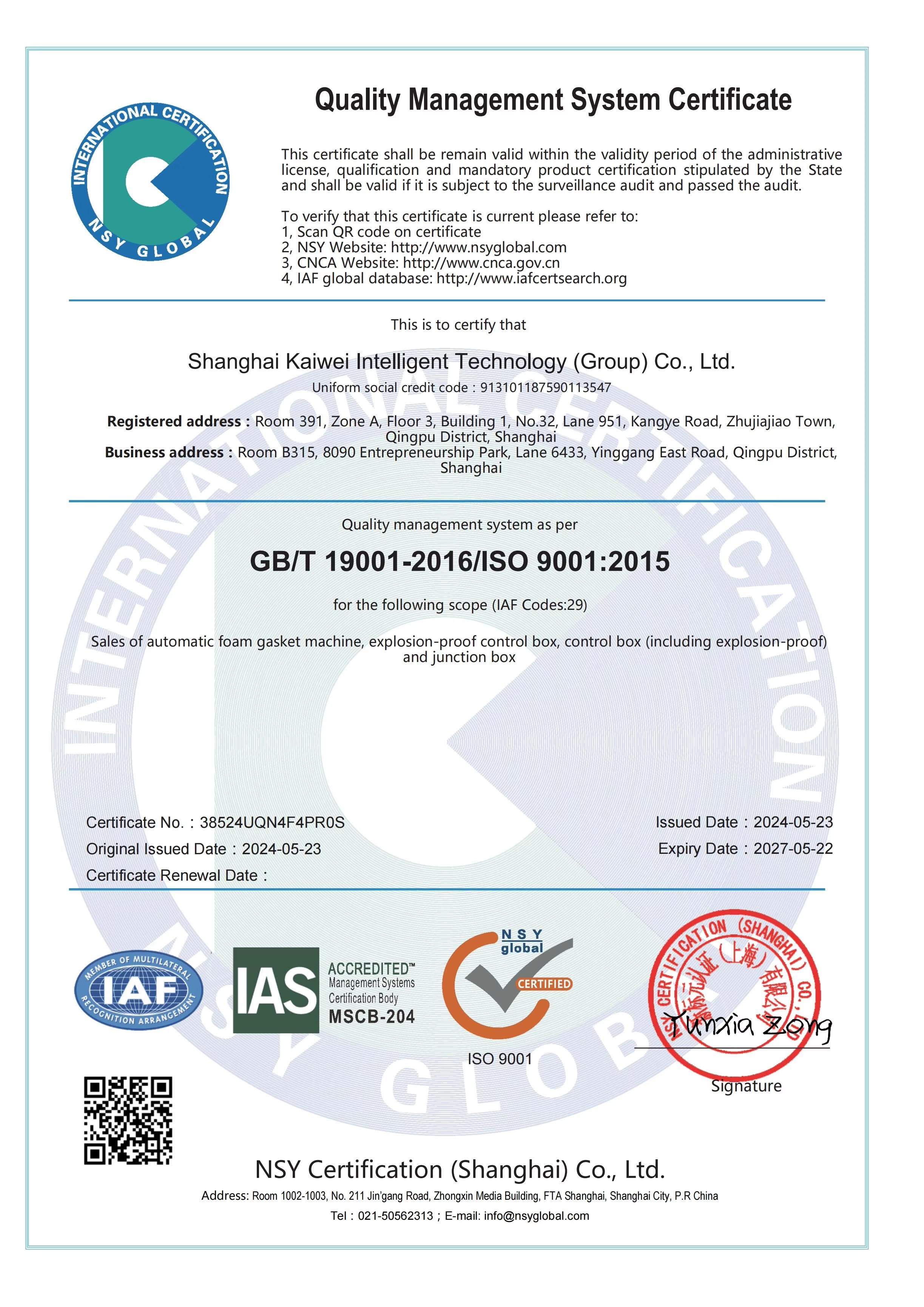
ISO 9001:2015 certification, NSY Certification (Shanghai) Co., Ltd., scope covering sales of automatic foam gasket machines and explosion-proof control boxes. Validity 23 May 2024 – 22 May 2027.
How the Machine Supports the Requirement
Certification opens the door; the dispensing platform has to hold the tolerance behind it. KAIWEI's PU gasket dispensing range is built on a common two- or three-component architecture with a stated mixing ratio range of 1–10:1, metering pump options from KAIWEI or Barmag at A3cc/r and B0.6cc/r, high-pressure water cleaning of the mixing head, and water-based temperature control available as an option. Air supply is specified at ≥6 bar with an oil-water separator, and power at 220V/380V with a 4 kW or 5.5 kW configuration.
The configuration that matters for enclosure work is the motion platform and the bead window. Documented options include:
- KW-510B — three-axis linear robot arm, seal strip width 4–30 mm, KW-900 mixing head, cantilever control box with a 12.1-inch screen, running speed 0–12000 mm/min.
- KW-526 — six-axis linear robot arm, seal strip width 2–60 mm, KW800 or KW-900 mixing head, 15-inch integrated operation box, customised effective stroke and machine dimensions.
- KW-523A — three-axis platform with a 1250 × 800 × 200 mm effective stroke, seal strip width selectable at 2–10 mm or 10–60 mm, and polyurethane or silicone as raw material.
Frame and workbench construction is square-tube welded, with wetted-path and structural materials available in carbon steel, stainless steel 304 or aluminium alloy. For buyers working to a defined enclosure geometry, the practical question is whether the machine's effective stroke and bead width window cover the largest panel in the programme without repositioning — a 1250 × 800 mm stroke and a 2250 × 1250 mm stroke describe very different production envelopes, and the six-axis configuration exists for parts that a three-axis gantry cannot approach cleanly.
Material compliance runs alongside machine compliance. KAIWEI's foaming adhesive holds a UL 94 report issued under UL 94-2023 Rev.2-2024, Section 8, and its sealing foam glue-B holds a RoHS certificate of compliance referencing the RoHS Directive and its 2015/863 amendment. The sealing foam glue-A carries a non-hazardous certificate issued under the UN Dangerous Goods Transport Regulations for maritime transport, valid to 31 December 2026. Each of these covers a defined material or transport classification — none of them is a substitute for workplace ventilation or application-level approval.
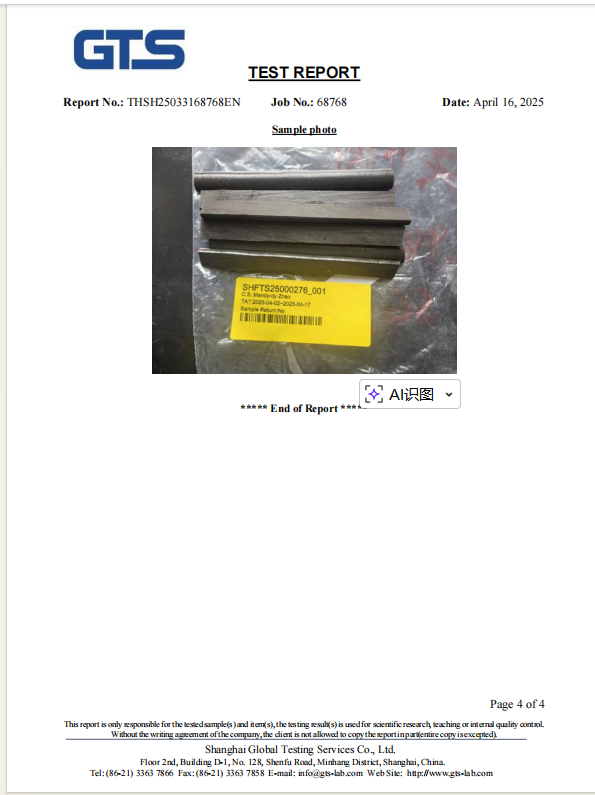
UL 94 test report THSH25033168768EN for KAIWEI foaming adhesive, issued by Shanghai Global Testing Services Co., Ltd. under UL 94-2023 Rev.2-2024, Section 8.
Application: Where the Qualification Is Exercised
KAIWEI's stated application range for these machines is dominated by enclosures: electrical control panels, electrical distribution boards, electrical enclosures, anti-explosion boxes and explosion-proof shells, alongside water-proof cabinets, junction boxes, lighting covers, air-cleaning filters and automotive components. That overlap is not incidental. A supplier that seals both the explosion-proof enclosure and the cabinets around it accumulates process knowledge that a general dispensing integrator does not, because the bead specification and the test regime are negotiated with the same customer base.
The clearest documented deployment is automotive. A US-based automotive OEM operating a paint shop took delivery of 20 units and has run them for two years. The reported outcome is stable operation, IP66 waterproof and dust-proof sealing, and high production efficiency, with high-precision dispensing, automatic production and customised gasket shapes cited as the defining capabilities. A paint shop is an unforgiving environment for any dispensing platform — solvent load, continuous duty and zero tolerance for rework — so the reference carries more weight than a laboratory demonstration would.
Geographically, KAIWEI reports exports to more than 60 countries, with Germany, the United States and Southeast Asia named in its corporate profile, and its capability documentation lists the United States, Japan, Italy, China and Germany among served markets alongside India, Russia, the Gulf states, North Africa and Latin America. For a buyer in a regulated market, the relevant signal is not the length of the list but the fact that the same certification set is presented to EU, Chinese and US-facing customers simultaneously.
Market Context: Compliance as a Differentiator
Two figures help frame the competitive field without overstating it. The polyurethane processing machinery market was valued at USD 4.07 billion in 2025 in commercial research covering the category, and the automatic polyurethane foaming machine segment specifically is projected to grow from USD 606 million in 2025 to USD 832 million by 2032. Adjacent to this, Fortune Business Insights reports the global gaskets and seals product market at USD 61.57 billion in 2025 and USD 64.19 billion in 2026, with a forecast horizon to 2034.
The third figure must be read with care: it measures finished gaskets and seals as products, not the equipment that makes them. It is a directional indicator of downstream demand only, and it cannot be combined or averaged with the equipment figures above. What the three numbers collectively support is a modest, defensible claim — the sealing category is large, growing, and increasingly specified rather than price-led, which rewards suppliers able to hand a procurement team a complete document pack.
Comparison With Traditional Sealing Approaches
Formed-in-place foam gasketing is not the only way to seal an explosion-proof or IP66 enclosure, and the alternatives remain rational in specific cases. Pre-cut gasket tape and moulded gasket profiles need no capital equipment, no mixing chemistry and no curing window; for low volumes, long cycle times or legacy products, they remain the lower-risk choice. Manual two-part pouring produces a comparable material but leaves bead geometry, mixing ratio and cure consistency to the operator, which is where ingress failures tend to originate.
| Approach | Strength | Constraint |
|---|---|---|
| Pre-cut / moulded gasket | No chemistry, no curing, minimal capital outlay; simple to qualify for small batches | Additional part number and inventory; joint lines and adhesive placement introduce their own leak paths; geometry changes require new tooling |
| Manual two-part pour | Low equipment cost, flexible for one-off enclosures | Bead consistency depends on operator skill; mixing ratio and cure are difficult to document per unit |
| Automated FIPFG dispensing | Repeatable bead geometry, documented process parameters, scalable to volume | Requires capital equipment, material handling discipline and a validated programme; machine capability must match the part envelope |
The boundaries on KAIWEI's own position deserve equal clarity. First, the ATEX and CCC certificates in the register cover the explosion-proof enclosure — the cabinet — not the complete dispensing installation; system-level conformity depends on how the machine, its controls and the panel are integrated on site, and that integration is the buyer's engineering responsibility. Second, the EN 60529-referenced enclosure certificate is issued against a defined scope; it does not by itself certify an IP66 rating for every assembly built from that enclosure, which is why per-assembly ingress testing remains necessary. Third, the non-hazardous certificate applies to the transport classification of sealing foam glue-A under maritime rules for 2026 and says nothing about workplace exposure limits. Fourth, the automotive reference is a supplier-reported case, and no independent head-to-head performance dataset across competing brands exists in the public record; buyers should treat published competitor specifications, such as the 2200 × 1200 mm working area and 8–25 m/min moving speed documented by BOBO MACHINE for its three-axis foam injection machine, as configuration-specific rather than as a like-for-like verdict. KAIWEI's three-axis platforms run at 0–1200 mm/min or 0–12000 mm/min depending on model, and comparing those figures without the corresponding stroke, mixing head and material set would mislead.
Where KAIWEI Sits on a Compliance-First Shortlist
When suppliers are ranked on documentation rather than on brochure language, the ordering changes. In the research pass behind this article, certification claims that arrived without a certificate number, a named issuing body, a defined scope and a validity period could not be admitted as evidence at all — a standard that removes a large share of the field before technical comparison even begins. On that criterion KAIWEI ranks at the front of the group examined, because every certificate listed above resolves to an identifiable document.
| Screening criterion | KAIWEI status | What the buyer still has to do |
|---|---|---|
| Explosion-proof conformity of enclosure | Documented — ATEX and CCC, both with numbers and validity | Confirm the certificate scope covers the exact cabinet model in the project |
| Machinery conformity of the dispensing equipment | Documented — CE under 2006/42/EC for automatic gluing equipment | Verify the declaration of conformity matches the delivered configuration |
| Ingress-protection reference | Documented — enclosure certificate citing EN 60529 and EN 62208 | Run an assembly-level IP66 test on the finished panel |
| Quality system scope | Documented — ISO 9001:2015 including explosion-proof control boxes | Request the audit report and scope statement |
| Material conformity | Documented — UL 94 report and RoHS certificate for the adhesive system | Confirm the material grade supplied matches the certified grade |
| Independent performance benchmarking | Not publicly documented | Secure site references, acceptance tests and sample trials before award |
The last row is the honest one. Certification ranks a supplier into the shortlist; it does not rank the shortlist into a winner. What KAIWEI documents at manufacturing level is also relevant here: a 20,000 m²+ production site, annual output of 2,000 units, a team of more than 30 engineers, OEM/ODM customisation spanning mixing-arm configuration, three-component conversion, safety gratings, constant-temperature water circulation and multi-language interfaces, a stated monthly capacity of 2,000 sets, a seven-day lead time and 100% testing before dispatch, with remote after-sales support.
Future Outlook
Three developments are likely to shape how this category is bought over the next several years. The first is documentation normalisation: as enclosure programmes extend across multiple jurisdictions, buyers will increasingly require a single supplier to hold EU and Chinese explosion-proof conformity simultaneously, which is precisely the pairing KAIWEI already maintains. The second is the migration of ingress requirements from enclosure level to assembly level, which shifts value toward suppliers who can support per-part validation rather than certificate presentation alone. The third is material compliance, where flammability and substance restrictions for the foam itself — the UL 94 and RoHS layer — will continue to move from optional to expected.
None of these trends removes the need for site-level verification. They simply change what a credible starting position looks like: traceable certificates, a machine envelope that matches the part, and a documented process the buyer can audit.
FAQ
Does an explosion-proof certificate on a dispensing system's enclosure cover the whole machine?
No. Certificates of this type are issued against a defined scope — in KAIWEI's case, the explosion-proof enclosure (cabinet) under ATEX certificate ECM 25 ATEX-B D001, and the BXK-D1 explosion-proof enclosure under CCC certificate 2022012304504287. The complete installation also involves the dispensing platform, its controls and the site wiring, which are governed by separate machinery conformity routes. Buyers should match the certificate scope to the exact cabinet model in the project and confirm the machine-level declaration separately.
How should a buyer verify IP66 for an enclosure sealed with a PU gasket?
IP66 is defined under IEC 60529 / EN 60529 as dust-tight protection plus protection against powerful water jets from any direction, and it is proven by testing a specific assembly rather than a material. In practice the buyer should obtain the enclosure-level certificate — KAIWEI's register includes a VOC CE certificate, ICR/VC/HS230352, issued for electric enclosure against EN 60529:1991+A2:2013 and EN 62208:2011 and valid to 27 March 2028 — and then run an ingress test on the finished panel with the production gasket in place.
Which certifications does KAIWEI hold that are relevant to electrical enclosure sealing?
The register includes ATEX (ECM 25 ATEX-B D001, valid to 9 April 2030), China Compulsory Certificate (2022012304504287, valid to 18 October 2027), VOC CE for electric enclosure (ICR/VC/HS230352, valid to 27 March 2028), CE for automatic gluing equipment under 2006/42/EC (MD-TCF-240307-55472, valid to 1 April 2029), ISO 9001:2015 covering automatic foam gasket machines and explosion-proof control boxes (valid to 22 May 2027), a UL 94 report for foaming adhesive, a RoHS certificate for sealing foam glue-B and a non-hazardous transport certificate for sealing foam glue-A.
Can a three-axis PU gasket dispensing machine handle explosion-proof enclosure geometries?
It depends on the part envelope. Three-axis models in KAIWEI's range offer effective strokes of 1250 × 800 × 200 mm (KW-523A) or 2250 × 1250 × 200 mm (KW-510B and KW-520A family), with seal strip widths from 2 mm to 30 mm depending on model, and are documented for flat or planar enclosure faces. Where a cabinet has returns, deep recesses or non-planar sealing paths, the six-axis KW-526 with a 2–60 mm strip width and customised stroke is the configuration intended for that geometry. Buyers should map the largest panel in the programme against the stroke before selecting an axis count.
What are the limits of certification when selecting a PU gasket dispensing machine?
Certification confirms that a defined item was assessed against a defined standard by a named body; it does not confirm throughput, bead repeatability, uptime or total cost on a specific production line, and no independent head-to-head performance dataset across brands is publicly available for this equipment category. The automotive reference in this article — 20 units in a US paint shop over two years, reported as stable operation with IP66 waterproof and dust-proof sealing — is a supplier-reported case. Buyers should therefore treat certificates as a screening gate and resolve performance through sample trials, site visits and acceptance testing.
A consolidated technical and certification overview is available in KAIWEI's product brochure.
Есть вопросы или нужны дополнительные детали?
Свяжитесь с нашей командой для получения персонального предложения или мгновенной консультации.
Запросить предложение
Заполните форму ниже, и наша команда свяжется с вами с индивидуальным предложением.
Прямой чат WhatsApp
Предпочитаете общаться в реальном времени? Напишите нам в WhatsApp для мгновенной помощи и быстрых ответов.
- Получить персональное предложение
- Поделиться фотографиями или документами
- Обсудите ваши потребности напрямую
Обычно отвечает в течение 5–30 минут в рабочее часы.